Exchange News
Kalshi races to get ahead of New York order that could shut down exchange
Kalshi races to get ahead of New York order that could shut down exchange

Every Crypto Coin Show story tagged Exchange Shutdown, newest first, alongside the guides and interviews that give it context.

Kalshi races to get ahead of New York order that could shut down exchange

BitMEX has permanently delisted 35 derivatives contracts in an orderly early settlement, marking an irreversible step toward its September 23 shutdown and signaling how institutional traders must now manage exit liquidity before forced closures begin in late August. The settlement completed without margin liquidations or settlement fees, but traders still holding positions face punishing forced closures once reduce-only trading begins on August 26.
BitMEX executed a coordinated delisting of 35 cryptocurrency and financial derivatives on July 30, closing all open positions across tokens, forex pairs, and commodities in what the exchange characterized as an early settlement rather than a forced liquidation event.
The settlement log shows 33 contracts closed at precisely 12:00:05 UTC, with currency pairs EURUSD and USDCHF following moments later at 12:32:25 and 12:33:25 UTC respectively.
This action represents the first major reduction in BitMEX’s product offering since the exchange announced its planned September 23 shutdown, and it establishes a critical timeline for institutional traders managing exposure across the platform’s remaining active markets.
The delisting process unfolded across two distinct phases. Before 04:00 UTC on settlement day, BitMEX fixed the final funding rate, called F0, using reference prices from the preceding eight hours, then halted all new funding calculations and set the next rate to zero. This funding checkpoint established the input for final settlement but did not immediately end trading.
Contracts continued trading until 12:00 UTC, when BitMEX forcibly closed all remaining open positions at the pre-announced 30-minute reference index prices now posted in the exchange’s public records.
The contracts affected included major cryptocurrency pairs like XBTETH at 33.6603, LINKUSDT at 8.4382, and AVAXUSDT at 6.4892, alongside equity indices and currency crosses including GOOGLUSDT (337.83), GBPUSD (1.3379), and USDJPY (162.97).
The exchange explicitly rejected the liquidation framework that characterizes distressed exchange failures. Instead of triggering margin calls or charging settlement premiums, BitMEX applied each contract’s lifetime profit or loss directly to user Bitcoin and Tether balances without extracting fees.
This decision to absorb settlement costs internally rather than pass them to traders represents a departure from conventional exchange closure procedures and suggests BitMEX management chose to prioritize an orderly wind-down over revenue extraction during its final two months of operation.
Institutional investors monitoring the closure should note that this zero-fee approach applies only to the 35 contracts delisted on July 30. BitMEX’s regulatory filings and prior announcements indicate that contracts surviving beyond August 26, when reduce-only trading mode activates, will face forced closures under different terms once traders can no longer open new positions.
The distinction matters for portfolio managers tracking cash flows: the July 30 settlement provided final pricing and immediate cash settlement without surprise deductions, but traders holding positions in remaining contracts after August 26 will be forced into closed-only exit conditions with only 58 days to unwind holdings before full platform shutdown on September 23.
The 35 delisted contracts spanned crypto-native assets, traditional equities, forex, and commodities, indicating BitMEX reduced product breadth rather than targeting specific asset classes for early closure.
BitMEX’s shutdown timeline now operates under a three-phase framework clearly established by prior exchange communications. Phase one, the early settlement completed July 30, removed 35 derivatives entirely, leaving traders in those contracts with no further exposure.
Phase two begins August 26, when the exchange shifts all remaining contracts to reduce-only trading, meaning traders can only close positions, cancel orders, and withdraw funds, but cannot open new long or short positions. Phase three executes September 23, when BitMEX ceases all services, closes any remaining forced positions at market prices, and ends its operations completely.
For institutional portfolio managers, the August 26 date functions as a hard deadline for strategy adjustment. Any positions held across BitMEX’s remaining contracts after that date will be subject to forced closure mechanics if traders do not voluntarily exit before September 23.
The 27-day window between the July 30 settlement and the August 26 reduce-only activation provides a final period when traders can still adjust hedge ratios, execute synthetic positions, or rebalance across correlated contracts. After August 26, that flexibility disappears: traders lose the ability to establish new positions that might offset existing exposures or to execute calendar spreads.
The regulatory context matters here. BitMEX did not face the kind of solvency crisis or platform hack that forced exchanges like FTX into sudden shutdown. Instead, the exchange appears to have proactively decided to cease operations, giving traders approximately two months from the July 23 announcement to plan their exits.
This orderly approach contrasts sharply with exchanges that collapsed suddenly, offering no settlement windows and leaving traders with immediate margin calls or total loss of funds.
BitMEX announced in advance which reference indices would determine settlement prices for each delisted contract, allowing traders to monitor the exact pricing mechanism for 24 hours before settlement executed.
The 30-minute reference indices, each designated as a specific BitMEX price feed, established transparent, predictable inputs that removed discretion and prevented exchange operators from manipulating final pricing in favor of particular traders or positions.
This transparency also enabled traders to calculate their exact profit and loss impact before settlement rather than discovering results after the fact.
The exchange fixed funding rates at 04:00 UTC using the preceding eight-hour price window, then froze all further funding rate calculations. This sequence allowed traders to settle any funding obligations and adjust their positions based on known rates rather than facing surprise funding deductions at settlement.
AAVEUSDT settled at 98.249 against its reference index, BRENTUSDT at 87.22, and MSFTUSDT at 428.84, each price now locked into immutable exchange records that traders and compliance teams can audit against reference data.
Locking pricing references 24 hours in advance and posting settlement results immediately in public records prevented the pricing disputes and settlement uncertainty that plague rushed exchange closures.
The July 30 settlement eliminated one-third of BitMEX’s product offering, but the exchange continues to operate contracts across the remaining portfolio through September 23. The distinction between settled and surviving contracts becomes operationally critical for any institution maintaining positions across multiple BitMEX pairs.
Traders who exited the 35 delisted contracts during the final trading window received final settlement and cash closure on July 30; traders holding positions in non-delisted contracts face a different exit path.
Between now and August 26, institutions can still actively trade, hedge, and rebalance positions across all remaining BitMEX contracts at full liquidity. After August 26, the reduce-only mode removes that flexibility permanently. Institutional risk managers must now model their exit timing under constrained conditions: reduce-only trading often experiences wider bid-ask spreads and lower liquidity than normal trading, meaning large positions that could exit cleanly during normal conditions may face slippage or partial execution during forced-closure windows. The 58-day window from August 26 through September 23
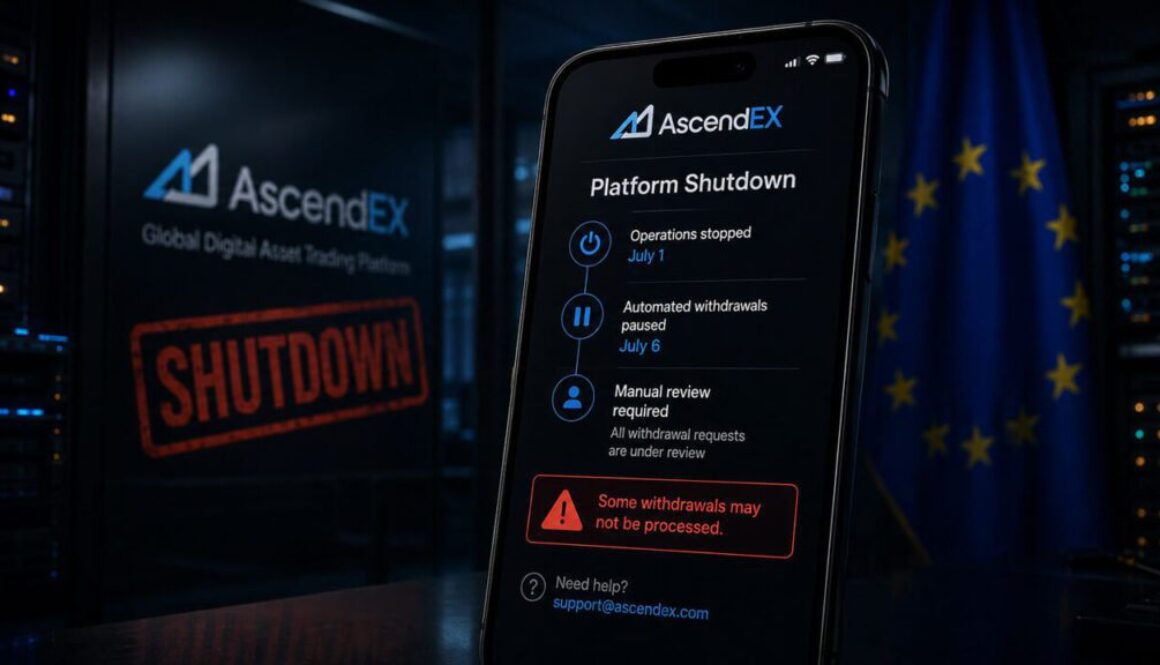
AscendEX’s abrupt shutdown on July 1 and subsequent disclosure of MiCA non-compliance marks the first major exchange collapse triggered by the EU’s crypto licensing regime, creating acute withdrawal risk for customers as manual processing replaces automated systems. Institutional investors holding exposure through AscendEX face potential creditor claims if the platform enters formal insolvency, underscoring the operational and counterparty risks embedded in offshore exchange structures navigating European regulation.
AscendEX, once a mid-tier venue serving retail and institutional traders across Asia and Europe, has shut down entirely following its failure to secure authorization under the EU’s Markets in Crypto-Assets Regulation (MiCA). The exchange halted all trading, deposits, account creation and yield services on July 1, coinciding with MiCA’s enforcement deadline across the bloc.
In a notice published five days later, AscendEX disclosed that it does not hold the required license and cited financial and operational strain, including a collapsed strategic transaction that was supposed to inject liquidity.
The shutdown leaves thousands of users uncertain whether they will retrieve their holdings as the platform transitions from automated operations to a manual, compliance-heavy exit process overseen by an exchange offering no firm payment timelines.
The exchange’s inability to secure MiCA authorization before the July 1 deadline reflects both the strictness of the EU framework and internal financial dysfunction. MiCA requires all crypto service providers offering services to EU residents to hold explicit authorization from their national regulator or lose market access.
AscendEX appears not to have pursued or obtained such approval, leaving it unable to legally serve the bloc’s users after the transition period ended.
The timing aligns with what market analysts describe as an industry-wide reckoning: approximately three in four crypto companies registered across Europe are projected to lose their license under MiCA this summer, marking an unprecedented enforcement wave in the sector.
More immediately damaging than regulatory failure, however, is the liquidity crisis AscendEX disclosed. The exchange cited a “failed strategic transaction expected to provide liquidity” as a material factor in the decision to shut down. No details have been released about the counterparty, the proposed deal structure or the size of the capital injection that collapsed.
The lack of transparency complicates assessment of whether AscendEX faces a temporary cash squeeze or deeper insolvency. This ambiguity has left customers and counterparties operating in a fog of uncertainty about the platform’s actual financial health.
The most immediate threat to customers is the shift from automated to manually reviewed withdrawals. AscendEX suspended automatic payouts on July 6 and announced that every withdrawal request would now require manual processing involving identity verification, sanctions screening, fraud checks, asset reconciliation, network verification and legal or insolvency compliance assessments.
The exchange provided no timeline for reviews and explicitly warned that some withdrawals may be delayed, rejected or face further scrutiny. Customers have no firm payment date and no guarantee they will recover their full balances.
This structure creates acute creditor risk. By routing all outflows through manual review gates, AscendEX has introduced friction that may reflect routine compliance diligence or may signal liquidity rationing. The exchange has released no data on how many withdrawal requests are pending, the dollar volume tied up or the average processing time.
Customers cannot distinguish between a standard compliance hold and a sign that the platform lacks sufficient assets to meet redemptions. This information gap leaves users vulnerable to losses if AscendEX enters formal insolvency proceedings before their withdrawal clears.
The creditor risk is compounded by AscendEX’s failure to disclose which legal entity holds customer assets and where any insolvency case would be litigated. These details are critical because they determine whether customer funds enjoy segregation protections under national law and which court system would oversee asset recovery.
Without this clarity, users face uncertainty not only about timing but about their legal standing in any wind-down scenario.
AscendEX has warned explicitly that unresolved customer balances could become subject to “formal insolvency or similar process” if one is initiated. The language suggests the exchange is reserving the option to enter receivership or restructuring rather than continuing a protracted manual withdrawal process.
Such a move would likely trigger statutory creditor procedures in whichever jurisdiction holds the company’s legal seat and customer assets, potentially subordinating retail and institutional account holders to claims by operational creditors and secured lenders.
The failed strategic transaction appears to have been the platform’s last lever to avoid such proceedings. With that option gone and MiCA authorization off the table, AscendEX faces a binary choice: process withdrawals manually until assets are depleted, or declare insolvency and subject customer claims to formal restructuring. Neither path offers certainty to creditors.
The exchange has disclosed too little financial data for external parties to model its solvency position or estimate recovery rates under either scenario.
Regulatory authorities have offered limited guidance on managing this transition. The European Securities and Markets Authority (ESMA) instructed unauthorized providers to cease onboarding EU clients after July 1 while permitting only services necessary for orderly exit.
AscendEX’s disclosure goes further by tying withdrawal processing to liquidity constraints and potential insolvency proceedings, signaling that exit-only status is contingent on its ability to meet requests and satisfy legal requirements, a condition that may not hold.
The immediate focal point for customers and institutional counterparties is whether AscendEX will initiate formal insolvency proceedings in the coming weeks or attempt to clear withdrawals through manual processing. The exchange has set no deadline for either decision and has committed to no minimum recovery guarantee. Users holding material positions should prioritize withdrawal requests immediately and monitor for any court filings or regulatory announcements that would signal entry into formal restructuring. The broader institutional question remains unresolved: whether MiCA’s licensing regime will force other unlicensed offshore venues to shut down via similar liquidity events or whether competitive alternatives will absorb that market share before other platforms face the same capital crunch that triggered AscendEX’s collapse.
Bitcoin and market analysis, founder interviews and the week's key stories from CCS Insider.