South Korea’s crypto trading volume hit a two-year low, dropping below 10 trillion won ($6.7 billion) for the first time since September 2023.
The slump coincides with a dramatic collapse across the country’s stock markets.
Is South Korea Losing Its Crypto Market?
Trading volume measures the total value of assets bought and sold across exchanges over a set period. Weekly volume across South Korea’s five main fiat exchanges hit a two-year low, signaling a sharp cooling in overall market activity.
The five platforms include Upbit, Bithumb, Coinone, Korbit, and Gopax. In the week of July 3 to July 10, combined volume reached roughly 9.97 trillion won ($6.65 billion). Furthermore, that marks a 25.75% drop from the prior week’s 13.4 trillion won total ($8.9 billion).
The decline deepens over time. The current volume is about 43.5% below early June levels, according to WuBlockchain.
It marks the fifth consecutive weekly drop, reflecting a broad retreat in retail speculation nationwide.
Top 5 South Korean Exchanges’ Volume Falls for Five Straight Weeks, Below KRW 10 Trillion
According to Digital Asset, the weekly trading volume of South Korea’s top five fiat-market crypto exchanges (Upbit, Bithumb, Coinone, Korbit, and Gopax) has fallen for five consecutive… pic.twitter.com/0iko3rSLNY
Structural challenges add to the pressure. During the first quarter of 2026, combined volume had already fallen notably, with Bithumb dropping over 30%.
Furthermore, an operational error at Bithumb earlier this year damaged trust among cautious retail investors.
Tighter regulation compounded the caution. New limits on exchange ownership stakes reinforced a defensive mood. Consequently, many retail traders pulled back from the major platforms, deepening the multi-week slide in overall trading activity.
Why Are Crypto and the KOSDAQ Falling Together
The synchronized decline is no coincidence, given how South Korean investors move between tech stocks and crypto. Many traders speculate across both markets, so a decline in risk appetite in one quickly spreads to the other.
The KOSDAQ index has crashed 31% over the past 9 weeks, erasing nearly a full year of gains. That correction rivals the 2020 crash, when it fell 32% in five weeks.
— Global Markets Investor (@GlobalMktObserv) July 12, 2026
The AI trade sits at the center of the turmoil. Optimism around artificial intelligence is fading, especially after doubts over chip and semiconductor spending. Samsung and SK Hynix, along with leveraged ETFs, account for over 70% of traded market value, amplifying volatility.
As a result, that intervention adds pressure and pushes capital toward more defensive positions.
Shocking stat of the day:
The Memory ETF, $DRAM, has surpassed $25 billion in assets under management (AUM) for the first time, officially overtaking the 26-year-old South Korea ETF, $EWY, despite launching on April 2nd.
Ethereum has continued its recovery from the June lows and is now approaching a major technical inflection point. While the recent rally has improved short-term sentiment, the asset is still trading beneath a confluence of long-term resistance levels.
Interestingly, the liquidation landscape aligns closely with these technical barriers, suggesting that ETH could first target overhead liquidity before the market decides whether a larger trend reversal is underway or another corrective leg lower remains ahead.
Ethereum Price Analysis: The Daily Chart
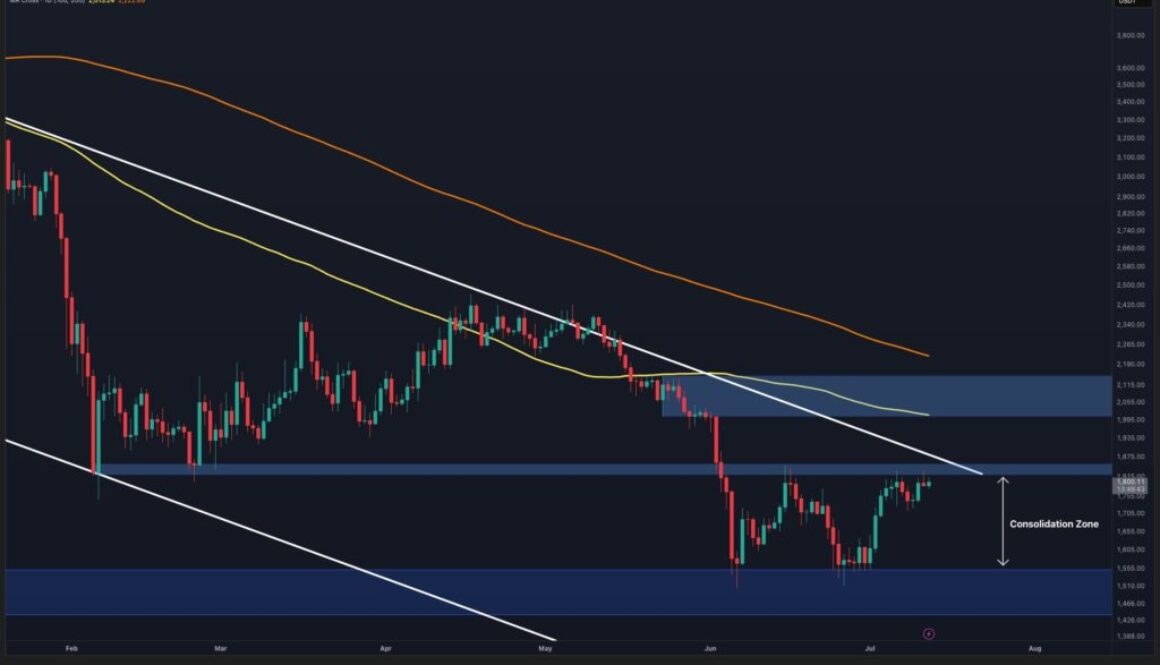
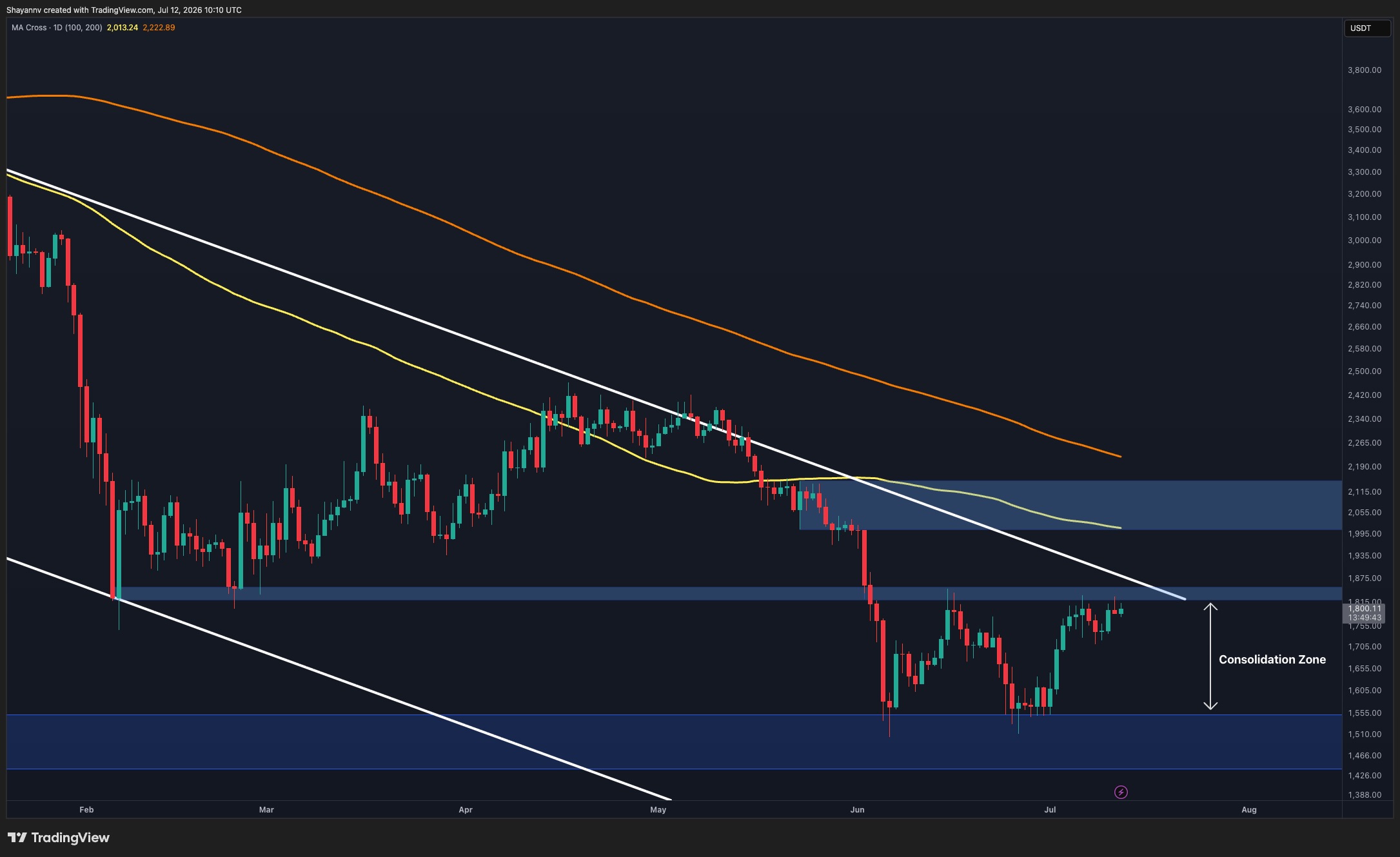
On the daily timeframe, ETH remains within a broader descending structure in place since the beginning of the year. It has recovered strongly from the major demand zone around $1.45K-$1.55K and is currently testing the key resistance region around $1.80K-$1.85K.
This area is particularly significant because it coincides with the descending trendline that has capped price action since May. The level also represents a major horizontal resistance that previously acted as support before the June breakdown.
Despite the recent strength, ETH remains below the 100-day and 200-day moving averages, both of which continue to trend lower. The 100-day MA is positioned around the $2K-$2.1K resistance zone, while the 200-day MA remains considerably higher near $2.2K, reinforcing the broader bearish market structure.
As long as ETH remains below the descending trendline and the $1.80K-$1.85K resistance zone, the current move can still be viewed as a recovery rally within a larger downtrend. A decisive breakout above this area would shift focus toward the next major resistance at $2K-$2.1K.
ETH/USDT 4-Hour Chart
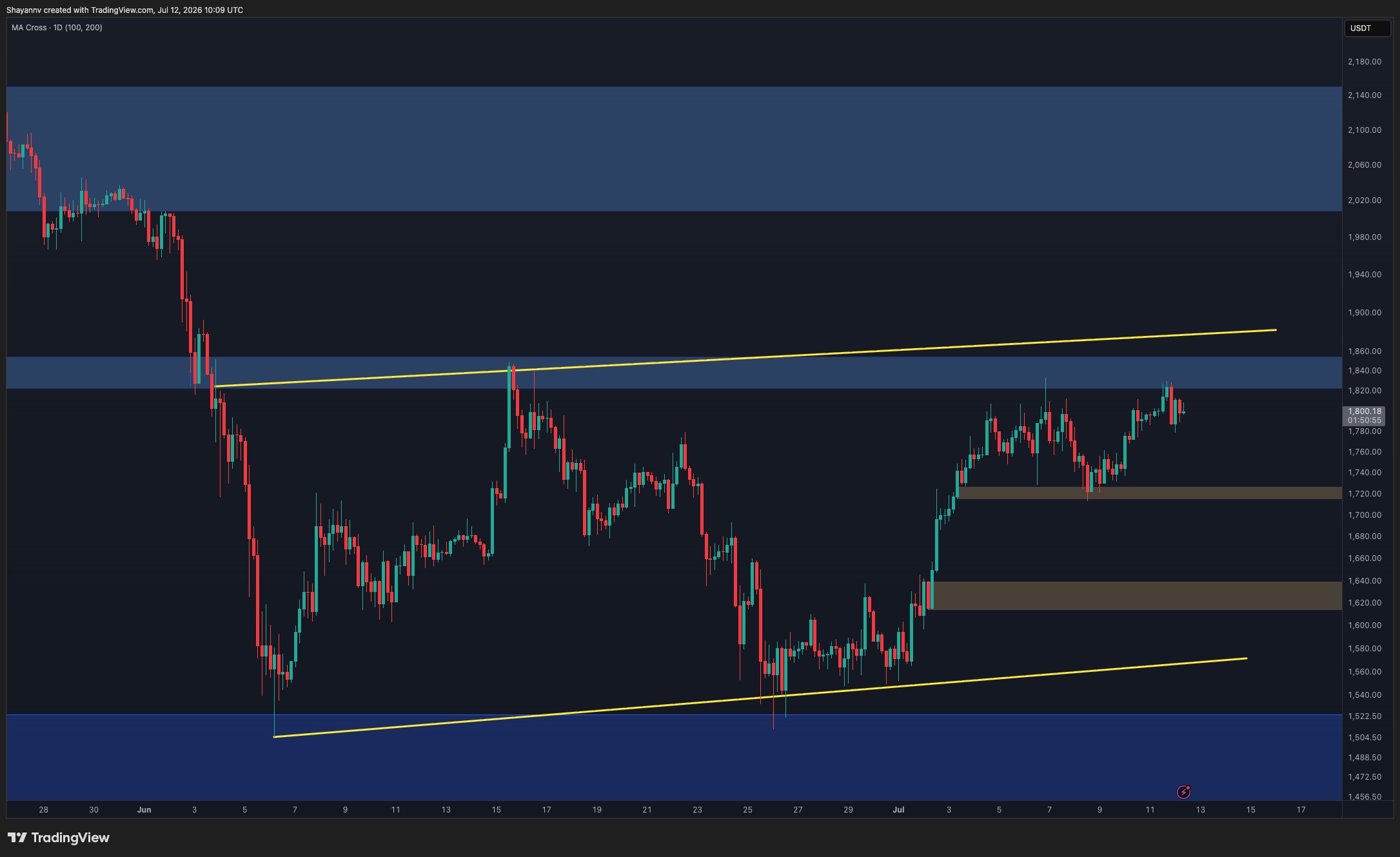
The 4-hour chart highlights a clear ascending structure that has developed since the late-June low. Price has respected the rising channel boundaries while forming higher highs and higher lows, reflecting improving short-term momentum.
The market has already reclaimed the $1.62K-$1.64K demand zone and subsequently established another support area around $1.72K-$1.74K. These zones have repeatedly attracted buyers during pullbacks and continue to define the short-term bullish structure.
However, the rally is now approaching the upper boundary of the channel and the major resistance band around $1.83K-$1.85K. This creates a natural area where profit-taking and seller activity could emerge.
From a structural perspective, ETH remains constructive above the $1.72K-$1.74K support region. Losing this level would be the first sign that bullish momentum is fading and could expose the lower channel boundary and the broader support zone around $1.55K.
Sentiment Analysis
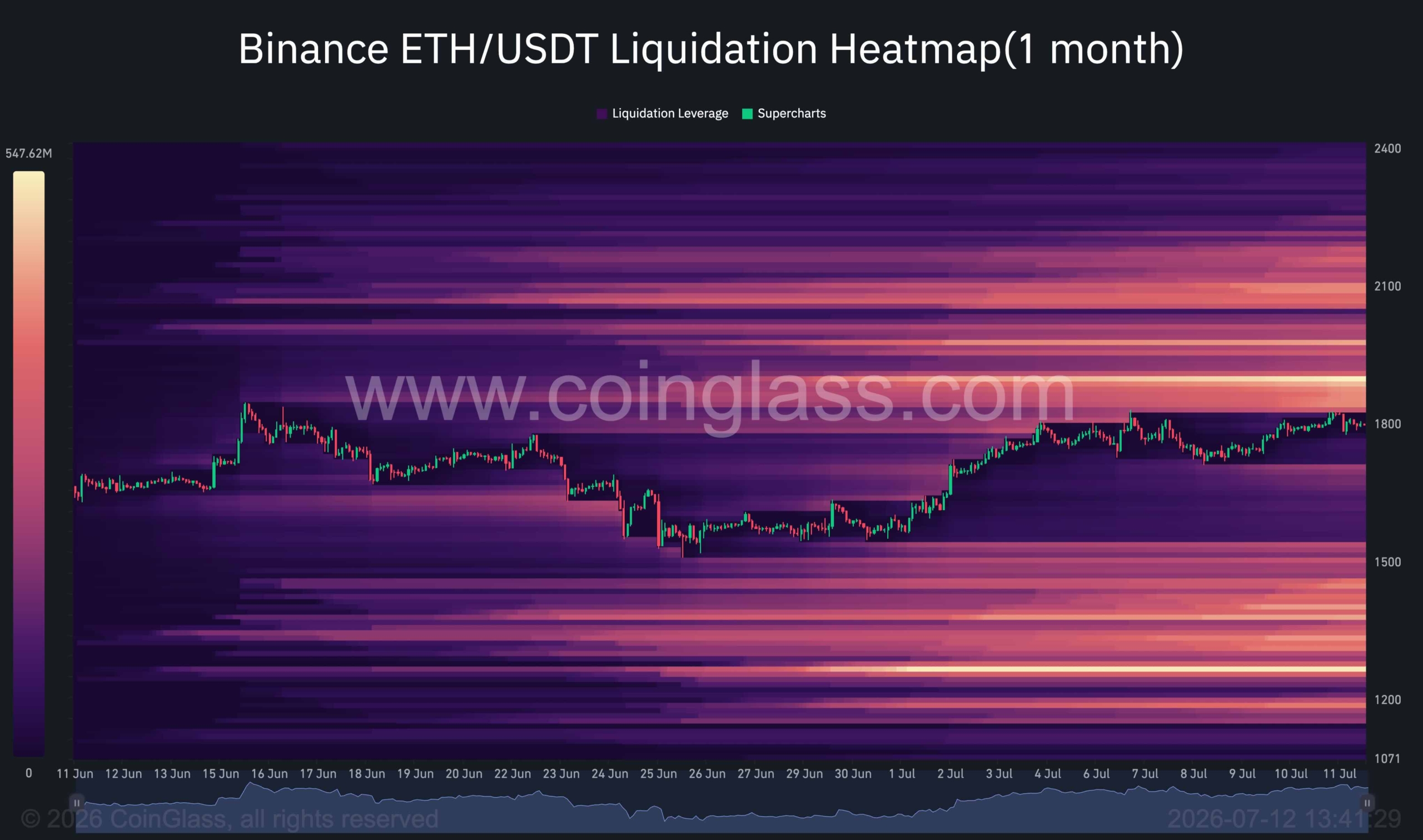
The Binance ETH/USDT liquidation heatmap provides an important clue regarding the next likely move.
The most significant concentration of short-side liquidity sits above the current market price, particularly within the $1.95K-$2.1K region. This cluster aligns remarkably well with the daily chart resistance zone, the 100-day moving average, and the broader supply area visible on the higher timeframe.
Meanwhile, substantial liquidity pools remain below the market around the $1.45K-$1.55K region, which corresponds closely with the major daily demand zone that has supported ETH throughout the recent recovery.
The alignment between the liquidation map and the technical structure suggests that the market may first be drawn toward the overhead liquidity cluster. A move into the $2K-$2.1K area would effectively sweep a large concentration of short liquidations while simultaneously testing one of the most important resistance zones on the chart.
The reaction at that region will likely determine the next major directional move. If buyers manage to reclaim the $2K-$2.1K resistance area and establish acceptance above it, the recovery could evolve into a broader bullish trend reversal. However, if the liquidity sweep is followed by strong selling pressure and rejection from resistance, ETH could enter another notable decline, potentially targeting the large liquidity pools resting beneath the market around the $1.45K-$1.55K support zone.
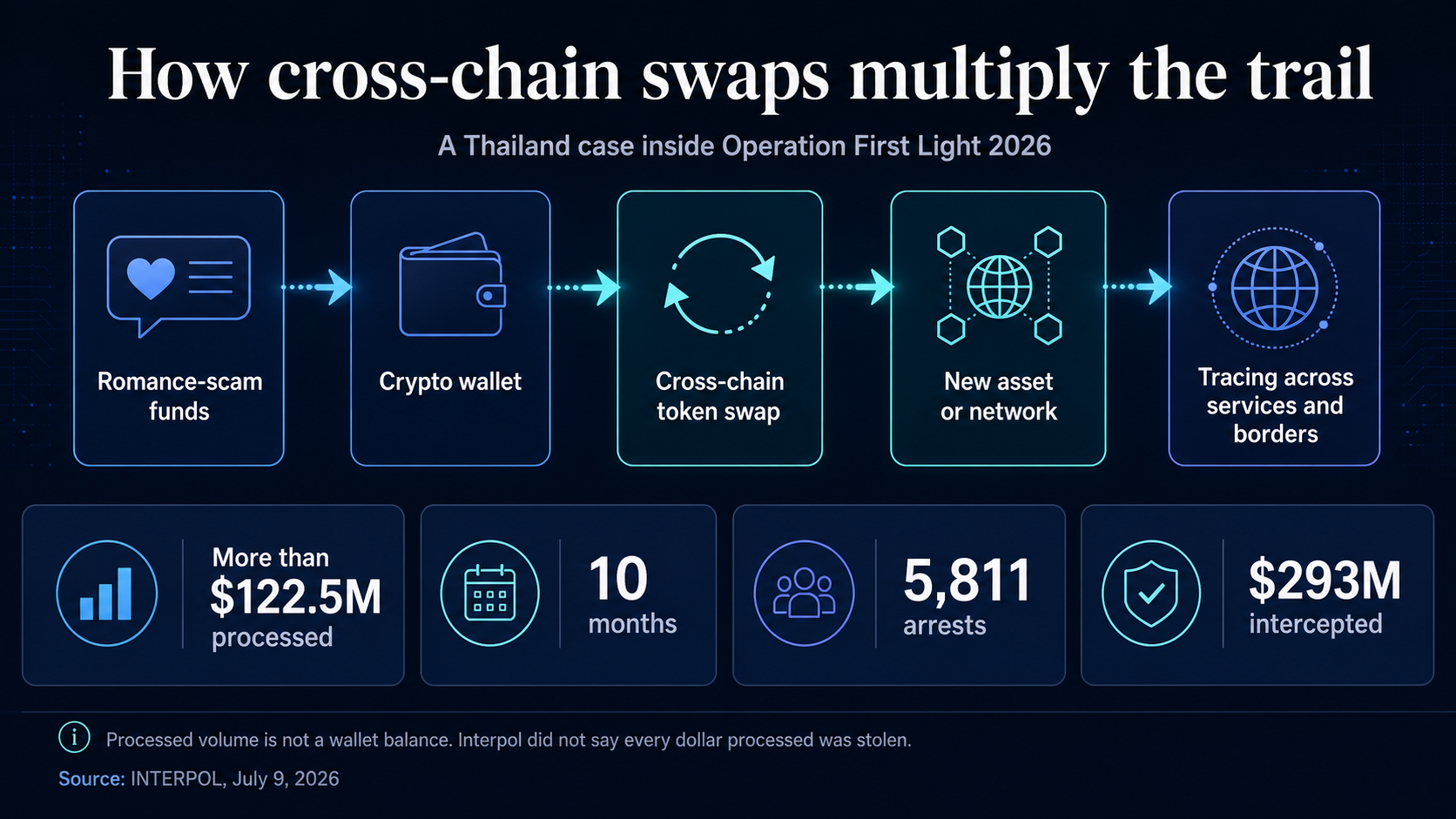
Interpol said a crypto wallet linked to a 20-year-old fraud suspect processed more than $122.5 million over 10 months.
Police in Thailand arrested two people in a money-laundering investigation involving romance-scam proceeds moved through crypto and cross-chain token swaps. The swaps were used to obscure the financial trail, Interpol said in a July 9 account of Operation First Light 2026.
The $122.5 million reflects money that passed through the wallet over 10 months, rather than a balance sitting there at once. Interpol did not identify the wallet, name the assets or chains used, say how much of the total came from theft, or disclose how much Thai authorities recovered.
The case was one part of a coordinated operation spanning 97 countries and territories. Interpol reported 5,811 arrests, $293 million in intercepted illicit assets, and more than 142,000 identified victims.
A token swap can push funds from one asset or blockchain into another. Once a laundering trail spans multiple chains, investigators must piece together records from different ledgers and services before the money reaches an off-ramp tied to a real-world identity.
Using cross-chain swaps means each transition adds another technical and legal handoff to an investigation, especially when funds pass through peer-to-peer wallets or services with different recordkeeping and compliance controls.
The Financial Action Task Force said in a March 2026 report that cross-chain activity can fall outside some counter-illicit-finance controls. It called for law-enforcement and supervisory bodies to build expertise in cross-chain mechanics, smart contracts and blockchain analytics, alongside stronger monitoring of peer-to-peer risks.
Thailand shows how quickly that policy concern becomes an enforcement problem. Any company along a cross-chain route, from wallets and exchanges to swap services and analytics firms, may be expected to keep records authorities can use and flag suspicious flows before the trail goes cold.
Operation First Light combined intelligence exchange with raids, account and wallet freezes, Interpol notices, and requests through I-GRIP, a mechanism designed to block illicit flows in fiat and virtual assets.
The operation ran from Jan. 15 through April 30 after an initial intelligence-gathering period. Its results show that enforcement agencies can disrupt large fraud networks, but the Thailand case also highlights the next pressure point: tracing value quickly enough as it changes hands across chains before investigators can act.
Uniswap’s founder, Hayden Adams, has shared that the company collects roughly $5.2 million in fees per day. Data from DefiLlama backs the figure at $5.16 million over the past 24 hours.
The surge is largely thanks to Robinhood’s two-week-old blockchain, which now accounts for most of that fee flow. Meanwhile, a key governance vote is underway that could extend UNI token burns to v4 pools.
Why is Robinhood Chain so important for Uniswap?
Uniswap’s CEO, Hayden Adams, has revealed through a post on X that it is raking in over $5 million in fees every day, with Robinhood’s new blockchain, which launched on July 1, accounting for most of that money.
Of the $5.16 million in fees Uniswap collected over 24 hours, DefiLlama attributes $4.38 million to Robinhood Chain. In comparison, Ethereum, which used to be the protocol’s core market, contributed only about $296,000. Base was close behind at roughly $288,000.
Robinhood Chain, built on Arbitrum’s technology, went live on July 1. The trading activity on the blockchain has exploded since then, with more than 220,000 daily traders and cumulative volume hitting $1 billion in just nine days.
For UNI token holders, this could mean more token burns if a current “snapshot” vote regarding extending its fee-and-burn mechanism to v4 pools passes.
Uniswap was integrated as the main automated market maker from day one. Its v2, v3, v4, and UniswapX products were all deployed at launch. Over seven days, Robinhood Chain accounts for $10.98 million of Uniswap’s $20.1 million total weekly fees.
UNI is trading around $3.62, up roughly 35% from its early-July low of about $2.70. However, it remains about 92% below its all-time high of $44.97 reached in May 2021.
Across all 47 chains it operates on, Uniswap logged $2.112 billion in 24-hour DEX volume, more than five times the next-largest exchange, PancakeSwap.
The company’s CEO, Hayden Adams, posted on X that the protocol was out-earning every crypto project except the stablecoin issuers behind USDC and USDT.
However, it is important to note that these “fees” are not the same as protocol income. DefiLlama shows Uniswap’s 24-hour revenue at just $73,454. The bulk of the $5.2 million flows to liquidity providers, not to the treasury or token holders directly.
How will the snapshot vote affect users?
Cryptopolitan previously reported that Uniswap Labs is running a “Snapshot” vote from July 7th to the 12th. The vote is regarding whether or not to extend its fee-and-burn mechanism to v4 pools.
This mechanism is part of the UNIfication program approved in December 2025 that requires anyone who wants to claim fees from the protocol to first burn an equivalent value of UNI tokens. The burned tokens are permanently removed from circulation.
Early Snapshot results indicate over 93% approval, with about 13.9 million UNI votes in favor. If passed, binding on-chain votes are expected the week of July 13.
The proposal would activate fees on three families of v4 pools across 11 different blockchain networks, including Ethereum, Arbitrum, and Polygon. This expansion would broaden the burn engine to its largest scope yet.
Uniswap holds a record of burning 186,000 UNI in a single day last month, surpassing the previous daily high of 134,000.
However, liquidity providers have warned that the v4 fee switch could drive them away. Protocol fees are taken from the amount that LPs earn, so fee-enabled pools will offer slightly lower returns than those with zero fees.
Don’t just read crypto news. Understand it. Subscribe to our newsletter. It’s free.
HDFC Bank ended the March financial year with 3,343 fewer employees, a major contraction for India’s biggest private lender.
Total headcount stood at 211,178 as of March 31, down from 214,521 a year earlier. The lender said it is steadily moving routine processing onto digital and automated systems.
AI Automation Hits Back-Office Jobs Hardest
The greatest impact fell on operational staff. Non-supervisory employees, classified as workmen or clerical, and subordinate staff fell by more than 8,000 to 162,797. New hiring also slowed, dropping by 3,811 across the period.
Higher tiers moved the other way. Middle-level headcount rose by 1,252, junior-level by 3,543, and senior management added 15 roles.
The bank tied the shift to strategy. The report said it is steadily shifting routine tasks, such as cash deposits, to Cash Recycler Machines and other automated channels.
That effort runs on Neev, the bank’s in-house AI platform for model access, governance, and workflow integration. Chief Executive Officer Sashidhar Jagdishan said the bank is “consciously redeploying talent from backend functions” toward customer-facing roles as technology takes over routine work.
“As we accelerate the transformation toward becoming a technology-led, customer-centric bank, employees need to keep pace,” he said.
HDFC Bank is not alone. Standard Chartered plans to trim 15% of corporate function roles by 2030 as it scales automation. The trend is now evident in the data. AI drove 38,579 US job cuts in May, roughly 40% of the monthly total, according to Challenger, Gray & Christmas.
However, not every leader shares the gloom. Jeff Bezos argues AI will lift productivity and living standards rather than erase work.
so far at least, i’m pretty sure AI has been net job-creating.
this was not what i expected–although i was much less pessimistic than others, i thought by this level of capability we’d have seen some impact.
For HDFC Bank, the math already favors fewer hands. Profit after tax rose 10.9% to ₹74,671.3 crore, about $7.83 billion, in FY26, even as the workforce shrank.
The Zcash (ZEC) price has climbed roughly 1,190% over the past year, earning it a spot on Forbes’ new top 10 list of the best cryptocurrencies to buy.
The privacy coin trades near $545 after rising about 17% in a week. It is one of just 10 names Forbes picked, beside Bitcoin (BTC), Ethereum (ETH), and Hyperliquid (HYPE).
To make Forbes’ shortlist, a token had to top $5 billion and pass a utility or store-of-value screen. Zcash cleared both, and its rally rests on more than sentiment.
On-chain supply is tightening. By early June, a record shielded supply held about 5.1 million ZEC. That is close to a third of all coins, and those holdings sit outside the liquid market.
A November 2024 halving added to the squeeze. It cut the block reward in half, from 3.125 to 1.5625 ZEC, slowing new issuance.
Regulatory pressure eased at the same time. The Zcash Foundation said in January that the SEC closed a two-year investigation into crypto asset offerings without enforcement. The probe had followed a 2023 subpoena.
The Case Against the Run
The risks are just as concrete. In late May, a researcher found a critical flaw in Zcash’s Orchard shielded pool. The bug had gone undetected for about four years, and in theory it could have minted counterfeit ZEC.
Electric Coin Company and the Zcash Foundation patched it through an emergency hard fork within days. Network accounting showed no fake coins were created. Still, ZEC fell about 38% on the news, and on-chain data flagged lingering stress. Gemini’s Winklevoss twins later backed formal verification, a math-based check meant to make such bugs impossible.
Europe poses the clearest threat. Under MiCA, the bloc’s crypto rulebook, platforms cannot list assets with built-in anonymity features. That provision takes effect in 2027, and some exchanges have already dropped privacy coins.
Will It Hold?
The honest answer is a qualified yes, with caveats. This run has firmer footing than past Zcash pumps. A shrinking liquid supply, slower issuance, and named institutional backers are structural, not hype. Momentum also points up, with gains across the weekly and monthly windows.
Durability is a separate question. Zcash still trades far below its 2016 record high. Adoption stays thin, and Forbes flagged volatility as a core weakness. The Orchard scare showed how fast confidence can crack.
Forbes Names 10 Top Cryptocurrencies to Buy, Including HYPE, Zcash, and Bitcoin. Source: Forbes
“Given crypto’s higher volatility, we chose a more conservative cutoff: screening only for projects with a market cap of at least $5 billion,” Forbes stated.
The takeaway is that Zcash’s rally rests on firmer ground than its history suggests, yet it is far from safe. Its longer-term price outlook now turns on a single question. Can privacy demand outlast the regulation it invites?
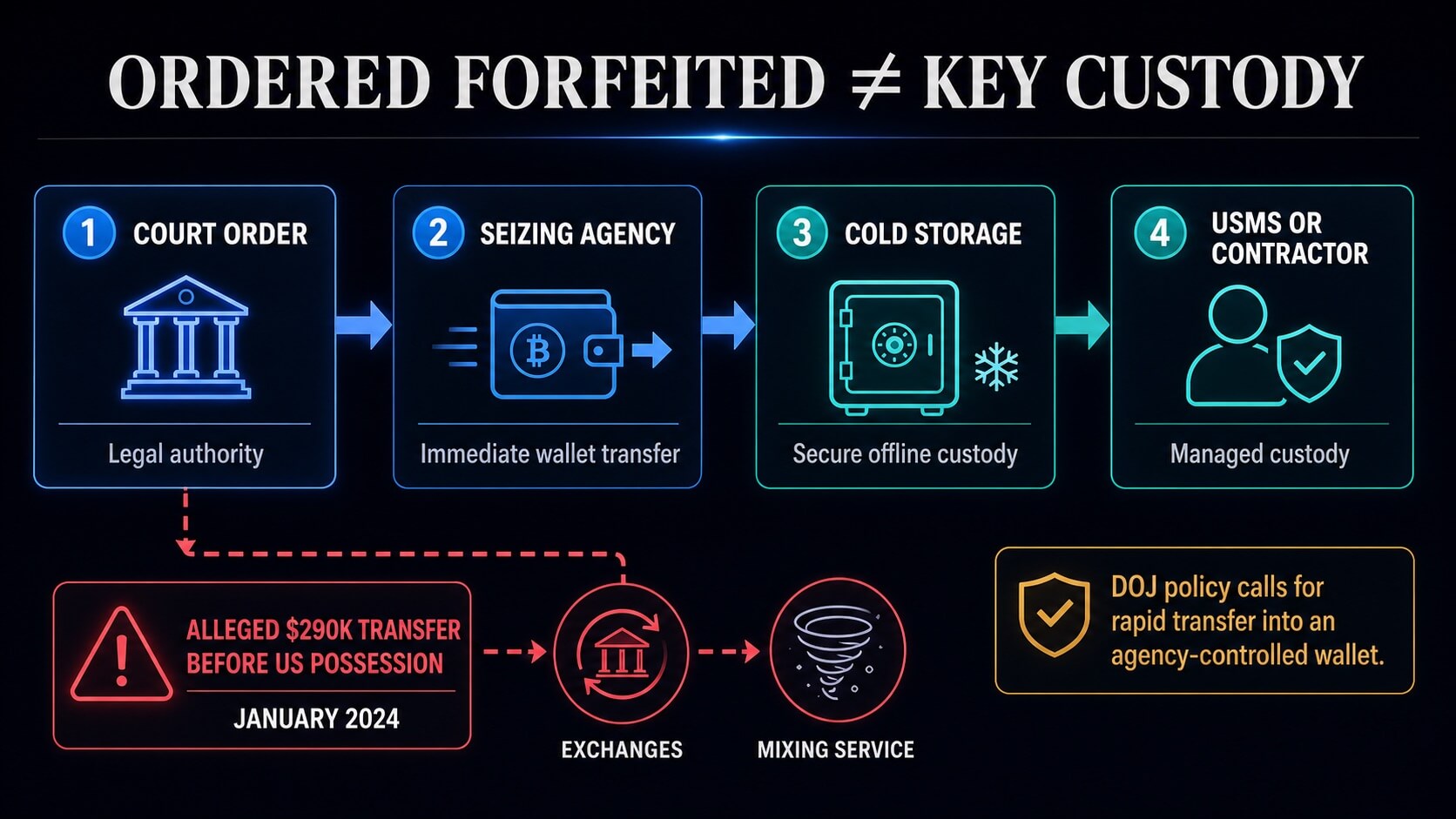
The US Justice Department says a prisoner serving a nine-year sentence for money laundering conspired to move about $290,000 in cryptocurrency in January 2024 after a court ordered the assets forfeited to the United States.
The case highlights a potential gap between a court’s forfeiture order and the government obtaining control of assets that can still be transferred.
Until an agency obtains practical control of the wallet, someone with valid access may still be able to send the assets elsewhere.
In a July 9 announcement, the Justice Department said Rossen Iossifov allegedly routed the cryptocurrency through multiple exchanges and illicit mixing services, preventing the United States from obtaining possession.
Iossifov owned Bulgaria-based crypto exchange RG Coins and was convicted of RICO conspiracy and conspiracy to commit money laundering.
Prosecutors said Romanian scammers posted fake listings for vehicles and other expensive goods on sites such as Craigslist and eBay, took payments from at least 900 Americans, then converted the proceeds into crypto.
The release calls the funds seized and forfeited but leaves a crucial gap: Had agents taken the private keys or moved the crypto into a government wallet before the alleged transfer?
According to the DOJ, they had not. The crypto moved before the government secured it.
A warrant or forfeiture order can freeze the account, but control changes hands only once every usable key and credential is out of reach. Exclusive control begins only when another usable key or account credential can no longer authorize a transaction.
Iossifov was in prison when the alleged conduct occurred.
The filings do not say where Iossifov’s crypto was held, who had the keys, which services moved it, or how he pulled it off from prison. The specific failure point and any prior arrival in an agency-controlled wallet remain unresolved.
A November 2024 court order states that Iossifov received a 121-month sentence in January 2021, which was reduced to 111 months in May 2024.
DOJ says Iossifov had also been ordered to pay $2.64 million in restitution to victims of the earlier fraud scheme.
The new indictment charges him with removal of property to prevent seizure and conspiracy to commit money laundering, carrying a combined maximum of 25 years if he is convicted.
The case exposes the operational gap that can remain between a court’s forfeiture decision and technical control of the assets. For future seizures, DOJ policy calls for agencies to pair court authority with a rapid transfer into a wallet they control.
What remains unanswered in this case is where that chain of control stopped short.
And the situation is only getting worse. According to a shocking new BBC investigation, Instagram has been profiting off paid adverts that promote CSAM in India, a shocking revelation that highlights glaring holes in Meta’s efforts to get ahead of the problem.
Earlier this year, Meta announced it was trying to reduce its reliance on third party human moderators by — you guessed it — switching to AI. But considering the latest news, these systems are seemingly inadequate to stem a tidal wave of deeply disturbing content on its platforms.
Some of the incriminating ads reviewed by the BBC include terms like “rape video” and “child video” and link the platform’s users to shadowy Telegram channels, where the material can be bought for as little as $1.
The shocking revelation has sent shockwaves through the country’s government. Over the weekend, Ministry of Electronics and Information Technology issued a notice to Meta, calling it to immediately disable all ads and content that promote the sale of CSAM. According to Indian broadcaster DD News, the ministry is giving Meta until July 11 to provide a “detailed explanation.”
After the BBC reached out to Meta for comment, the company claimed to have disabled several adverts and suspended any associated accounts for violating its policies. A Meta spokesperson argued that “no system is perfect, and our review process may not detect all policy violations.”
“We continue to run proactive detection technology on ads once they’re live, and anyone can report an ad to us that they think breaks our rules,” the spokesperson told the BBC.
Telegram also told the British broadcaster it had removed “more than 274,000 groups and channels related to child sexual abuse material in 2026.”
Former Facebook vice president Brian Boland argued that Instagram’s algorithms were designed to maximize profit.
“I think what’s sad and tragic is over time, the trade-off of revenue and user experience became a more core part of the conversation,” he told the BBC.
Boland testified against Meta in a trial that saw a New Mexico jury find the company guilty of misleading users over the safety of its platforms for children. The jury concluded in March that Meta had allowed the proliferation of CSAM, turning its platforms into marketplaces for child sex trafficking.
“Meta executives knew their products harmed children, disregarded warnings from their own employees, and lied to the public about what they knew,” said New Mexico’s attorney general Raúl Torrez in a statement at the time. “Today the jury joined families, educators, and child safety experts in saying enough is enough.”
With 1.9 million reports of CSAM on a leading tipline, India is only second to the United States. And children’s rights advocacy groups warn that plenty of crime is still falling through the cracks.
Demand for XRP is weakening across several key market indicators, testing whether the XRP Ledger’s (XRPL) growing institutional pipeline can translate into sustained investor and network activity.
US spot XRP exchange-traded funds recorded about $7.2 million in net outflows in the week ended July 10, according to SoSoValue. The withdrawals ended a nine-week inflow streak that brought nearly $200 million into the products.
The weekly outflow ranked among the five largest for XRP funds this year, though it represented only a modest reversal in the broader trend. The products have attracted cumulative net inflows of $1.48 billion, while their combined assets approached $1 billion at the end of the week.
Still, the shift coincided with a decline in futures exposure and some of the weakest XRPL user activity recorded in 2026, suggesting that demand is cooling across both regulated investment products and the wider market.
XRP open interest falls as bullish traders pay more
That cooling in fund demand is also showing up in the leveraged market, where traders are cutting exposure.
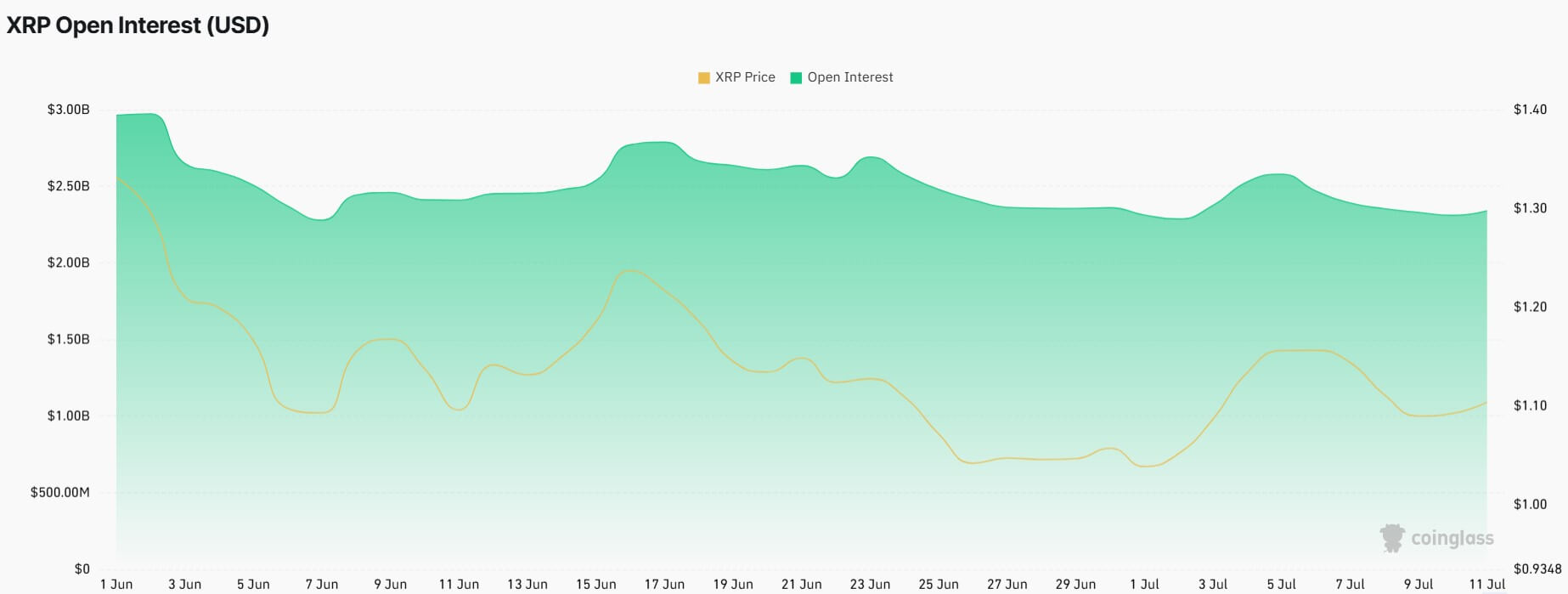
Global open interest in XRP futures fell from nearly $3 billion in June to about $2.3 billion by mid-July, according to CoinGlass.
XRP Open Interest (Source: CoinGlass)
The decline was most evident on Binance, where open interest fell from over $500 million in mid-June to $399 million by July 10, according to CryptoQuant data. Long liquidations rose 94% from the previous week and stood 172% above their three-month average, while short liquidations fell by more than half.
Meanwhile, XRP funding rates moved in the opposite direction. Binance’s XRP funding rate increased 266% over the week despite a shrinking pool of open positions and elevated long liquidations.
The divergence suggests that the remaining bullish traders are paying higher premiums to maintain exposure in a contracting derivatives market.
That structure could leave XRP vulnerable to another funding reset if prices weaken and additional long positions are forced to close.
XRPL activity concentrates as wallet growth stalls
The retreat from leveraged trading is also evident in XRPL, where fewer wallets are participating even as established services generate more activity.
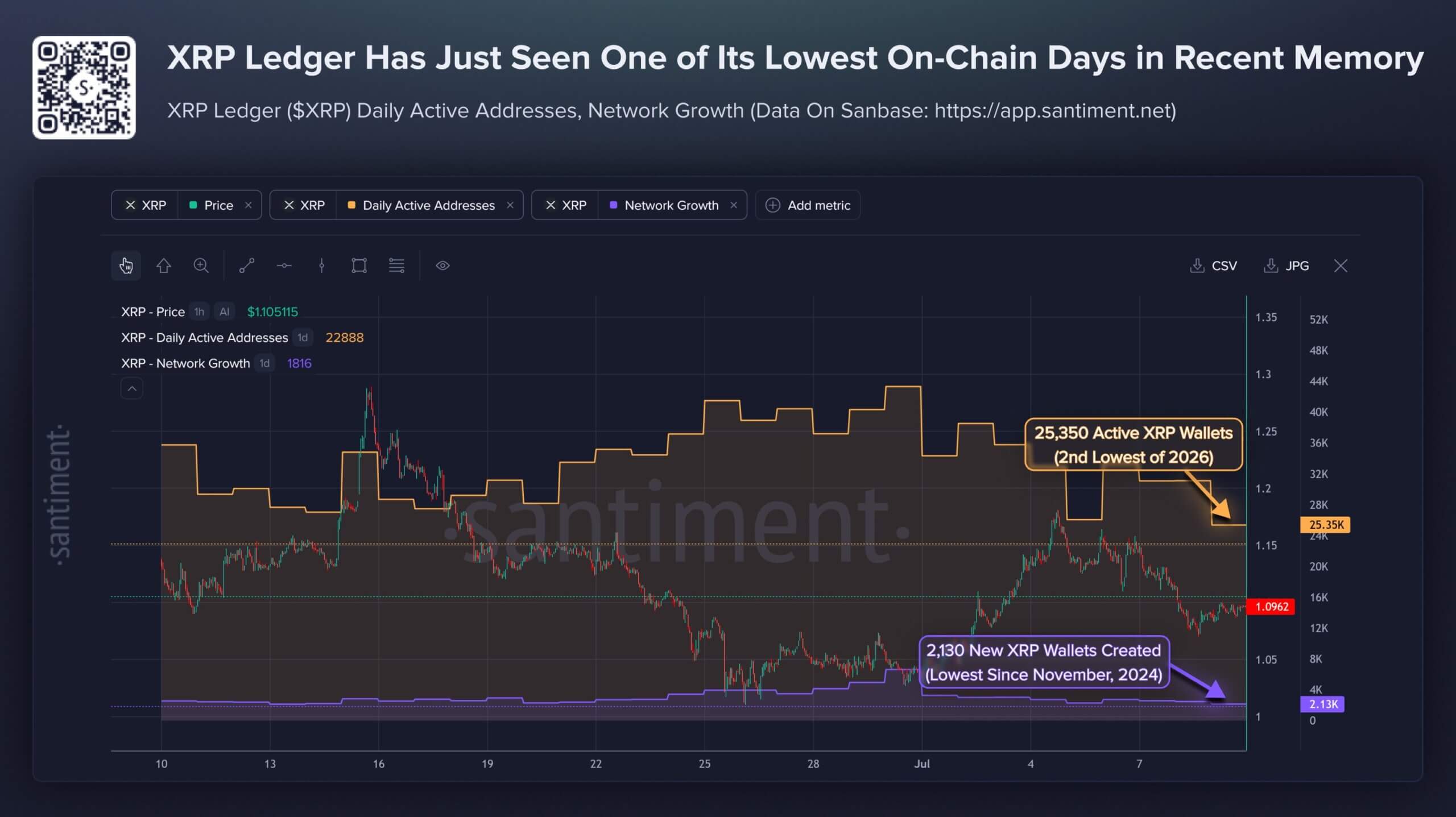
Blockchain analysis platform Santiment reported that XRPL experienced its second-quietest day of the year this week, logging only 25,350 active wallets.
The pipeline of new participants has similarly dried up, with new wallet creation plummeting to 2,130. This is the lowest level recorded since November 2024.
XRPL Network Activity (Source: Santiment)
The slowdown followed a brief increase in dip-buying activity in late June. Since then, both active wallet numbers and new wallet creation have fallen back, with no clearer price or network catalyst.
However, other indicators suggest that network activity has become more concentrated among existing users and applications rather than disappearing altogether.
Vet, an XRP Ledger validator, said transactions containing source tags rose 28.6%, while the number of source tags increased 13%. The tags are commonly used by exchanges, payment providers, and other services to identify transactions linked to customers who use shared accounts.
The increase points to greater activity from service-based applications, but it does not necessarily signal broader adoption. A smaller group of established platforms can generate more transactions even as the number of active and newly created wallets declines.
CryptoQuant data showed the same divide. Transaction counts increased about 3% to 4% over the previous week and month, but remained roughly 21% below their three-month average. Active addresses were also 11% below their three-month baseline.
The network-value-to-transactions ratio eased over the period, suggesting utilization may be stabilizing after an earlier decline.
However, the improvement remains limited, as transaction volumes and user participation continue to trail their longer-term averages.
Can XRPL’s institutional growth revive demand for XRP?
Data from CryptoSlate shows that the token has fallen about 5% over the past week to roughly $1.11, as ETF outflows, declining futures exposure and weaker wallet growth point to reduced demand across several parts of the market.
That growth gives developers an incentive to make the ledger more suitable for banks, asset managers and other financial companies. Their latest effort focuses on privacy, one of the main features institutions often require before moving sensitive financial activity onto public blockchains.
The proposed XLS-96 standard would introduce confidential transfers for Multi-Purpose Tokens. It would use encryption and zero-knowledge proofs to hide individual balances and transfer amounts while still allowing validators to verify that transactions comply with the ledger’s supply rules.
The proposal would also allow selective disclosure, enabling issuers to provide transaction information to regulators and auditors without making it publicly available. Controls such as freezing and clawback functions would remain available for confidential assets.
Those features could make XRPL more attractive to institutions that do not want competitors or outside observers monitoring their collateral movements, settlement amounts or trading positions in real time.
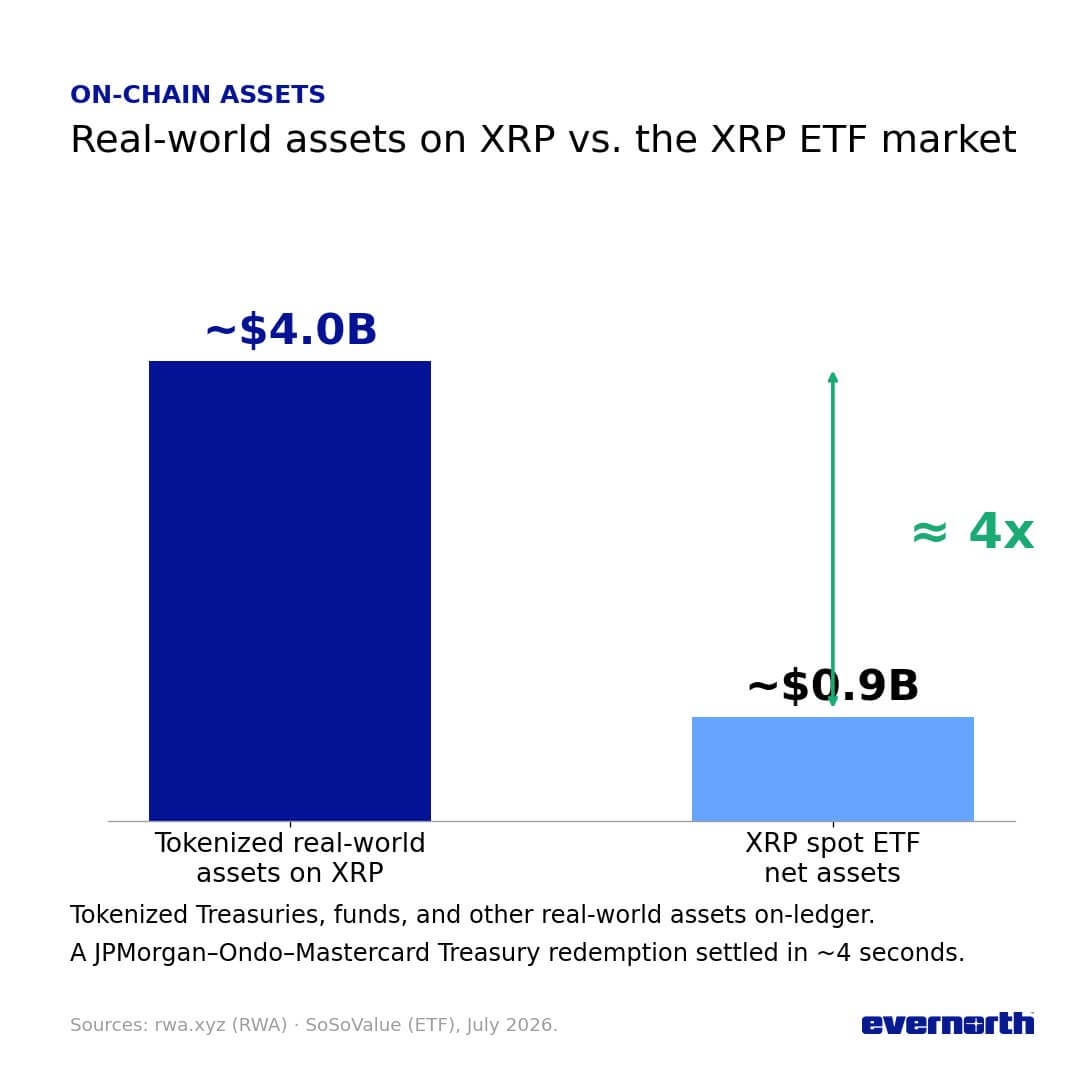
The tokenized asset portion was processed on XRPL in less than five seconds, while the corresponding dollar payment moved through Kinexys and JPMorgan’s banking network. The transaction showed how assets recorded on the ledger could interact with traditional financial infrastructure.
Adding confidential transfers could help expand that activity by removing a key obstacle to institutional adoption. More tokenized assets, settlement transactions, and financial products on XRPL could, in turn, strengthen demand for XRP if the token is used for liquidity, transaction fees, collateral, or settlement.
The Bitcoin Policy Institute (BPI), a nonprofit research group, has officially stepped in to fight a lawsuit that seeks to claim ownership of about 3.7 million Bitcoin.
The case, filed in New York County Supreme Court, argues that Bitcoin left untouched for years should be treated as “abandoned property” under state law. The plaintiffs, led by a person called Noah Doe, are using New York’s lost-and-found law, Article 7-B of the Personal Property Law, to get a judge to declare them the owners of roughly 39,000 wallets that haven’t moved funds in years.
BPI joins fight for Bitcoin founder’s coins
The Bitcoin Policy Institute (BPI) announced through a post on X that it filed to intervene as a defendant in a case concerning 3.7 million bitcoin.
This includes about 1.10 million BTC from Satoshi-era addresses and nearly 80,000 BTC tied to the 2011 Mt. Gox hack.
The plaintiffs argue that they “found” dormant wallet addresses, reported them to the NYPD, sent on-chain messages using Bitcoin’s OP_RETURN field to try to contact owners, waited 90 days, and then asked a court to declare the wallets abandoned.
The Bitcoin Policy Institute, represented by the law firm White & Case, has submitted a proposed answer, 15 affirmative defenses, and plans to file a motion to dismiss.
The case has since been paused by Judge Kathy J. King until a hearing on July 14. Two amicus briefs have already been filed against the plaintiffs’ claims, one from attorney Ian Cohen and another from the Digital Chamber, a blockchain trade group.
Galaxy Research valued the targeted coins at nearly $274 billion in late May. However, the plaintiffs may never get to receive that money as analysts have flagged their claim as unenforceable.
Cryptopolitan reported back in May that Bitcoin has no mechanism to reassign funds without a wallet’s private key. The plaintiffs have admitted that they don’t have these keys.
Galaxy Research Director Alex Thorn noted that the plaintiffs had already dropped 44 addresses from the case after those wallets moved coins following the lawsuit’s filing. This alone disproves the claim that these wallets are truly abandoned.
Who else is gunning for the coins?
Before the Bitcoin Policy Institute intervened to kill the case, a pseudonymous defendant calling himself John Doe 33 filed a verified answer and affirmative defenses on July 8, appearing pro se and saying his portfolio topped $80 billion when the case was filed.
John Doe 33 argues that public Bitcoin addresses are not legal persons and cannot be sued. The plaintiffs simply copied public address data onto a USB drive, and that does not amount to finding or possessing anyone’s coins. He went on to point out that OP_RETURN messages are a poor method of notice because many wallets never display them, and cold-storage users have no reason to check. He also alleges that an identified owner had already contacted plaintiffs’ counsel by phone, disproving the claim that owners were unknown and unreachable.
Two amicus briefs also preceded the institute’s move. Attorney Ian Cohen filed the first on May 29, arguing the dormant coins cannot be treated as lost or abandoned property under New York law, as that only applies to physical objects like jewelry or cash.
The blockchain trade group Digital Chamber filed the second on July 7 with help from consulting firm CahillNXT and Brown Rudnick attorney Stephen Palley.