And the situation is only getting worse. According to a shocking new BBC investigation, Instagram has been profiting off paid adverts that promote CSAM in India, a shocking revelation that highlights glaring holes in Meta’s efforts to get ahead of the problem.
Earlier this year, Meta announced it was trying to reduce its reliance on third party human moderators by — you guessed it — switching to AI. But considering the latest news, these systems are seemingly inadequate to stem a tidal wave of deeply disturbing content on its platforms.
Some of the incriminating ads reviewed by the BBC include terms like “rape video” and “child video” and link the platform’s users to shadowy Telegram channels, where the material can be bought for as little as $1.
The shocking revelation has sent shockwaves through the country’s government. Over the weekend, Ministry of Electronics and Information Technology issued a notice to Meta, calling it to immediately disable all ads and content that promote the sale of CSAM. According to Indian broadcaster DD News, the ministry is giving Meta until July 11 to provide a “detailed explanation.”
After the BBC reached out to Meta for comment, the company claimed to have disabled several adverts and suspended any associated accounts for violating its policies. A Meta spokesperson argued that “no system is perfect, and our review process may not detect all policy violations.”
“We continue to run proactive detection technology on ads once they’re live, and anyone can report an ad to us that they think breaks our rules,” the spokesperson told the BBC.
Telegram also told the British broadcaster it had removed “more than 274,000 groups and channels related to child sexual abuse material in 2026.”
Former Facebook vice president Brian Boland argued that Instagram’s algorithms were designed to maximize profit.
“I think what’s sad and tragic is over time, the trade-off of revenue and user experience became a more core part of the conversation,” he told the BBC.
Boland testified against Meta in a trial that saw a New Mexico jury find the company guilty of misleading users over the safety of its platforms for children. The jury concluded in March that Meta had allowed the proliferation of CSAM, turning its platforms into marketplaces for child sex trafficking.
“Meta executives knew their products harmed children, disregarded warnings from their own employees, and lied to the public about what they knew,” said New Mexico’s attorney general Raúl Torrez in a statement at the time. “Today the jury joined families, educators, and child safety experts in saying enough is enough.”
With 1.9 million reports of CSAM on a leading tipline, India is only second to the United States. And children’s rights advocacy groups warn that plenty of crime is still falling through the cracks.
Our GRAM (prev. TON) price prediction anticipates a high of $3.35 in 2026.
In 2028, it will range between $7.26 and $9.49, with an average price of $7.60.
In 2030, it will range between $17.71 and $20.42, with an average price of $18.27.
In June the TON community voted in favor of renaming Gram to Gram, with the ticker changing from GRAM (prev. TON) to GRAM. The change took effect at 12:00 UTC on June 15, 2026. The blockchain itself stays The Open Network. Only the token’s name, ticker, and logo change.
Our GRAM (prev. TON) price prediction expects Gram to reach a high of $3.35 in 2026, move above $10 in 2029, and climb to an average price of $37.37 by 2032. For traders, investors, and crypto enthusiasts tracking Gram, this forecast breaks down what GRAM (prev. TON) is, where its price stands now, how it has performed historically, and what technical analysis and market sentiment suggest for 2026 through 2032.
GRAM (prev. TON) (The Open Network) is a decentralized protocol developed by Telegram for the community. The protocol is a distributed supercomputer, or “super server,” comprising GRAM (prev. TON) Blockchain, GRAM (prev. TON) DNS, GRAM (prev. TON) Storage, and GRAM (prev. TON) Sites. The native token for the GRAM (prev. TON) ecosystem is called Gram (TON).
Gram is the native cryptocurrency of The Open Network and is used for transactions, digital payments, and network-level services, including Telegram Premium and ad purchases.
That Telegram integration gives GRAM (prev. TON) access to more than 900 million monthly active users and supports broader ecosystem growth, which is one reason GRAM (prev. TON) price predictions matter when evaluating future demand. In a volatile crypto market, where market capitalization and sentiment can shift quickly, understanding the factors that influence TON’s value can help readers make more informed investment decisions.
Gram price movements are shaped by supply and demand, and by fundamental factors such as hacks or other market events, which can quickly shift sentiment.
Large holders, or whales, can influence short-term price movements and volatility in the GRAM (formerly TON) market.
GRAM on July 4, was up 7.87% in 24h and 3.01% in 30 days. Its short-term current forecast is based on technical factors and broader market conditions.
GRAM (prev. TON) turned bullish this week after hitting support levels at $1.50. The correction was accompanied by rising trading volumes.
Each candle shows the opening, closing, highest, and lowest prices for the session. The latest candlestick pattern on candlestick charts suggests an undecided market – short candles.
Traders use this price action view and indicators such as the RSI to gauge momentum. The Relative Strength Index (RSI) is a momentum oscillator: readings above 70 can signal overbought conditions, and below 30 can signal oversold conditions, while the current RSI of 60.37 points to a neutral market.
The 4-hour chart shows GRAM (prev. TON) consistently producing long candles this week, with positive market momentum. Many traders watch this timeframe for short-term moves and near-term market trends. Traders are now watching to see whether GRAM (prev. TON) holds above the $1.80 psychological support level, as a drop below $1.70 could restore downward momentum. In the coming days and into next week, direction will likely depend on whether GRAM (prev. TON) can defend that level and reverse from overbought territory. Its RSI is at 71.55.
GRAM (prev. TON) technical indicators: Levels and action
In technical analysis, moving averages use the average closing price over selected periods to help spot support levels and resistance levels.
Daily simple moving average (SMA)
Period
Value ($)
Action
SMA 3
1.63
BUY
SMA 5
1.61
BUY
SMA 10
1.59
BUY
SMA 21
1.62
BUY
SMA 50
1.73
BUY
SMA 100
1.62
BUY
SMA 200
1.54
BUY
Daily exponential moving average (EMA)
Period
Value ($)
Action
EMA 3
1.64
BUY
EMA 5
1.62
BUY
EMA 10
1.61
BUY
EMA 21
1.63
BUY
EMA 50
1.67
BUY
EMA 100
1.65
BUY
EMA 200
1.73
BUY
What to expect from the GRAM (prev. TON) price analysis next?
If GRAM (prev. TON) fails to hold above $1.80, it could retest lower support at $1.70, setting near-term price targets around that zone. The relative strength index remains neutral, and a correction is likely before another run, though the current technical setup does not yet confirm renewed downward momentum. Multiple technical quantitative indicators and moving averages support a neutral GRAM (prev. TON) forecast over the short term.
Is GRAM (prev. TON) a good buy?
According to Cryptopolitan price predictions, GRAM (prev. TON) will trade higher in the years to come. However, both technical analysis and fundamental factors can support or invalidate this bullish case for investors deciding whether to buy Gram. Even so, GRAM (prev. TON) remains highly risky, so readers should conduct thorough research before making any investment decision.
Will GRAM (prev. TON) reach $10?
Yes, GRAM (prev. TON) should rise above $10 in 2029. The move will come as the market recovers to previous highs.
Will GRAM (prev. TON) reach $100?
Per the Cryptopolitan price prediction, GRAM (prev. TON) is unlikely to reach $100 before 2031.
Will GRAM (prev. TON) reach $1,000?
According to the Cryptopolitan price prediction, GRAM (prev. TON) is unlikely to reach $ 1,000 before 2031.
Does Gram have a future?
GRAM (prev. TON) has been on a bullish run since its inception, despite seasonal market corrections. Future growth will depend in part on the development of more decentralized applications, decentralized storage, and mini apps on the GRAM (prev. TON) network within the Telegram ecosystem, where Gram enables smart contracts for various applications and supports real-world utility. Gram also serves as a fee for cross-chain transactions. The GRAM (prev. TON) blockchain has a vibrant community of users and developers, with access to a broad base of Telegram users. Looking ahead, Gram has the potential to trade higher in the coming years.
Recent news
Recent developments include Pavel Durov’s Telegram post alleging that Reliance, an Indian telecom Company, is sabotaging access to Telegram for millions of users outside India, including in the UAE, through a rogue method called BGP hijacking. The sabotage, according to the post, is intentional, as Reliance ignored multiple reports.
GRAM (prev. TON) price prediction July 2026
The GRAM (prev. TON) July price prediction is an expected range of $1.67 to $2.30. It will average at $1.32.
Period
Potential low ($)
Potential average ($)
Potential high ($)
July
1.67
1.32
2.30
GRAM (prev. TON) price prediction 2026
As 2026 unfolds, GRAM (prev. TON) remains bullish, as evidenced by higher price highs. The price will range between $0.97 and $4.35. The average price for the month will be $2.23.
Year
Potential low ($)
Potential average ($)
Potential high ($)
2026
0.97
1.63
3.35
GRAM (prev. TON) price prediction 2027-2032
Year
Potential low ($)
Potential average ($)
Potential high ($)
2027
4.48
4.80
5.71
2028
7.26
7.60
9.49
2029
11.84
12.22
14.29
2030
17.71
18.27
20.42
2031
24.31
25.16
30.81
2032
35.21
37.37
45.12
GRAM (prev. TON) price prediction 2027
The GRAM (prev. TON) token prediction climbs even higher into 2027. According to the prediction, Gram’s price will range from $4.48 to $5.71, with an average of $4.80.
Gram (TON) price prediction 2028
The analysis suggests a further acceleration in TON’s price. GRAM (prev. TON) will trade between $7.26 and $9.49. It will average at $7.60.
GRAM (prev. TON) price prediction 2029
According to the Gram forecast for 2029, the price of GRAM (prev. TON) will range from $11.84 to $14.29, with an average of $12.22.
GRAM (prev. TON) price prediction 2030
The GRAM (prev. TON) price prediction for 2030 is $17.71 to $20.42. The average price of Gram will be $18.27.
GRAM (prev. TON) price prediction 2031
The Gram price forecast for 2031 has a high of $30.81. However, when the market corrects, GRAM (prev. TON) will reach a minimum price of $24.31 and an average of $25.16.
GRAM (prev. TON) price prediction 2032
The year 2032 will experience more bullish momentum. According to the GRAM (prev. TON) price prediction, it will range between $35.21 and $45.12, with an average trading price of $37.37.
Our predictions indicate that GRAM (prev. TON) will reach a high of $3.35 in 2026. In 2028, it will range between $7.26 and $9.49, with an average of $7.60. In 2030, it will range between $17.71 and $20.42, with an average of $18.27. Note that the predictions are not investment advice. Seek independent professional consultation or do your research before making any investment decision. Crypto assets are highly risky, and there may be limited regulatory recourse for losses from such transactions.
GRAM (prev. TON) is the native cryptocurrency of the GRAM (prev. TON) network, which launched in 2018 as the Telegram Open Network before being renamed and taken over by the GRAM (prev. TON) Foundation. Its ties to the Telegram ecosystem provide access to a large user base.
In June 2020, all Gram tokens (98.55% of the total supply) became available for mining, further widening access to that user base.
The tokens were placed in special Giver smart contracts, enabling anyone to mine until 28 June 2022. Users mined around 200,000 GRAM (prev. TON) daily.
All the tokens were mined in two years, marking the completion of the distribution event.
On September 20, 2021, GRAM (prev. TON) reached its all-time low of $0.3906.
Its first significant break came in November 2021. Over the past few days, the coin has slid from $0.8 to $4.5.
It corrected in 2022, reaching a low of $0.9.
In 2023, it ranged between $1.1 and $2.5.
In 2024, it registered another bull run, rising from $2.11 to its all-time high of $8.24 on Jun 15, 2024.
It corrected later, trading at $ 5.20 in October and $4.98 in November, when it began to recover.
The recovery saw the coin rise above $6.5 in December.
It then crossed into 2025, trading at $5.5. From there, it entered a bear market, falling below $3.8 in February and $3.0 in May. It crossed into June at $3.20 and maintained that level into August. In October, it fell to $3.00, and in November to $2.50.
In December, it traded at $1.60 and rose above $1.80 in January 2026. The trend reversed in February, falling below $1.40. In May, at $1.35. In June, it crossed above $1.50, and in July, it crossed above $1.80.
Reports of Telegram outages are mounting in Russia, with difficulties using the messenger reaching rarely seen levels, according to service status tracking websites.
Russian authorities have been slowing down traffic to the platform since February, but attempts to completely restrict access to the app escalated in late March and April.
Telegram down across Russia before the weekend
Russia is now trying to fully block the popular messaging service Telegram on its territory, local and regional media reported Friday.
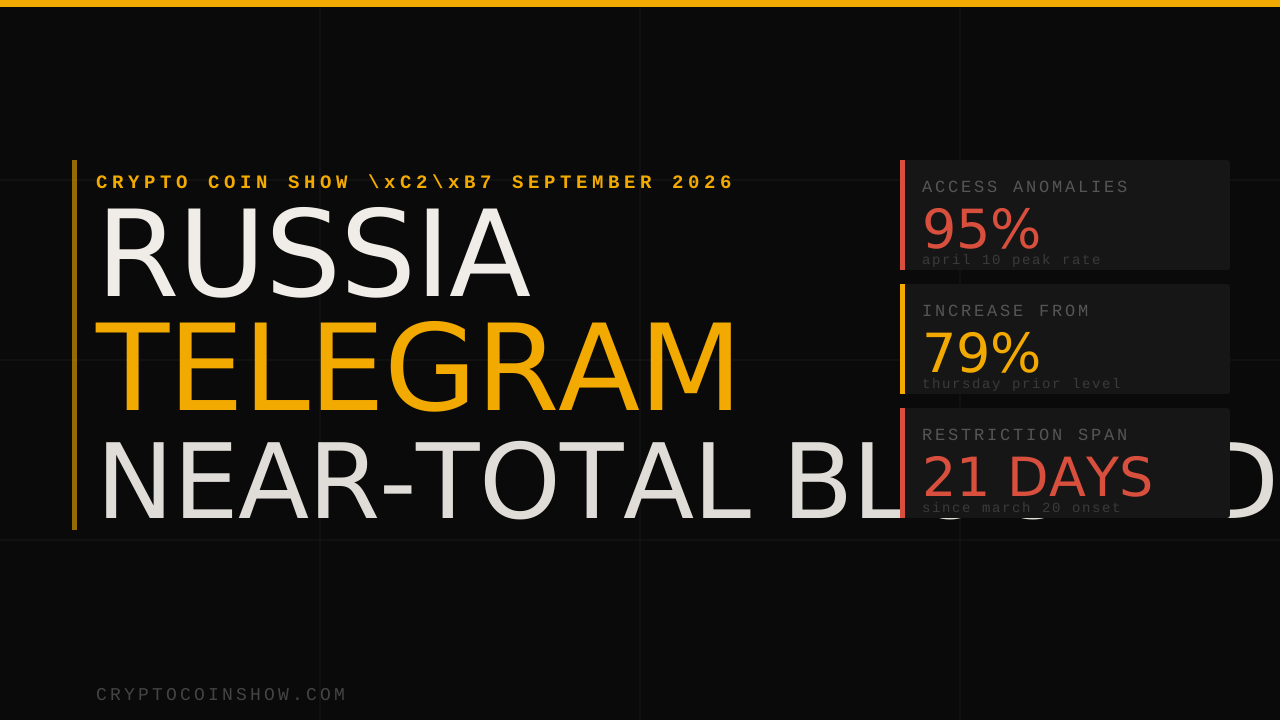
“Anomalies” affecting access reached 95% on the morning of April 10, jumping from 79% on Thursday, the independent Russian investigative media outlet Agentstvo found out first.
Referring to data from the Open Observatory of Network Interference (OONI), a global platform monitoring online censorship, it noted in a post:
“This is the highest anomaly rate ever recorded since the new restrictions on the messaging app began in Russia on March 20.”
Russia’s telecom watchdog, Roskomnadzor (RKN), started throttling Telegram in early February, citing non-compliance with requests to remove prohibited information.
Attempts to interrupt traffic started the following month, ahead of a reported April 1 deadline for the messenger to meet Moscow’s requirements regarding content moderation.
Since then, they have intensified periodically, usually towards the end of the working week, Agentstvo pointed out and commented:
“These figures may indicate that Pavel Durov’s messaging app is already being blocked more severely than WhatsApp and Signal.”
“For comparison, the officially blocked Signal and the effectively blocked WhatsApp on Friday morning had an anomaly rate of 89%,” the outlet added.
Long before the current crackdown, Russian regulators had already banned Signal, Discord, and Viber by the end of 2024.
Besides going after Telegram, the RKN practically banned WhatsApp when it deleted its domain this past February. Each had over 90 million users in Russia.
Voice calls through both were limited in August 2025, with Roskmonadzor claiming they had become a favorite tool for fraudsters, extremists, and cybercriminals.
User reports of outages on sites like Downdetector also rose sharply overnight between Thursday and Friday, the report further detailed.
Detector404.ru has registered over 5,000 complaints in 24 hours, as of the time of writing. Reports have also increased on another Russia-focused tracker, Сбой.рф, with over half of them coming from the capital Moscow and Russia’s second-largest city, St. Petersburg.
Putin hits Telegram ahead of unpopular decisions, says Zelenskyy
Discussing the blocking of Telegram in Russia, Ukraine’s President Volodymyr Zelenskyy attributed the ban to Moscow preparing to make “unpopular decisions.” In a post on Friday, he suggested:
“Perhaps this is the end of the war in one format or another. Or, conversely, an escalation.”
In the first case, he pondered, the Kremlin would have to deal with part of the Russian society that has been radicalized by propaganda and is not ready for an end to the war.
And the second means even greater mobilization, this time sending people from the large cities to the front, Zelenskyy commented at a press conference, quoted by Ukrainian media.
“In my opinion, these are two main scenarios, but, of course, there may be other motivations. And soon we will see which of the scenarios Putin chose,” he concluded.
Telegram has been under pressure over content moderation lately, not just in Russia, but also in Ukraine, as previously reported by Cryptopolitan.
The messenger is widely used by soldiers on both sides in the conflict. Moscow and Kyiv have now committed to a truce for the Orthodox Easter this weekend.
Reacting to the RKN’s crackdown on Telegram, founder Pavel Durov recently urged Russians for “digital resistance,” highlighting that 65 million of them still use it, bypassing the blockade via VPNs.
His call came after a recent report revealed that Russian authorities have foiled a number of protests in defense of the messenger in various parts of the vast country.
If you want a calmer entry point into DeFi crypto without the usual hype, start with this free video.