The ECB is refusing to blink. Even as Donald Trump threatens to slap a 30% tariff on imports and crank up global trade tensions, the European Central Bank decided Thursday it wouldn’t react just yet.
They’re locking rates at 2% and postponing any cut in borrowing costs. The move comes right before their seven-week summer break, with policymakers clearly choosing to wait and see if Trump’s threats actually turn into pain before they make a move.
The logic is simple: don’t rush. A lot of officials are about to disappear on holiday. They’d rather keep repeating that inflation is on target, park any panic until the next batch of economic projections is available for the September 10–11 meeting, and deal with it then.
That means no new action now, but no denial either that things are getting ugly. The euro’s getting stronger, which is hitting exporters and dragging down inflation forecasts. France’s messy budget problems are adding more heat at the worst time.
ECB watches data, ignores panic
Behind closed doors, the ECB knows the pressure is building. A rate cut in September is clearly back on the table, even if they keep hiding behind the usual “meeting-by-meeting” line.
President Christine Lagarde didn’t flinch in her statement Thursday, repeating that “risks to growth are tilted to the downside,” as flagged by Morgan Stanley economists in their preview titled Ready for the Beach. The coming week will pour in the data the ECB needs to weigh that risk.
On Tuesday, their own bank lending survey drops. Wednesday follows with a consumer confidence report, and Thursday will deliver purchasing manager indexes from all across the region, conveniently right before policymakers log off. Germany’s Ifo business confidence and Italy’s economic sentiment numbers wrap the week up on Friday.
Outside the euro area, more inflation data will fly in from Japan, Brazil, and others, while Bank of England chief Andrew Bailey will testify to UK lawmakers about financial stability.His appearance comes just as the UK drops public finance data on Tuesday and faces PMI figures and retail sales later in the week.
Global markets brace as central banks diverge
Over in the US, the economic calendar is light.A Wednesday housing report is expected to show barely any change in the sale of existing homes.
Numbers have been flatlined near a 4 million annualized rate, just slightly better than the 2010 post-crisis low. Thursday brings a report that might show a modest bounce in new home sales, after a brutal drop in June.But the truth is the US housing market is still locked in place.High mortgage rates and unaffordable prices are keeping buyers out.
Meanwhile, Canada’s economic mood gets measured through business and consumer surveys this week. They’ll give insight into inflation fears and investment trends. Retail sales data for May and June could also confirm that shoppers are retreating, especially after tariffs spiked car purchases earlier in the year.
In Asia, everyone’s scrambling to make sense of global trade chaos. South Korea opens the week with export data, followed by confidence and retail numbers. China will keep loan prime rates steady for the second straight month.
Over in Africa, South Africa will show June inflation is likely up to 3.1% from 2.8%, thanks to meat prices. In Nigeria, the central bank will likely keep rates frozen at 27.5%, for the third straight time, with inflation still hot at 22.2%.
In Latin America, Argentina releases its May GDP-proxy Monday. April saw a 1.9% monthly jump and 7.7% year-over-year, helped by President Javier Milei’s move to loosen currency controls tied to a $20 billion IMF deal. Analysts now expect Argentina’s second-quarter GDP to grow 8%, and third quarter by 4.2%, according to Bloomberg.
Mexico is under pressure too. The Tuesday GDP-proxy print will follow April’s surprise strength, and inflation eased in June, finally, and the central bank has hinted it may now slow its easing plans.
Brazil will close the week with its mid-month inflation report, likely down for a third straight time, driven by sky-high borrowing costs. But expectations for 2025 inflation are still above target.
Your crypto news deserves attention – KEY Difference Wire puts you on 250+ top sites
With its presale already surpassing $14 million and a growing community rallying behind it, XYZVerse ($XYZ) is quickly attracting the attention of investors and crypto lovers.
But does it have the fundamentals to sustain the hype? In this guide, we’ll explore what XYZVerse is, how its ecosystem creates real utility, and whether it stands out in a crowded meme coin market.
Is XYZVerse.io the next breakout token? Let’s dive in and find out.
What Is XYZVerse?
Coin
XYZVerse ($XYZ)
Contract Address
0xD75Ab4b69F2eDfb072fDFD7e2D15a875f95Ae5ae
Current Presale Raise
$14M+
Type
Meme token
Launch Date
Q4 2025 (Listing target: $0.10)
Price Increase (At Time of Writing)
>3200% (from $0.0001 to current stage price of $0.003333)
XYZVerse is a community-driven meme coin that merges sports culture, gamified staking, and crypto. At its core, the project aims to do more than ride the meme wave—it integrates with bookmaker.XYZ, giving token holders exclusive betting perks, rewards, and access to crypto-based play-to-earn experiences.
Unlike many meme coins that live and die by social media trends, XYZVerse is building a complete ecosystem featuring:
Telegram-based crypto games
Airdrop programs
Upcoming dApps for staking and rewards
Real-world sportsbook integration
How XYZVerse Reached $15M+ and Why Its Presale Strategy Works
XYZVerse launched its presale with a clear, methodical structure designed to reward early adopters and build long-term momentum. XYZVerse introduced a 15-stage pricing model where the token price gradually increases as each round sells out.
This tiered structure serves two key purposes:
It incentivizes early participation by offering substantial discounts at the earliest stages
It helps the project build sustainable traction, with each stage reflecting real demand and community growth
Starting at just $0.0001 in Stage 1, the price has climbed steadily with strong participation across every round. As of today, the presale has already raised over $14 million, reflecting confidence in both the token’s mechanics and its broader vision of merging sports, meme culture, and crypto rewards.
While XYZVerse is still in its presale phase, several signals suggest it is a legitimate and carefully structured project. However, as with any presale token, true validation will come post-launch—when real market performance and ecosystem utility are put to the test.
The audit results were highly positive, confirming that XYZVerse’s smart contract is secure, well-structured, and gas-efficient. No critical or high-severity vulnerabilities were found. This level of scrutiny and openness reflects a commitment to best practices in an industry where unaudited and hastily deployed meme coins are common. The audit report is publicly available and serves as a key foundation for investor confidence.
Liquidity & Token Control
XYZVerse operates with a fixed total supply of 100 billion tokens, introducing scarcity as a foundational principle. To further support long-term value, the project employs a deflationary burn mechanism—where a portion of tokens is systematically removed from circulation through buybacks and burns. This structure not only discourages inflation but also rewards long-term holders by reducing overall supply over time.
XYZVerse Tokenomics Breakdown
Total Supply: 100,000,000,000 XYZ
Category
Allocation
Quantity
Presale
17.87%
17,870,000,000 XYZ
Marketing
15%
15,000,000,000 XYZ
Liquidity
15%
15,000,000,000 XYZ
Deflationary Burn
17.13%
17,130,000,000 XYZ
Incentives, Bonuses & Airdrops
10%
10,000,000,000 XYZ
Development & Ecosystem
10%
10,000,000,000 XYZ
Team
10%
10,000,000,000 XYZ
KOLs (Key Opinion Leaders)
5%
5,000,000,000 XYZ
Tokenomics reveal a project’s economic structure and are a crucial factor in evaluating its long-term sustainability. XYZVerse adopts a clear and balanced tokenomics model, with a fixed total supply of 100 billion tokens—ensuring the project is non-inflationary and scarcity-driven by design.
The structure reflects a well-thought-out strategy focused on liquidity, growth, and community engagement. Key allocations include:
Marketing (15%) and Liquidity (15%), which ensure both visibility and exchange readiness
A generous 17.13% burn allocation, making XYZVerse one of the few meme coins with a built-in, large-scale deflationary mechanism
10% set aside for development and ecosystem growth, providing fuel for product innovation and long-term expansion
10% for incentives, airdrops, and bonuses, fostering early engagement and decentralized community participation
Unlike many meme tokens that overallocate to teams or rely on hype alone, XYZVerse limits team allocation to a responsible 10%, aligning with industry best practices. Meanwhile, community-focused distributions—presale, airdrops, and KOLs—make up over 40% of total supply, reinforcing the project’s grassroots-first approach.
If executed with discipline, this allocation model supports both market momentum and ecosystem utility, setting a foundation not just for hype, but for sustained relevance through 2025 and beyond.
Community: What’s the Sentiment?
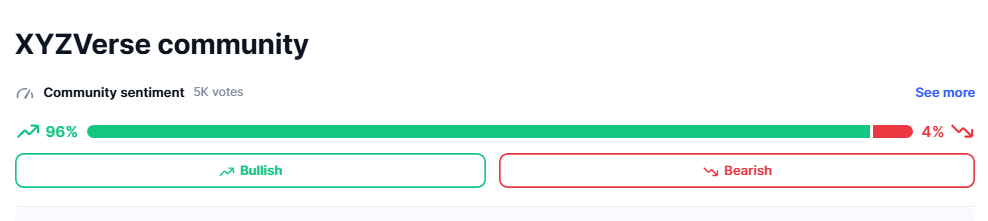
Community sentiment around XYZVerse is strongly bullish, reflecting both growing excitement and trust in the project’s direction. On CoinMarketCap, over 96% of user votes indicate a positive outlook for XYZ, placing it among the most favorably viewed tokens in its category.
This optimism is echoed across the project’s social channels:
21K+ followers on X (formerly Twitter)
12K+ active Telegram members
High engagement across airdrop announcements, presale updates, and interactive campaigns
Influential voices in the crypto space are already buzzing about XYZVerse, with several prominent analysts and content creators calling it a “moonshot opportunity” for the 2025 cycle. Their enthusiasm is fueled by the project’s transparency, unique blend of meme culture and sports utility, and growing credibility.
Combined with recognition from CryptoNews as the “Best New Meme Project”, and a partnership with bookmaker.XYZ, XYZVerse is not only attracting investors—it’s building a passionate, conviction-led community.
As broader crypto sentiment turns optimistic, XYZVerse appears well-positioned to become a breakout name in the upcoming bull run, supported by both grassroots enthusiasm and early influencer endorsement.
The future for XYZVerse looks increasingly promising as it positions itself at the intersection of community-driven meme culture, gamified crypto engagement, and real-world sports integration.
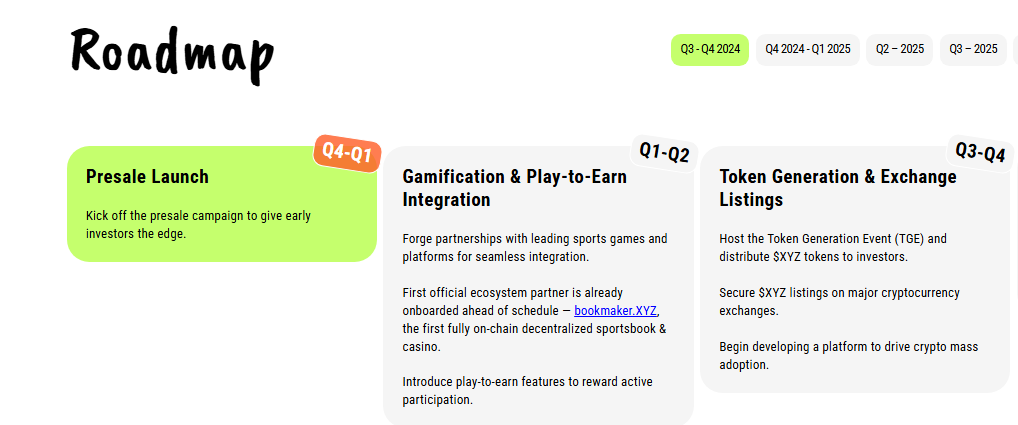
With a clear post-launch roadmap and strong early traction, the project is preparing for a high-profile debut on both centralized and decentralized exchanges. This move is expected to significantly boost visibility and liquidity, allowing XYZ to reach a broader investor base beyond presale participants.
Several key developments lie ahead:
Launch of staking and reward-based dApps, allowing holders to earn passively while engaging with the ecosystem
Expansion of its play-to-earn games on Telegram and other platforms, turning casual engagement into real crypto value
Influencer and athlete partnerships, bridging Web3 and global sports audiences
Aggressive marketing and sports sponsorships, giving the project exposure beyond the crypto-native crowd
Token burns and liquidity programs, reinforcing price sustainability over time
Importantly, the combination of a fixed supply, burning mechanics, and a loyal, growing community gives XYZVerse the ingredients needed for long-term relevance—not just a short-term meme cycle.
If execution stays aligned with its roadmap and community energy continues to build, XYZVerse could evolve from a speculative token into one of the standout crossover stories of the 2025 bull run—where utility, culture, and Web3 entertainment collide.
Visit the official XYZVerse website to learn more about the project: https://xyzverse.io/
The unlucky trader reached out to the Ethereum validator named TitanBuilder through on-chain messages. These blockchain messages are viewable on the Ethereum network.
In the message, the trader wrote to the gas fees recipient, “Help! Some buggy wallet sent this transaction on Ethereum instead of Pulsechain, can you please send me back the super-high fee 31.22ETH this mistake has caused? please it is a huge amount of money to me.”
The trader stated that his wallet is buggy, causing the transaction to be processed on the Ethereum network instead of the PulseChain network. Since PulseChain utilizes the Ethereum Virtual Machine (EVM), the transaction is valid on both PulseChain and Ethereum.
Such a human error happens because the trader has to choose between paying the fees in ETH or the network’s native coin. In this case, it’s PulseChain’s native coin, PLS, which is trading at $0.00003014, based on data from CoinGecko. Ether, on the other hand, is trading at $3,525.88.
Conor Grogan, a Director at Coinbase, took to X and urged the Ethereum validator TitanBuilder to return the funds to the trader. He wrote, “Do this poor guy a solid and farm some good karma.” Grogan also stated that the 31 Ether coins were transferred to a crypto exchange wallet, which seems to be an automated transaction.
Grogan stated on X that he spends his free time helping users find their lost funds or unclaimed airdrops. Last month, Grogan said that over the past few years, he has helped more than 50 people recover over $10 million in lost Ether or unclaimed airdrops. He also managed to recover more than $3 million belonging to the crypto exchange Gate.
Four hours ago, Ethereum validator TitanBuilder refunded the trader and sent him 29.5295 ETH, equivalent to $103,511.61. The validator wrote on X “We have refunded 100% of the block profit back to the user.”
KEY Difference Wire: the secret tool crypto projects use to get guaranteed media coverage
Apple has launched a major lawsuit against popular YouTuber Jon Prosser and California man Michael Ramacciotti, claiming the pair stole and then leaked confidential information about the company’s latest iPhone software update – iOS 26.
The complaint, filed in US District Court for the Northern District of California, accuses Ramacciotti of using unauthorized access to an Apple employee’s phone to leak sensitive details of iOS 26. He reportedly sent it to Prosser, who ran with it on his YouTube channel Front Page Tech.
The leaked information included details on as-yet-unreleased features and designs for iOS 26, which Apple intends to release publicly in the fall of 2025, according to the court documents.
The company claims the leak caused “irreparable harm” by disclosing unfinished and secret product plans before they were ready. It is also seeking damages, but did not specify an amount.
Apple has emphasized that it places a high priority on confidentiality and protecting its trade secrets. The company typically did not comment publicly beyond what is stated in its official legal filings.
YouTuber denies wrongdoing
In a statement to Reuters, Jon Prosser, an online personality who has gained prominence by disseminating news and scoops related to tech, said the lawsuit is another attempt by a large organization to silence those who speak the Truth.
“I certainly did not plot to steal information, nor did I even know how it was originally obtained,” he said.
Prosser said he believed the information he received was accurate and that publishing it fell within the legal boundaries of journalism. He added that he was eager to have the opportunity to present his side of the case in court.
This far, neither Ramacciotti nor a representative from Front Page Tech has returned requests for comment.
The video, uploaded to Prosser’s channel for the first time in January 2025, is called iOS 26. Inside, he detailed features and settings that Apple had not yet released. The video had people talking in the tech community and ranting online about Apple’s internal monitors and how they keep a tighter lid on leaks.
Whistleblower exposes iPhone software breach
Apple said that it became aware of the leak in April 2025, after it was alerted by an anonymous whistleblower. According to court documents, the whistleblower told Apple that Ramacciotti had accessed the data by hiding behind a close friend’s work phone. That friend happened to be an Apple employee at the time.
The suit claims Prosser drove Ramacciotti, whom the vice principal supposedly “owed money,” to secure and relay the information. According to Apple, Ramacciotti is accused of numerous crimes and breaking company regulations. Falsehoods can lead to consequences; for Mike Prosser, that means a net gain. Prosser deliberately profited from the law-breaking, sharing secret information on his platforms to build an online audience and personal brand.
Apple claims that protecting its IP is essential to its innovation and market position. It said both defendants had acted “maliciously and unlawfully.” The company also argued in the lawsuit that its trade secrets would harm its competitiveness and confidence between employees and business partners if revealed to the public.
In 2021, Apple accused one of its former employees, Simon Lancaster, of leaking confidential company information to a reporter. In court documents, the company said Lancaster had abused his position and the trust in him to share sensitive trade secrets for his gain.
KEY Difference Wire helps crypto brands break through and dominate headlines fast
As Ethereum (ETH) hovers around key resistance levels, speculation is mounting over whether the world’s second-largest cryptocurrency could finally reach the $10,000 mark in 2025. While analysts debate ETH’s trajectory amidst shifting market sentiment and Ethereum ETF buzz, a new player is rapidly gaining traction, Mutuum Finance (MUTM).
Mutuum Finance is priced at $0.03 in the 5th presale phase, well over 80% sold out. Investors in this stage will enjoy a 100% return on investment when the token is listed. Well over $12.6 million has been raised and more than 13,600 early-stage investors. The token will rise in presale Phase 6 to $0.035, and that is 16.67% return on investments done in Phase 5. Mutuum Finance is capturing the attention of investors who are seeking more than just price speculation.
Ethereum Price Outlook: Can ETH Clear Its Next Milestone?
Ethereum (ETH) is currently trading at $3,461, bolstered by strong institutional flows, most notably from spot ETFs like those backed by BlackRock, which recently saw nearly $717 million in inflows in a single day. Analysts anticipate ETH could push toward the $3,600–$3,700 range in the short term, with potential upside to the $4,000–$5,000 zone by year’s end if ETF-driven demand and network fundamentals hold steady.
That said, $3,200–$3,300 remains a critical support area, and a dip below could lead to consolidation around $3,000. Meanwhile, emerging alternatives, like Mutuum Finance (MUTM), are starting to attract attention as complementary plays in the crypto market.
Investor Demand Propels Mutuum Presale to $12.6M
Mutuum Finance presale has more than 13600 investors and is more than $12.6 million in funds. Investors have put over 80% of the tokens in phase 5. This indicates growing confidence by the investors in the project’s near-term success as well as its better future.
Mutuum Finance Launches Major Token Giveaway Program
Mutuum Finance (MUTM) is offering $100,000 giveaway, distributed among 10 winners of $10,000 in MUTM tokens. In addition, the top 50 holders of the Mutuum Finance will be rewarded based on its new leaderboard system. The bonus tokens will be given to the users when they level up.
Mutuum Finance’s Model for Transforming DeFi Lending
Mutuum Finance (MUTM) is innovating the DeFi lending with the creation of a platform that renders customers the sole proprietor of their own assets. It is a functional double-lending multifunctional platform, combining the synergy of Peer-to-Contract (P2C) and Peer-to-Peer (P2P) model.
In P2C, smart contracts are used to access lending pools. The platform responds to real-time market conditions, a factor that makes lenders’ returns less volatile and the borrower financially stable. With the elimination of intermediaries, the P2P model provides direct lending, which is very convenient on highly volatile assets like other coins.
More than 13,600 investors have already poured over $12.6 million into Mutuum Finance (MUTM), a clear signal that this DeFi gem is quickly becoming a top alternative to legacy tokens like Ethereum. Phase 5 i s over 80% sold out, and the token is still just $0.03, guaranteeing 100% returns at the $0.06 launch price. A 16.67% increase is already locked in for Phase 6, making this the last chance to get in before the next price hike. As ETH eyes $10,000, investors are shifting focus to where real growth potential lies, and right now, that’s Mutuum Finance. Don’t wait until it’s trending. Secure your MUTM tokens now before Phase 5 closes.
For more information about Mutuum Finance (MUTM) visit the links below:
The Bank of England (BoE) has asked several banks to assess their resilience to potential US dollar shocks, as concerns over Trump’s policies on global financial stability grow.
Trump’s departure from long-standing US positions on free trade and defense has rattled confidence in the dollar—the world’s dominant reserve and trade currency—sending shockwaves through global markets.
The uncertainty has also reached lawmakers, who debate whether continued reliance on dollar distribution is sustainable amid rising economic risks.
Uncertainties surround the US dollar as nations rethink their reliance on the country
The US Federal Reserve has asserted that the central bank will continue using dollars in its operations. However, following Trump’s policy shift, the US’s European trading partners are rethinking their reliance on the country.
The European regulators have gone to the extent of triggering the Bank of England, the central bank responsible for maintaining monetary and economic stability for the country, to emphasize to lenders the urgency of assessing their dollar funding approach in their operations. Moreover, according to sources familiar with the situation, it has also requested them to examine their reliance on the currency for short-term needs.
Considering the intense nature of the situation, a Britain-based global bank was recently requested to conduct an internal stress test on the possibility of a shutdown for the US dollar swap market.
Richard Portes, an economics professor at London Business School and a former Chair of the Advisory Scientific Committee for the European Systemic Risk Board, mentioned that in a worldwide dollar funding crisis, the Fed may be reluctant to provide swaps due to concerns about a strong reaction from Trump. Portes explained that the Fed mainly focuses on keeping monetary policy independent.
He further urged the supervisors of foreign banks to encourage their banks to reduce their dollar exposures drastically.
In response to Portes’s statement, the Prudential Regulation Authority, the supervisory part of the Bank of England, requested separate information from several banks concerning the situation, people with knowledge of the matter who wished to remain anonymous due to the confidential nature of the situation said.
When asked to comment, neither the Bank of England’s representative nor the global UK banks ‘ spokespersons that operate in banks such as HSBC, Standard Chartered, and Barclays respond to a request for comments.
Contrastingly, a spokesperson from the White House responded to a request for comment. In a statement, the spokesperson mentioned that during President Trump’s administration, several markets and investors demonstrated strong confidence in the US dollar.
The spokesperson based the argument on the increase in bonds, stocks, and historic investments that have increased to trillions of dollars since Trump’s election day.
Analysts express concerns about the US Fed’s financial stance
Earlier assessment of internal stress test on the US dollar revealed that euro zone banks required approximately one-fifth of the currency in their operations. The assessment also revealed that they highly rely on financial borrowing from short-term markets, which are unreliable in an economic crisis.
For example, European central banks have significantly borrowed funds from the US Federal Reserve. This is where the US dollar comes from, highlighting their reliance on the currency to fill their financial gaps.
Interestingly, the US Fed has several loan programs that apply to the ECB, among other US partners. This aims to address the global US dollar shortage and prevent the effects of financial hardship from hitting the country.
Two reliable sources have highlighted that the US Fed never stopped indicating support for these safety precautions. Despite this, some sources suggest the possibility of the Fed shifting this stance.
Cryptopolitan Academy: Want to grow your money in 2025? Learn how to do it with DeFi in our upcoming webclass. Save Your Spot
Japan’s core inflation rate fell to 3.3% in June, offering some relief after hitting a 29-month high.
The core inflation figure excludes fresh food, which fluctuates more due to weather and supply conditions.
The most recent figures, published on Friday by Japan’s Internal Affairs Ministry, were generally in line with theforecasts of economists polled by Reuters.
The headline inflation rate covers all categories and was down to 3.3% in June from 3.5% in May. Nonetheless, it is the 39th straight month that inflation has exceeded the Bank of Japan’s (BOJ) 2% goal.
A broader measure, the so-called “core-core” rate of inflation, which excludes not only fresh food but also energy prices, rose to 3.4% from 3.3% the previous month. It’s regarded as the benchmark for underlying inflation trends and is closely monitored by the BOJ.
While inflation has slowed, prices are still high compared with previous years, and the public continues to bear an increasing cost of living.
Rice prices begin to stabilize
A key driver of recentJapanese inflation has been rice, a staple in virtually every household. In May, rice prices had surged more than 101.7% year-on-year, the steepest jump in over 50 years.
But that rate slowed a bit in June. The 100.2% year-on-year jump in the price of rice was the first indication of a let-up in months.
The relaxation came after the government released rice stockpiles earlier this year to cool prices. The intervention helped shore up supply and dampen speculation in the market.
However, prices are still high, and officials warn that the ripples of that bad harvest in 2023 are still being felt. The 2023 harvest season was affected by abnormal weather, including typhoons and record heat that cut output in the main rice regions.
Although the current trend is promising, according to experts, a return to stable rice prices will depend on the 2025 harvest, which is still unknown.
The confidence data comes from Japan’s economy, which is increasingly clouded by external economic uncertainties. A big one is US trade policy.
US President Donald Trump says he is not ready to strike a trade deal with Japan. That has stoked fears of additional tariffs that would damage Japanese exports, particularly of cars, the largest product that Japan ships to the United States.
A 25% tariff on a broad swath of Japanese goods will go into effect on August 1, while a 25% levy on cars will remain in place.
The introduction of these tariffs would come at a particularly challenging time for the Japanese economy. Japan has announced its GDP fell 0.2% in the first three months of 2025 compared to the previous quarter. It was the first contraction in a year, driven primarily by a steep export fall.
The financial pressure is shaping up to be a significant issue ahead of next summer’s upper house elections, in which voters remain angered by the creeping prices but stagnant wages.
The persisting inflation growth has some market participants speculating about the need for interest rate increases by the Bank of Japan. After all, the headline inflation rate has been above the 2% target for over three years.
But the central bank remains wary. Bank of America analysts have said the BOJ will unlikely raise rates before January 2026.
They say BOJ Governor Kazuo Ueda targets inflation expectations, which remain below 2%. These expectations — what businesses and households expect as future inflation — are an important signal of whether inflation is genuinely embedded in the economy.
Cryptopolitan Academy: Tired of market swings? Learn how DeFi can help you build steady passive income. Register Now
Meta, the American tech giant behind Facebook and Instagram, has hired two former Apple AI specialists, Mark Lee and Tom Gunter, shortly after recruiting their former supervisors.
According to sources familiar with the matter, both experts will join Meta’s Superintelligence Labs team. Lee has already started his new role, while Gunter is set to begin in the coming days.
The tech giant’s action demonstrates a growing trend in the tech ecosystem involving stiff competition for AI talent. Additionally, it has been very proactive in its staff recruitment.
Meta increases its workforce with AI experts from Apple
Meta CEO Mark Zuckerberg has demonstrated a strong commitment to artificial intelligence, motivated by its surging global demand. His dedication is evident in the company’s heavy investments in AI, the recruitment of top AI talent, and a substantial boost in spending on data centers.
With this, the company aims to cement its position as the leader in AI, beating up its rivals such as OpenAI and Google.
Following the tech firm’s hiring move, the company recruited Ruoming Pang, former head of Apple’s Foundation Models team, early in the month. The tech company offered him a significant salary package of $200 million to win Pang, effective for several years. Coincidentally, Pang teamed up with Gunter and Lee at Apple, who have also left the company for Zuckerberg’s company.
In addition, the two were the longest-serving members in Pang’s team. Lee was his first worker at Apple. On the other hand, Gunter was a reputable engineer in the firm. After departing from Apple, Gunter accepted a job offer from another AI company but stepped down from that role following Meta’s offer.
Meta’s recent hires demonstrate an ongoing disorder in the Apple Foundation Models (AFM) team. The team is responsible for creating an effective technology useful in generative AI.
The AFM team is also facing uncertainties due to the company’s AI executives’ decision to initiate external models into their operations as a solution to improve its Siri voice assistant, among other Apple Intelligence features.
AI Senior Vice President John Giannandrea is among the AI executives at Apple. Under the research leader Daphne Luong, the team is weighing some strategic changes with Mike Rockwell and Craig Federighi, software leaders currently overseeing Siri.
Neither Meta’s spokesperson nor Apple replied to a request for comment.
Meta offers Apple’s employees significant salary packages
Apple is developing parallel versions of its voice assistant using in-house AI models and third-party technologies to deliver long-promised enhancements to Siri, such as leveraging personal data to fulfill user queries. However, before its launch next spring, the company must decide which software backbone will power the revamped assistant.
Meta has seized on Apple’s internal indecision by aggressively recruiting its AI talent with highly lucrative job offers. In many instances, Meta offers several times higher salaries than Apple’s compensation for engineers in its Apple Foundation Models group.
In response, Apple has begun issuing raises to select members of the roughly 100-person team to retain the talent.
Yet, those counteroffers pale compared to what Meta compared to the table. One high-profile defector, Gunter, is among several AI specialists receiving multiyear compensation packages exceeding $100 million.
Mark Zuckerberg underscored Meta’s ambitions earlier this week, posting on Threads that the company plans to “invest hundreds of billions of dollars into computers to build superintelligence”—a nod to AI that surpasses human capabilities. At Meta’s Menlo Park headquarters, some of its top AI recruits have been strategically seated near Zuckerberg to enable close collaboration on the company’s most critical AI initiatives.
Your crypto news deserves attention – KEY Difference Wire puts you on 250+ top sites
While Cardano (ADA) continues to hold investor attention with a cautiously optimistic price outlook heading into 2025, all eyes are quietly shifting to a fast-emerging DeFi disruptor, Mutuum Finance (MUTM). At its current price of $0.03 MUTM is flying fast during presale stage. Mutuum Finance is in presale stage 5 of which 75% has been sold out as investors pile in. The token is at its lowest possible price of $0.03. A 16.7% jump will follow as phase 6 sets in.
Over $12.5 million has been raised to date, and over 13500 investors have entered the presale. As Cardano navigates regulatory and technical headwinds, Mutuum’s lending-first protocol is making noise across crypto circles for its unique blend of real-world asset integration, non-custodial architecture, and capital-efficient design.
Cardano (ADA) recently rallied approximately 30% from mid‑June lows, climbing above its 200‑day EMA and testing resistance near $0.75–$0.77, key indicators of renewed technical momentum. Institutional activity has notably ramped up, with around $73 million in inflows so far this year and Grayscale allocating nearly 18.5% of its smart contract fund to ADA.
Meanwhile, the on‑chain ecosystem remains steady. Roughly 60% of circulating ADA is staked, supporting network decentralization, and Catalyst funding rounds continue to drive community innovation. However, active daily addresses remain relatively modest, suggesting room for broader user adoption. With critical resistance holding, medium‑term price forecasts hover toward $0.90–$1.00, though macro sentiment and user growth may cap upside. In this context, emerging DeFi names like Mutuum Finance are quietly gaining attention on the horizon.
Mutuum Finance (MUTM) has emerged as one of the most promising DeFi tokens in 2025. With over $12.5 million raised and over 13500 investors already in, the presale is gaining real traction. During phase five, the token is priced at $0.03.
The next stage will see the price increase to $0.035, and with an already set official launch price of $0.06, early investors are already on a 100% profit. MUTM could skyrocket 9900% to $3 before 2025 ends.
Reshaping Finance Through Decentralized Lending
Mutuum Finance offers a non-custodial liquidity protocol where users own complete control of assets throughout decentralized lending. The project follows a double-model approach that incorporates Peer-to-Contract and Peer-to-Peer lending in an attempt to achieve greater flexibility and efficiency.
Peer-to-Contract system utilizes smart contracts to establish automatic lending with no human interference and rather, the smart contracts respond to the market by giving dynamic interest rates. Peer-to-Peer model eliminates middlemen and gives direct access between the borrowers and the lenders. The model is highly preferred by users for volatile assets like meme coins.
Mutuum Finance Strengthens Security with $50K Bounty & Giveaway
Mutuum Finance (MUTM) is hosting a $100,000 giveaway. 10 people will each receive $10,000 MUTM tokens. The project has also launched a new leaderboard where top 50 token holders will be rewarded with bonus tokens for maintaining their ranks.
To improve security, Mutuum Finance has initiated a $50,000 Bug Bounty Program with CertiK. Every vulnerability will be rewarded, with the bounty focusing on four key levels: critical, major, minor, and level four will be low.
Mutuum Finance is rapidly gaining ground as one of the top DeFi coins of 2025, raising over $12.5 million from more than 13,500 investors as its presale accelerates. At a price of $0.03 and with Stage 5 nearly complete, the project is drawing serious attention for its real-world lending utility, capital-efficient design, and advanced smart contract models.
As Cardano continues its steady rise, Mutuum is positioning itself to potentially outpace ADA in growth by year-end. A built-in $100,000 giveaway, a $50,000 CertiK security bounty, and a rising leaderboard reward system are helping fuel community momentum. Buy Mutuum Finance today.
For more information about Mutuum Finance (MUTM) visit the links below
Federal Reserve Chair Jerome Powell has pushed back against sharp criticism from the White House over the central bank’s $2.5 billion renovation of its historic Washington, D.C., headquarters.
On Thursday, Powell formally responded to a letter from Russell Vought, director of the White House Office of Management and Budget (OMB), who accused Powell of wasteful spending and mismanagement of the project.
Vought had issued Powell a deadline of seven days to answer a series of questions about the renovation, which had exceeded its original budget. The letter was highly unusual and personal, underscoring increasing tensions between the Federal Reserve and allies of President Donald J. Trump.
But instead of piling on in kind, Powell’s response was measured. He also pointed Vought to a new section of the Federal Reserve’s website, which offers an expanded description of the project, its budgets, schedules, and design choices.
“The Board believes it is of the utmost importance to provide transparency for our decisions and to be accountable to the public,” Powell wrote.
He did not respond to Vought’s political jabs, including accusing Powell of “grossly mismanaging the Fed” or having misled Congress in testimony last month.
Fed denies ‘luxury upgrades’ claims
Among the more sensational claims in Vought’s complaint was the accusation that the renovation had decked out the building with such luxury amenities as private elevators, exclusive dining rooms, and a rooftop garden. Powell strongly denied these claims.
A Federal Reserve official stated that the renovation plans do not include private elevators or VIP lunchrooms. The official also clarified that the roof space would not be used as a garden or for outdoor entertainment, but would house essential mechanical equipment.
Powell said the renovation responds to aging infrastructure and bona fide safety issues. Some buildings from the early 20th century need seismic reinforcements, modern electrical and plumbing systems, and augmented cybersecurity defenses.
He added that the renovation is intended to conform to federal environmental standards and enhance accessibility under the Americans with Disabilities Act.
Powell’s necessary and fiscally prudent spending would guarantee that the headquarters will remain safe, functional, and operational for many years.
He also said that the Federal Reserve is not usually beholden to the National Capital Planning Commission (NCPC) – the entity that reviews major public developments in D.C. However, Powell said the Fed willingly worked with the NCPC to ensure the renovation complied with high design and planning standards.
Trump allies question Powell’s leadership
Even with Powell’s modulated response, the blowback from Trump allies will likely escalate. Vought said Thursday that he plans to visit the office in person to review the project. The building is several blocks from the White House.
That same day, Rep. Anna Paulina Luna (R-FL) said she planned to urge the US Department of Justice to investigate whether Powell had provided false or misleading information to a congressional committee regarding the scope and status of the renovation project.
The criticism is part of a larger bid to undercut Powell’s leadership. Trump, who nominated Powell only to lash out at him later, has often hammered the Fed Chair for monetary policy. Trump has criticized Powell for the US central bank’s refusal to cut rates despite inflation having remained tame.
In his letter, Vought stated that the President had grown increasingly concerned that Powell was unwilling to support his public statements with concrete actions. He also accused Powell of moving forward with an expensive renovation project rather than focusing on the nation’s economic challenges.
On the other hand, Powell made it plain that the renovation is not a luxury but a long-deferred investment in infrastructure that underpins the Fed’s core operations, including monetary policy, financial oversight, and payment systems.
Powell’s reply, however, won’t settle the controversy. It could signal the start of a broader effort to pressure him and steer the Fed in a different direction in the coming months.
KEY Difference Wire: the secret tool crypto projects use to get guaranteed media coverage