Anthropic dragged to court by Warner, Sony Music over ‘blatant theft’ of IP
Anthropic faces a second major copyright lawsuit in months, this time from Sony Music Publishing and Warner Chappell Music over alleged piracy of more than 20,000 songs used to train Claude. The case hinges on a legal principle established in a prior ruling: that using copyrighted material for AI training may constitute fair use, but obtaining that material from pirated sources does not.
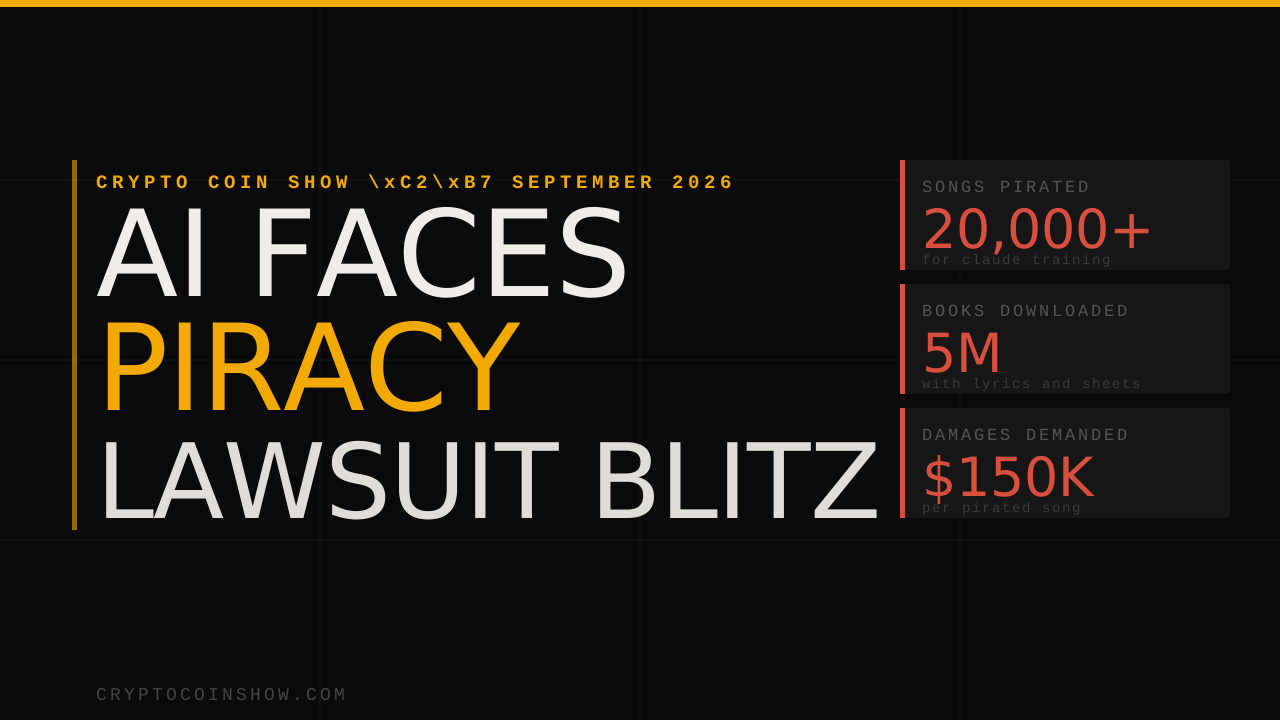
- Sony and Warner allege Anthropic pirated over 20,000 songs to train Claude via BitTorrent, Pirate Library Mirror, and licensed services
- Co-founder Benjamin Mann is named as individual defendant and accused of downloading 5 million pirated books containing lyrics and sheet music
- Plaintiffs seek $150,000 statutory damages per pirated song plus $25,000 per copyright notice stripped, totaling billions across the alleged catalog
- 20,000+ Songs allegedly pirated and used for Claude model training
- $1.5B Settlement Anthropic paid in separate author piracy case decided in 2025
- $150K Statutory damages sought per pirated song under federal copyright law
Sony Music Publishing and Warner Chappell Music filed a federal complaint in Northern California on Friday, August 28, accusing Anthropic of operating what they describe in the 48-page filing as “one of the largest and most blatant ongoing thefts of intellectual property in history.” The lawsuit names not only the company but also CEO Dario Amodei and co-founder Benjamin Mann as individual defendants.
The core allegation is that Anthropic obtained over 20,000 copyrighted songs through illegal means and fed them into the training data for Claude, Anthropic’s flagship conversational AI model, without authorization or compensation to the rights holders.
The specific methods of acquisition matter greatly here. According to the complaint, Mann personally obtained more than five million pirated books using BitTorrent technology, while Anthropic employees pulled down an additional two million books from Pirate Library Mirror, a notorious file-sharing platform. These materials contained song lyrics and sheet music alongside text.
The company also obtained licensed lyrics directly from MusixMatch and LyricFind, both commercial services that operate under licensing agreements and compensate record labels for content access. The plaintiffs argue this dual approach demonstrates Anthropic’s knowledge of the legal distinction between licensed and unlicensed sources, yet proceeded with the latter anyway.
The suit catalogs specific commercial recordings allegedly included in the pirated dataset: Mariah Carey’s “All I Want for Christmas is You,” Taylor Swift’s “Paper Rings,” Marvin Gaye and Tammi Terrell’s “Ain’t No Mountain High Enough,” Bon Jovi’s “Livin’ on a Prayer,” Earth, Wind & Fire’s “September,” and Leonard Cohen’s “Hallelujah.”
Prior court ruling on fair use establishes the precedent now haunting Anthropic
This lawsuit arrives in the context of a recent and closely watched ruling that reshapes how courts view AI model training and copyright.
Earlier in 2025, a federal judge determined that training an AI model on copyrighted material can qualify as fair use under U.S. copyright law, a decision that sent waves through the AI industry and appeared to offer legal cover for large language model developers.
That same judge, however, added a critical caveat: obtaining the copyrighted works from pirated sources does not enjoy fair use protection, even if the downstream use of the material in AI training might.
Anthropic itself was the defendant in that case, brought by authors alleging that copyrighted books were used to train Claude. The company settled for $1.5 billion, a settlement figure that reflected both the scale of the alleged infringement and the judge’s mixed ruling on fair use doctrine.
Now Sony and Warner are invoking that same precedent in their music copyright complaint, arguing that Anthropic’s pattern of piracy demonstrates the company has not altered its behavior despite the earlier judgment and settlement.
The plaintiffs specifically reference the judge’s finding in their filing, claiming Anthropic’s business model remains “built on copyright theft” rather than licensed or legitimately sourced training data.
The legal distinction cuts to the heart of institutional risk for Anthropic: fair use may shield AI training methodology, but it does not shield piracy.
Statutory damages framework creates exposure in the billions across the alleged song catalog
Federal copyright law permits rights holders to seek statutory damages without proving actual financial loss, a provision that dramatically increases the financial exposure for companies accused of large-scale piracy.
Sony and Warner are seeking $150,000 in statutory damages for each pirated song and an additional $25,000 for each instance where copyright information was stripped or removed from a work. Across an alleged catalog of over 20,000 songs, the combined exposure reaches into the billions of dollars.
Notably, this is not a damages calculation based on lost licensing revenue or market harm; it is a per-work statutory penalty that assumes willful infringement.
The plaintiffs have explicitly requested a jury trial, a choice that matters tactically. Jury verdicts in copyright cases involving major entertainment companies often reflect broader cultural and moral judgments about piracy, not merely technical legal analysis.
The fact that Anthropic is simultaneously managing a $1.5 billion settlement from a related copyright case, brought by a different group of rights holders, undercuts any argument that the company faced genuine uncertainty about the legal implications of sourcing training data from pirated material.
Sony and Warner’s decision to name Amodei and Mann as individual defendants is also significant. Individual liability exposure can affect executive behavior and board-level decision-making in ways that corporate-only liability may not.
For institutional investors evaluating Anthropic’s risk profile, the stacking of two major copyright settlements in the same calendar year, plus ongoing litigation from other content creators, raises questions about whether the company’s compliance infrastructure around data sourcing meets institutional standards.
Broader pattern of AI copyright litigation tests regulatory and market patience
Anthropic is far from alone in facing copyright litigation tied to AI model training. OpenAI, Meta, Google, and other major AI labs have all been named as defendants in separate copyright suits brought by authors, visual artists, journalists, and now music publishers.
The cumulative effect of this litigation wave is to establish a legal and factual record of how AI companies sourced training data, what they knew about the legality of those sources, and whether they made good-faith efforts to license or obtain consent where required.
The music industry’s decision to pursue Anthropic alongside earlier suits by the Authors Guild and other groups suggests a coordinated strategy among major rights holders to establish clear precedent that AI companies cannot treat copyright piracy as a cost of doing business.
Each successful suit or settlement raises the legal standard for competitors and forces subsequent entrants into the AI market to justify their data sourcing methods more rigorously. Institutional investors in the AI sector should expect this litigation to continue and to inform future licensing negotiations between AI companies and content providers.
For Anthropic specifically, the back-to-back copyright exposure creates a compounding problem. The company must now defend both its data sourcing methodology and its individual executives in federal court while simultaneously managing the integration of the $1.5 billion author settlement into its financial and operational planning.
Regulatory bodies, including the European Commission and potential U.S. legislative action on AI governance, are also watching these cases closely as they develop policies around AI training transparency and data provenance.
The case is set for jury trial in Northern California federal court; no trial date has been announced. The key open question for institutional observers is whether a jury will treat the prior $1.5 billion settlement as evidence of a knowing pattern or as a good-faith resolution that should reduce exposure in the music case. Sony and Warner’s explicit invocation of the judge’s prior ruling suggests they expect a court to view Anthropic’s behavior as escalated misconduct rather than isolated infringement, a framing that could significantly affect both verdict and settlement dynamics.