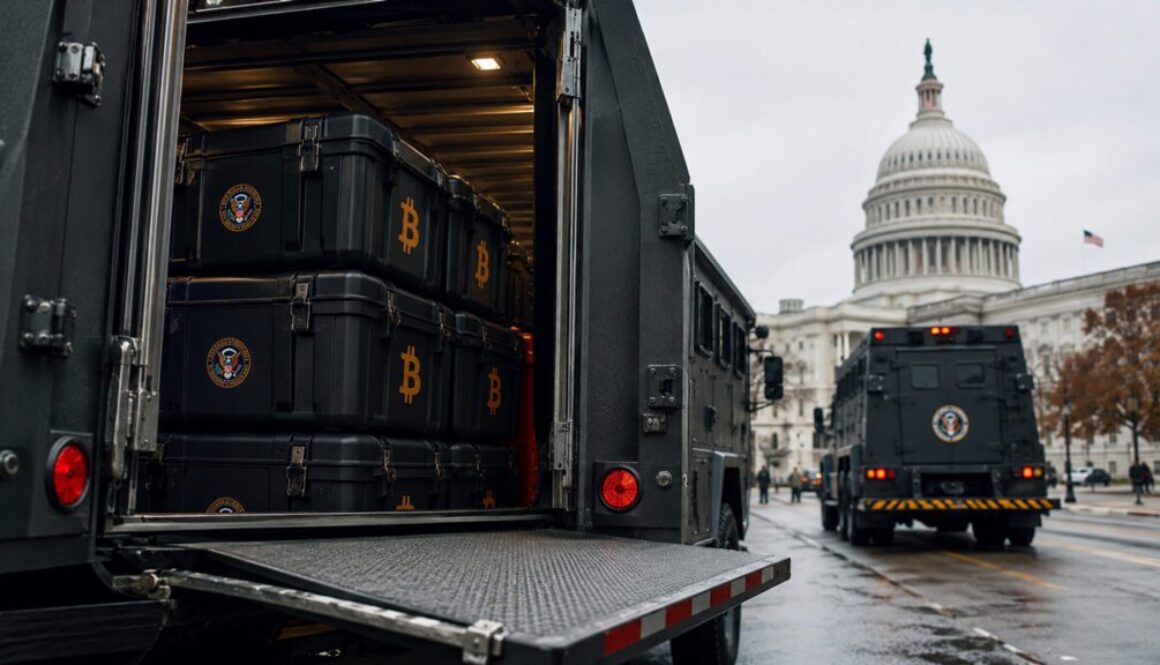
A renewed push to solidify the United States’ foothold in the digital asset market emerged Thursday as lawmakers unveiled legislation to establish a formal strategic Bitcoin reserve and consolidate the federal government’s multibillion-dollar cryptocurrency stockpile.
Spearheaded by Representative Nick Begich, the American Reserve Modernization Act (ARMA) of 2026 mandates the creation of a secure Bitcoin reserve within the US Department of the Treasury, alongside a separate “Digital Asset Stockpile” for federally held, non-Bitcoin cryptocurrencies.
The legislation aims to provide a long-term structure to the government’s existing digital wealth, primarily amassed through law enforcement seizures. According to data from Bitcoin Treasuries, the US currently holds 328,372 Bitcoin, a stash valued at more than $25 billion.
US Government’s Bitcoin Holdings (Source: Bitcoin Treasuries)
“The American Reserve Modernization Act positions the United States to lead confidently in the digital age while protecting taxpayer interests, strengthening financial sovereignty, and reinforcing the principles of transparency and sound stewardship.”
The bill has 17 original House co-sponsors, including Buddy Carter, Ben Cline of Virginia, Barry Moore of Alabama, Burgess Owens of Utah, Mariannette Miller-Meeks of Iowa, Mike Carey and Michael Rulli of Ohio, Mike Collins of Georgia, Mike Lawler of New York, Riley Moore of West Virginia, and Tim Moore of North Carolina.
Apart from the strong legislative support, crypto industry leaders are already throwing their weight behind the measure.
Matt Cole, CEO of Bitcoin treasury firm Strive, called the proposal “the single most important crypto legislation that can come out of D.C.” for the long-term health and security of the United States.
ARMA establishes a 20-year Bitcoin bet
If enacted, the bill would radically alter how Washington handles digital assets. Rather than periodically auctioning off seized crypto, the Treasury would be forced to consolidate custody and oversight across all federal agencies.
Crucially, the legislation requires that any Bitcoin held in the strategic reserve be maintained for at least 20 years, effectively turning the US government into a long-term “hodler.”
To address persistent industry demands for transparency, the bill establishes stringent reporting measures. The Treasury would be required to publish quarterly public “Proof of Reserve” reports, submit to independent third-party audits, and face direct congressional oversight.
The legislation also directs a study into budget-neutral acquisition strategies. The goal is to evaluate lawful methods for the government to expand its digital reserves without relying on tax increases, deficit spending, or adding to the national debt.
Furthermore, the bill offers an olive branch to crypto advocates by explicitly protecting self-custody rights, affirming that the federal government may not impair Americans’ lawful right to own, transfer, or independently secure their digital assets.
Last year, Sen. Cynthia Lummis proposed the BITCOIN Act, which would require the United States to acquire 1 million Bitcoin over five years, hold the assets for at least 20 years, and distribute storage across secure sites nationwide.
The bill also includes a financing mechanism tied to Federal Reserve gold certificates, a structure that would make the proposal a direct bet on converting part of the federal balance sheet into Bitcoin exposure.
However, these initiatives have considerably stalled despite the Trump administration’s pro-crypto stance.
Still, the Begich bill aims to build on the recent advancement of the Clarity Act, which passed the Senate Banking Committee with bipartisan support. That bill is designed to establish clear rules of the road for the industry and encourage institutional investment.
The US Treasury now accepts PayPal and Venmo for voluntary public debt contributions through its Pay.gov form. The update arrives as a Strategic Bitcoin Reserve bill targeting the same fiscal problem stalls in Congress.
Donations average roughly $120,000 a month against a $39 trillion total. Interest payments alone run near $88 billion a month, dwarfing any voluntary inflow.
A 64-Year-Old Program Meets Viral Attention
The “Gifts to Reduce the Public Debt” program has operated since 1961 under 31 U.S.C. § 3113. Treasury data show cumulative donations of about $67 million since 1996, with February 2026 inflows near $30,000.
US Treasury Adds Venmo for Debt Donations. Source: Pay.gov
Amid growing US debt. Senator Rand Paul has pushed his Six Penny Plan. The proposal would trim six cents from every federal dollar over five years.
“I introduced the Six Penny Plan because the answer to our debt crisis isn’t complicated. Cut six cents off every dollar. Balance the budget in five years. Protect your children’s future. The only thing standing in the way is Washington’s refusal to live within its means,” he stated.
Strategic Bitcoin Reserve as the alternative
Bitcoin (BTC) advocates contrast the donation program with active proposals to build sovereign crypto holdings. The BITCOIN Act of 2025 was introduced by Senator Cynthia Lummis. It would direct the purchase of 1 million BTC over five years.
US Bitcoin Reserve Value/National Debt Value in 2049. Source: VanEck
“Assuming today’s $900 trillion of total global financial assets compound at 7.0% from 2025 – 2049, Bitcoin would represent 18% of global financial assets in this scenario,” the firm added.
The bill remains stuck in committee. Lummis announced in December 2025 she will not seek reelection.
The current outlook leaves taxpayers with two contrasting tools. Voluntary digital gifts sit on one side, while a stalled legislative push for fixed-supply reserves sits on the other.
America holds roughly 38% of global Bitcoin mining capacity, and the specialized hardware powering that position comes overwhelmingly from Chinese manufacturers.
Senators Bill Cassidy and Cynthia Lummis introduced the Mined in America Act on Mar. 30 to address that gap, proposing certification, domestic manufacturing support, and the codification of President Donald Trump’s Strategic Bitcoin Reserve to begin unwinding a foreign hardware dependence they frame as a national industrial vulnerability.
Both data points describe the same supply-chain gap: American mining operations running on machines supplied by Chinese manufacturers. That combination of leading the world in an activity while relying on adversary-linked manufacturers for the machines that enable it is the argument the bill puts into legislative form.
A bar chart contrasting the US share of global Bitcoin mining capacity at 37.5% against China-origin hardware’s 97% share of mining equipment supply.
The bill proposes a voluntary “Mined in America” certification administered by Commerce. Certified facilities would phase out mining hardware linked to foreign adversaries.
NIST and the Manufacturing Extension Partnership would support domestic hardware manufacturing by drawing on existing federal energy and rural programs. Cassidy’s office says the bill operates within current program authorities.
The bill would also write the Strategic Bitcoin Reserve into statute. Trump’s March 2025 executive order created the reserve using forfeited government Bitcoin and specified that any additional acquisition strategies must be budget neutral, imposing no incremental taxpayer cost.
Moving the reserve from executive action to law would give it legislative standing beyond a single administration and, for the first time, bind the hardware-sourcing argument to a federal balance sheet instrument.
The Mined in America Act rests on a specific argument: owning the activity layer while ceding the hardware layer to foreign-origin manufacturers leaves the US exposed upstream.
The bill’s answer spans certification, manufacturing support, and reserve codification, three policy levers that together frame Bitcoin mining as a sector deserving the same upstream attention Washington gives to semiconductors or critical minerals.
Why Washington got here
Reuters reported that US authorities began seizing some Chinese-made mining equipment at ports in late 2024 on FCC and Customs enforcement grounds, before releasing some of it in March 2025.
Those seizures gave the hardware dependence argument concrete, documented weight.
The port-level friction raised a question that the bill now codifies in law: if Chinese-origin mining gear can be caught by customs enforcement, what does that mean for an industry whose hardware stack now connects directly to Treasury reserve policy?
For the bill’s backers, the episode turned that question from theory into documented enforcement history.
Mining economics made the supply chain exposure more consequential. A CoinShares report puts network hash price in the $30 to $35 per petahash per day range, with roughly 15% to 20% of the global fleet operating at a loss at those levels.
Hardware supply disruptions land harder when the hash price environment already squeezes margins, with operators unable to quickly source replacement machines facing real operational exposure from a customs hold or tariff escalation.
The SEC released guidance on Mar. 17 clarifying the treatment of protocol mining and other crypto activities. A July 2025 White House digital assets report directed Congress and regulators to support US digital asset leadership.
Washington now treats crypto infrastructure as an industrial-policy category, and the Mined in America Act arrives as the hardware-sourcing component of that reorientation.
Date
Event
Why it mattered
Late 2024
U.S. authorities began seizing some Chinese-made mining equipment at ports
Turned hardware dependence from a theoretical concern into a real enforcement issue
March 2025
Some of the seized mining equipment began to be released
Showed the issue was active and operational, not a one-off headline
March 2025
Trump’s executive order created the Strategic Bitcoin Reserve
Elevated Bitcoin from a market topic to a federal policy and Treasury issue
July 2025
White House digital assets report backed U.S. digital-asset leadership
Placed crypto infrastructure within a broader national competitiveness agenda
March 17, 2026
SEC released guidance on protocol mining and other crypto activities
Signaled a more formal federal posture toward crypto infrastructure
March 30, 2026
Cassidy and Lummis introduced the Mined in America Act
Put the mining-hardware supply-chain issue into legislative form
The bill’s logic runs through the same channel as semiconductor policy, battery manufacturing, or telecom equipment: who controls the machines behind a compute-intensive infrastructure that now touches power markets and the Federal Reserve.
The harder question the bill raises is what “American” hardware actually means. Reports noted that Chinese-origin manufacturers have already begun establishing US production footholds, in part to navigate tariffs, while US-based Auradine has been promoting its products and policy case for domestically designed ASICs.
Assembly in America and design-plus-component-sourcing in America produce different supply chain outcomes, and the bill’s certification framework will eventually have to define which one earns the label.
What this bill represents
The Mined in America Act drawing broad Republican support and the White House folding it into a combined reserve-protection and manufacturing plank represents the bull case.
Domestic and domestically assembled rig capacity expands enough to capture meaningful orders from certified facilities.
The US holds its high-30s share of global hash rate while reducing upstream concentration risk, and Bitcoin mining joins semiconductors and critical minerals as a named category in US industrial policy.
In this scenario, Auradine and potential new entrants capture orders that currently go abroad.
In the bear case, the legislation stalls. “Mined in America” functions as a certification brand with limited uptake, and miners continue buying from Chinese-origin vendors because price, performance, and availability dominate purchasing decisions.
Test area
Bull case
Bear case
Domestic mining hardware capacity
U.S. and domestically assembled rig supply expands enough to win meaningful orders
Domestic capacity stays too limited to shift buying patterns
Certified facility uptake
Miners adopt “Mined in America” certification in meaningful numbers
Certification becomes mostly symbolic with limited market uptake
U.S. hash-rate position
U.S. keeps its high-30s share of global mining while reducing hardware dependence
U.S. maintains mining share but remains exposed to foreign hardware supply
Dependence on Chinese-origin vendors
Operators diversify away from dominant Chinese-origin manufacturers
Price, performance, and availability keep miners buying from the same vendors
Auradine and potential new entrants
U.S.-based suppliers capture orders that previously went abroad
New entrants struggle to compete on cost and scale
Strategic Bitcoin Reserve relevance
Reserve policy and mining hardware policy become part of one industrial strategy
Reserve codification remains mostly separate from the actual hardware bottleneck
Broader policy meaning
Bitcoin mining joins semiconductors and critical minerals as a named industrial-policy category
The bill stands mainly as a statement of vulnerability rather than a reshoring success
Bottom line
America converts mining leadership into upstream supply-chain resilience
America continues leading in mining activity without controlling the machines behind it
Washington’s policy ambitions outpace its industrial capacity to execute them, and the bill serves as a documented statement of vulnerability that the domestic manufacturing base has yet to answer.
The bill’s introduction puts the supply chain gap in Bitcoin’s hardware layer onto the Senate’s legislative record.
The BITCOIN Act Would Buy 1 Million Bitcoin. Here’s How It’s Funded. | CCS
Legislation ExplainedCCS Exclusive
29 March 2026 · 6 min read
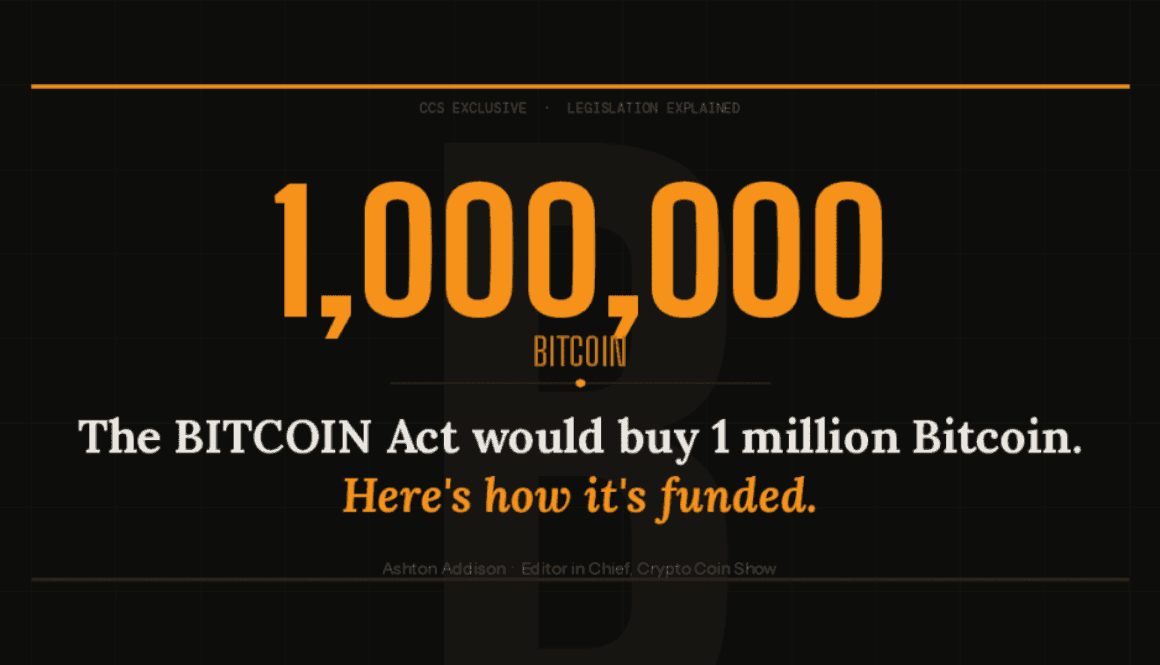
The BITCOIN Act would buy 1 million Bitcoin. Here’s how it’s funded.
AA
Ashton Addison · Editor in Chief, Crypto Coin Show|29 March 2026
Senator Cynthia Lummis has spent years making the case that the U.S. government should buy one million Bitcoin. She finally has a White House that agrees. Now she has to get it through Congress — before January 2027, when she walks out the door for good.
A bill twelve years in the making
She has held Bitcoin since 2013. She wore a Bitcoin lapel pin to the Senate floor. And on a March morning in Washington D.C., she walked onto a stage at the Bitcoin Policy Institute flanked by Michael Saylor and declared — for the second time in eight months — that the United States must buy one million Bitcoin.
That was 11 March 2025. Senator Cynthia Lummis of Wyoming was reintroducing the BITCOIN Act — formally, the Boosting Innovation, Technology, and Competitiveness through Optimized Investment Nationwide Act — and the political conditions had shifted more dramatically in twelve months than in the previous twelve years.
President Trump had signed an executive order that same week formalising a Strategic Bitcoin Reserve, funded by seized assets. David Sacks, his crypto policy advisor, was in the room. The bill had five Republican co-sponsors: Senators Jim Justice, Tommy Tuberville, Roger Marshall, Marsha Blackburn, and Bernie Moreno. Congressman Nick Begich of Alaska had introduced a companion bill in the House. What it still did not have — and still does not — is a path to the Senate floor.
Analysis
The most ambitious reserve proposal in U.S. history
The BITCOIN Act would direct the U.S. Treasury to acquire 200,000 Bitcoin per year over five years, reaching one million Bitcoin by 2029 — approximately five percent of the total supply that will ever exist, accumulated by a single sovereign entity. All of it locked by statute for a minimum of 20 years, with the only exception being targeted sales to reduce the national debt.
The funding mechanism is arguably the bill’s most audacious feature. Lummis argues it requires no new taxpayer spending whatsoever, drawing instead on two existing pools of capital.
Funding source 1
Federal Reserve remittances
The first $6 billion of annual Fed remittances between 2025 and 2029 are redirected into the Bitcoin Purchase Program — existing government cashflows, not new appropriations.
Funding source 2
Gold certificate revaluation
The Fed’s gold certificates have sat at a statutory $42.22 per troy ounce since 1973. Marking them to current market value — over 60 times higher — unlocks an enormous unrealised capital pool.
Structure
Decentralised secure reserve
A network of geographically distributed secure facilities across the United States. States may voluntarily store their own Bitcoin in segregated accounts within the same reserve.
Transparency
Quarterly proof of reserves
The Treasury Secretary must publish quarterly public reports with cryptographically verifiable proof of ownership — a provision unique to Bitcoin’s on-chain architecture.
Section 7 of the bill explicitly codifies the right of individual Americans to hold Bitcoin in private wallets, free from government interference. A federal law that simultaneously builds a government reserve and enshrines self-custody as a protected right is an unusual combination. It is also a deliberate one. Lummis has been direct: “I’m a big proponent of self-custody, of individual wallets, of the sovereignty I have to store my wealth.”
“Bitcoin is not simply a technological opportunity, but a national imperative for America’s continued financial leadership in the 21st century.”
— Senator Cynthia Lummis, Chair, Senate Banking Subcommittee on Digital Assets
The Story
From obscure proposal to White House priority
When Lummis first introduced the BITCOIN Act in July 2024, the Bitcoin community cheered and almost everyone else dismissed it. Limited bipartisan appetite, a disinterested White House, and a Senate Banking Committee with no urgency on crypto meant it went nowhere.
A lot changed in twelve months. Trump signed his executive order in March 2025, formalising a Strategic Bitcoin Reserve funded by existing criminal forfeitures — roughly 200,000 Bitcoin accumulated through federal seizures. The order stopped short of new acquisitions, but it was the clearest possible political signal. David Bailey, CEO of BTC Inc, captured the logic: “The executive action clears the political lane and tells Congress this is a priority.”
As of early 2026, the United States holds an estimated 328,372 Bitcoin — the world’s largest state holder. Treasury Secretary Scott Bessent reaffirmed at the World Economic Forum in Davos that the administration is actively pursuing budget-neutral ways to expand that stockpile beyond forfeitures. The question is no longer whether the White House wants a larger reserve. The question is whether Congress will write it into law.
Proponents point to VanEck’s modelling: held to 2049, the reserve could be worth $42.4 trillion. Lummis frames it in terms her Wyoming constituents understand — a way to address the national debt without raising taxes or printing money, while ensuring America is not outpaced by adversaries quietly accumulating digital assets.
Skeptics raise harder questions. Bitcoin’s volatility makes it a risky line item on a national balance sheet. Senate Democrats have shown little appetite for a bill of this scale in an asset they consider speculative. And Trump’s executive order already delivered the political symbolism without the financial exposure — the case for going much further remains genuinely contested, even within the Republican caucus. The bill sits in the Senate Banking Committee. It has not come to a floor vote.
What It Means
A clock running out on a senator who started early
In December 2025, Lummis announced she will not seek reelection. It was a quiet announcement from a senator who has never been quiet about Bitcoin — and it put a hard deadline on everything she still wants to accomplish.
Her portfolio is significant. She co-sponsored the GENIUS Act — signed into law in July 2025 as the first federal stablecoin legislation in U.S. history. She introduced a de minimis tax exemption bill for small Bitcoin transactions, pressing Treasury Secretary Bessent on it as recently as February 2026, with Bessent committing his Office of Tax Policy to work directly with her team. She has predicted the CLARITY Act market structure legislation should advance out of the Senate Banking Committee by late April 2026.
She will speak at Bitcoin 2026 at The Venetian in Las Vegas, 27–29 April — one of her last major public stages as a sitting senator, with the BITCOIN Act still unresolved. The BITCOIN Act, the CLARITY Act, and the stablecoin framework she co-sponsored are all in motion simultaneously — a legislative trifecta that, if any meaningful part clears the Senate in the coming months, would represent one of the most consequential individual contributions to crypto policy any U.S. lawmaker has ever made.
What to watch
Senate Banking Committee: The BITCOIN Act sits in committee. Watch for any markup session scheduling — that is the first real signal of movement.
CLARITY Act timeline: Lummis predicted late April 2026 for committee advancement. Movement there could create momentum for the broader crypto legislative agenda.
Bitcoin 2026 — 27–29 April, Las Vegas: Lummis is confirmed. Expect a policy update on the BITCOIN Act and what the final stretch of her Senate term looks like.
Treasury rulemaking: Bessent’s “budget-neutral” language at Davos signals executive interest in expanding the reserve beyond seized assets — even without Congress acting.
State-level reserves: Texas, New Hampshire, and Arizona have already passed or advanced state Bitcoin reserve legislation. If the federal bill stalls, state action accelerates regardless.
Related reading
The BITCOIN Act sits alongside the GENIUS Act — already signed into law — as part of the broader push to establish U.S. digital asset leadership. For the full breakdown of the stablecoin law Lummis co-sponsored, see the CCS GENIUS Act reference page.
Whether the BITCOIN Act becomes law on her watch or becomes the blueprint someone else eventually carries across the finish line, Cynthia Lummis has already changed the terms of the conversation. A sitting U.S. senator who bought Bitcoin in 2013, wore the lapel pin to the Senate floor, and spent a decade writing the legislation — that is not a character the political establishment produced. It’s one that produced itself.
CCS Exclusive · Legislation Explained · 29 March 2026
North Carolina Moves to Stack Sats: Senate Bill 327 Would Create State Bitcoin Reserve | Crypto Coin Show
State Bitcoin Legislation · March 20, 2026
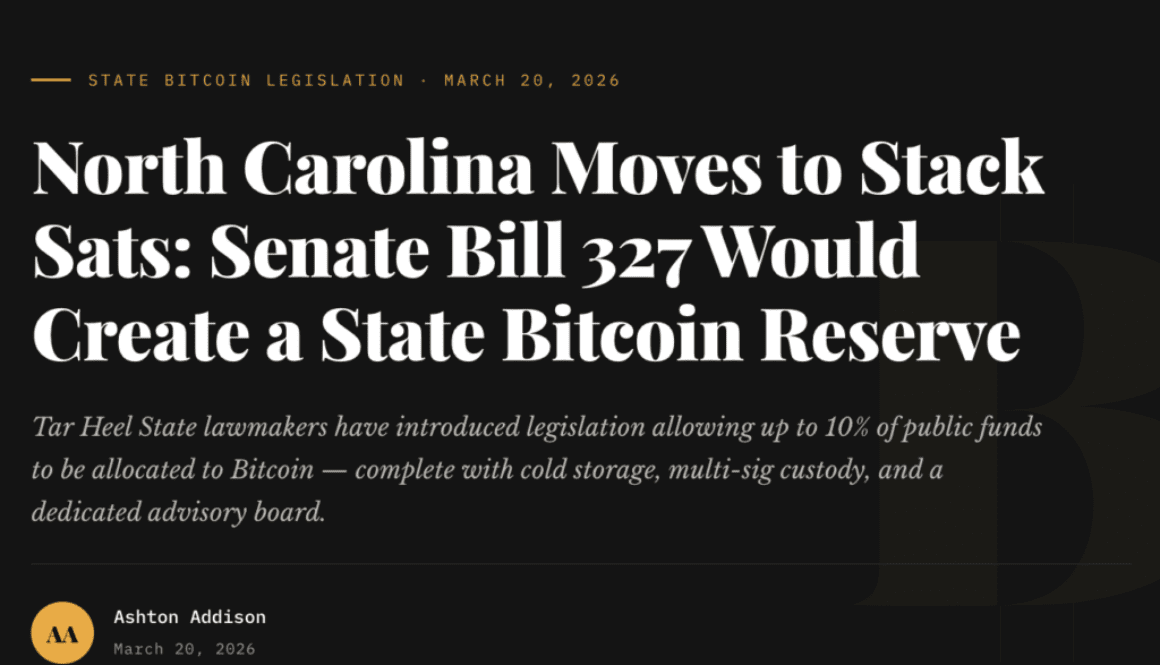
North Carolina Moves to Stack Sats: Senate Bill 327 Would Create a State Bitcoin Reserve
Tar Heel State lawmakers have introduced legislation allowing up to 10% of public funds to be allocated to Bitcoin — complete with cold storage, multi-sig custody, and a dedicated advisory board.
AA
Ashton Addison
March 20, 2026
North Carolina’s General Assembly took a significant step toward digital asset adoption this week, with the introduction of Senate Bill 327 — the North Carolina Bitcoin Reserve and Investment Act — which would authorize the state Treasurer to allocate up to 10% of public funds into Bitcoin as a long-term financial strategy.
The bill, sponsored by Senators Johnson and Overcash, passed its first Senate reading and was referred to the Rules and Operations Committee. If enacted, it would establish a formal Strategic Bitcoin Reserve for the state, positioning North Carolina as a leader in government-level crypto adoption.
📋 Quick Facts — Senate Bill 327
Bill Name
NC Bitcoin Reserve & Investment Act
Bill Number
Senate Bill 327
Sponsors
Senators Johnson & Overcash
Max Allocation
10% of Public Funds
Current Status
Passed 1st Reading → Rules Committee
Liquidation Threshold
⅔ Both Chambers Required
Reporting Cadence
Monthly Audits + Quarterly Reports
⚡ Senate Bill 327 — Key Provisions
Up to 10% of public funds may be allocated to Bitcoin by the Office of the State Treasurer
Holdings to be secured in cold storage wallets with multi-signature authentication
A dedicated new department within the Treasurer’s office will take custody of assets
A Bitcoin Economic Advisory Board of industry experts will provide guidance
Monthly audits to verify reserve balances, security, and performance
Acquisitions through regulated U.S.-based exchanges, timed to market conditions
Treasurer to explore Bitcoin mining operations as a supplementary acquisition method
Any BTC liquidation requires two-thirds approval from both chambers of the General Assembly
Quarterly public reports posted to the Treasurer’s website detailing reserve status and value
What the Reserve Can — and Cannot — Do
The bill doesn’t just authorize Bitcoin purchases — it carefully delineates when and how the reserve may be deployed. Usage would be restricted to severe financial crises, approved investment strategies, critical infrastructure and economic development projects, and support for Bitcoin-related research, education, and business incentive programs.
Importantly, the reserve could also serve as collateral to back bonds as an alternative financing mechanism for public projects — a novel approach that, if successful, could give North Carolina a lower-cost route to public financing as its Bitcoin holdings potentially appreciate over time.
“Any liquidation of BTC would require approval from at least two-thirds of both chambers of the General Assembly — a high bar designed to prevent short-term political pressures from forcing premature sales.”
Purchases would be conducted through regulated, U.S.-based exchanges, with bulk acquisitions timed strategically to take advantage of market conditions. The bill also directs the Treasurer to explore whether Bitcoin mining operations could provide an additional pathway to grow state holdings without market purchases.
10%Maximum allocation of North Carolina public funds that could flow into Bitcoin under SB 327
A Growing Trend Across the States
North Carolina joins a rapidly expanding list of U.S. states exploring Bitcoin as part of their treasury strategy. The national picture is now clearly three-tiered: states that have already enacted reserve legislation, those actively working to pass bills, and those where proposals have stalled or been rejected.
Texas, New Hampshire, and Arizona have already enacted laws allowing a portion of state funds to be allocated to Bitcoin. A larger cohort — Maryland, Iowa, Kentucky, Michigan, South Dakota, Illinois, Tennessee, Missouri, and now North Carolina — have active legislation working through their respective legislatures.
Meanwhile, proposals in Oklahoma, Utah, and Pennsylvania remain in committee, and bills in Wyoming, Montana, and Florida have either stalled or been voted down outright. The divergence reflects differing attitudes toward digital assets at the state level, though momentum is clearly building in the pro-reserve camp.
The CCS Take
Senate Bill 327 is one of the more structurally sophisticated state Bitcoin reserve proposals we’ve seen. The combination of cold storage mandates, multi-signature authentication, an independent advisory board, monthly audits, and a supermajority requirement for any liquidation suggests North Carolina’s legislators have studied the landscape carefully and are designing for long-term stewardship rather than a short-term political stunt.
The exploration of Bitcoin mining as an acquisition mechanism is particularly interesting — it’s a path that could allow the state to accumulate BTC while also potentially generating economic activity and energy-sector jobs within its borders.
Whether SB 327 clears the Rules and Operations Committee and makes it to a floor vote remains to be seen. But its passage through a first reading is a meaningful signal that state-level Bitcoin adoption is no longer a fringe conversation — it’s becoming mainstream policy.
Watch this space. CCS will continue covering SB 327 as it moves through the North Carolina legislature.
Get weekly blockchain insights delivered to your inbox via the CCS Insider newsletter.