Sen. Warren has requested documents about communications between Bitmain, Eric Trump, Donald Trump Jr., and Commerce officials
Senator Elizabeth Warren has demanded Commerce Department records of communications between Bitmain, members of the Trump family, and federal officials, widening congressional scrutiny of potential conflicts of interest in crypto policy. The request follows a Department of Homeland Security investigation into whether Bitmain’s mining hardware poses espionage or infrastructure risks to the United States.
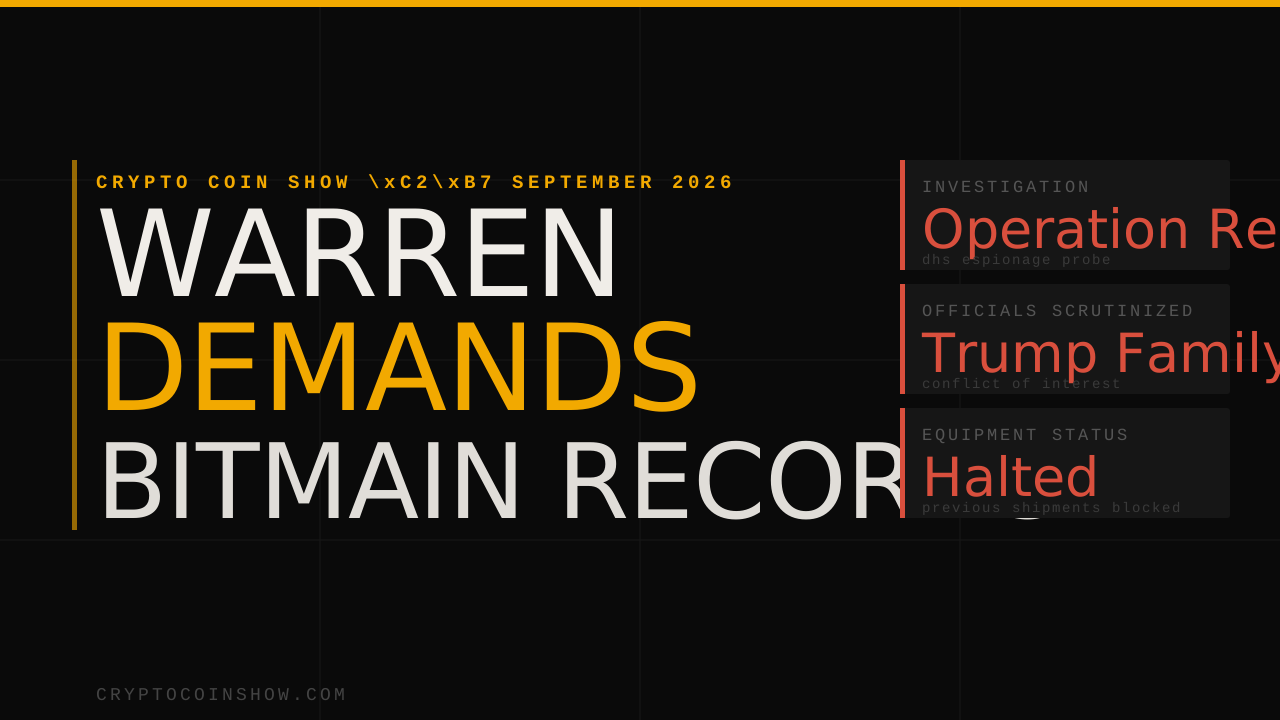
- Senator Warren requested Commerce Department records on Bitmain communications with Eric Trump and Donald Trump Jr.
- DHS launched “Operation Red Sun” to examine whether Bitmain ASIC miners could enable remote espionage or disrupt U.S. power grids.
- Previous Bitmain equipment shipments have been halted; mining machines near U.S. military bases flagged as national security concern.
- $1B Revenue claimed by Trump family from crypto ventures in recent public statements
- April 10 Deadline for Kansas City Federal Reserve to respond to Rep. Waters inquiry
- 2025 Year DHS launched Operation Red Sun investigation into Bitmain hardware risks
Congressional pressure on crypto policy is intensifying on multiple fronts, with two separate investigations now targeting potential conflicts of interest and national security vulnerabilities in the digital asset ecosystem.
Senator Elizabeth Warren’s demand for Bitmain communications records represents an unprecedented scrutiny of a major hardware manufacturer’s relationship with U.S. policymakers and members of a politically prominent family.
The inquiry arrives against a backdrop of heightened concern over foreign technology embedded in critical U.S. infrastructure, particularly as crypto mining operations expand their footprint nationwide and near sensitive military installations.
Warren demands transparency on Bitmain’s undisclosed ties to Trump family and Commerce Department
Senator Warren has specifically requested that the Commerce Department produce all records documenting communications between Bitmain and Eric Trump and Donald Trump Jr., as well as all exchanges between the company and Commerce Department officials.
The senator also asked the agency to detail what steps it has taken to ensure that national security decisions remain insulated from firms with business ties to the Trump family. This represents an explicit concern that commercial interests may be influencing federal policy on technology procurement and security vetting.
The timing of Warren’s request is significant. Eric Trump claimed publicly in late 2024 that the Trump family’s cryptocurrency ventures have generated over $1 billion in revenue, raising questions about the scale and nature of those business interests at the precise moment when Trump family members may have influence over federal technology policy.
Warren’s demand for transparency suggests concern that undisclosed financial stakes could create incentives misaligned with national security. The Commerce Department has not yet publicly disclosed the existence or contents of such communications.
Warren’s inquiry is narrower than a traditional investigation but carries institutional weight through the Senate. By requesting documentary evidence rather than initiating a formal hearing, she is establishing a record and forcing the Commerce Department to either produce materials or formally refuse disclosure, either of which has political consequences.
The request implicitly questions whether existing ethics rules and conflict-of-interest protocols are adequate to manage the overlap between wealthy businesspeople with crypto holdings and those advising on technology policy.
DHS launches Operation Red Sun to assess espionage and grid-disruption risks from Bitmain hardware
The Department of Homeland Security has launched a classified investigation codenamed “Operation Red Sun” to determine whether Bitmain’s application-specific integrated circuit (ASIC) miners contain backdoors or remote-access capabilities that could enable foreign espionage or attacks on U.S. electrical infrastructure.
This investigation reflects a broader policy concern: as crypto mining becomes increasingly concentrated in specialized hardware and that hardware becomes critical to U.S. power grid stability, the national security implications of foreign-controlled supply chains grow acute.
Previous shipments of Bitmain equipment have been halted at U.S. ports and borders, suggesting that authorities have already identified specific security risks requiring further investigation. The flagging of Bitmain mining machines deployed near U.S. military bases as a significant national security concern indicates that the threat assessment is not theoretical.
Bitmain is a Chinese-headquartered company and the world’s dominant manufacturer of Bitcoin mining hardware, holding an outsized position in global ASIC supply. Any compromise of its products would affect not just private mining operations but potentially the resilience and reliability of networks running military or dual-use infrastructure.
The Operation Red Sun investigation represents standard national security vetting, but its public profile has been elevated by reports that Bitmain equipment has already triggered concern at sensitive installations.
If the investigation finds evidence of intentional backdoors or vulnerability to remote access, it could result in equipment bans, procurement restrictions, or sanctions against Bitmain itself. The investigation’s outcome will likely influence both congressional crypto policy and executive branch decisions on technology supply chain security for years to come.
Rep. Waters separately investigates Kansas City Federal Reserve’s Kraken account approval before policy framework established
Representative Maxine Waters, the ranking Democrat on the House Financial Services Committee, has opened a parallel investigation into the Federal Reserve Bank of Kansas City over its decision to grant Kraken, a major crypto exchange, a “limited-purpose master account” with direct access to Federal Reserve payment systems.
Waters raised the fundamental legal question: neither federal statute nor the Federal Reserve Board’s published Account Access Guidelines explicitly authorizes such accounts, leaving the approval process opaque and the account’s exact privileges undefined.
The Kansas City Fed granted the account to Payward Financial, which operates as Kraken Financial, on an initial one-year term. The regional bank justified the decision as supporting a competitive financial system and reinforcing the stability of Fed payment systems.
However, Waters’ letter to Kansas City Fed President Jeff Schmid requested clarification on whether the account grants Kraken direct access to FedACH, Fedwire, or FedCash services, and whether Kraken faces balance limits, overdraft restrictions, or supervisory requirements beyond Wyoming’s Special Purpose Depository Institution rules.
The absence of clear answers to these questions suggests that the approval may have proceeded without full public documentation of its scope or conditions.
The Bank Policy Institute criticized the approval for occurring before the Federal Reserve had established a formal policy framework governing such accounts, compounding concerns about transparency and risk management.
Waters set an April 10 deadline for the Kansas City Fed to respond to her questions, framing the matter as one of “critical importance to the development and oversight of our financial system.” This investigation addresses a different institutional risk than Operation Red Sun, but it reflects the same underlying concern: that crypto infrastructure is being integrated into critical financial systems without adequate public vetting or disclosed safeguards.
The convergence of these investigations, Warren’s demand for Bitmain-Trump communications, DHS’s Operation Red Sun, and Waters’ Kraken account review, signals that Congress and the executive branch are moving beyond rhetorical skepticism of crypto toward concrete institutional oversight. The April 10 deadline for the Kansas City Fed’s response, the classified status of Operation Red Sun’s findings, and the Commerce Department’s handling of Warren’s document request will all shape whether crypto infrastructure becomes subject to the same security and transparency standards applied to traditional finance, or whether different rules apply. Markets should watch for whether either investigation produces formal recommendations for legislation or regulatory action, and whether the Trump administration’s stated pro-crypto stance influences how aggressively these inquiries proceed.
Original reporting: cryptopolitan.com