Solana treasury company shutters its SOL accelerator as a $27 million quarterly reversal forces deep cuts
DeFi Development Corp., the Solana treasury entity, reported a $27 million net loss in the second quarter and is shuttering its Treasury Accelerator program and cutting costs sharply. The move signals financial strain at a major institutional holder of SOL and raises questions about the sustainability of crypto treasury models as asset prices weaken.
- $27 million net loss in Q2 2025, reversing a $21.194 million gain in Q2 2024
- Treasury Accelerator program closed to new deals; operating expenses cut 22.6% year-over-year
- $3.5 million of convertible debt repurchased at 35% discount since last shareholder update
- $27M Second-quarter net loss, reversing prior-year gain
- 22.6% Year-over-year operating expense reduction to $4.635 million
- 2.31M SOL holdings as of August 12, 2025
DeFi Development Corp., the publicly traded treasury company holding Solana’s native token as a core asset, disclosed a severe financial contraction in its second-quarter shareholder letter dated August 12. The firm reported a $27 million net loss on digital assets, a dramatic reversal from a $21.194 million gain in the same quarter a year prior.
The loss triggered an immediate operational retrenchment: the company closed its Treasury Accelerator program to new investments, signaled further cost cuts beginning in Q3, and accelerated buybacks of its own convertible debt at steep discounts.
For institutional investors monitoring treasury companies as a new asset class, the filing underscores the leverage and volatility embedded in entities that hold crypto as a treasury reserve while managing public equity and debt structures simultaneously.
$27 Million Loss Forces Closure of SOL Accelerator Investment Program
The net loss on digital assets totaled $21.519 million in Q2 2025, according to the shareholder letter, compared to the $21.194 million gain recorded in Q2 2024.
The company did not break out realized versus unrealized components, making it impossible for external analysts to determine whether the loss reflected actual sales or mark-to-market declines on the 2.31 million SOL units held as of August 12. What is clear is that the magnitude of the swing, a roughly $42.7 million adverse turn year-over-year, forced immediate action.
In response, DeFi Development Corp. shut its Treasury Accelerator to new deals. That program had been designed to deploy capital into Solana ecosystem investments and acquisitions, positioning the company as both a treasury holder and an active venture investor. The closure signals that management no longer has the risk appetite or liquidity to pursue new commitments.
Operating expenses fell 22.6% year-over-year to $4.635 million from $5.990 million, demonstrating that cost-cutting began before the Q2 close. Management indicated further reductions would arrive in Q3, though it declined to quantify the expected savings or specify which programs would be affected.
The decision to halt new accelerator investments reflects a broader constraint: treasury companies can only cut so much before core operations suffer.
Convertible Debt Buybacks Deliver $400,000 in Annual Interest Savings
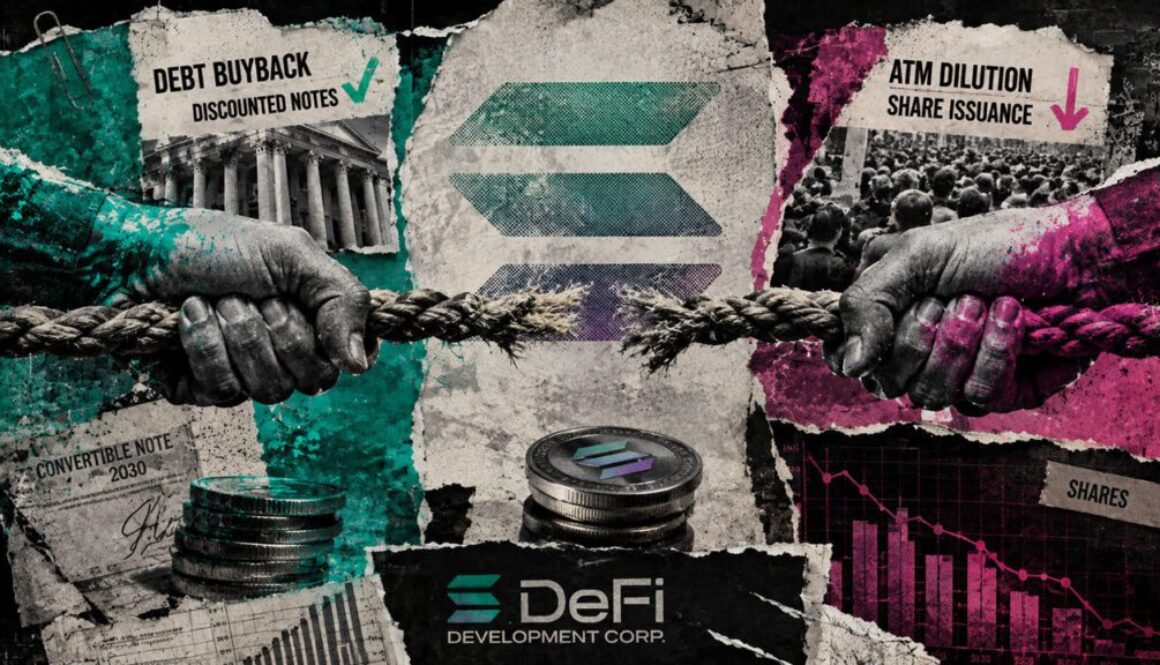
DeFi Development Corp. has pursued an aggressive debt-reduction strategy, repurchasing its own unsecured convertible notes at substantial discounts. Since the previous shareholder update, the company repurchased approximately $3.5 million in principal value of its July 2030 convertible notes for $2.3 million in cash, representing a 35% discount to face value.
Cumulatively, the company has now retired about $7.9 million in principal for $5.0 million in cash, generating estimated annual interest savings above $400,000.
The July 2030 notes carry a 5.5% coupon and are unsecured, with no collateral maintenance clauses or margin-call triggers written into their indenture. That structural detail matters: unlike some treasury company debt, these notes carry no automatic liquidation risk if SOL prices fall or if the company’s asset base shrinks.
The latest repurchase retired $1.2 million more in principal than the cash spent, before transaction costs, while simultaneously reducing the potential dilution from future conversions into equity shares.
However, the debt buyback strategy contains a hidden cost. Beginning in late June, DeFi Development Corp. issued approximately 478,000 shares through its at-the-market (ATM) facility for $1.4 million to cover cash operating costs. Management estimated that issuance reduced SOL per share by approximately 1.4%, offsetting a portion of the benefit gained from retiring debt at a discount.
The company now carries roughly 31.0 million common shares and 43.7 million fully diluted shares outstanding, alongside a 27.351 million weighted-average fully diluted share count for the quarter.
SOL Holdings Rise 24% Per Share Despite $27 Million Loss
As of August 12, DeFi Development Corp. held 2,311,523 SOL and SOL equivalents, up from 0.053 SOL per share a year earlier to 0.066 per share at quarter-end, a 24% increase on a fully-converted basis.
This metric warrants careful interpretation. The 0.066 SOL per share figure assumes full conversion of all convertible debt into equity and is a point-in-time measure, not a GAAP accounting standard. It reflects the company’s accumulated SOL holdings divided by a hypothetical fully-diluted share count.
The per-share increase occurred despite the $27 million net loss because SOL’s price recovered partially during the period, and because the company did not liquidate holdings to cover operating expenses.
The composition of the treasury also matters for risk assessment. The company holds SOL equivalents alongside raw SOL tokens, suggesting exposure to derivative positions, staking arrangements, or other structured holdings. Institutional investors evaluating treasury companies must assess not only the quantity of assets but also the nature and leverage embedded in those holdings.
A company that holds 2.31 million SOL outright faces different risks than one holding the same notional exposure through repo agreements, leveraged positions, or long-dated contracts.
DeFi Development Corp. will report Q3 2025 results later this year, at which point investors should monitor whether announced operating expense reductions materialize, whether the Treasury Accelerator remains closed or reopens, and whether SOL’s price trajectory prevents further convertible debt buybacks or triggers the need for additional share issuance to fund operations.
Treasury Company Leverage Amplifies Solana Price Volatility Into Balance Sheet Losses
DeFi Development Corp.’s $27 million swing from gain to loss in a single year reflects the structural risk of treasury companies that combine cryptocurrency holdings with public debt and equity obligations.
The company held 2.31 million SOL as of August 12, 2025, a position that generates mark-to-market losses when token prices decline but also creates forced selling pressure when balance sheets deteriorate.
By comparison, a traditional corporate treasury holding U.S. Treasury bonds or equities would face minimal quarterly volatility; cryptocurrency treasuries face daily repricing of their primary asset against liabilities denominated in fiat currency.
The Treasury Accelerator program closure is particularly significant because venture deployment typically requires treasury reserves to absorb draw-downs and follow-on commitments over 18 to 36 months. Shuttering new deal flows suggests the company determined that capital preservation under current SOL price conditions takes precedence over growth capital allocation.
This decision parallels moves by other crypto-native treasuries in 2024-2025 that reduced venture commitments as digital asset volatility increased the risk of equity dilution during downturns.
The key variable for institutional creditors and equity holders is whether the 22.6% operating expense reduction and accelerated debt buybacks at 35% discount signal a stabilization plan or a liquidity management exercise ahead of further SOL depreciation. Upcoming quarters will show whether the company’s SOL holdings remain sufficient to support both its equity structure and any remaining venture commitments without triggering a capital raise or debt restructuring.