Hyperliquid (HYPE) has posted an evident recovery throughout April, with its price climbing by 7% since the beginning of the month.
However, one popular analyst warned that the upswing could soon reverse into a double-digit pullback.
Prepare for a Slump?
Over the past few days, HYPE has consolidated around $40, while its market capitalization stands just south of $10 billion. This makes it the 13th-largest cryptocurrency, but according to Ali Martinez, things may change for the worse in the short term. He argued that HYPE has broken out of a rising wedge: a pattern that signals a correction toward $31, or a 22% decline from the current levels.
Another analyst who recently weighed in on the asset’s performance is the X user Ted. Several days ago, he assumed that “big clusters are forming to the downside,” adding that this could result in a short-lived surge to $42-$46, but after that, “the max pain is dump, not pump.”
It is important to note that earlier this week, Hyperliquid’s native token briefly climbed into that range before heading south, so it remains to be seen whether the rest of Ted’s outlook proves accurate.
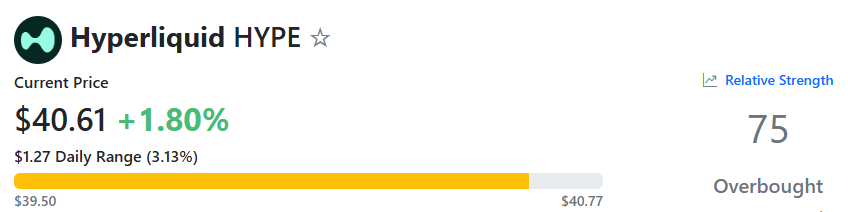
HYPE’s Relative Strength Index (RSI) reinforces the bearish scenario. The technical analysis tool runs from 0 to 100, where anything above 70 signals that the price has soared too much, too quickly, and could be a precursor to a correction. On the contrary, readings below 30 are interpreted as buying opportunities. As of this writing, the RSI stands at around 75.
HYPE RSI, Source: RSI Hunter
How About a Further Rally?
In the meantime, some analysts think that HYPE is poised for much more significant gains soon. The trader, using the X moniker Crypto King, told their nearly 900,000 followers that the price may surpass $50 sometime next month.
“HYPE is respecting every level on this move up. The chart shows a clean stair-step structure with three successful support retests. Each bounce leads to a strong push higher. We’re now sitting on the third retest, looking for a move toward $50,” their analysis reads.
The coin’s recent exchange netflow stands as a clear bullish factor. Data shows that over the past few days, outflows have exceeded inflows, indicating that investors have abandoned centralized platforms and shifted to self-custody methods. This, in turn, reduces immediate selling pressure.
Aave entered April 2026 as DeFi’s largest lending protocol. By mid-month, it was managing the fallout from one of the most damaging exploits in its history — and the on-chain data is now revealing just how deeply the event disrupted the protocol’s core activity.
The incident began at Kelp DAO, where attackers exploited a $293 million vulnerability and used the stolen tokens as collateral on Aave V3. Aave’s smart contracts were never breached — the protocol functioned exactly as designed. However, it could not defend the integrity of the assets it accepted. Fraudulent collateral entered the system. Borrowers used it to take out real assets, and the resulting bad debt triggered a confidence crisis that drove billions in deposits toward the exit within days.
A CryptoQuant report tracking Aave V3 activity in the aftermath has now quantified the impact of that crisis on the protocol’s borrowing market. The data tells a two-chapter story. Borrowing rates across USDT, USDC, and WETH spiked sharply. A reflexive response to sudden liquidity tightening as participants scrambled to adjust positions. Then, almost as quickly, borrowing activity collapsed toward near-zero levels.
That second chapter is the more significant one. Rate spikes during a crisis are expected. The near-complete cessation of borrowing that followed is the signal that requires examination. Because it reflects not just liquidity stress, but a fundamental shift in participant behavior.
The Rate Spike Was the Alarm. The Silence That Followed Is the Story
The CryptoQuant report places the borrowing collapse in a framework that distinguishes shock response from structural breakdown. Rate spikes during liquidity crises are mechanical — when available capital tightens abruptly, the price of borrowing rises immediately as participants compete for shrinking supply. That is what happened in the immediate aftermath of the Kelp DAO exploit. It is expected, it is temporary, and it does not by itself indicate lasting damage.
What followed is less routine. Rather than recovering as rates normalized, borrow event activity across Aave V3 collapsed toward near-zero — a response that reflects participants choosing to step back entirely rather than re-engage once the initial stress passed. Capital that was previously active in Aave’s lending markets has moved into defensive positioning. The protocol’s mechanics are intact. The participants who used them have temporarily left.
The cross-market nature of the contraction makes the signal particularly difficult to dismiss. Stablecoin borrowing weakness reflects reduced appetite for leveraged directional exposure — traders unwilling to borrow against positions. WETH activity falling simultaneously points to the unwinding of more sophisticated strategies: collateral recycling, basis trades, and the layered DeFi positions that require sustained confidence in the underlying protocol to maintain. When both retreat at once, the signal is systemic rather than isolated.
The CryptoQuant assessment is precise about what recovery looks like from here. Borrow event activity returning alongside normalized rates would signal the end of capital preservation mode and the beginning of genuine redeployment. Until that combination appears, the data describes a protocol that has survived the shock structurally but has yet to regain the participant confidence that makes it functionally whole.
AAVE Tests Key Support After Prolonged Downtrend
AAVE is trading near $98 on the weekly chart, attempting to stabilize after a sustained decline from the $350–$380 highs set earlier in the cycle. The structure is clearly bearish on higher timeframes: a sequence of lower highs and lower lows has defined price action for months, with each rally failing beneath declining moving averages.
The recent drop into the $85–$95 zone marks a critical support test. This area aligns with prior consolidation from late 2023 and early 2024, making it a historically relevant demand region. The current bounce is technically constructive, but it remains corrective in nature until proven otherwise.
All major moving averages — 50-week, 100-week, and 200-week — are positioned above price and sloping downward. This creates a stacked resistance structure between roughly $130 and $200, where previous breakdowns occurred. Any recovery attempt will need to reclaim that range to shift the broader trend.
Volume behavior reinforces caution. The sharp selloff phases were accompanied by elevated volume, indicating strong distribution, while the recent rebound has developed on lighter participation.
For now, AAVE is attempting to build a base. Holding above $85 keeps the structure intact. Losing it would likely open the path toward deeper downside.
Featured image from ChatGPT, chart from TradingView.com
After riding the tap-to-earn wave and crashing dramatically, TON is making a strategic comeback. The network is placing itself in the race to become the go-to platform for autonomous AI agents by introducing a new open, self-custodial wallet standard, which grants each agent a personal on-chain wallet.
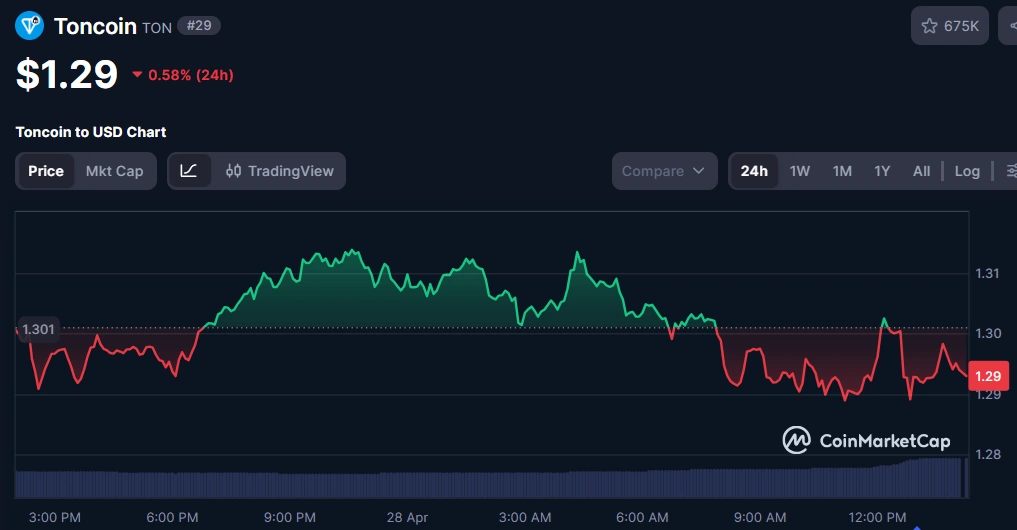
Released today, April 28, 2026, the new standard introduced by the TON Tech team is pivotal to the network’s rise after its failed attempt at infiltrating the gaming era. With TON currently trading at $1.29, the pressure is on the network to find the next credible growth engine.
Toncoin price. Source: CoinMarketCap
What is the agent wallet standard?
TON’S new agentic wallet standard was created to give AI agents their own on-chain financial identity. Each wallet is made up of a smart contract that consists of two separate keys: one for the user and the other for the agent, allowing the agent to approve and carry out transactions using only its own operator key.
This means the agent can make swaps, pay fees, and interact with decentralized apps on its own without needing access to the user’s main wallet or exposing user credentials.
Additionally, the system is also designed to ensure users keep full control, as any fund placed in the agent’s control is limited to the amount the user chooses. Furthermore, the user can change the agent’s key, remove its access, or withdraw funds whenever they wish through a dedicated dashboard at agents.ton.org.
Lastly, there’s no cap on how many agents a user can deploy, so users who wish to have multiple agents can do so, with each agent having access to its own independent wallet and balance.
An earlier Cryptopolitan report cited McKinsey analyst projections that AI agents could be running anywhere from $3 trillion to $5 trillion of global consumer commerce by 2030.
TON joins the agentic payment wave
The agentic AI trend is growing immensely throughout the ecosystem, with TON’s edge in this race being its integration with Telegram, which grants developers direct access to over a billion daily users, an added benefit most chains can’t provide.
While the future looks bright, it’s worth noting that the agentic wallet contracts have not yet passed a formal security audit. TON’s own documentation described the current version as a developer preview, hinting that the product needs further testing before being widely adopted.
What TON has made clear, however, is that it is no longer counting on casual games to carry the network. However, given what happened with Hamster Kombat and its evident crash, the crypto market is going to need more than a promising architecture before rewarding TON with a sustained recovery.
Can TON avoid a repeat of the tap-to-earn era downturn?
In 2024, the TON blockchain introduced one of the fastest-growing digital products in history called Hamster Kombat. The project ended up pulling in over 300 million users and was publicly praised as a breakthrough moment in Web3 adoption.
After the launch of its native token HMSTR in September 2024, Hamster Kombat lost over 260 million active players, thus shedding 86% of its users within three months. The token itself dropped more than 76% from its launch price, eventually taking a toll on other projects, including Catizen, Tapswap, and other tap-to-earn games.
With the lessons from the collapse now in the history books, the question now is whether the TON blockchain can return to those highs. And if it does, how will it avoid returning to its current lows?
Don’t just read crypto news. Understand it. Subscribe to our newsletter. It’s free.
Our SEI price prediction anticipates a high of $0.21 by the end of 2026.
In 2028, it will range between $0.35 and $0.43, with an average price of $0.36.
In 2030, it will range between $0.78 and $0.91, with an average price of $0.81.
The Parallel Stack, a robust, open-source framework designed for crafting rollups and Layer 2s that harness parallel processing, is now on SEI V2. The stack enhances Ethereum’s performance by addressing the most common bottlenecks Layer 2 blockchains face. Such developments are anticipated to drive SEI value over the long term.
Regarding price performance, SEI shows signs of trading higher; however, it remains influenced by broader market sentiment. How high will SEI go? Is SEI a good investment? What will SEI’s value be in 2026? Will SEI rise? Read on and discover the SEI price prediction from 2026 to 2032.
Overview
Cryptocurrency
Sei
Ticker
SEI
Current price
$0.05937
Crypto market cap
$414.16M
Trading volume
$25.61M
Circulating supply
6.97B
All-time low
$0.007989 on Aug 15, 2023
All-time high
$1.14 on Mar 16, 2024
24-hour high
$0.06063
24-hour low
$0.05885
SEI price prediction: Technical analysis
Metric
Value
Volatility (30-day variation)
8.66%
50-day SMA
$0.06359
200-day SMA
$0.1522
Sentiment
Bearish
Green days
10/30 (33%)
Fear and Greed Index
21 (Extreme Fear)
SEI price analysis
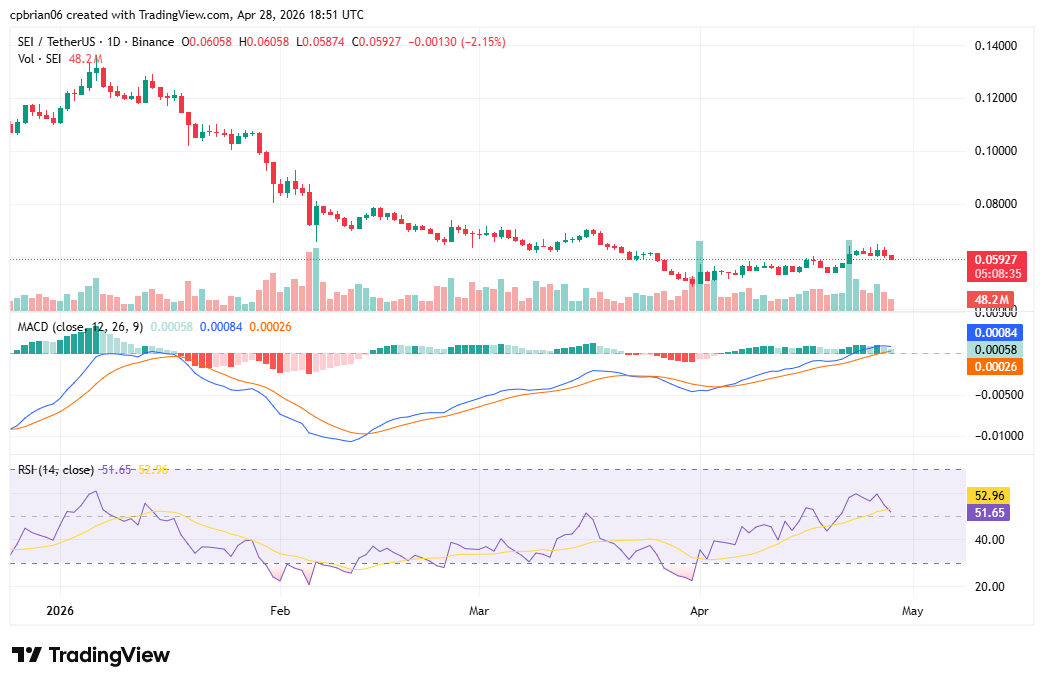
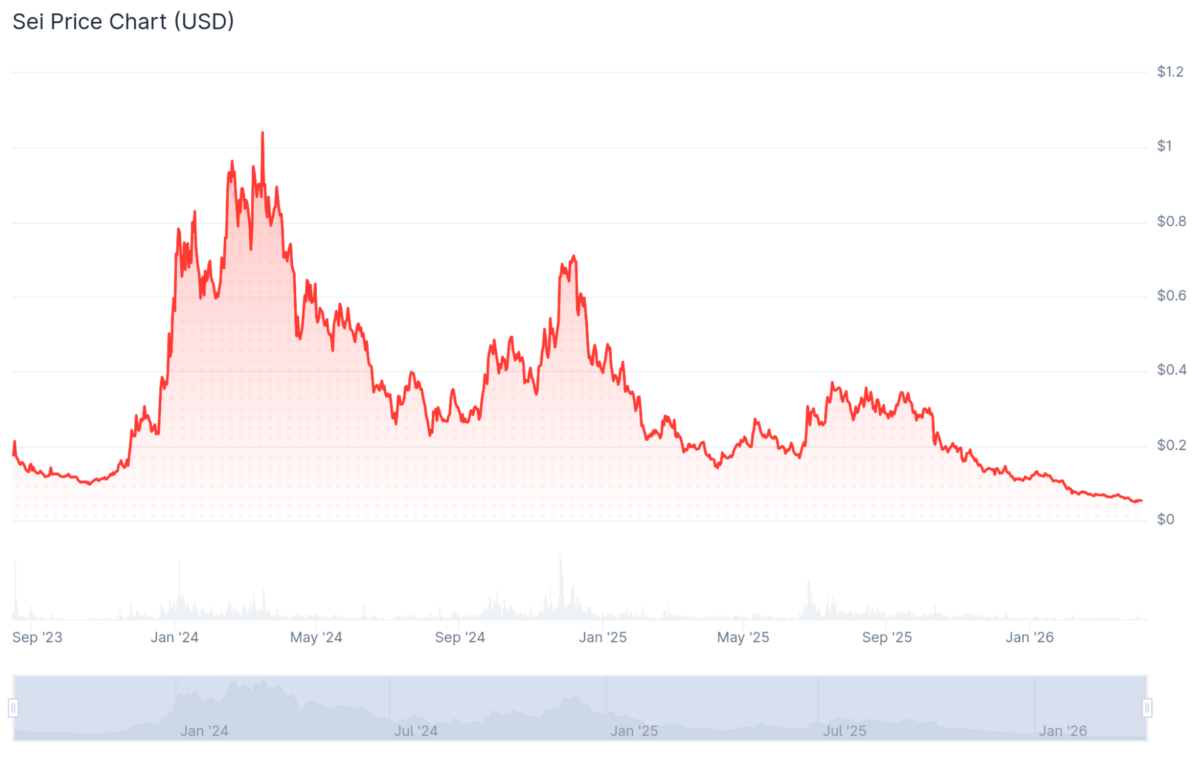
On April 28, SEI’s price dropped 0.89% in the past 24 hours and was up 12.02% over the past 30 days. Its 24-hour trading volume dropped 28.39% to $26 million, signaling low conviction in the market trend.
The chart shows SEI is moving sideways at $0.06 following a months-long bear run. Its MACD histogram shows waning positive momentum with falling trading volumes signaling less trading interest. Traders are waiting to see if SEI will reclaim $0.08 if it bounces back.
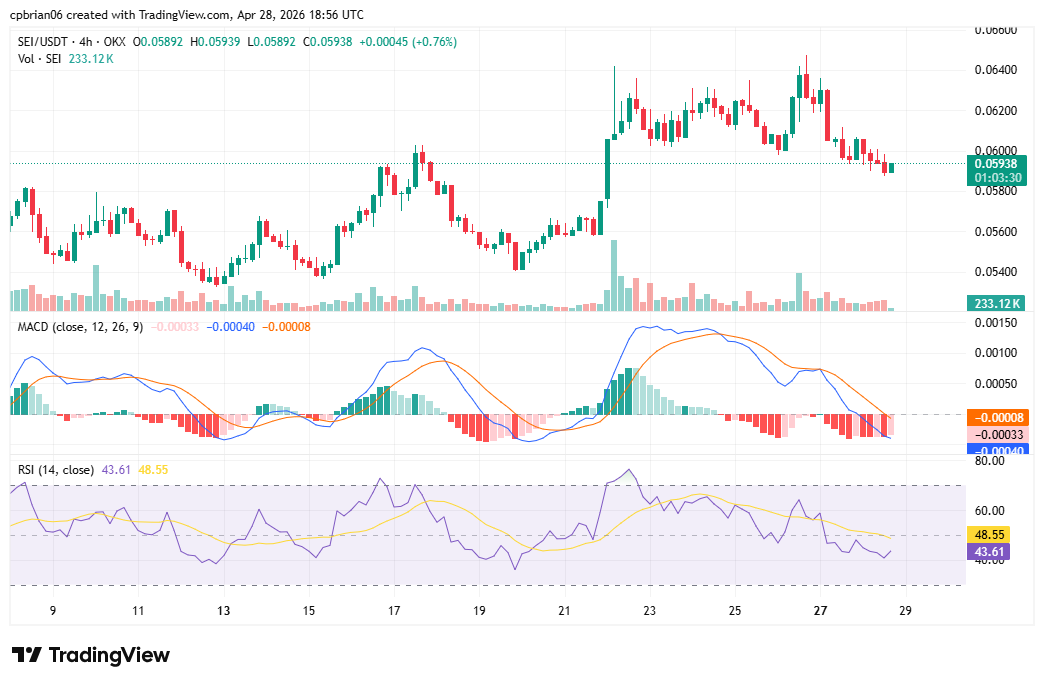
The 4-hour chart highlights SEI’s run in the last 7 days. The trend shows it trades at its highest price range this month. A drop below $0.058 could send SEI back to previous lows with support at $0.053.
SEI technical indicators: Levels and action
Daily simple moving average (SMA)
Period
Value
Action
SMA 3
0.06129
SELL
SMA 5
0.06147
SELL
SMA 10
0.05921
BUY
SMA 21
0.05762
BUY
SMA 50
0.05885
BUY
SMA 100
0.07032
SELL
SMA 200
0.1103
SELL
Daily exponential moving average (EMA)
Period
Value
Action
EMA 3
0.06114
SELL
EMA 5
0.06088
SELL
EMA 10
0.05982
SELL
EMA 21
0.05858
BUY
EMA 50
0.06136
SELL
EMA 100
0.07667
SELL
EMA 200
0.1168
SELL
What to expect from the SEI price analysis next?
SEI remains bearish, with the trend indicating it is moving sideways. A drop from the current level could send SEI to $0.05. Short-term indicators signal consolidation.
Why is SEI down?
Sei’s price decline occurred without a specific negative catalyst in the last 24 hours. Instead, the move extends a broader bearish trend.
Recent news
As part of SEI’s SIP-3 (Giga Upgrade) initiative for mid-February, the coin is set to part with its initial EVM architecture. The inbound IBC transfers are to be disabled as part of the initiative.
Will SEI reach $1?
According to the Cryptopolitan price prediction, SEI will rise above $1 in 2031, reaching a high of $1.37.
Can Sei Coin reach $10?
Per the Cryptopolitan price prediction, SEI is unlikely to reach $10 before 2031.
Will SEI reach $100?
Per the Cryptopolitan price prediction, SEI is unlikely to reach $100 before 2031.
Does SEI have a good long-term future?
According to Cryptopolitan price predictions, SEI will trade higher in the years to come. However, factors like market crashes or difficult regulations could invalidate this bullish theory
Is SEI a good investment?
SEI has growing utility, and its EVM compatibility helps it steal a share of Ethereum’s dominance. While the technical analysis is bearish, price predictions paint a different picture.
SEI price prediction April 2026
SEI will average at $0.106 in April. The price will range between $0.049 and $0.136.
Month
Potential low ($)
Potential average ($)
Potential high ($)
April
$0.049
$0.106
$0.136
SEI price prediction 2026
This year, SEI will trade between $0.07 and $0.18, with an average of $0.21.
Year
Potential low ($)
Potential average ($)
Potential high ($)
2026
0.0708
0.1758
0.2078
SEI price prediction 2027 – 2031
Year
Potential low ($)
Potential average ($)
Potential high ($)
2027
0.2459
0.2529
0.2946
2028
0.3539
0.3640
0.4261
2029
0.5210
0.5392
0.6199
2030
0.7849
0.8065
0.9054
2031
1.1300
1.17
1.3700
2032
1.6600
1.7200
2.0200
SEI crypto price prediction 2027
The SEI forecast climbs higher into 2027. It will range between $0.2459 and $0.2946, with an average price of $0.2529.
SEI coin price prediction 2028
The analysis suggests a further acceleration in SEI’s growth in 2028. According to the Cryptopolitan price forecast, it will trade between $0.3539 and $0.4261, with a year-round average of $0.3640.
SEI token price prediction 2029
Based on SEI’s price movements in 2029, the maximum price is $0.6199, the minimum is $0.5210, and the average is $0.5392.
SEI price prediction 2030
The SEI coin price prediction for 2030 suggests a price range of $0.7849 to $0.9054 and an expected average trading price of $0.8065. This long-term prediction also hinges on SEI’s rising global market recognition and adoption.
SEI prediction 2031
SEI forecast for 2031 sets the high at $1.37. On the lower side, it will drop to a low of $1.13, with an average price of $1.17.
SEI price prediction 2032
Per expert predictions, the price of SEI will range between $1.66 and $2.02, with an average of $1.72.
SEI market price prediction: Analysts’ SEI price forecast
Firm
2026
2027
2028
Gate.com
$0.05354
$0.005434
$0.06993
Coincodex
$0.09070
$.1431
$0.09405
Cryptopolitan SEI price prediction
SEI key price levels are expected to rise in the coming years, according to price prediction tools. The coin will reach a high of $0.2078 before the end of 2026. In 2028, it will range between $0.35 and $0.43, with an average of $0.36. However, SEI is still highly volatile. Negative market sentiment, such as market crashes, could derail the predictions. Always seek independent professional consultation for investment advice.
OpenAI CEO Sam Altman’s unsettling blockchain-based side gig, a startup with the uninspired name “World,” has left us scratching our heads for years.
The startup claims that gazing into its spherical “Orb” iris scanner will solve the problem of “verifying humanness,” a cryptic value proposition most recently adopted by dating platform Tinder.
But considering the company’s latest gaffe, Altman appears to have failed to ponder the orb long enough. In an April 17 announcement, Tools for Humanity — also founded by Sam Altman, and which contributes to the World project — announced it was selling the first tickets to global music sensation Bruno Mars’ upcoming world tour via a new product called Concert Kit.
Unfortunately, there turned out to be a glaring problem: Bruno Mars and his management had no idea about any of it, once again highlighting Altman and his companies’ propensity to distort the truth. In a joint statement to Wired last week, Bruno Mars Management and Live Nation said that the partnership “does not exist” and that Tools for Humanity had never even approached them.
Now, as Vice reports, the startup has updated its website, with a spokesperson confirming that it “does not have any agreement with Bruno Mars to test or feature Concert Kit.”
Worse yet, Tools for Humanity now claims it’s instead partnering with Thirty Seconds to Mars — the rock band of actor Jared Leto, who’s been accused of a startling number of sex crimes.
It’s hard to look past the sheer irony of a company that claims to verify human identity hallucinating a major partnership with a superstar — only to recruit an unrelated music act that also happens to have the word “Mars” in its name. (It’s unclear if the Thirty Seconds to Mars partnership was drawn up before or after the latest gaffe.)
But we’d be remiss not to note that it would be far from the first time Altman has been caught lying, or at least misinterpreting reality to a baffling degree to suit his agenda.
Former OpenAI staffers claim that Altman has fibbed about a great number of things, from hiding non-disparagement agreements employees were forced to sign to mothballing the company’s foundational promise of realizing artificial general intelligence (AGI) that purportedly “benefits all of humanity.”
Altman’s shaky track record was put on full display earlier this month in an extensive investigation by journalists Ronan Farrow and Andrew Marantz for The New Yorker. According to the piece, Altman has picked up at lengthy reputation at OpenAI and beyond for stretching the truth to — and often beyond — the breaking point.
“Sam exhibits a consistent pattern of,” an internal list obtained by the publication reads, with the first item being: “lying.”
Big Tech OwnsYour Compute.Here’s Who’sTaking It Back.
While Big Tech races to build ever-larger data centers, 80% of existing GPU capacity sits idle. io.net is betting that the future of AI compute looks nothing like the past.
The numbers coming out of the hyperscalers are staggering. An estimated $650 billion is being spent on AI data center infrastructure in 2026 alone, with Amazon, Microsoft Azure, and Google Cloud racing to stake out compute real estate across the United States and beyond. Headlines about planned campuses have become routine. So have the headlines about delays.
Grid constraints, community opposition, soaring construction costs, and permitting backlogs have pushed back roughly half of planned US data center openings. The irony is sharp: the industry most loudly declaring a compute shortage is struggling to build its way out of one.
But there is a more uncomfortable truth underneath the construction race. The data centers that already exist are chronically underused. Industry estimates suggest that around 80% of global GPU capacity goes unutilized at any given time. Compute workloads are spiky by nature. A company trains a model, then the chips sit. Inference traffic surges and then falls quiet. The infrastructure built for peak demand idles through the troughs.
“Instead of having to build lots of data centers all over the world constantly, we should be juicing the data centers we have more effectively.”
Jack Collier, CMO, io.net
It is this inefficiency, not just the cost, that io.net was built to address. The company aggregates spare GPU capacity from secondary data centers, mining operations, and consumer-grade hardware, pooling it into a single marketplace that anyone can access. Three providers — AWS, Azure, and Google Cloud — control roughly 70% of global compute. The remaining 30% is fragmented across thousands of secondary operators and consumer hardware. io.net connects that fragmented supply into a single, accessible network.
The Business Case
Under $2 an Hour for an H200. That Is Not a Typo.
The flagship claim io.net makes is cost. H200 GPUs, among the most powerful chips available for AI workloads, are listed on the io.net platform today for under $2 per hour. The same hardware on AWS or Google Cloud runs $25 to $30 per hour. For a startup burning 40 to 60 percent of its operating budget on compute, that difference is not marginal. It is existential.
H200 on io.net
<$2
per hour
H200 on AWS
$25–30
per hour
Devices live
10K+
across 138 countries
Cluster setup
~2 min
no waitlist, no KYC
Token
$IO
staked by suppliers
Leonardo.ai, the AI imaging company recently acquired by Canva, is perhaps io.net’s most prominent case study. The team uses io.net for inference workloads and has credited the cost savings with giving them room to innovate faster. That kind of reference point matters when trying to convince web2 companies that decentralized infrastructure is not an experiment.
And that, according to io.net CMO Jack Collier, is where most of the company’s revenue actually comes from today. “Most of our revenue comes from web2,” he noted, “people who don’t even know that they’re building on crypto rails.” The blockchain layer, in other words, is infrastructure, not identity.
Why Web2 Companies Aren’t Switching Faster
Lock-in is real. Once a business has built its stack on AWS or Azure, the connective tissue runs deep through every service, billing integration, and workflow. Extraction is costly and disruptive. Add to that the narrative pressure from hyperscalers themselves, who have significant marketing budgets dedicated to reinforcing fears of GPU shortages, and the inertia becomes easier to understand. io.net’s answer is to let the price differential speak for itself and build the track record one customer at a time.
Resilience and Geography
When AWS Goes Down, Everything Goes Down. That Is the Problem.
Centralized infrastructure carries a centralized failure mode. When a major cloud provider experiences an outage, the cascade is immediate and broad. Thousands of services, often unrelated to one another, go dark simultaneously because they all share the same dependency.
Decentralized compute inverts this logic. io.net customers can distribute their workloads across GPU clusters in four or five countries simultaneously. If one node fails, traffic reroutes. For global products, this also enables something else: local inference. A company serving customers in Japan can run its models from Japan. Customers in South Africa get inference from South Africa. Latency drops. Performance improves. The infrastructure adapts to geography rather than forcing geography to adapt to infrastructure.
This geographic flexibility, available today across more than 138 countries, is one of io.net’s less-discussed advantages. It quietly solves a problem that hyperscalers solve only expensively and slowly, by building new regional data centers.
Full Interview — CCS Blockchain Interviews
Jack Collier, CMO of io.net, speaks with Ashton Addison of the Crypto Coin Show about decentralized compute, the IDE, Agent Cloud, and the future of AI infrastructure.
Fixing the Economics
The Incentive Dynamic Engine: From Inflation to Utility
Most decentralized physical infrastructure networks, DePIN projects in crypto parlance, share a structural problem. They incentivize suppliers by minting new tokens and distributing them as rewards. When token prices rise, suppliers flood in. When prices fall, they leave. The network’s supply is held hostage to speculation rather than anchored to real demand.
io.net has responded with what it calls the Incentive Dynamic Engine, or IDE, scheduled for full implementation in Q2 2026. The shift is fundamental: instead of paying suppliers a fixed amount of IO tokens each month, suppliers are now compensated in proportion to actual demand on the network. Payments are denominated in USDC-equivalent value of IO, meaning suppliers receive stable dollar-value compensation regardless of token price fluctuations.
Revenue above what is needed to pay suppliers flows into a reserve vault. That vault absorbs volatility. In price downturns it subsidizes supplier rewards. In stronger markets, excess emissions from that vault are burned. io.net has committed to burning at least 50 percent of those excess emissions permanently, meaning the total IO supply contracts over time as the network grows.
IDE Change
Detail
Status
Network model
Supply-driven → demand-driven
Q2 2026
Supplier payments
USDC-equivalent IO (stable dollar value)
Q2 2026
Emissions burn
50% minimum of vault excess
Ongoing
Network direction
Inflationary → deflationary over time
By design
“Tokens aren’t just there as an investment vehicle. They’re there to power a trustless network.”
Jack Collier, CMO, io.net
The result is a tokenomic model where the value of IO is tied directly to the utility of the network it powers, not to sentiment cycles. For anyone evaluating whether a blockchain project is serious, that kind of alignment is among the clearest signals available.
The Agent Economy
AI Agents That Buy Their Own Compute
One of io.net’s more forward-looking product moves is Agent Cloud, launched in March 2026. The premise is simple and slightly startling: AI agents, which already automate enormous swaths of software work, can now autonomously purchase the compute power they need to run. No human in the loop. No approval workflow.
Launched
Mar 25
2026
Protocol
MCP
library by io.net
Payment
Both
crypto or fiat
Guardrails
Yes
spend limits built in
Agent Cloud is built on a Model Context Protocol library created by io.net. An agent with access to a wallet can query the io.net marketplace, identify the GPU configuration it needs, and complete the purchase automatically. Guard rails prevent runaway spending, with limits on how many devices can be acquired and for how long.
The concept points toward something larger. If AI agents are going to be first-class economic participants, they need infrastructure that is programmatically accessible. Centralized cloud providers require account creation, billing agreements, and human oversight at the procurement layer. A permissionless marketplace, accessible via API and payable in crypto or fiat, removes those friction points entirely.
“Our CEO talks quite passionately about a world where AI agents are being spun up themselves and are able to purchase their own compute power and run entirely autonomously,” Collier said. It is a vision of compute as a commodity that intelligent systems consume on demand, the same way applications consume electricity or bandwidth.
Where This Goes
The Demand Curve Only Runs One Direction
The case for decentralized compute rests on a straightforward projection: AI demand will grow faster than centralized infrastructure can be built, and the inefficiency of today’s capacity utilization leaves enormous room for networks that can aggregate and reallocate idle supply. io.net is not alone in making this argument, but it is among the furthest along in proving it with revenue.
From zero to $25 million in annualized revenue, in roughly a year of serious commercial operation, against a global data center market measured in the hundreds of billions, there is a long road ahead. But the trajectory is real, the product is live, and the customers are increasingly the kind of companies who do not think of themselves as crypto users at all.
That quiet expansion — blockchain as invisible infrastructure rather than explicit identity — may be the most durable growth story in the space. Spin up a cluster at io.net in two minutes. No waitlist. No KYC labyrinth. Just compute, available to whoever needs it.
Earlier this month, it seemed like Ethereum (ETH) was on its way to reclaim $2,500, but the bears intercepted the move.
Currently, the asset trades at around $2,300, and some analysts believe a more substantial correction could be knocking on the door. On the other hand, certain on-chain indicators suggest that the bulls might regain control in the near future.
Plunge on the Way?
According to X user Ted, the asset is “looking weak” right now. He claimed that Bitcoin has reclaimed its key level, while the second-largest cryptocurrency keeps getting rejected from the $2,400 resistance zone.
The analyst added that the major support zone for ETH is around $2,200-$2,250 and claimed that a drop to that range won’t be a surprise before a rebound forms.
Prior to that, Ted has been paying attention to the asset’s sideways movement lately. He predicted that this week would be “very crucial” for the market, citing uncertainty surrounding the ongoing peace talks between the USA and Iran.
“If Ethereum manages to reclaim the $2,400 level, it’ll tap the $2,470-$2,500 liquidity. And if it loses the $2,300 zone, a retest of the $2,150-$2,200 support level will happen quickly,” he stated.
Crypto Tony – a popular trader with almost 600,000 followers on X – also weighed in, saying they await a plunge to the support level of around $2,290, which could offer the opportunity for opening a possible long position.
The Indicators Point in a Different Direction
Contrary to the aforementioned skepticism, several metrics suggest that ETH could be on the verge of a price rally. First on the list is the Relative Strength Index (RSI), which has dropped to 30. This means that the asset has entered oversold territory and could be due for an upward move.
ETH RSI, Source: RSI Hunter
Next is the declining amount of ETH stored on exchanges. CryptoQuant’s data shows that the figure recently tumbled to a nearly 10-year low of approximately 14.47 million. This development is seen as bullish since it reduces the immediate selling pressure.
ETH Exchange Supply, Source: CryptoQuant
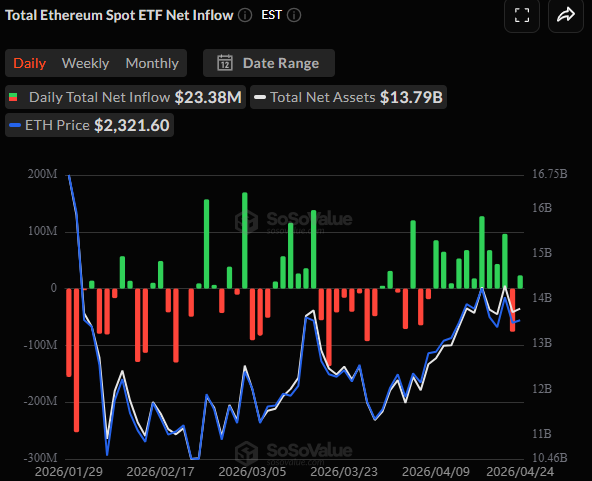
Last but not least, there is renewed interest from institutional investors. According to SoSoValue, spot ETH ETFs have seen significant inflows lately, indicating that pension funds, hedge funds, and other big players are ramping up their exposure to the asset, forcing the issuers of these products to back the purchased shares with actual Ethereum.
India and New Zealand signed an historic free trade deal this Monday to expand market access and strengthen economic ties between the two countries. This deal comes as India seeks to accelerate efforts to modernize its domestic economy through a massive digital infrastructure growth push.
India is at a once-in-a-generation inflection point. The global economic power structure is undergoing a major transformation, and the South Asian country is quickly becoming the center of it. As geopolitical uncertainty mounts under the circumstances of the Iran War, more countries than ever appear to be rushing into economic partnerships with India.
Last Monday, India and South Korea announced a significant upgrade to their bilateral trade agreement, and this Monday, the Indian government announced a free trade agreement with New Zealand. This deal comes after 9 months of negotiations and includes a 15-year commitment from New Zealand’s government to invest $20 billion USD in India. It serves New Zealand by decreasing their trade reliance on China.
As India quickly moves to boost external economic growth, efforts to further the country’s internal growth engine are also blossoming. A large piece of this includes India’s upgraded digital public infrastructure strategy, or “DPI,” as policymakers have titled it. NITI Aayog, which is essentially India’s central policy think tank, recently announced a two-phase strategy for DPI over the next decade. This new outline serves the purpose of assisting India in becoming a $30 trillion economy by 2047.
India’s Digital Public Infrastructure (DPI) expansion
NITI Aaayog released a new report titled “DPI 2047: The Roadmap to Prosperity.” This new two-phased roadmap for India’s digital public infrastructure outlines the next phase of growth (known as DPI 2.0, DPI 3.0) after the first phase (DPI 1.0) laid down foundational systems. DPI 1.0 was successful in creating a verifiable digital ID for over 1 billion Indian citizens, expanding financial access and opportunity for the country’s massive population.
DPI 2.0, which is focused on the next decade leading up to 2035, aims to transition this foundational infrastructure into a digital ecosystem that creates widespread, inclusive, socio-economic growth. It will focus on implementing interoperable systems across industries like healthcare, finance, employment, agriculture, and commerce by leveraging technology.
DPI 3.0 will focus on fostering innovation and further growth within the new economy created through the success of DPI 2.0. It is less defined as of now, but is focused on the decade between 2035 and 2047, and generally aims to position India as a global exporter of digital infrastructure systems and frameworks.
The expansion of India’s digital public infrastructure is just one component of Viksit Bharat 2047, India’s vision of transforming the country into a developed economy by 2047. The dual-track external and internal growth that we are seeing today is all in service of this extensive, long-term initiative. By strengthening the country’s domestic capacity, India is simultaneously attracting newfound levels of foreign investment, positioning itself as an increasingly central player in global trade. The new trade deal with New Zealand is just another benchmark in India’s aggressive (and attractive) push for foreign investment in its blossoming economy.
If you want a calmer entry point into DeFi crypto without the usual hype, start with this free video.
A crypto founder had his laptop compromised when he joined what appeared to be a Microsoft Teams call with Pierre Kaklamanos, a Cardano Foundation contact he had spoken with before.
When “Pierre” reached out about Atrium and sent a Teams invite, nothing looked out of place. On the call, the face and voice matched what he remembered, and two other apparent foundation members were present.
When the call lagged and dropped him, a prompt told him his Teams software was out of date and needed reinstalling through Terminal. He ran the command, then shut the laptop off because the battery was dying, which limited the damage in retrospect.
He describes himself as “quite technically savvy,” which is part of the point that the attack worked because the context felt legitimate.
Social engineers have always relied on familiarity, and executing that at scale once required either a compromised account or weeks of text-based rapport-building.
The video call was the authentication layer, the thing victims learned to trust, and replicating it is now within reach.
Fake update
Microsoft documented campaigns in February and March 2026 in which malicious files masqueraded as workplace apps, such as msteams.exe and zoomworkspace.clientsetup.exe, with phishing lures that mimicked legitimate Teams and Zoom meeting workflows.
In a separate warning, Microsoft described “ClickFix”-style prompts targeting macOS users, instructing them to paste commands into Terminal and targeting browser passwords, crypto wallets, cloud credentials, and developer keys.
The fake Teams update fits both patterns simultaneously.
Mandiant said it could not independently verify which AI model, if any, generated the video, but confirmed the group used fake meetings and AI tools during social engineering.
On Apr. 24, the real Pierre Kaklamanos posted on X saying his Telegram had been hacked and that someone was impersonating him, along with “a few other people in the industry this week.”
He told followers to avoid clicking links or booking meetings through the account and to verify contact through LinkedIn direct messages.
By then, the founder had already messaged the account suggesting they switch to Google Meet. Whoever controlled Pierre’s Telegram account replied that he had gotten busy and asked to reschedule, with the attacker still managing the persona once the call ended.
That exchange turns the incident from an isolated embarrassment into a live campaign signal that the method is active, the account compromise is the entry point, and the relationship history is the weapon.
Stage
What the victim saw
Why it looked legitimate
What the attacker was likely trying to achieve
Initial outreach
“Pierre” reached out about Atrium and suggested a call
The victim had spoken with Pierre before, including on video
Reopen an existing trust relationship instead of starting from a cold approach
Meeting setup
A Microsoft Teams invite for the next day
Teams is a normal business workflow and the topic was plausible
Move the target into a controlled environment that felt routine
Live call
Familiar face, familiar voice, plus two other apparent Cardano Foundation members
The social context matched the victim’s memory of prior interactions
Lower suspicion and make the call itself feel like verification
Call disruption
Lagging, instability, then getting kicked out
Technical glitches are common in video calls
Create frustration and set up the fake “fix” as a normal troubleshooting step
Fake update prompt
A message saying Teams was out of date and needed reinstalling through Terminal
Software update prompts are familiar, and the user rarely used Teams
Get the victim to execute a malicious command directly
Command execution
The victim ran the command, then shut down the laptop because the battery was dying
The workflow still felt like a routine app fix at that moment
Launch the infection chain and gain access to credentials or device data
Post-call follow-up
The victim suggested switching to Google Meet; the attacker said he got busy and asked to reschedule
The persona continued behaving like a real contact after the failed attempt
Keep the relationship alive for another attempt and avoid immediate suspicion
Why generative media changes the threat surface
The founder said he now believes the call may have involved AI-generated or manipulated video. Forensic confirmation of the tools is lacking, and the OpenAI connection here is governed by its own safety documentation.
OpenAI launched its 4o image generation model on Mar. 25, describing it as capable of “precise, accurate, photorealistic outputs,” and released the ChatGPT Images 2.0 System Card on Apr. 21.
The firm stated that the model’s “heightened realism” could, absent safeguards, enable more convincing deepfakes of real people, places, or events. One of the leading AI labs has now put on record that its own image model raises the ceiling on what a convincing fake can look like.
The World Economic Forum said in January 2026 that generative AI lowers the barrier to phishing while raising its credibility, through realistic deepfake audio and video that can evade both detection systems and human scrutiny.
INTERPOL declared financial fraud one of the world’s most severe and rapidly evolving transnational crimes in March 2026, identifying deepfake videos, audio, and chatbots as tools that make impersonation of trusted people easier to carry out at scale.
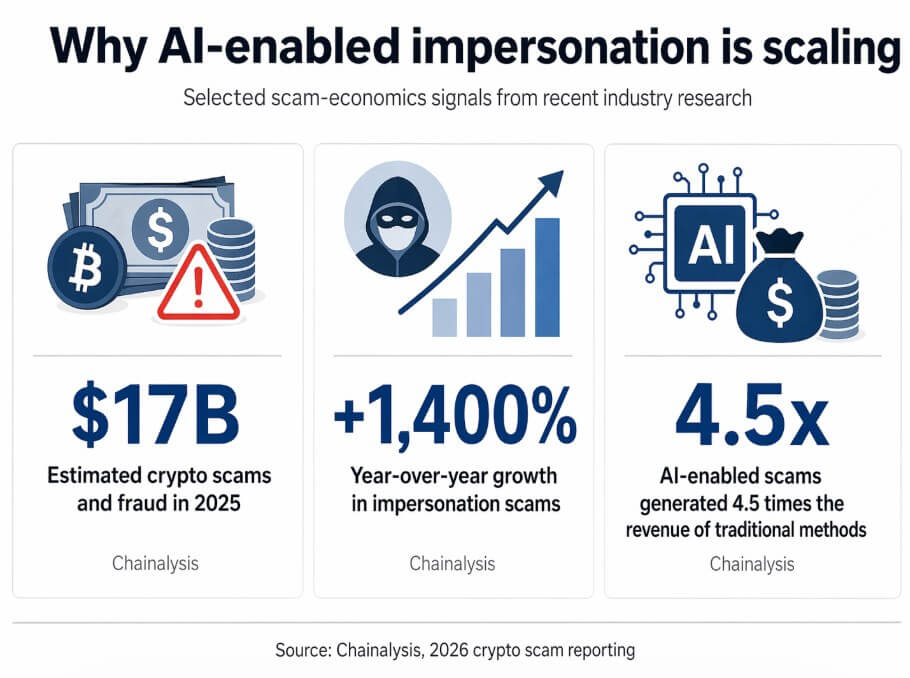
Chainalysis data shows crypto scams reached $17 billion in 2025, impersonation scams up 1,400%, and AI-enabled scams generating 4.5 times traditional revenue.
Crypto attracts this class of attack because it combines high-value targets, fast settlement rails, and an informal communications culture in which Telegram introductions and ad hoc video calls between founders are routine.
Mandiant documented that the group behind the crypto Zoom intrusion targeted software firms, developers, venture firms, and executives across payments, brokerage, staking, and wallet infrastructure.
Mandiant noted that the victim’s data could be used to seed future social engineering, with each compromise generating material for the next.
Two paths forward
Zoom announced on Apr. 17 a partnership to add real-time human verification to meetings, a “Verified Human” badge, and a “Deep Face Waiting Room,” treating participant authenticity as a product problem.
In the bull case, that buildout reaches critical mass quickly enough that attackers must defeat multiple independent trust layers to complete a conversion, and the economics of impersonation campaigns deteriorate.
In the bear case, the timeline compresses before defenses do. Gartner warned that AI agents may halve the time required to exploit account takeovers by 2027, narrowing the window for human hesitation or security team intervention.
Deloitte estimated that generative AI-enabled fraud losses in the US alone could climb from roughly $12 billion in 2023 to $40 billion by 2027.
Scenario
What changes
What stays vulnerable
Implication for crypto firms
Bull case
Verification tools spread quickly: human-verification badges, liveness checks, stronger internal trust rails, and more formal approval workflows
Informal founder-to-founder chats, legacy messaging habits, and ad hoc scheduling still create openings
Attackers face more friction and lower conversion rates because they must defeat several trust layers instead of one
Bear case
AI-generated impersonation improves faster than defenses are adopted; fake meetings and fake troubleshooting become standard playbooks
Public-facing executives, Telegram-based outreach, video-first verification habits, and staff under time pressure
Relationship hijacking becomes routine, and each compromise creates material for the next scam
What success looks like
Sensitive requests get verified across separate channels, with known numbers, shared passphrases, hardware keys, or pre-agreed internal systems
Social pressure, urgency, and trust in familiar faces and voices cannot be fully removed
Firms reduce the chance that one spoofed call can lead directly to compromise
What failure looks like
Teams rely on the call itself as proof of identity, even as deepfake and impersonation tools improve
Video remains persuasive even when it is no longer reliable as authentication
Crypto organizations become easier to target because executives are both high-value victims and reusable lure assets
Every public-facing crypto executive becomes both a target and a lure asset, a source of voice recordings, video clips, and relationship graphs that attackers can deploy against the next victim.
Zoom is building liveness checks into meetings, Microsoft is documenting attack chains that impersonate its own software, and the FBI has warned that malicious actors are already using AI-generated voice and text to impersonate trusted contacts, advising against assuming a message is authentic because it appears to come from a known person.
Verification now requires independent rails, such as a known phone number, a hardware key, a shared passphrase established before any meeting, or a pre-agreed internal channel that no attacker has accessed.
The Hallucination Problem — And the Data Layer That Solves It
Analysis
AI Keeps Lying. The Fix Isn’t a Better Model. It’s Better Data.
OpenAI formally admitted it in 2025: language models are structurally rewarded to guess rather than say “I don’t know.” A growing field of blockchain-based data infrastructure projects believes the real fix happens before the model is ever trained—at the data layer itself.
April 25, 2026 · 11 min read · DePIN / AI / Blockchain / Data Infrastructure
The Problem
The Test That Punishes Honesty
Picture a standardized exam where leaving a question blank gives you zero, but a wrong guess gives you a chance at a point. Rational test-takers guess. Always. Now imagine your AI is trained on exactly that exam, at scale, across billions of questions. You haven’t built a truthful system—you’ve built an optimized guesser.
This isn’t a metaphor. It is the exact structural critique published by OpenAI researchers in September 2025. Their paper, Why Language Models Hallucinate, argues that models hallucinate because standard training and evaluation procedures reward guessing over acknowledging uncertainty. Saying “I don’t know” scores zero. Confidently guessing wrong at least has a chance of scoring something—so over thousands of benchmark questions, guessing pays.
“Hallucinations are not a mysterious artifact of neural networks. They are a predictable outcome of how we train and evaluate language models.”
The paper’s core insight is structural, not incidental: accuracy-only leaderboards dominate how the entire field evaluates models. On those scoreboards, a model that guesses boldly—and occasionally gets lucky—outranks a model that abstains with honest uncertainty. The scoring hasn’t fundamentally changed, so neither has the behavior.
⚠ The Core Mechanism
For a question a model doesn’t know—say, a specific person’s birthday—guessing “September 10” gives a 1-in-365 chance of being right. Saying “I don’t know” guarantees zero points. Multiplied across millions of training examples, the statistical pressure to guess is enormous. This is not a prompt engineering problem. It is baked into how AI is scored.
Scaling Hasn’t Fixed It
OpenAI acknowledges that GPT-5 significantly reduces hallucinations—especially in reasoning tasks—but still confirms they occur. The Vectara FaithJudge Leaderboard in 2025 put grounded hallucination rates at roughly 15–16% for GPT-4o and Claude 3.7 Sonnet, with Gemini 2.5 Flash around 6%. Those are meaningful improvements. They are not solutions. Even a 6% hallucination rate, considered excellent by benchmark standards, translates into serious operational errors at scale—a corrupted field in a medical record, a fabricated legal citation, a wrong fact embedded in a financial report.
More parameters did not fix this. Larger context windows did not fix this. The problem isn’t the model’s size—it’s the incentive to guess, which is written into the scoring system that shapes training.
§
Data Quality
Garbage In, Hallucinations Out
Training incentives are one dimension of the hallucination problem. Data quality is another—and arguably the deeper one. When models are trained on vast swaths of the internet, they absorb noise, contradictions, outdated facts, fabrications, and synthetic text at scale. The model has no reliable way to distinguish between a peer-reviewed paper and a confidently written blog post that happens to be completely wrong.
OpenAI researchers describe this as the GIGO problem—Garbage In, Garbage Out. Post-training techniques like RLHF can reduce errors like common misconceptions and conspiracy theories, but they cannot fundamentally undo what was baked in during pretraining. If the data layer is polluted, the model is polluted. No amount of fine-tuning fully reverses that.
The bias problem is equally serious. AI trained on data that skews toward wealthy, English-speaking markets will perform well in those markets and fail quietly everywhere else. Markus Levin of XYO has pointed to a concrete example: when the COIN App was translated into Amharic—spoken by 57 million people in Ethiopia—ChatGPT’s translations were riddled with errors. Not because the model was broken, but because Ethiopia was not a priority data market. The training signal simply wasn’t there.
✕ Status Quo Data Pipeline
Web-scraped text with no origin verification
No audit trail for when or how data was generated
Cannot distinguish fact from plausible fiction at scale
Skewed toward high-resource languages and markets
Models incentivized to guess when knowledge gaps appear
✓ Verified Data Pipeline
Cryptographic Proof of Origin for every data point
Immutable on-chain audit trail anchored to real events
Data tied to real-world sensors and independent validators
Decentralized collection across underserved geographies
AI can verify claims rather than pattern-match guesses
✓ What Verified Data Has Already Proven
AI trained on high-quality, verified, structured data has produced breakthroughs in science and academia that seemed impossible a decade ago—protein folding, drug discovery, climate modeling. The models evolved, but so did the data. The two are inseparable. Better data is not a nice-to-have for AI. It is the single highest-leverage input in the stack.
§
The Skeptics
The Case Against Blockchain as a Data Fix
Not everyone is convinced that decentralized infrastructure is the right answer. The counterarguments deserve a fair hearing.
Retrieval-Augmented Generation (RAG) already helps. Many AI deployments now use RAG pipelines—anchoring model responses to retrieved documents rather than relying on baked-in training data. This reduces hallucinations significantly in enterprise contexts. Stanford’s 2025 legal RAG reliability work showed meaningful gains in accuracy for grounded tasks. The argument: you don’t need a new blockchain; you need better retrieval architecture.
Benchmark reform may be sufficient. OpenAI’s own paper proposes a targeted fix: change how accuracy-only scoreboards are weighted so that abstaining scores better than confident wrong answers. If the field adopts uncertainty-aware evaluation, the training incentive to guess diminishes—without needing any new data infrastructure at all.
Blockchain adds complexity without guaranteeing quality. Cryptographic proof of origin tells you where data came from, not whether what was recorded was true. A network of nodes can corroborate a false reading just as easily as a true one if the sensors or participants are compromised. Garbage In, Garbage Out applies to DePIN systems too.
⚠ A Fair Critique
RAG, better benchmarks, and RLHF-based fine-tuning are all genuine improvements and are already reducing hallucination rates in production systems. None of them, individually or in combination, has yet eliminated the problem—particularly for low-resource languages, niche domains, and real-time physical data. That gap is where verified data infrastructure makes its case.
The honest answer is that these approaches are complementary, not competing. Better benchmarks fix the training incentive. RAG grounds outputs in documents. Verified on-chain data grounds those documents in reality. Each layer addresses a different failure mode. The question isn’t which one wins—it’s which combination gets AI closest to reliable.
§
The Field
Who Else Is Building the Data Layer
XYO is not alone in recognizing that verified, decentralized data infrastructure is a missing piece of the AI stack. A cluster of projects has been converging on the same thesis from different angles.
Ocean Protocol
Ocean Protocol focuses on data marketplaces—enabling individuals and organizations to publish, share, and monetize datasets while maintaining control. Its model addresses a different angle of the same problem: not just verifying data provenance, but creating economic incentives for high-quality data contributors to participate in the first place. For AI training, a well-structured data marketplace with verified provenance is a meaningful step toward cleaner inputs.
Chainlink
Chainlink’s oracle network is arguably the most battle-tested decentralized data verification layer in production. Its core function is bridging off-chain real-world data—price feeds, weather data, sports scores, financial events—onto blockchains in a tamper-resistant way. While Chainlink’s primary use case has been DeFi smart contracts, the infrastructure directly applies to AI: verified, real-time external data feeds that a model can query with known provenance rather than guessing from training data.
Filecoin & The Storage Layer
Filecoin approaches the problem from persistence: decentralized, verifiable storage of data at scale. If AI training datasets can be stored and retrieved from a verifiable, censorship-resistant layer, it becomes harder to corrupt or quietly alter training inputs over time. Combined with provenance tracking, decentralized storage is a foundational piece of any serious verified-data architecture.
Ceramic Network
Ceramic is building a decentralized data streaming protocol—a layer for mutable, user-controlled data that remains verifiable across applications. Where most blockchain data is static, Ceramic enables dynamic, updateable data streams with identity and provenance attached. For AI applications that need fresh, real-world signals rather than stale training snapshots, this is an important architectural piece.
✓ A Converging Thesis
These projects approach data verification from different angles—marketplaces, oracles, storage, streaming—but they share a core conviction: that unverified, centrally curated data is a structural weakness in the AI stack, and that decentralized infrastructure can address it in ways that no single company controlling its own data pipeline can. The field is early, fragmented, and competitive. But the direction is coherent.
// Case Study: How XYO Verifies Data
From Raw Reality to Verified Truth
S
Sentinel
IoT devices & smartphones gather raw real-world data — location, proximity, environmental signals
B
Bridge
Relays data across the network with cryptographic bound-witness interactions between nodes
A
Archivist
Stores verified data with immutable Proof of Origin & Proof of Location anchored to XYO Layer One
D
Diviner
Answers queries with provably verified facts — enabling AI to act on truth rather than statistical guesses
Case Study — XYO
XYO and the Case for Physical Data Verification
Among the projects building verified data infrastructure, XYO occupies a specific and significant niche: real-world physical data. Founded in 2018 as the first DePIN project, its network now spans over 10 million nodes—smartphones, IoT sensors, and edge devices—across nearly every country on earth. Each node participates in a process called bound witnessing, where multiple independent nodes corroborate the same physical event cryptographically, making any single data point extremely difficult to falsify.
In September 2025, XYO launched XYO Layer One—the first blockchain designed from the ground up for data-heavy industries. After seven years of operations, the team concluded no existing chain could handle the volume, latency, and validation requirements of real-world physical data at scale. So they built their own, with a dual-token model: $XYO for governance and staking, $XL1 for gas and transactions.
@OfficialXYO on X
“XYO is going to end AI hallucinations. OpenAI has admitted that LLMs are structurally rewarded for guessing, and will always hallucinate. Saying ‘I don’t know’ scores zero on a benchmark, so they don’t say it.¹ AI trained on real, verified data has already done things for science and academia that seemed impossible a decade ago.² Better AI is possible, and it hinges entirely on the quality of data underneath it. XYO is building that data layer for everyone. Hallucination isn’t unsolvable. It just hasn’t been solved for everyone yet. That changes with XYO.”
¹ “Why Language Models Hallucinate,” OpenAI · ² “Good AI Starts Before the Model. It Starts With the Data,” XYO
Real Deployments, Real Stakes
What distinguishes XYO from many blockchain infrastructure plays is that it has been generating revenue and real-world traction for years before the AI data conversation caught up to it. The network generated $8.8 million in revenue in 2024, with 80% of users outside the crypto ecosystem entirely. In March 2026, XYO partnered with climate analytics firm Resiliocs to provide cryptographic verification for environmental and geospatial data used in climate risk modeling—an application where data accuracy is legally and financially material. In December 2025, Revolut, with a reported $75 billion valuation, listed $XYO—the first major fintech to add a DePIN token.
What XYO is specifically good at—physical location verification, real-world event attestation, Proof of Origin for sensor data—is exactly the category of data that current AI training pipelines handle worst. Language models can approximate text. They cannot approximate the physical world. That is the gap XYO is positioned to fill.
✓ Where XYO Fits the Broader Picture
XYO is not trying to solve every dimension of the hallucination problem. It is building the physical data verification layer that projects like Ocean Protocol (marketplaces), Chainlink (oracles), and Filecoin (storage) don’t specialize in. In a mature verified-data ecosystem, these layers are complementary. XYO’s edge is the depth and scale of its physical-world node network—10 million strong, built over seven years, before anyone was calling it AI infrastructure.
§
Conclusion
The Data Layer Is the Unlock
The AI industry has spent enormous resources making models larger, smarter, and better at reasoning. Those investments have paid off. But the hallucination problem has persisted because its root cause was never primarily about model architecture. It was about incentive structures and data quality—two things that no amount of additional compute directly fixes.
Benchmark reform, RAG pipelines, and fine-tuning are real improvements that are already helping in production systems. But they operate on top of a data foundation that remains largely unverified, unaudited, and biased toward the markets that happened to generate the most internet text. That foundation is what the DePIN and blockchain data layer is trying to fix.
It is early. The ecosystem is fragmented. Chainlink, Ocean Protocol, Filecoin, Ceramic, and XYO are each approaching one corner of a large problem, and none of them has yet become the dominant infrastructure standard for AI data verification. That race is still open.
Reliable data is now the most valuable resource, yet the infrastructure to verify and process it on-chain still did not exist. That is why we built XYO Layer One from the ground up.
What is no longer early is the problem itself. Hallucination rates of 6–16% across frontier models are not acceptable for high-stakes applications. The costs—fabricated legal citations, corrupted medical data, biased outputs in underserved communities—are real and documented. The question for AI’s next decade is not whether models will get more capable. They will. The question is whether the data underneath them can be trusted.
The answer starts before the model. It starts with the data. And the infrastructure to verify that data at global scale is being built right now—by a field that, until recently, was mostly ignored by the AI conversation. That’s changing fast.