
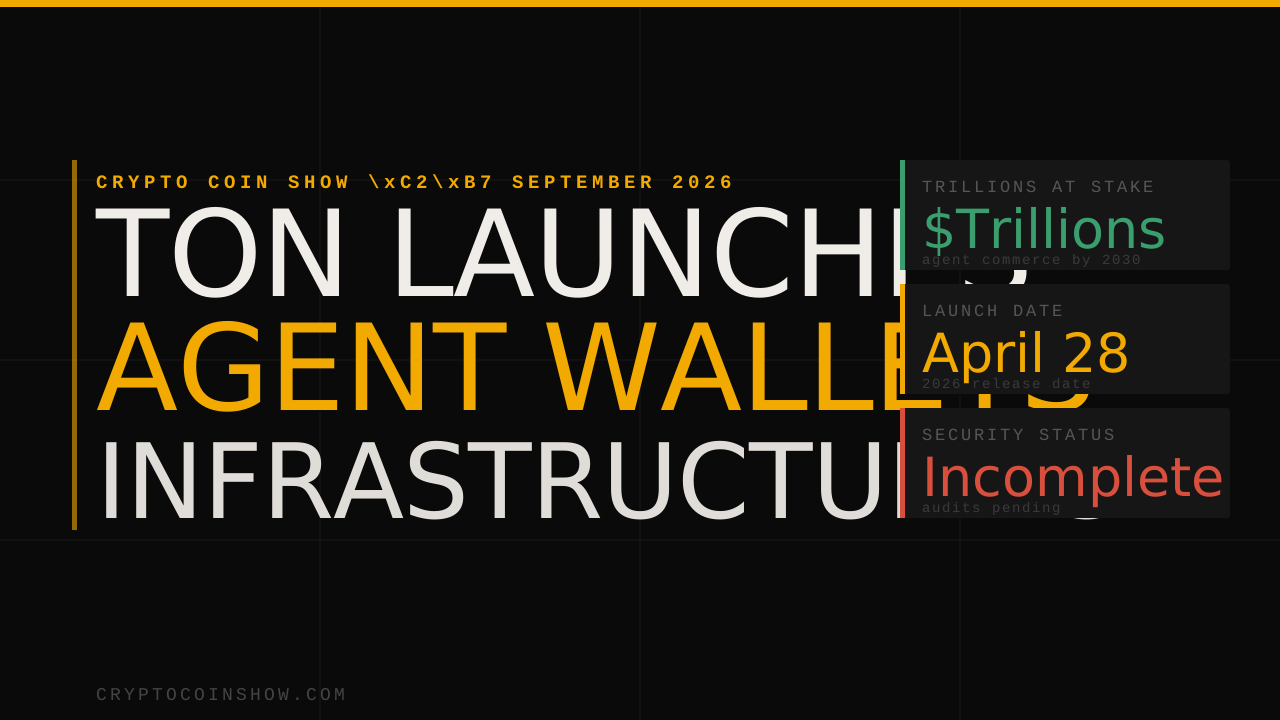
TON launches open self-custodial wallet standard that gives AI agents their own dedicated on-chain wallets
TON has released an open self-custodial wallet standard that allows AI agents to operate their own dedicated on-chain wallets with independent keys and spending limits, positioning the network to compete for infrastructure dominance as autonomous agents emerge as a major economic force. The move signals a deliberate pivot away from casual gaming toward infrastructure that could capture trillions in agent-directed commerce by 2030, though security audits remain incomplete and investor skepticism runs high after the Hamster Kombat collapse.
- TON released agent wallet standard on April 28, 2026, enabling AI agents independent on-chain financial identity with dual-key architecture
- Each agent wallet operates with user-controlled spending limits and user-retained override authority over agent access and funds
- McKinsey projects AI agents could direct $3 trillion to $5 trillion in global commerce by 2030, driving infrastructure competition
- $1.29 Current TON price as network seeks next growth driver after gaming collapse
- 300M+ Users that Hamster Kombat attracted before the tap-to-earn model deteriorated
- $3-5T Projected range of agent-directed global commerce by 2030 per McKinsey
The Telegram-integrated blockchain released a new agentic wallet standard designed to furnish autonomous AI agents with independent financial authority while preserving user control. Released by the TON Tech team, the architecture grants each AI agent a dedicated smart contract wallet with two separate cryptographic keys: one for the user, one for the agent operator.
This dual-key design allows agents to execute transactions, swaps, fee payments, dApp interactions, without accessing the user’s primary wallet or exposing user credentials, addressing a critical operational bottleneck for agent-based systems. The standard represents TON’s explicit strategic shift toward autonomous systems infrastructure after its high-profile pivot away from casual gaming.
Dual-Key Architecture Isolates Agent Spending from User Wallet Exposure
The technical design isolates agent financial activity from user account compromise. An agent operating within its designated wallet cannot access, transfer, or interact with the user’s primary holdings, because the agent’s operator key exists independently within a sandboxed contract.
The user sets an explicit spending limit for each agent, determining the maximum capital the agent can deploy, and retains unilateral power to revoke agent access, rotate keys, or withdraw remaining funds via a dedicated dashboard interface at agents.ton.org.
This architecture addresses a foundational trust problem in autonomous agent systems: how to grant agents financial agency without granting them account-level control.
The system permits unlimited agent deployment per user, enabling portfolio managers, trading firms, or DAOs to operate multiple agents simultaneously, each with independent wallets and balances.
A hedge fund could deploy one agent to manage algorithmic spot trading on TON’s DEX, another to manage liquidity provision across Curve or Orca-equivalent protocols, and a third to handle treasury rebalancing, without any agent having visibility into the others’ operations or access to the master account.
The wallet standard is currently positioned as a developer preview and has not undergone formal third-party security audit, limiting immediate adoption by capital-intensive institutional users.
Telegram’s Billion-User Moat Differentiates TON From Ethereum and Solana Competitors
TON’s integration with Telegram, which reports over one billion daily active users, provides the network a structural advantage over Ethereum, Solana, and Polkadot in the race to become the default infrastructure layer for consumer-facing agents.
Other chains must bootstrap developer adoption and user acquisition independently; TON developers gain immediate access to Telegram’s messaging interface, wallet embedding, and notification system. An agent deployed on TON can seamlessly prompt users via Telegram, collect approvals, and execute transactions without requiring users to switch platforms or download new applications.
This embedded distribution channel is particularly valuable for agent monetization use cases. A user might authorize an AI financial advisor agent to manage a portion of their portfolio via Telegram chat. The agent sends daily briefings, alerts, and transaction summaries directly to the user’s Telegram inbox, then executes rebalancing logic according to pre-approved parameters.
The same user experience on Ethereum or Solana would require maintaining a separate interface, visiting a website or app, and managing multiple authentication flows, creating friction that suppresses adoption.
TON’s position does not guarantee dominance in the agent infrastructure race, however. Solana’s throughput and cost structure remain competitive, while Ethereum’s liquidity depth and institutional infrastructure continue to attract professional trading and treasury management activity.
McKinsey Projection of $3 Trillion to $5 Trillion Agent Commerce Drives Infrastructure Stakes
McKinsey & Company projects that autonomous AI agents could direct between $3 trillion and $5 trillion in global consumer commerce transactions by 2030. This forecast, a compound of expected growth in enterprise automation, consumer finance robo-advisory, and autonomous trading, establishes the economic prize that blockchains are now competing to capture.
TON’s release of an agent wallet standard positions the network to capture a significant portion of on-chain agent transaction volume if adoption scales.
The timeline is critical. If agents begin directing meaningful capital flow in 2027 and 2028, infrastructure decisions made in 2026 will determine which chains accumulate developer network effects, transaction volumes, and fee revenue. A chain that attracts early-adopter teams of agent developers in the next 12 months is likely to retain incumbent advantage as the market matures.
TON’s Telegram moat and now-live wallet standard place it in contention, but competitive development on rival chains remains rapid.
The McKinsey projection assumes agents will handle autonomous decision-making at commercial scale, not merely speculation, but insurance claims, supply chain logistics, and portfolio rebalancing.
Hamster Kombat Collapse Demands Institutional Credibility Beyond Architecture Promises
TON’s credibility with institutional investors has been materially damaged by the Hamster Kombat episode. The tap-to-earn gaming platform attracted over 300 million users in 2024 and was publicly celebrated as a watershed moment in blockchain adoption metrics.
The collapse of user engagement and token value after launch created skepticism among institutional capital allocators about TON’s ability to sustain growth beyond novelty mechanics. Many hedge funds and family offices interpreted Hamster Kombat’s failure as evidence that TON’s user base is retail-skewed, incentive-driven, and prone to exodus once rewards diminish.
The agent wallet standard is being released into an environment where TON must demonstrate that it can build infrastructure of genuine utility, not merely user acquisition gimmicks. Institutional investors will scrutinize adoption metrics closely: How many distinct agents are deployed after three months? What is the total on-chain volume generated by agent wallets?
Are the agents performing economically meaningful work, or are they executing low-value spam transactions? A rapid climb in agent wallet deployment would rebuild institutional credibility. Continued flatness would reinforce the narrative that TON remains a consumer novelty platform.
TON is no longer counting on casual games to carry the network.
TON Tech team documentation
The architectural quality of the agent wallet standard is unambiguous, the dual-key design is sound, and the Telegram integration provides genuine distribution moat. But technical quality alone does not translate to adoption if market participants expect another wave of hype followed by user collapse.
Security Audit Completion Will Unlock Institutional Capital Deployment
The agent wallet contracts are currently circulating as a developer preview without formal independent security audit.
This gap will need to close before major institutional actors, hedge funds, market makers, or corporate treasuries, will commit meaningful capital to agent wallets on TON. A formal audit by a tier-one security firm such as OpenZeppelin, Certora, or Trail of Bits would validate that the dual-key architecture does not contain hidden key extraction vulnerabilities, reentrancy paths, or fund-lock risks.
TON’s documentation acknowledges the preview status and invites community testing and feedback. This open approach is appropriate for a new standard, but it also signals that TON is not rushing to institutional adoption before the security foundation is complete. The timing of the audit completion and public release of results will be a critical inflection point: