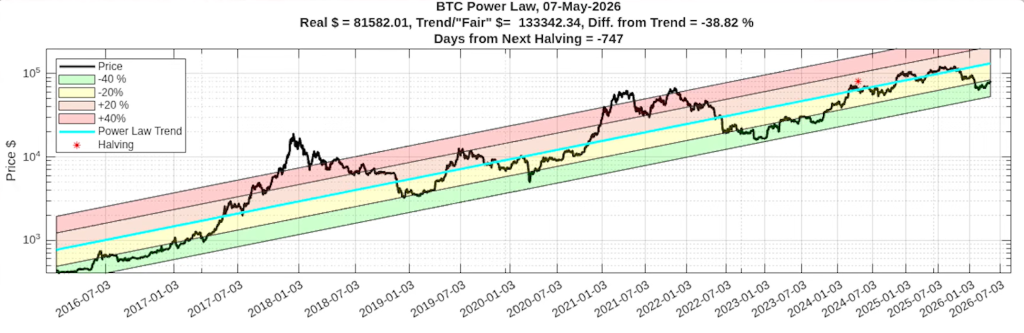
Physicist Giovanni Santostasi says Bitcoin’s long-term price trajectory is not best understood as an S-curve, speculative bubble, or simple exponential trend, but as a power law similar to patterns found in cities, biology and other natural systems. Speaking with Nathalie Brunell on the May 12 episode of the Coin Stories podcast, the director of the Scientific Bitcoin Institute argued that Bitcoin’s historical data points to roughly $1 million per coin in about eight years and $10 million in roughly 20 years.
Santostasi explained his Bitcoin Power Law thesis in detail. His core claim is that Bitcoin’s price has followed a nonlinear mathematical relationship with time since the network’s early trading history. In his formulation, Bitcoin’s price is proportional to time raised to a power of roughly 5.8 to 5.9, often rounded to six. That exponent, he said, is not just a curve-fitting artifact but a “fingerprint” of the system.
“With bitcoin we found a similar relationship where the price is proportional to the time,” Santostasi said. “So the age of bitcoin, how many years, you can measure it in days, you can measure it in years. And then you take the power and that power is 5.8.”
Bitcoin Is Growing Like A City
He acknowledged that Bitcoin remains volatile in the short term, with wars, crises and liquidity shocks producing large deviations. But he argued those moves are oscillations around a deeper trajectory.
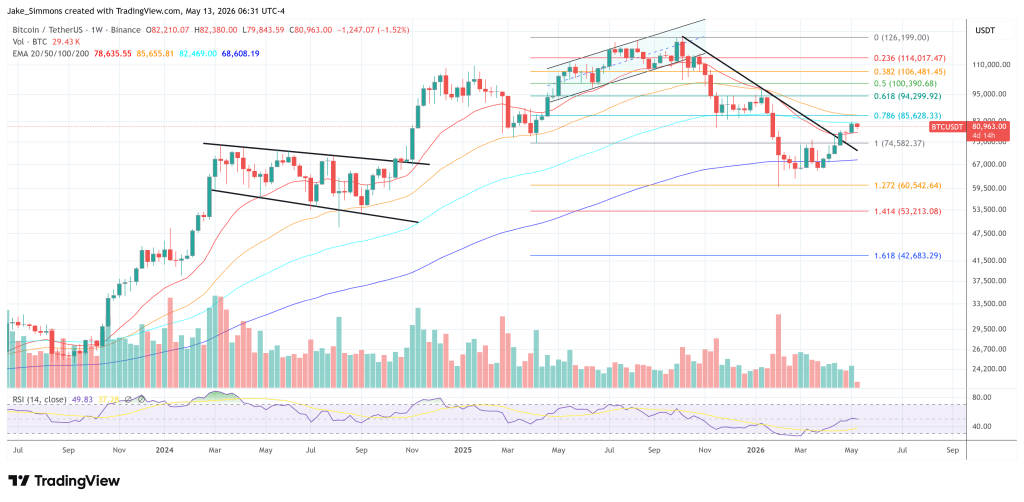
According to Santostasi, Bitcoin’s power law currently implies a central price level around $120,000, while the market has recently traded below that level. He said the lower statistical band, which he described as a kind of floor, is currently near $56,000 to $57,000. He also cited a correlation coefficient of 0.97 for the power law fit, arguing that only around 3% of Bitcoin’s long-term price variation is not described by the model.
A key part of Santostasi’s thesis is that Bitcoin behaves more like a networked organism than a corporate asset. He compared Bitcoin to cities, which he said grow through bottom-up interaction and tend to endure far longer than corporations. Cities, in his telling, follow power laws because their value emerges from networks of people freely interacting, building and exchanging information.
“Bitcoin is like a city,” Santostasi said. “Bitcoin is like tooth and nails and thorns and shells, these natural forms. To me, if you can simplify this message — and because it’s not poetry, it’s science actually, it’s based on data — it is one of the most convincing orange-pilling arguments that you can make.”
The physicist contrasted that with exponential growth, which he associated with systems that expand quickly but eventually hit resource limits. He cited corporations as an example, saying most die within 150 years, while cities such as Rome can persist for millennia. That distinction led to one of the more provocative implications of the discussion: corporations backed by Bitcoin, Santostasi suggested, could theoretically become more city-like in their durability.
“This is one of the reasons why I want Saylor to start adopting this language of a power law,” he said, referring to Strategy executive chairman Michael Saylor. “He could say exactly that. We are turning corporations into cities.”
Santostasi also argued that Bitcoin’s address growth supports the thesis. He said Bitcoin addresses have grown as a power law with time cubed, while price reacts to address growth roughly according to a square relationship, similar to Metcalfe’s Law. Combining those two relationships, he said, produces the observed price relationship of time to the sixth power.
“If you double the number of addresses, the price goes up to four,” Santostasi said. “If you triple it, it goes to nine. So it’s a power law with the square.”
That framework also leads Santostasi to reject the common view that Bitcoin adoption should be modeled primarily as an S-curve, like refrigerators, televisions or other consumer technologies. Those products, he argued, are not networks in the same way Bitcoin is. Bitcoin’s social, monetary and technical layers make it closer to the internet or a city than to a household appliance.
Still, Santostasi stopped short of presenting the forecast as certainty. Asked how confident he is that Bitcoin will reach roughly $1 million per coin in about eight years and $10 million in roughly 20 years, he put the probability near 90%, while leaving room for failure conditions. He said continued capital inflows, larger institutional participation and new pools of capital are necessary for the path to remain intact.
BREAKING: XYO Layer One Just Became Buildable by Anyone — AI SDK & Data Lakes Launch
Breaking News
Layer 1
AI SDK
Data Lakes
$XYO · $XL1
XYO Layer One Just Became Buildable by Anyone — AI SDK & Data Lakes Go Live
No blockchain experience needed. No coding background required. The XYO AI SDK and Data Lakes launch marks the moment real-world verifiable data meets mainstream development — and every product built on this chain feeds transaction volume for $XYO and $XL1.
By Crypto Coin Show Staff
Published: May 12, 2026
Category: Layer 1 · AI · Blockchain Infrastructure
XYO has just made the most significant product announcement in its history. In a dual launch landing today, the blockchain project is opening Developer Suite Early Access alongside a formal launch of Data Lakes — two products that together fundamentally change who can build on XYO Layer One. The message is direct: you no longer need a development background or blockchain expertise to ship a real product on this chain.
The AI SDK sits at the center of that claim. Designed to work with tools like Claude, Cursor, and Windsurf, it lets builders describe what they want in plain language and receive working code that writes directly to a permanent ledger. A prediction market. A cheat-proof blockchain game. A Proof of Location-powered treasure hunt for millions of participants. A farming application that instructs autonomous robots when to harvest. According to XYO, all of it is now buildable in hours.
The things that get built on XYO Layer One over the next few years will be unlike anything the blockchain space has seen.
Data Lakes addresses a problem that has quietly undermined confidence in AI systems for years. Most AI products run on data with no genuine chain of custody — inputs scraped from unknown sources, model outputs with no audit trail, sensor feeds nobody can independently verify. XYO’s Data Lakes give every product built on the chain a foundation of data that is immutable, auditable, and cryptographically verifiable by anyone, forever. The cost to verify stays constant regardless of payload size: a kilobyte or a terabyte costs the same to prove.
5 Things Investors Need to Know
The use cases are concrete. Farming robots, cheat-proof games, Proof of Location treasure hunts — these are real products that anyone can build on XYO Layer One today, not future roadmap items.
Every product built here drives token value. More products mean more transactions, more $XL1 burn, and more $XYO utility — adoption at scale is now the key variable to watch.
Data Lakes solves AI’s trust problem. Enterprises and regulators are increasingly demanding data provenance. XYO now provides it natively at the chain level.
Further announcements are planned. XYO has signaled this is the first in a series of releases rolling out over the coming weeks.
Early access is open now. The products built at the start of a platform shift tend to define what that platform becomes. The window opens today.
The investment case is straightforward. Every product that integrates with XYO Layer One adds to on-chain transaction volume. More transactions drive $XL1 burn and expand $XYO utility. The SDK is effectively an on-ramp designed to scale adoption to levels the chain has not previously seen — and the wider that adoption grows, the stronger the long-term value case becomes for both tokens.
Build with AI, Build for AI
The platform is built for two types of builders — and both end up in the same place.
For Everyone
Build WITH AI
Use Claude, Cursor, or Windsurf to describe your idea in plain language. Receive working code that writes to a permanent ledger. No blockchain background required. Launch in hours, not months.
For Developers
Build FOR AI
Already shipping AI products? Integrate XYO Layer One into your existing stack and add cryptographic proof to model outputs, sensor feeds, agent decisions, and robot telemetry. Every integration generates on-chain transactions.
The implications for enterprise-scale AI are worth considering. The SDK architecture makes possible integrations that would previously have required months of custom development: an AI model that trains on data with a clear, cryptographic chain of custody rather than unverifiable scraped inputs; a logistics network where every robot records its operations directly to a data lake, creating an auditable record of real-world work; a connected vehicle application routing decisions using immutable, private data from calendars and live traffic feeds, all stored on-chain. None of these represent announced partnerships — they illustrate the category of product the platform is now technically capable of supporting.
What’s Live Today
Two products are available as of this announcement. Data Lakes is accessible at xyo.network/data-lakes, and Developer Suite Early Access is open at xyo.network/build/early-access. The Developer Suite brings together JS, React, and CLI SDKs alongside the AI SDK, with integration designed to take minutes rather than months.
0
Coding Background Required
HOURS
Time to First Deployment
∞
Payload Verification Scale
JS · CLI
React & More Supported
What to Watch
For investors tracking $XYO and $XL1, the key metric going forward is developer adoption. Every builder who integrates with XYO Layer One represents a recurring source of transaction volume. The Data Lakes product addresses genuine, growing demand from enterprises and regulators who increasingly require data provenance — this is not a speculative use case, but a current, unsolved problem that XYO now has a credible answer to.
XYO has confirmed this is the first in a series of announcements planned for the coming weeks, suggesting the full scope of the launch extends beyond what is public today. Whether that promise is realized will depend on developer uptake, but the architecture is now in place and the early access window is open.
The SDK makes complex integrations buildable today, by anyone, in hours — no partnership announcement required.
Consider what the Proof of Location network alone makes possible: a consumer brand that can verify where and how a product was used, powering loyalty programs and real-world rewards at scale. These are the categories of application the platform is now inviting anyone to build. The question is not whether the infrastructure exists — it does, as of today. The question is how quickly the developer community moves to use it.
Ready to build on XYO Layer One?
No coding experience needed. Developer Suite Early Access is open now.
An attack on the V1 smart contracts of Huma Finance on Polygon resulted in a loss of $101,400 USDC. The exploit added to what’s already been a difficult time for DeFi protocols on the network.
The exploit was reported by web3 security firm Blockaid. The attacker targeted BaseCreditPool deployments related to Huma’s older V1 infrastructure. The total loss was ~$101,400 in USDC and USDC.e coins across various contracts.
Huma Finance confirmed the incident on X, saying “No user funds at risk and PST is not impacted.” The team said its V2 system, which runs on Solana, was built from scratch. It shares no code with the compromised contracts.
Huma’s V1 flaw was in one function
The smart contract flaw was found inside a function named refreshAccount(). Its a function located within the V1 BaseCreditPool contracts. Blockaid security researchers identified the bug. They shared more information on X, saying:
“Bug: refreshAccount() unconditionally promotes a Requested credit line to GoodStanding, bypassing the EA approval step and enabling drawdown().”
refreshAccount() labelled accounts with ‘good standing’ without actual verification or conditions. The attacker took advantage of this flaw and drained funds from the protocol’s treasury pools
The losses were found in three contracts according to Blockaid’s on-chain analysis. One account lost ~82,300 USDC. A second lost ~17,300 USDC.e. And a third account lost ~1,800 USDC.e. According to on-chain data, the entire exploit was completed in one transaction.
There was no cryptographic issue. The attacker just changed the contract’s state machine to trick it into treating an unauthorized account as legit.
Huma’s team wrote on X, “Earlier today a vulnerability in Huma’s legacy v1 contracts on Polygon was exploited for 101,400 USDC.” They continued, “Huma’s v2 system on Solana is a complete rewrite and this issue does not apply to v2 systems.”
Huma said it had already been winding down V1 operations before the exploit occurred. The team said on X, “The teams were already in the process of sunsetting all the legacy v1 pools, and have paused v1 completely now.”
After the incident, the team fully paused all remaining V1 contracts. The company said that user deposits on V2 were untouched and that the newer platform continues to operate normally.
According to a recent report from Cryptopolitan, the exploit took place on the same day that Ink Finance lost almost $140,000 from its Workspace Treasury Proxy contract on Polygon. The attacker deployed a contract matching a whitelisted claimer address to bypass eligibility checks.
In both incidents, the attackers found logic mistakes in smart contract design. The back-to-back exploits on Polygon come after April 2026, setting the record for the worst month of smart contract losses.
Circle’s $222 million ARC token presale has given Wall Street a new way to value the USDC issuer, while raising a harder question for one of crypto’s most profitable alliances.
On May 11, Circle said investors led by a16z Crypto backed the presale of ARC, the native token for Arc, its planned public blockchain for institutional finance.
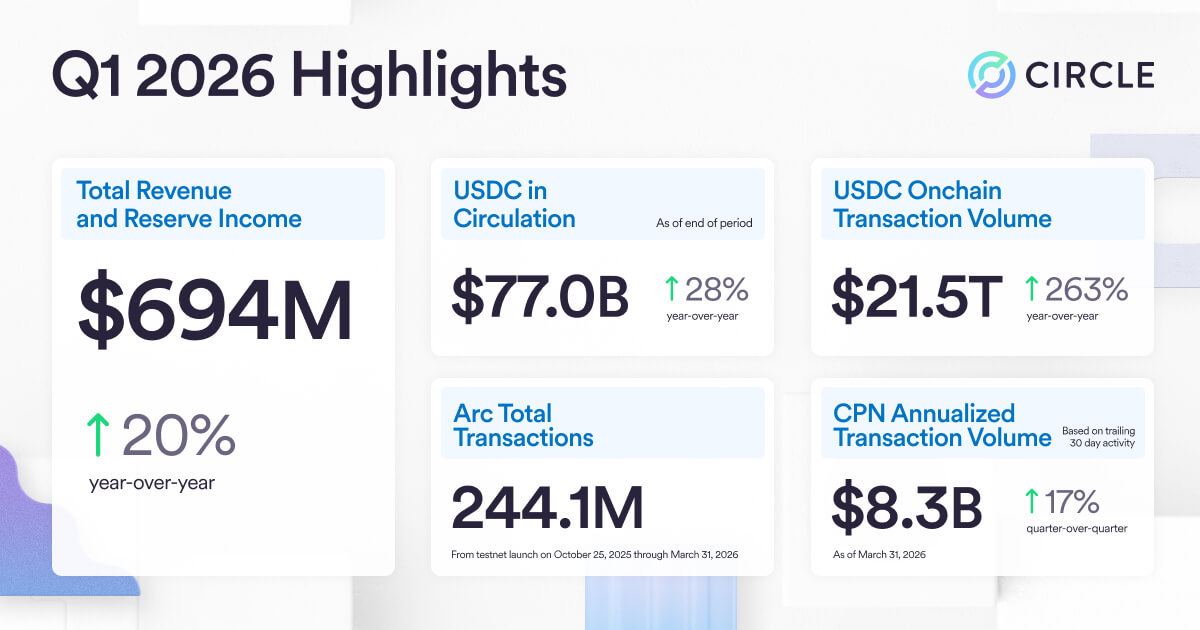
The sale valued the network at $3 billion on a fully diluted basis and came alongside first-quarter results that showed $694 million in total revenue and reserve income, up 20% from a year earlier.
At the same time, USDC in circulation rose 28% to $77 billion, while on-chain transaction volume reached $21.5 trillion, up 263% year over year.
Circle’s Q1 Earnings Report (Source: Circle)
Those figures reinforced Circle’s position as one of the main issuers in the global stablecoin market, where tokenized dollars have become core infrastructure for trading, payments, and settlement.
However, the more important development was Circle’s attempt to move beyond issuance through its new blockchain network, Arc.
Arc gives the company a network-level growth story built around payments, tokenized assets, foreign exchange, capital markets, and AI-driven commerce.
That push places Circle closer to the terrain already occupied by Coinbase, its longtime USDC partner and the operator of Base, the Layer 2 network that the US-based exchange has positioned as a settlement layer for stablecoins, consumer payments, and agentic transactions.
Considering this, Circle’s aggressive expansion could bring a new competition to the crypto landscape: a looming, head-to-head battle with Coinbase.
Circle gives investors a wider story
Circle’s business has long been tied to the economics of stablecoin reserves. The company issues USDC, holds safe assets backing the token, and earns income on those reserves.
That model can be powerful when rates are elevated, but it also raises questions about how durable its earnings will be as interest income declines.
The company is pitching the network as an “economic operating system” for the internet, a shared environment where stablecoins, tokenized assets, and financial applications can operate on common infrastructure.
The chain is expected to be EVM-compatible, with stablecoin-native fees, deterministic sub-second finality, and configurable privacy designed for institutions that need auditability without exposing every transaction detail to the public.
Circle Chief Executive Jeremy Allaire framed the quarter around the convergence of AI platforms and on-chain money, saying:
“Circle’s first quarter reflected strong execution against a much bigger opportunity: the rapid convergence of AI platforms and economic operating systems into a new internet stack. With the ARC token presale, momentum behind the Arc network, and the launch of our Agent Stack, we are building trusted infrastructure for AI-native economic activity and a more programmable internet financial system.”
The investor list shows how far that pitch now reaches. a16z Crypto led the presale with a $75 million investment.
Other participants included BlackRock, Apollo Funds, Intercontinental Exchange, SBI Group, Janus Henderson Investors, Standard Chartered Ventures, General Catalyst,a IDG Capital, Haun Ventures, and Bullish.
The message to investors is clear: Circle wants to be valued less as a stablecoin issuer exposed to rate cycles and more as a full-stack infrastructure company for on-chain finance.
In a note shared with CryptoSlate, Clear Street analysts echoed that view, writing that Circle is “no longer a pure crypto play” and has built the Layer 1 network, application layer, and partner ecosystem required to become a critical infrastructure provider.
The firm raised its price target on the stock from $152 to $157, citing Arc, Agent Stack, Circle Payments Network, and regulatory momentum as potential sources of upside.
USDC already moves across more than 30 blockchains and is integrated throughout exchanges, wallets, fintech platforms, and institutional systems.
That distribution has been one of the stablecoin’s main strengths. Circle could grow as USDC became more widely used, regardless of where the activity settled.
Arc gives Circle a reason to bring more of that activity onto the infrastructure it controls.
The network is designed to support payments, lending, foreign exchange, capital markets, and tokenized assets. Circle has also positioned ARC as a coordination token for validators, builders, liquidity providers, exchanges, institutions, and users.
In that structure, USDC remains the transactional asset, while ARC is intended to help govern economic rules and align network participants.
That creates a broader economic layer around Circle’s core product. If Arc gains traction, investors will not only measure Circle by USDC circulation and reserve income.
They will also track transaction volume, developer adoption, institutional participation, validator activity, and the degree to which Circle can capture revenue from the infrastructure surrounding USDC.
Circle Payments Network adds another part of that strategy. Clear Street said CPN reached $8.3 billion in annualized total payment volume and approached $10 billion by May 7, with 136 financial institutions enrolled.
Managed Payments is intended to reduce friction for banks and payment service providers by handling licensing, liquidity, custody, and compliance burdens.
Taken together, Arc, Agent Stack, CPN, and Managed Payments give Circle a more ambitious public-market story. The company is trying to become the platform where digital dollars move, settle, and interact with software.
That ambition makes the Coinbase relationship more complicated.
Coinbase already controls much of the flow
However, Coinbase has its own claim to the USDC infrastructure story.
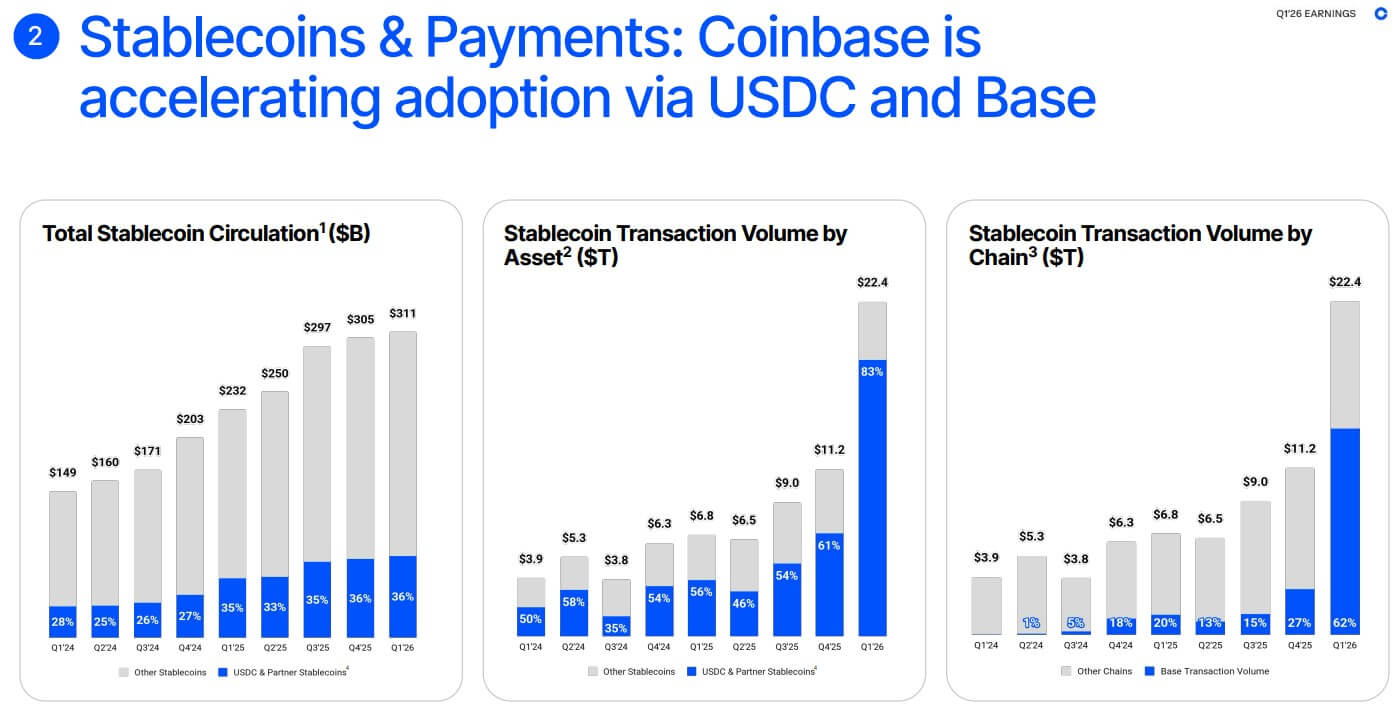
In its first-quarter report, the company described itself as the distribution engine for USDC, with more than 25% of total USDC in circulation, or about $19 billion on average, held across Coinbase products.
Coinbase said Base processed 62% of global on-chain stablecoin transaction volume during the quarter, more than all other chains combined.
At the same time, more than 100 million payments were processed through its x402 protocol, with more than 99% completed using USDC.
How Coinbase is Growing Stablecoin Adoption via USDC and Base (Source: Coinbase)
Those figures show why Arc is sensitive for Coinbase.
Coinbase is no longer merely a distribution channel for Circle’s stablecoin. It is building the rails around the asset.
Its stack includes USDC as the programmable dollar, Base as the low-cost settlement network, and Coinbase Developer Platform, AgentKit, and x402 as infrastructure for developers and AI-enabled payments.
Circle’s emerging stack points in the same direction. USDC provides the dollar asset, Arc provides the network, Agent Stack targets AI-native commerce, and CPN connects financial institutions and payment companies.
The companies remain commercially aligned around USDC growth. But their infrastructure strategies increasingly point toward the same flows.
The alliance gets a new scoreboard
For years, the Circle-Coinbase relationship was one of crypto’s cleanest partnerships. Circle issued USDC. Coinbase distributed it across its exchange, wallet, and institutional products. The stablecoin gained scale, and Coinbase shared in the economics.
That relationship helped make USDC one of the most important dollar assets in crypto. It also gave Coinbase a major stablecoin revenue line and helped turn USDC into a regulated alternative to Tether’s USDT for many US-based institutions.
However, Arc introduces a different incentive structure.
Omar Kanji, an investor at Dragonfly, captured the concern in a post asking how long the “marriage” between Circle and Coinbase can stay clean.
His argument was that the old model worked when Circle was the issuer, and Coinbase was the distributor. But Circle’s public-market demands and Arc’s token-backed network now require the company to show investors that it can own more customers, flows, and infrastructure directly.
That is where Arc overlaps with Base. Circle wants Arc to host USDC balances, tokenized assets, payments, settlement, and eventually foreign-exchange activity. Coinbase wants Base to serve as the main venue for stablecoin payments, on-chain consumer transactions, AI-agent activity, and institutional settlement.
The tension is already visible in adjacent products. Coinbase has cbBTC, a wrapped BTC product used across DeFi. Circle is preparing cirBTC, which is designed to integrate with Arc and Circle Mint.
While this overlap does not signal an immediate rupture, it shows that the companies are no longer staying in separate lanes and are beginning to compete on similar products.
AI payments raise the stakes
The competition becomes more significant when viewed through the lens of agentic commerce.
AI agents are expected to become a larger share of internet activity, handling tasks such as purchasing data, paying for software, settling invoices, managing subscriptions, and executing business processes.
Those transactions require programmable money, low-cost settlement, and infrastructure that can authorize spending without constant human intervention.
Stablecoins are well-suited to that environment because they operate continuously, settle quickly, and can be embedded directly into software. That has made agentic commerce one of the most attractive long-term narratives for stablecoin infrastructure providers.
Coinbase is already claiming early leadership. Its first-quarter materials pointed to Base’s share of on-chain agentic stablecoin transaction volume and the rapid growth of x402 payments. The company is presenting Base, USDC, AgentKit, and x402 as a ready-made stack for machine-driven economic activity.
Circle is moving to meet that opportunity with Agent Stack and Arc. Allaire has framed AI platforms and on-chain money as part of a new internet stack, and Circle’s product roadmap suggests the company wants USDC to become a settlement layer not only for humans and institutions, but also for software agents.
Considering this, Tom Wan, the head of data at Entropy Research, concluded:
“[Circle and Coinbase] business lines are converging across blockchain, tokenization, payments and stablecoins. A formal split is unlikely given the mutual benefits still on the table, but the trajectory is clear. Both sides are building toward a less dependent relationship, and the overlap will only create more friction over time.”
The Sui Network is moving to redefine the balance between transparency and confidentiality by integrating native private transactions directly into its core protocol. Unlike traditional systems where transparency is the default, Sui aims to make confidentiality a built-in feature, eliminating the need for users to rely on external tools.
Why Sui’s Native Privacy Upgrade Matters For Blockchain Adoption
The SUI network is preparing to make a move in blockchain infrastructure by embedding native private transactions directly into its base protocol in 2026. Crypto analyst Kyle Chasse highlighted that, unlike traditional approaches, this model requires no optional privacy tools and no separate privacy layer, with transaction details visible only to the sender and receiver by default.
Mysten Labs Chief Product Officer, Adeniyi Abiodun, believes privacy is essential for mainstream blockchain adoption, particularly in the payments sector. Abiodun stated that achieving mass global consumer adoption for digital payments is impossible without built-in privacy protections.
Most blockchains have treated privacy as an add-on layered on top of existing infrastructure. SUI is taking a different approach by making privacy a first-class primitive, enabling developers to build applications on it.
This shift directly addresses a long-standing barrier to on-chain institutional adoption. In today’s transparent systems, transaction flows are visible in real time, allowing competitors to monitor activity, strategy, and liquidity movements.
A major shift is underway in one of the world’s most powerful crypto markets. The Sui Intern has revealed that South Korea’s massive crypto liquidity is beginning to move on-chain, driven by a wave of new regulations that are reshaping how capital flows through the ecosystem.
Recent developments surrounding stablecoin legislation, tokenized asset frameworks, and broader digital asset regulation are opening the door for Korean exchange capital to flow directly into decentralized finance protocols, self-custody wallets, and on-chain finance systems.
As a result, one of the most liquid crypto markets in the world may be shifting away from centralized platforms and into on-chain infrastructure. Among the potential beneficiaries is Sui Network, which is positioning itself as a high-performance destination for this incoming liquidity.
Sui Network Strength Continues Turning Heads Across Crypto Market
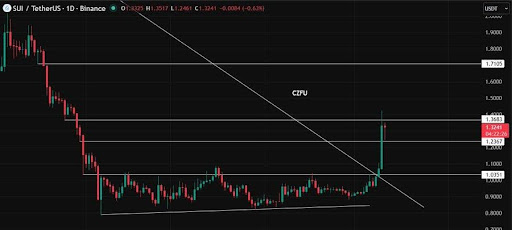
Sui Network is showing explosive momentum, with price action breaking out of a 7-month descending trendline and moving through three key resistance levels. According to the Sui Community on X, the rally has sparked renewed bullish momentum in the SUI, with many anticipating the $1.36 level as the next major breakout point. A confirmed move above this zone could open the door to $1.71 and potentially reach the $3.32, which would mark a new all-time high.
Sui Community noted that this is a remarkable development in the market, with Sui Network showing incredible strength. If this trajectory holds, SUI could be entering a high-volatility phase, where rapid price expansion becomes the norm, and many market participants will start to pay attention to SUI.
Bermuda’s government is sticking to their plan of migrating their national economy onchain and is now partnering with the Stellar Development Foundation to move payments and other financial services onto its network, XLM.
The island mentioned that its residents were facing processing costs of up to 10%, making the move onchain not just an attempt at modernizing the system, but a necessary step for retaining economic value.
Bermuda moves onchain
The Stellar Development Foundation and the Government of Bermuda announced today that Bermuda will begin moving its payment and financial activities onto the Stellar network (XLM). Bermuda revealed its plans to become the world’s first fully onchain national economy at the World Economic Forum in January this year.
The announcement explains that local merchants currently pay 3% to 5% per transaction in card fees, and effective payment processing costs can reach as high as 10% in some categories. Introducing the use of digital assets and infrastructure will keep more of that value on the island.
Under the plan, Bermudian residents will be able to receive wages, pay local merchants, settle government fees, and hold, send, and receive digital assets through digital wallets on the Stellar network.
Government agencies expect to pilot stablecoin-based payments, financial institutions will be able to integrate tokenization tools, and residents can participate in nationwide digital literacy programs. Digital assets may also be used for government payment systems related to social service disbursements.
“The lack of mobile money applications and reliance on legacy payments infrastructure has left Bermudians paying high payment processing fees and hindered additional economic growth opportunities,” The Hon. E. David Burt, JP, MP, Premier of Bermuda said.
Denelle Dixon, the CEO and Executive Director of the Stellar Development Foundation, added that Stellar was built for the purpose of seamlessly connecting the global financial system.
Before Bermuda, the Philippines had also launched a blockchain transparency system called Integrity Chain for its Department of Public Works and Highways (DPWH) after citizens held mass protests over corruption in flood-control projects.
An estimated 130,000 people protested on September 21, 2025, demanding accountability after reports of overpriced contracts, substandard construction, and ghost projects. The Australian Institute of International Affairs shared that the Philippines allocated over $33 billion to flood-control projects across 15 years.
What other blockchain initiatives is Bermuda working on?
Cryptopolitan recently reported that the Bermuda Monetary Authority (BMA), the island’s central bank and financial regulator, recently completed an “Embedded Supervision Solution” with Chainlink (LINK), Apex Group, Bluprynt, and Hacken.
The solution, announced earlier this month, demonstrates how rules can be built directly into digital asset infrastructure and enforced in real time. The system uses Chainlink’s Automated Compliance Engine (ACE) to check every transaction against Bermuda’s policies.
With Proof of Reserve, it verifies that digital dollars are backed by real money in a bank account. It also uses Secure Mint to stop new coins from being issued when reserve limits have been reached.
Apex Group, acting as an independent fund administrator with $3.5 trillion in assets serviced across 52 countries, supplies authenticated reserve data from third-party custodians. Hacken’s Extractor platform provides real-time onchain monitoring with a detection speed of 250 to 500 milliseconds.
The market has not shown significant price action following today’s announcement. XLM is trading around $0.1622, down approximately 4.82% over 24 hours, according to CoinMarketCap data.
XLM has spent most of 2026 trading below $0.20, fluctuating primarily within the $0.15 to $0.18. The 0.20 level now serves as both technical resistance and a major psychological barrier. Above this level, the next resistance zone sits around $0.22 to $0.25. On the downside, support clusters around the $0.15 to $0.16 range.
Notably, the CME Group began rolling out futures for XLM in February 2026, but the impact on XLM’s price has remained limited, and the futures listing has not yet generated enough buying momentum to push the token out of its sideways range.
According to the Stellar Foundation, the network surpassed $2 billion in onchain real-world asset (RWA) value in the first quarter of 2026. Data from DeFiLlama shows that the network currently has a stablecoin market capitalization of approximately $ 415 million, with its daily decentralized exchange (DEX) volume around $1.83 million.
Over the past week, Cardano’s ADA has surged 6%, making it one of the best-performing top-15 cryptocurrencies.
Numerous analysts have recently spotted that the asset has been following a similar pattern witnessed during previous bull cycles, suggesting this could be just the beginning of a major rally.
‘Printing by the Plan’
Earlier this month, ADA came close to reclaiming the $0.30 mark, reaching its highest level since mid-March. It currently trades around $0.27, while its market capitalization remains above $10 billion.
The asset is often among the most talked-about cryptocurrencies and becomes the subject of price predictions. One popular analyst who recently touched upon the matter is JAVON MARKS. The X user claimed that ADA continues to maintain a similar structure to that observed in 2021 and shows “signs of strength.” They set a target of $2.91, meaning that the price could be gearing up for a whopping 10x pump.
Prior to that, Sssebi opined that ADA had been consolidating over the past few months, as it did towards the end of 2024, which was later followed by a price increase above $1.30. That said, the analyst believes a surge above $1 is still in play this year.
For their part, Vuori Trading argued that ADA is still “printing by the plan” and sits in a “strong buy level.” The analyst envisioned a staggering jump to as high as $14, occurring sometime between Q3 2027 and Q1 2028.
Ali Martinez has also given his two cents lately. He emphasized the importance of the $0.25 support zone, noting that it has repeatedly acted as a major inflection point for the token.
For instance, in January 2023, ADA bounced off $0.25, resulting in an 88.27% jump over the following weeks. In September that year, this level again served as firm support, sparking a 243% surge.
More Bullish Signals
ADA’s Relative Strength Index (RSI) also supports the bullish case for further price increases. The ratio of the technical analysis tool has plunged to 22, indicating the asset has entered oversold territory and could be gearing up for a move north.
ADA RSI, Source: RSI Hunter
The RSI measures the speed and magnitude of recent price changes and provides traders with vital information about potential price reversal points. It runs from 0 to 100, and conversely, anything above 70 is interpreted as a warning for an impending pullback.
S&P 500 payments business Corpay has today announced it is integrating stablecoin wallets and settlement into its global platform. This will give its +800,000 business clients payment rails that are open 24 hours a day, seven days a week, excluding bank holidays and weekend cutoffs.
The integration comes via a partnership with BVNK, a stablecoin infrastructure provider. Corpay customers will be able to keep stablecoin balances alongside their fiat currencies. They’ll be able to send, receive, store and convert stablecoins, all without ever leaving the Corpay interface, according to the release.
Corpay (NYSE: CPAY) processes +$12 billion in corporate payments each month. It also handles ~$26 billion in foreign exchange volume across over 145 currencies. The Canadian company plans to wire stablecoin rails into its own treasury operations too. This will cut its dependence on pre-funded accounts and speed up fund movement across its global network.
“At our scale, the ability to move liquidity quickly and reliably is critical,” said Mark Frey, Group President of Corpay Cross-Border Solutions. “Stablecoins introduce a 24/7 settlement capability that strengthens our existing infrastructure. BVNK provides the technology and compliance framework we need to deliver this securely and at scale.”
Jesse Hemson-Struthers, BVNK’s CEO, said Corpay’s reach makes the company a strong partner for pushing stablecoin payments into broader corporate adoption. He added, “Together, we’re enabling faster, more efficient ways for businesses to move and manage money across borders.”
BVNK attracts Mastercard, Visa, and Citi
Mastercard announced plans to acquire the company in a deal that could reach $1.8 billion by the time it closes at the end of 2026. Mastercard CEO Michael Miebach cited BVNK’s network of stablecoin stakeholders, liquidity providers, and hard-to-get licenses as the primary reasons for the purchase. He discussed the acquisition during the company’s Q1 2026 earnings call.
Visa Ventures, the investment arm of Visa, has invested in BVNK. Citigroup started backing BVNK in October 2025, according to Cryptopolitan. Arvind Purushotham, head of Citi Ventures, said that stablecoins are becoming more popular as a way to settle on-chain and crypto deals. He called out BVNK’s enterprise-grade infrastructure as a draw.
BVNK co-founder Chris Harmse said that the demand for stablecoin infrastructure has surged. The U.S. represents the company’s fastest-growing market. He pointed to the passage of the GENIUS Act as a catalyst for institutional confidence.
Stablecoins expand corporate payments integration
The Corpay deal lands as stablecoins continue to expand beyond crypto native use cases.
Dollar pegged stablecoin supply has reached $301 billion, according to data from CoinGecko. Tether’s USDT accounts for $189.6 billion of that total. Circle’s USDC sits at ~$77 billion.
Visa recorded a $7 billion annual run rate in stablecoin settlement volume during its most recent earnings call. That figure jumped +50% quarter over quarter. The card network now has +160 stablecoin card programs running globally with partners including Rain, Reap, and Bridge.
Citi raised its stablecoin market forecast in September. The bank projected the sector could hit $4 trillion by 2030 under a bullish scenario, up from earlier estimates of $1.6 trillion and $3.7 trillion, per Cryptopolitan.
Jayne Black is a Wisconsin-area environmentalist and mother of four. An organizer with the group Moms Clean Air Force, Black has plenty of experience struggling for environmental justice throughout her home state — but when a proposed data centered forced the fight onto her own doorstep, she won in a round-one knockout.
A 64-year old activist, Black first got her start organizing when two of her four children were diagnosed with asthma related to environmental factors and multiple sclerosis, People reported.
After learning about the a data center proposal on a plot of land 12 miles away from her home, she was horrified. “When you speak about wanting changes for cleaner air, and you have a child who’s impacted, it hits differently,” she told the magazine. “It’s gut-wrenching, and knowing too that these data centers primarily are using fossil fuels. It’s really disappointing and it’s scary.”
Black started a Facebook group to inform the public about the development, and the extremeenvironmentalcosts the facilities engender. Now called “Stop the Northeast Wisconsin Data Centers,” the group gathered over 2,000 members within just the first two days alone, and it’s since swelled to around 3,700.
Per her interview with People, Black used concerns around the area’s natural beauty as a jumping-off point to educate locals about the environmental harms data centers cause — effectively meeting people where they were at and building awareness from there.
“They’re like, ‘this is farmland. I don’t want it in my backyard. I love where I live. It’s gorgeous. It’s beautiful. I don’t want this,”” Black told People. “And then when you start talking to them about what this really would mean for their community and their health, they’re even more concerned. So that was the organizing part.”
Within days of the Facebook group’s launch, the facility’s Texas-based development firm Cloverleaf withdrew its plans, blaming a lack of support from local officials.
While it’s a huge win for the town of Greenleaf, Black acknowledges that the fight is far from over. “We had such strong opposition, [Cloverleaf] said, ‘okay, we’ll just go elsewhere.’ And that’s what they do, unfortunately.”
Still, the 64-year-old organizer isn’t gatekeeping any of this, and hopes the successes her nearby town enjoyed will inspire others to take action wherever the next Cloverleaf development pops up.
“I work with organizers all across the country, and so we really want Greenleaf to be inspirational to the fact that community pushback works, like how important your voice is,” Black told People. “I was just one person who started a Facebook page.”
Crypto trader and X personality Unihax0r lost +$200,000 on May 11 after someone drained two of his wallets across Ethereum, Base, and BSC. On-chain analysts think it was a private key leak linked to a Telegram trading bot.
“Just got drained or hacked for more than 200k. Sick to my stomach,” Unihax0r posted on X. He shared the attacker’s wallet address and asked people to help trace the funds.
Attacker swept three chains in under an hour
This wasn’t a smart contract exploit since there’s no malicious token approval.
On-chain analyst @k0braca1 looked at the transactions right after it happened and said it looked like a private key leak. The attacker “had full control over signing operations across multiple chains: Ethereum, Base and BSC.”
The drain took somewhere between 10 and 30 minutes. The biggest chunks were about $125,000 in $POD tokens on Base and $21,000 in $FHE on BSC, plus ETH and smaller positions. The attacker even sent a bit of ETH to the Ethereum wallet first to cover gas for sweeping the remaining token balances.
Hey bro, sorry this happened to you.
My quick assessment of what happened. The exploit looks like a private key leak rather than related to any malicious transactions, as the attacker has full control over signing operations across multiple chains: Ethereum, Base and BSC. It…
Both crypto wallets that got drained were created via a Telegram multichain trading bot called SIGMA. Unihax0r imported those wallets into GMGN, which is another Telegram trading tool, and Rabby Wallet.
Other wallets on Rabby and Jupiter were not drained since the SIGMA bot did not create them. This means that the SIGMA trading bot is the probable cause of this attack.
Investigators in the community have come up with a few ideas about what caused the theft of secret keys:
Telegram phishing through fake CAPTCHA bots that pop up when you use SIGMA.
Malware or infostealer infections.
Device compromise.
Malicious browser extensions.
Unihax0r said he checked his Telegram account and found no suspicious sessions, per Crypto Times.
The stolen crypto went to an externally owned account that the attacker controls.
The stolen crypto was transferred to an external wallet owned by the attacker. On-chain data shows the stolen tokens are already being mixed by the attacker.
Most of the assets are still sitting in the attacker’s wallets on Base. Community members and fraud tracking accounts have offered to help trace funds, but the odds of getting the money back are low.
Telegram bots are a structural weak point
Crypto losses connected to Telegram trading bots keep piling up. When a user generates wallets through Telegram bots, the private keys get created and stored within the bot’s infrastructure.
Security researchers from ForkLog warned about using Telegram bots to trade crypto. They explained that Telegarm bots “could potentially lead to asset losses and are not safeguarded against hacker attacks.”
Telegram bot scams have been ramping up. Web3 anti-scam platform ScamSniffer said Telegram group malware scams jumped by 2,000% between November 2024 and January 2025. Attackers use fake verification bots and phony group invitations to push malware that can access wallets and browser data.
Last September, Banana Gun, which is one of the most active Telegram trading bots, had 36 wallets exploited for 536 ETH. That was ~$1.9 million at the time. The bot went offline after that.