
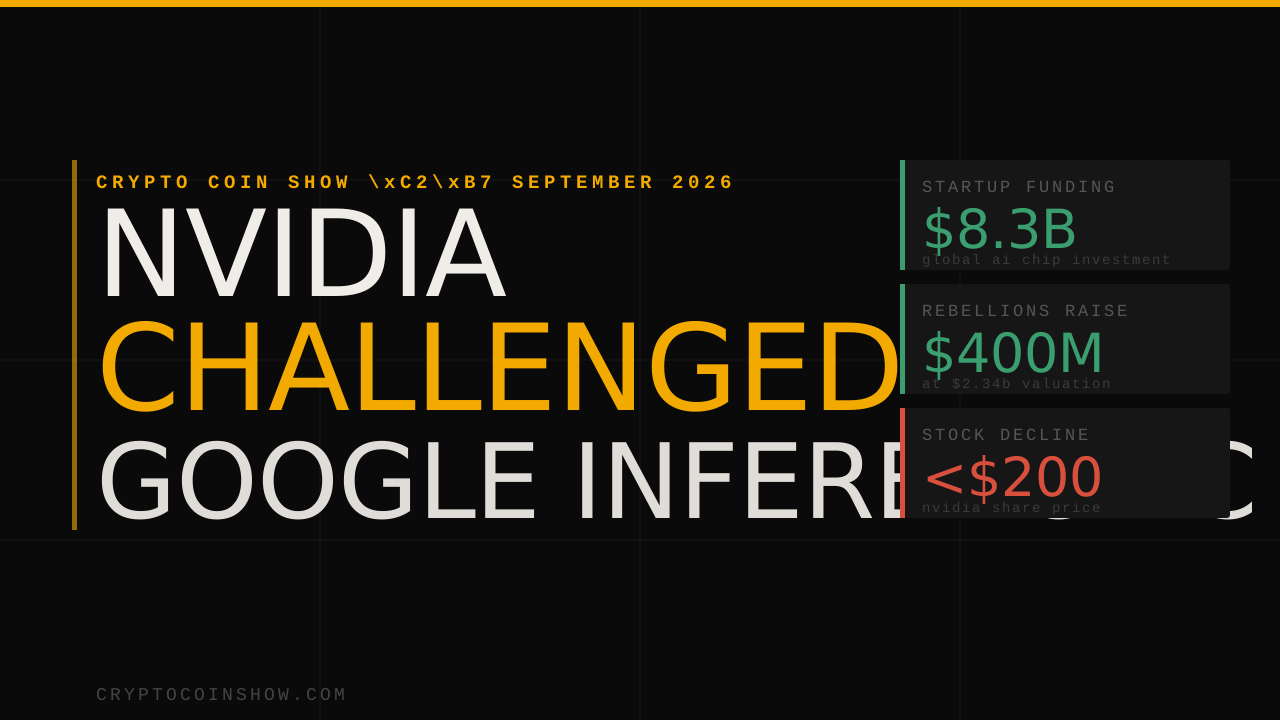
Nvidia’s stock dipped below $200 as Google prepares new inference chips
Google is preparing to launch specialized inference chips directly challenging Nvidia’s dominance in AI accelerators, while billions of dollars flow to competing chipmakers globally. For institutional investors, this signals a structural shift in AI infrastructure spending away from Nvidia’s GPU monopoly toward specialized alternatives.
- Google preparing new TPU generation focused on inference at Google Cloud Next conference this week in Las Vegas
- AI chip startups raised $8.3 billion globally in 2026, with Rebellions alone securing $400 million at $2.34 billion valuation
- Anthropic contracted for 1 million TPUs while Meta uses them via Google Cloud under multi-billion-dollar agreement
- $8.3B Total global AI chip startup funding in 2026 versus record-setting pace
- $400M Rebellions funding round, largest single raise by competing chipmaker this cycle
- $199.48 Nvidia closing stock price Monday, down 0.79% on the day
Nvidia’s stock fell to $199.48 on Monday, a modest 0.79% decline that on its surface signals routine market volatility.
But the timing and context reveal a more substantive challenge: Google is preparing to announce a new generation of tensor processing units at its Google Cloud Next conference in Las Vegas this week, deliberately targeting inference workloads, the fastest-growing segment of Nvidia’s AI accelerator business.
The move represents Google’s most aggressive entry into specialized chip design for production AI, backed by major customer commitments from Anthropic, Meta, and potentially Abu Dhabi’s G42.
Nvidia’s technical picture remains constructive despite the single-day decline. The stock sits above its 20-day, 50-day, and 200-day moving averages, all clustered near $181-$183, suggesting the longer-term uptrend persists. The MACD continues to flash a buy signal, and the ADX reading of 15.28 indicates weak but continuing upward momentum.
These indicators typically matter less to institutional investors than the fundamental threat Google’s announcement poses to Nvidia’s market share in AI inference.
Google Chief Scientist Signals Specialization Strategy for Inference Workloads
Google’s pivot to specialized chips reflects a deliberate engineering philosophy: inference and training require different computational profiles, and custom silicon can outperform general-purpose GPUs in one domain without sacrificing the other.
Jeff Dean, Google’s Chief Scientist, stated this reasoning directly: “It now becomes sensible to specialize chips more for training or more for inference workloads.” The company, he added, is “looking at a whole bunch of different things,” including the speed at which it can deliver AI results to end users, a competitive metric where specialized hardware offers measurable advantages.
This specialization argument carries weight with large-scale AI operators. Anthropic has already committed to 1 million TPUs, a volume commitment that signals confidence in Google’s roadmap. Meta is deploying TPUs through Google Cloud as part of a multi-billion-dollar infrastructure agreement, effectively validating Google’s inference performance claims against Nvidia alternatives.
Citadel Securities will present data at the upcoming Google conference comparing TPU training speeds directly against GPUs, putting competitive performance claims in front of an institutional audience.
Google is also removing friction from TPU adoption by loosening access controls that previously locked customers into Google’s software ecosystem. Some customers can now run TPUs inside their own data centers, and Google is supporting external frameworks like PyTorch rather than forcing reliance on proprietary tools.
This move mirrors the playbook that made Nvidia dominant: remove switching costs, make integration easy, let the superior performance do the selling. OpenAI’s reported frustration with Nvidia’s inference hardware and active search for alternatives suggests the strategy is working beyond Google’s direct customer base.
AI Chip Startups Raise Record $8.3 Billion Globally in 2026
Google’s announcement arrives as venture funding for specialized AI chips reaches unprecedented scale. Global AI chip startups raised $8.3 billion in 2026, putting the sector on pace for a record funding year, according to Dealroom data. This capital influx reflects genuine venture confidence that Nvidia’s dominance is vulnerable to specialized competitors, not merely a speculative bubble.
The U.S. market alone saw several nine-figure rounds. Cerebras raised $1 billion in February, while MatX, Ayar Labs, and Etched each secured $500 million rounds, demonstrating that multiple capital sources view alternative architectures as fundable paths to market share.
European competitors moved in parallel: Axelera and Olix both raised over $200 million, suggesting the opportunity is geographically distributed rather than concentrated in Silicon Valley or Asia.
South Korea’s Rebellions stands out as the most ambitious entrant. The Samsung-backed startup raised $400 million at a $2.34 billion post-money valuation, led by Mirae Asset Financial Group and South Korea’s state-backed National Growth Fund.
More significantly, Rebellions has raised $650 million in the past six months alone, representing more than 75% of its total funding, indicating accelerating investor momentum. The company is explicitly targeting U.S. customers, positioning itself as a direct Nvidia alternative rather than a niche player.
Institutional Capital Recognizes Inference as Detachable Market Segment
The clustering of capital around inference-specific startups signals a shift in how institutional investors view AI infrastructure. Inference represents a distinct business, lower computational density than training, higher volume, different hardware requirements, and therefore a separable competitive arena.
Nvidia’s dominance in training does not necessarily translate to inference, where the economics favor specialized, lower-power, cost-optimized designs.
This disaggregation matters to public equity investors because it fragments the serviceable addressable market Nvidia can defend. A decade ago, GPU vendors could argue that a single architecture, designed for maximum flexibility, would dominate all AI workloads. That argument is collapsing under the weight of evidence from production deployments.
Large AI labs like Anthropic, Meta, and OpenAI are large enough to evaluate alternatives directly, benchmark them against Nvidia, and commit capital to whichever performs better. None of these three organizations have exclusive loyalty to Nvidia’s architecture.
The venture funding pattern also suggests that institutional limited partners believe multiple winners will emerge, not consolidation back to Nvidia. If the market truly expected Nvidia to maintain monopoly pricing and market share, venture returns would be unattractive, and $8.3 billion would not flow into startups.
The mere fact that well-capitalized VCs from Abu Dhabi, South Korea, Europe, and the U.S. are all backing competing designs indicates consensus that sustainable revenue streams exist outside Nvidia’s shadow.
Google Cloud Next Conference Shapes Immediate Market Narrative
The upcoming Google Cloud Next conference in Las Vegas this week will determine near-term market perception of TPU viability. Google will announce its new generation of inference-focused TPUs, and presentations from major customers like Anthropic and Citadel Securities will provide public performance claims.
If data shows TPUs matching or exceeding Nvidia A100/H100 performance on inference workloads at comparable or lower cost, institutional investors will reassess Nvidia’s moat in that segment.
The conference also tests whether Google can execute go-to-market competently. Nvidia’s dominance rests partly on superior chips, but also on software ecosystems, developer adoption, and customer service. Google has failed at several GPU-related ventures in the past.
Success at TPUs requires sustained investment in the broader inference ecosystem, not merely the silicon itself. This week’s announcements will signal whether Google is committed to building a durable alternative or treating TPUs as a secondary priority.
Investors should monitor three specific outcomes from the Google Cloud Next conference: announced TPU performance metrics versus Nvidia’s current generation, confirmed customer commitments beyond Anthropic and Meta, and any pricing or availability timeline for the new chips. Additionally, watch for responses from Nvidia management on whether the company plans to specialize its own inference products or defend a unified GPU architecture. Rebellions’ $400 million raise and explicit U.S. market targeting will determine whether South Korean capital can create a credible third competitor or whether funding alone cannot overcome Nvidia’s software and supply chain advantages.