Microsoft sells OpenAI models to China’s biggest tech firms while rivals stay away
Microsoft is the sole authorized distributor of OpenAI’s GPT models to Chinese tech giants, generating Azure AI revenue that tripled year-over-year while competitors OpenAI and Anthropic refuse direct market entry due to IP theft concerns. This arrangement positions Microsoft as a strategic intermediary in U.S.-China AI competition, extracting substantial licensing fees while shielding American model creators from direct exposure to Chinese distillation practices.
- ByteDance spending over $1 billion annually on Microsoft Azure AI services, making it the largest customer in China region
- Azure AI revenue in China tripled in fiscal year ending June 2025, following a 400% increase the prior year
- Microsoft’s China business represents 1.5% of overall revenue despite regional growth, indicating vast total scale of operations
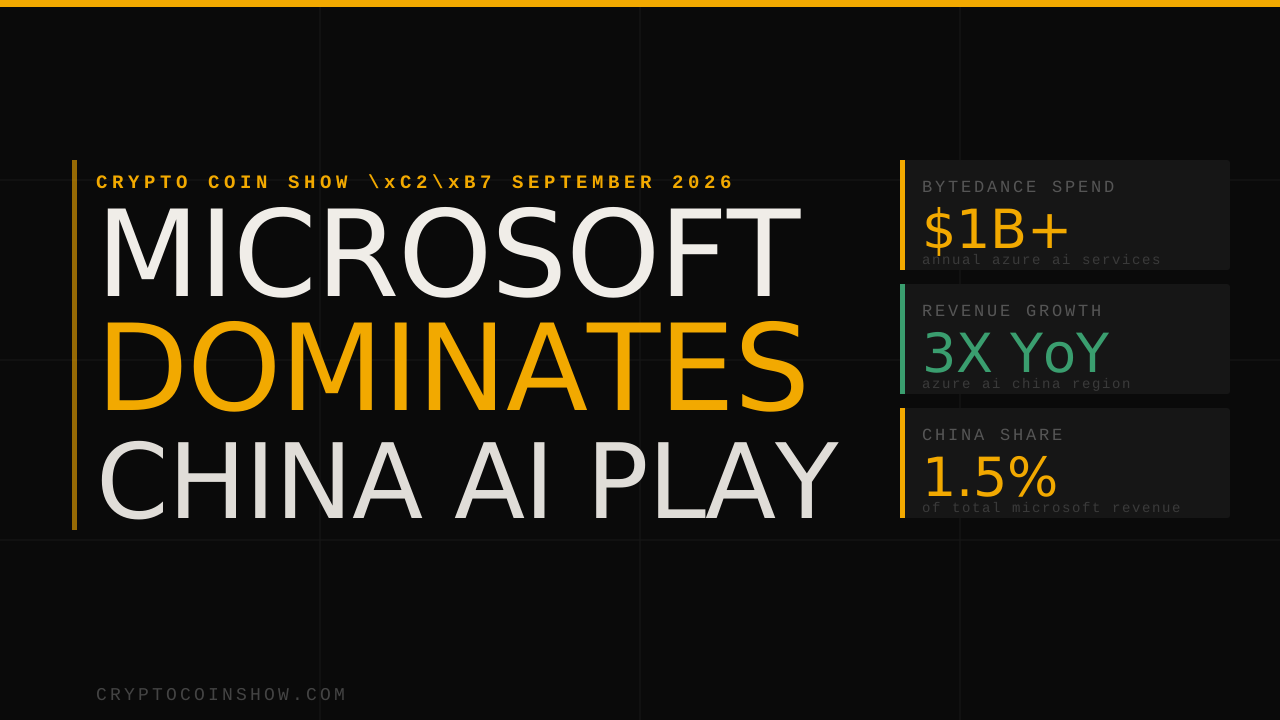
- $1B+ ByteDance’s projected annual spending on Microsoft AI and cloud services in China
- 3x Azure AI revenue growth rate in China year-over-year through June 2025
- 1.5% Microsoft’s China revenue as share of total 2024 company revenue
Microsoft has secured an exclusive commercial foothold in China’s artificial intelligence market by leveraging its contractual authority with OpenAI to license GPT models directly to Chinese technology firms.
ByteDance, Ant Group, Tencent, and Meituan now access advanced OpenAI capabilities through Microsoft’s Azure cloud platform, creating a revenue stream that has grown faster in China than anywhere else globally.
The arrangement sidesteps the direct market entry that OpenAI and Anthropic have rejected, allowing both American companies to maintain distance from Chinese operations while Microsoft captures the licensing premium and relationship economics of serving the world’s second-largest AI ecosystem.
This configuration emerged from Microsoft’s unique contractual position with OpenAI. Unlike other partners bound by OpenAI’s own geographic and ethical restrictions, Microsoft negotiated independent authority to set terms for selling GPT models internationally.
That autonomy became commercially decisive when OpenAI and Anthropic declined to operate in China, leaving Microsoft as the exclusive authorized channel for Chinese enterprises seeking access to frontier U.S. AI capabilities.
The arrangement creates a stable, defensible competitive moat: Chinese customers cannot bypass Microsoft to license directly from OpenAI, and American AI companies avoid the regulatory and IP risks of Chinese operations while maintaining indirect market presence through Microsoft’s infrastructure.
ByteDance spending $1 billion annually on Microsoft as China’s largest AI customer
ByteDance’s consumption of Microsoft’s Azure AI services has emerged as the primary driver of regional growth, with the Beijing-based company on track to spend over $1 billion per year on licensing and cloud infrastructure.
That spending level makes ByteDance Microsoft’s single largest AI customer in the China region, a position that reflects both the parent company’s dominance in Chinese consumer technology and its aggressive investment in competing large language models through its Doubao chatbot platform.
ByteDance’s appetite for GPT model access suggests the company views licensing advanced capabilities as faster and more cost-effective than building comparable systems internally, at least for certain enterprise and consumer applications.
The magnitude of ByteDance’s commitment underscores the pricing power Microsoft wields as the exclusive distributor. At over $1 billion annually, the customer represents a material revenue stream even for Microsoft’s massive scale.
The spend reflects not just API consumption but also underlying cloud infrastructure costs, professional services, and integration work required to operationalize advanced AI models across ByteDance’s portfolio of platforms. That bundled arrangement locks ByteDance into Microsoft’s ecosystem and creates switching costs that would be substantial if alternative sources became available.
ByteDance’s parallel investment in its own Doubao chatbot indicates the company is simultaneously building independent capabilities while licensing OpenAI’s models, a diversification strategy that insulates ByteDance from overreliance on Microsoft but also demonstrates confidence in its own technical trajectory.
Azure AI revenue in China tripled year-over-year, outpacing all other Microsoft regions
Microsoft’s Azure AI business in China expanded at an exceptional rate, tripling in the fiscal year ending June 2025 after posting a 400% increase in the prior year. That growth trajectory far exceeds the company’s cloud and AI expansion in Europe, North America, and other regions, signaling that Chinese demand for frontier AI models has eclipsed adoption rates in mature markets.
The acceleration reflects both the concentration of Chinese tech spending among a handful of megacap companies and the absence of competing suppliers willing to serve the market at scale.
The growth metrics reveal two distinct patterns: the base-building phase of the prior fiscal year, when ByteDance and other early adopters deployed GPT models broadly across operations, followed by deeper penetration and higher consumption per customer in the most recent year.
That progression typically precedes margin expansion and increased switching costs, suggesting Microsoft’s China AI business is transitioning from land-and-expand mode into a mature revenue stream with predictable retention dynamics.
The 3x expansion also outpaced general cloud adoption in China, indicating that GPT licensing specifically, not baseline infrastructure, drove the outsized performance.
Despite the regional growth rates, Microsoft’s president Brad Smith characterized the China business as representing approximately 1.5% of the company’s overall 2024 revenue.
That statement provides scale context: even with tripling growth, China remains a fractional portion of Microsoft’s nearly $250 billion annual revenue, though the fractional nature of the percentage does not diminish the strategic importance of maintaining exclusive access to the world’s second-largest technology market or the leverage Microsoft derives from being the sole U.S. AI company operating at meaningful scale in China.
OpenAI and Anthropic cite IP theft risks, leaving Microsoft as sole authorized distributor
OpenAI and Anthropic have publicly and privately refused direct entry into China, citing concerns about intellectual property theft and the risk of Chinese companies using distillation techniques to reverse-engineer advanced models.
Distillation represents a specific technical threat: Chinese firms could train their own smaller models by observing the outputs of GPT systems, effectively learning the underlying weights and reasoning patterns without paying for OpenAI’s research and computational investment.
That technique has already surfaced as a concern in OpenAI’s private communications with Microsoft, indicating the company views Chinese distillation as a material risk rather than a theoretical one.
OpenAI has reportedly pressed Microsoft to strengthen protections against this specific threat, pushing for contractual restrictions on how Chinese customers can use GPT outputs and deploy models downstream.
Microsoft has responded by implementing a technical architecture that keeps OpenAI models off servers physically located in China; instead, Chinese customers access the models remotely over the internet from data centers in Singapore and other nearby countries.
That geographic isolation reduces, though does not eliminate, the risk of local server compromise or wholesale model extraction by Chinese government actors or advanced technical teams.
Microsoft has also deployed automated monitoring tools to track how Chinese customers use the models and has restricted Azure AI access to established companies rather than offering service to startups or individuals.
Those restrictions create a managed customer base where Microsoft can implement oversight and contractual enforcement, reducing the surface area for distillation attacks or unauthorized model replication.
The monitoring infrastructure and customer vetting represent a form of risk mitigation that OpenAI was unwilling to undertake itself, but that Microsoft deemed necessary to unlock the China market opportunity while maintaining acceptable risk parameters for its partner.
Anthropic’s refusal to enter China alongside OpenAI suggests the IP theft concerns are industry-wide and not unique to OpenAI’s circumstances, indicating a broader consensus among U.S. AI labs that direct Chinese operations carry unacceptable compliance and security risks.
Microsoft’s exclusive distributor role creates strategic leverage in U.S.-China competition
Microsoft’s position as the sole authorized channel for U.S. frontier AI models into China creates strategic value that extends beyond the licensing revenue. The company has described itself as the primary business connecting the AI innovation centers of the U.S. West Coast and China’s East Coast, a characterization that understates the strategic gatekeeping function Microsoft exercises.
By controlling access and monitoring usage, Microsoft can observe how Chinese companies deploy advanced AI, gather competitive intelligence on Chinese AI development priorities, and maintain a relationship with major Chinese technology firms that would otherwise be unavailable to U.S. companies under current export control regimes.
That intermediary position also allows Microsoft to serve both sides of the U.S.-China technology competition simultaneously without direct conflict. The company profits from licensing American technology to Chinese customers while maintaining operations and market share in the United States. Microsoft leadership has