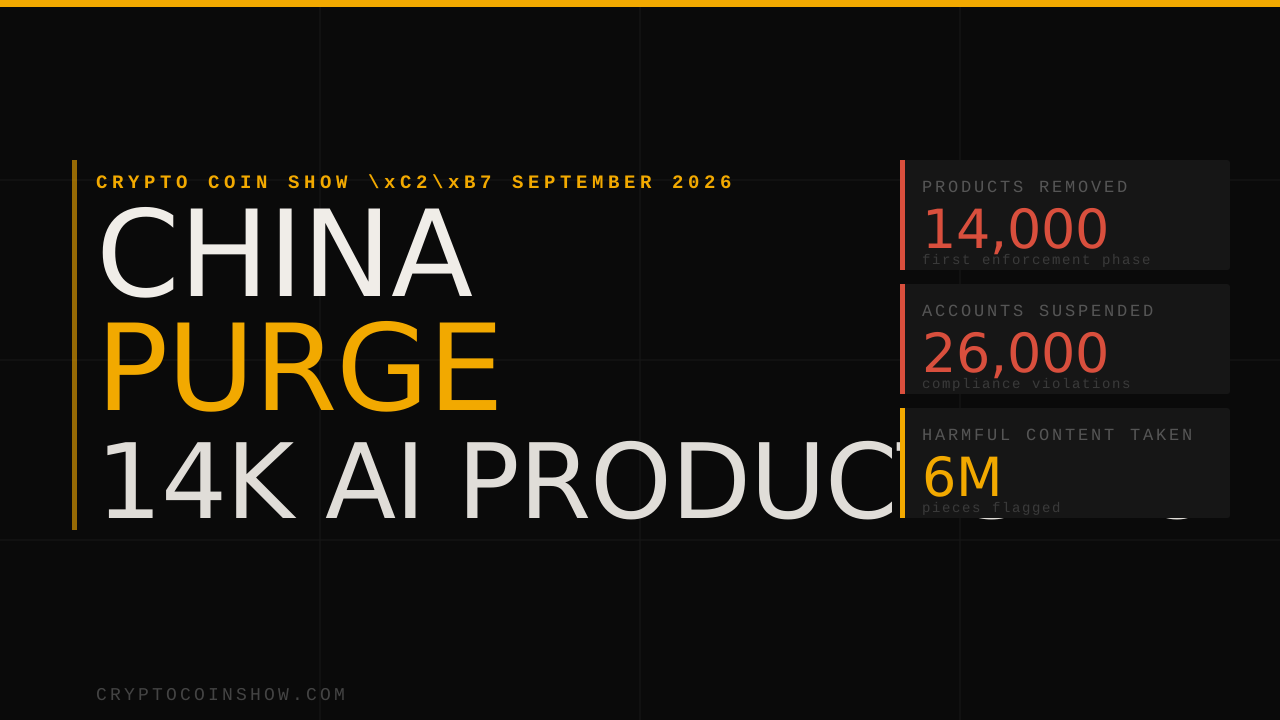
China pulls 14,000 AI products offline even as it races the US for the lead
China’s internet regulator has removed 14,000 AI products in the first phase of a sweeping cleanup campaign, signaling Beijing’s willingness to impose hard enforcement even as it competes with the United States for AI leadership. For institutional investors tracking China’s AI sector, this enforcement wave creates immediate compliance risk for major platforms and raises questions about which companies will absorb compliance costs versus lose market access.
- Cyberspace Administration of China removed 14,000 AI products, 6 million pieces of harmful content, and suspended 26,000 accounts in first phase
- Four core violations targeted: unregistered large models, weak safety filters, data poisoning, and unlabeled AI-generated content requiring immediate compliance
- Second phase launching with stricter penalties for disinformation, deepfakes, impersonation, and paid astroturfing, plus new rules on AI companions effective July 15
- 14,000 AI products removed from Chinese networks in initial enforcement sweep
- 26,000 accounts suspended for non-compliance with safety and registration standards
- July 15 effective date for new AI companion rules restricting minor access and requiring parental consent
China’s Cyberspace Administration of China (CAC) announced the removal of more than 14,000 AI products from domestic networks in April 2026, marking the opening salvo of an enforcement campaign called “Qinglang” (Clear and Bright).
The cleanup extended beyond direct product removals: regulators scrubbed over 6 million pieces of illegal or harmful content, suspended 26,000 accounts, and took down 1,300 AI-related product listings alongside nine open-source datasets deemed noncompliant.
The breadth of enforcement signals Beijing’s intent to establish binding safety standards even as Chinese AI companies race to compete globally with American counterparts.
The timing of this crackdown presents a strategic puzzle for international institutional investors. Beijing is simultaneously investing heavily in domestic AI development and imposing restrictions that could slow deployment velocity for Chinese platforms.
This dual approach reflects Beijing’s assessment that regulatory control over large language models and AI services is necessary to prevent systemic risks, including disinformation, data manipulation, and child safety threats, while maintaining China’s position as a leading AI developer.
Four specific violations triggered mass removal of AI products across Chinese platforms
The CAC identified four categories of noncompliance that drove the first phase enforcement. Companies failed to register mandatory large models as required under China’s AI governance framework. Platforms deployed weak safety review systems and content filters that CAC deemed insufficient.
Training datasets showed signs of deliberate poisoning or manipulation. And AI-generated content circulated without proper labels identifying its synthetic origin, violating transparency rules.
Major Chinese tech companies moved quickly to signal compliance. Huawei added specialized AI review processes to its app store. Alibaba upgraded its content identification systems.
Zhipu AI built new review models specifically designed to catch prohibited content. DeepSeek implemented checks to prevent data manipulation during model training. These moves suggest that established platforms understood enforcement would be sustained and costly to resist, making voluntary upgrades cheaper than forced shutdowns.
The compliance framework now requires all AI services to register with authorities, implement strong safety filters, label AI-generated content clearly, and maintain documented control over training data. Violations trigger real penalties including product takedown and account suspension.
The CAC also established a public reporting channel for AI-related abuses, creating distributed monitoring that supplements government inspection capacity.
Regional authorities adapted enforcement to local contexts: Beijing paired self-checks with routine monitoring, Shanghai tailored rules by platform type, Zhejiang focused on model auditing, Jiangsu created a five-category violation reporting system, and Guangdong built a multi-agency governance mechanism spanning the full AI service chain.
Second enforcement phase targets disinformation, deepfakes, and impersonation with escalated penalties
The CAC announced that phase two of the Qinglang campaign will focus on AI systems used to spread disinformation, generate violent or vulgar material, impersonate real people, harm minors’ rights, and execute paid astroturfing campaigns. The regulator promised heavier penalties for offending accounts and institutions alongside increased pressure on platforms to strengthen their own controls.
This expansion signals that Beijing views the first phase as baseline compliance, not ceiling enforcement.
Separate from the Qinglang campaign, the CAC introduced the “Interim Measures for the Administration of AI Anthropomorphic Interactive Services,” set to take effect July 15, 2026. This rule specifically targets AI companion services built for ongoing emotional relationships rather than functional work tasks.
The regulation bars virtual companions for minors entirely and requires parental or guardian consent for users under 14. This restriction reflects Beijing’s explicit concern that emotional AI systems pose developmental risks to children and can facilitate exploitation.
The companion AI rule has already prompted product changes from major platforms. ByteDance’s Doubao and Alibaba’s Qwen began disabling custom agent features rather than attempting to retrofit compliance into existing systems.
This response suggests platform operators assessed the cost of building separate product versions for minors as prohibitive, choosing instead to retreat from that market segment. For institutional investors, the decision signals that Beijing’s restrictions can force outright exit from product categories, not merely marginal adjustment.
Compliance costs and competitive outcomes remain unequally distributed across China’s AI sector
The enforcement wave creates asymmetric risk across Chinese AI companies. Established platforms with existing compliance infrastructure and regulatory relationships, Alibaba, ByteDance, Huawei, can absorb compliance costs and integrate them into product roadmaps.
Smaller AI startups and new entrants face higher marginal costs to build safety systems from scratch and may lack the political capital to negotiate timelines. Venture-backed companies operating at scale but outside state guidance risk sudden enforcement action.
The global competitive implications are mixed. American investors often view strict AI regulation as a brake on innovation. Yet Beijing’s enforcement wave does not preclude rapid scaling of approved products; it merely raises the bar for what constitutes approvable.
Chinese platforms that achieve compliance may have stronger safety credentials when operating internationally, particularly in markets where regulatory scrutiny of AI is rising. Conversely, if compliance requirements force slower iteration cycles or limit experimentation, Chinese AI companies may cede technical ground to American competitors with more permissive domestic environments.
For institutional portfolio managers holding Chinese tech stocks or considering exposure to China’s AI sector, the key variables are operational capacity to absorb compliance costs and willingness to accept reduced product optionality. Companies like Alibaba and Tencent have demonstrated this capacity historically.
Smaller AI-focused firms may face sustained pressure that affects margins or growth rates. The July 15 companion AI rule takes effect in less than five months, providing a near-term test of whether platforms will attempt compliance retrofits or exit the category entirely.
The critical question for institutional investors remains unresolved: will the second phase of Qinglang enforcement, launching in coming months with escalated penalties for disinformation and deepfakes, prompt faster compliance across the board, or trigger a bifurcation where platforms either strengthen controls substantially or exit high-enforcement-risk product lines entirely? The answer will shape which Chinese AI companies can scale internationally and which face sustained revenue headwinds in their largest market.