
Institutional miners shift to Zcash after Grayscale ETF launch creates 4x profitability advantage over Bitcoin
Grayscale’s August launch of the first US spot Zcash ETF has triggered a 2-4x profitability gap favoring ZEC mining over Bitcoin, prompting institutional miners to redeploy hardware and capital away from BTC as network competition erodes Bitcoin mining returns. The shift underscores how ETF inflows and privacy-coin adoption are reshaping mining economics at a time when Bitcoin’s hashrate growth is outpacing price gains.
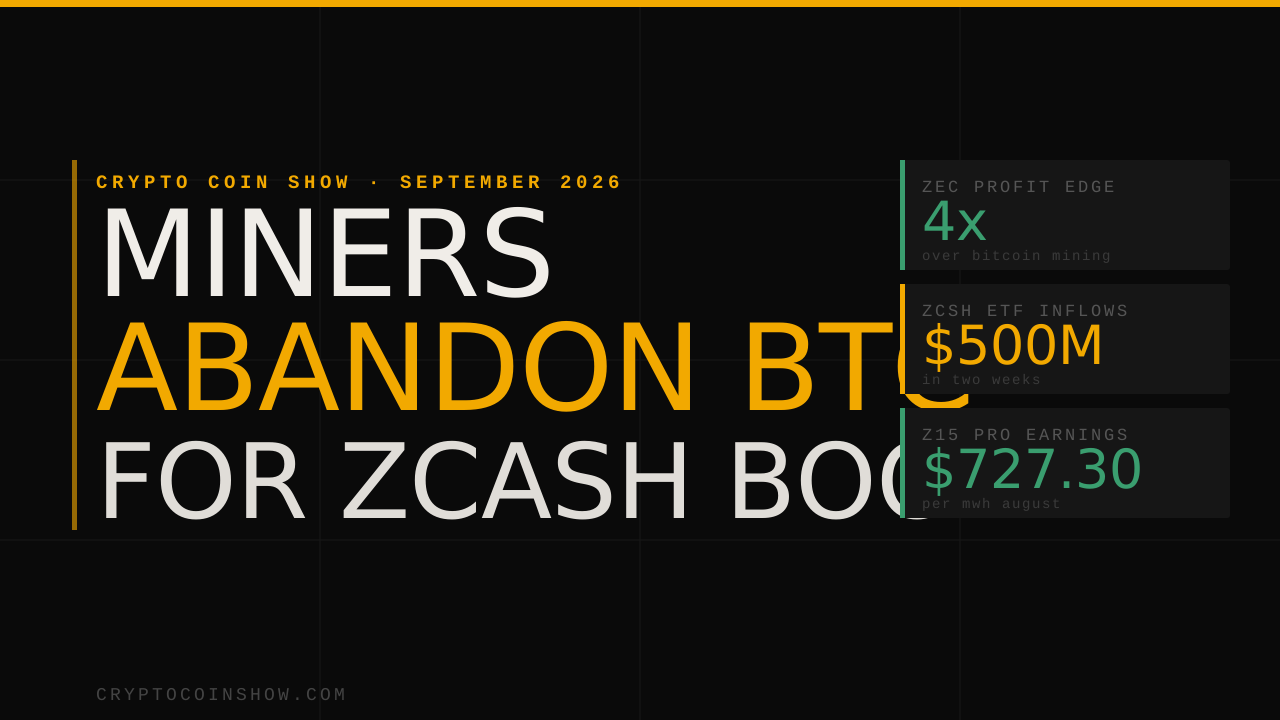
- Bitmain Z15 Pro Zcash miners earned $727.30 per MWh in August, versus $179 per MWh for Bitcoin’s S23 Pro, a 4x gap that has drawn major institutional miners including Cypherpunk Technologies.
- Grayscale’s ZCSH ETF exceeded $500 million in assets within two weeks of its August 25 NYSE Arca debut, with DCG affiliate investing $100 million, propelling ZEC to $1,180 from a prior $890 record in August.
- Bitcoin mining returns are compressed: network difficulty is set to rise again on September 19, while major ASIC makers report collapsing margins and revenue guidance in the tens of millions quarterly.
- $727.30 Z15 Pro Zcash revenue per MWh versus $179 for Bitcoin’s S23 Pro
- $500M+ ZCSH ETF assets under management within two weeks of launch
- 18% Zcash network hashrate controlled by Cypherpunk Technologies’ mining fleet
Institutional miners are pivoting from Bitcoin to Zcash at scale, driven by a historic swing in mining profitability that first reported by Cryptopolitan reflects Zcash’s rally following the launch of the first US spot privacy-coin ETF. According to energy-use data, a state-of-the-art Bitmain Z15 Pro mining Zcash generated around $727.30 per megawatt-hour of electricity in August, more than four times the $179 earned by Bitcoin’s best current ASIC, the S23 Pro. Even as more miners join the Zcash network and compress returns, the Z15 Pro still earns approximately $708 per MWh as of early September, maintaining a 3.9x advantage over Bitcoin’s leading hardware.
Grayscale’s Zcash ETF sparks $500 million inflow and privacy-coin rally to $1,180
The profitability inversion stems directly from capital flows into a new institutional product. Grayscale converted its Zcash Trust into an exchange-traded fund and listed ZCSH on NYSE Arca on August 25, marking the first US offering providing spot exposure to a privacy coin. The fund’s assets under management exceeded $500 million within two weeks, including roughly $100 million from DCG International Investments, an affiliate of Grayscale’s parent, Digital Currency Group.
The capital influx triggered a token rally that reshaped mining economics overnight. ZEC crossed $1,000 for the first time on September 4 and now trades near $1,180, up from the $890 record it hit in August, bringing the network’s market capitalization to around $20 billion. On September 3, Grayscale attributed the momentum to “the hard money thesis and growing awareness around digital privacy.” Mining profitability tracks token price directly: the Z15 Pro’s August returns of $727.30 per MWh represent a 24% jump from June’s $585.61.
Cypherpunk Technologies and rivals secure 18% of Zcash hashrate in three-month land grab
The arbitrage has drawn well-capitalized institutional players into direct competition for network share. Cypherpunk Technologies (Nasdaq: CYPH), backed by Cameron and Tyler Winklevoss, paid $33.33 million in August to establish what it calls the world’s largest Zcash mining fleet, operating at 4.2 GSol/s, approximately 18% of the network’s hashrate.
The company now holds nearly 2% of the ZEC supply and has stated a target of 5%.
Larger mining pools are moving faster. Foundry USA launched an “institutional-grade” Zcash pool in March and captured close to 30% of mining share within a month. Fortitude Mining Holdings, another DCG subsidiary, acquired a 12.5-megawatt site in Nebraska to expand capacity.
As the network’s solrate, the rate at which the network solves hashes, rises faster than token price, each miner’s portion of the roughly 43,800 ZEC in monthly rewards contracts, creating pressure for further consolidation and efficiency gains.
Bitcoin mining economics collapse as difficulty rises and rivals lure hash toward AI workloads
Bitcoin mining returns have collapsed independent of Zcash’s rise. BTC rallied to $82,000 on September 3 but has since fallen to around $77,000, while network difficulty is set to increase again on September 19.
Hardware makers are reporting severe margin compression. Canaan announced second-quarter mining revenue of $17.7 million paired with a net loss of $97.6 million, and guided third-quarter revenue as low as $11 million. These figures underscore the structural erosion in Bitcoin mining profitability that has persisted since the 2024 halving and continued network difficulty growth. The pressure has driven miners toward alternative revenue streams: Riot Platforms signed a $9 billion, 20-year compute deal with Anthropic for AI workloads, and Bitdeer struck a 16-year agreement with an unspecified AI buyer. Only mining Zcash and AI cloud workloads, generating close to $941 per MWh, now justify deployment of state-of-the-art hardware at scale.
Zcash mining profitability hinges on whether ZEC’s price holds above $1,000 and whether institutional capital continues to flow into ZCSH as the product matures; if token price falls sharply or inflows reverse, the mining margin advantage collapses and hardware will pivot again. Watch for Foundry USA’s and Cypherpunk Technologies’ hashrate share over the next 90 days, if either firm reaches 40% or higher, network centralization will become a governance and security concern for Zcash’s community.