A major Bitcoin miner burned through 357 BTC on secret compute deals while its output plummeted
BitFuFu burned through 357 BTC in July to secure hashrate capacity through advance payments, a move that signals aggressive expansion but obscures the unit economics underlying the deal. The undisclosed pricing and supplier details leave institutional investors unable to assess whether the miner is sacrificing profitability for growth, a red flag given the company’s prior stated commitment to margin discipline.
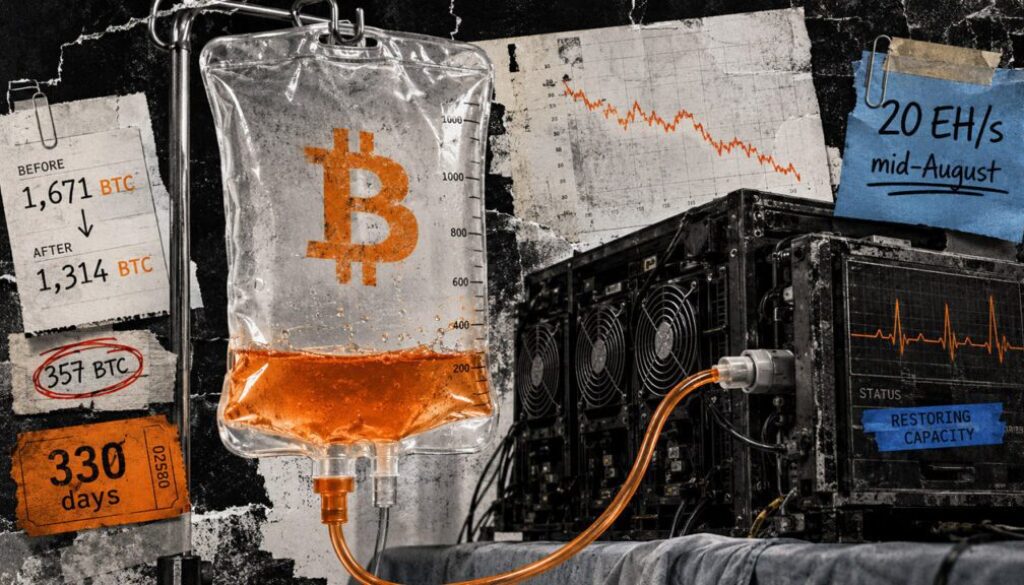
- BitFuFu’s Bitcoin holdings fell 357 BTC in July, from 1,671 BTC to 1,314 BTC, primarily for 330-day advance hashrate payments.
- Total managed hashrate declined to 14.2 EH/s in July from 15.3 EH/s in June, while daily production slipped to 3.6 BTC from 4.2 BTC.
- Management targets restoring capacity to approximately 20 EH/s by mid-August, a 41% increase, contingent on securing undisclosed supplier agreements.
- 357 BTC spent on advance capacity payments as percentage of total July holdings.
- 14.2 EH/s managed hashrate at month-end, down from prior-month peak capacity baseline.
- 20 EH/s target capacity by mid-August, representing the disputed operational checkpoint to verify.
BitFuFu, a Bitcoin miner and cloud-mining provider, disclosed in its July SEC filing that a sharp 357 BTC drawdown on its balance sheet was driven almost entirely by advance payments for 330 days of future computing capacity. The move left the company holding 1,314 BTC as of July 31, down from 1,671 BTC a month earlier, a 21% monthly decline that dwarfs typical operational expenses.
Simultaneously, the miner’s actual output collapsed: total July production fell to 112 BTC from 125 BTC, and average daily output slipped to 3.6 BTC from 4.2 BTC, signaling an operational crisis that the capacity purchase is intended to resolve.
The transaction raises a critical question for institutional investors evaluating BitFuFu’s capital allocation discipline. In April, management had stated publicly that it would decline to renew third-party mining contracts if they pressured unit economics, and would not pursue hashrate growth at the expense of profitability.
The July advance payment appears to contradict that posture, yet BitFuFu filed no details on the price, the supplier, energy costs, uptime guarantees, or cancellation protections embedded in the deal. Without those economics, there is no way to verify whether the company kept its April promise or abandoned it.
BitFuFu’s managed hashrate fell 7% month-on-month despite expansion plans
BitFuFu’s total managed hashrate declined to 14.2 EH/s in July from 15.3 EH/s in June, a 1.1 EH/s drop that undercuts the narrative of a company on an expansion path. The decline was driven entirely by third-party supplier capacity, which fell to 10.6 EH/s from 11.8 EH/s.
Self-owned hashrate edged up slightly to 3.6 EH/s from 3.5 EH/s, but that marginal gain could not offset the loss of rented capacity, suggesting BitFuFu may have deliberately allowed some supplier contracts to lapse rather than renew them at unfavorable terms.
The company’s July filing includes a forward-looking claim that capacity secured in June and July should restore total managed hashrate to approximately 20 EH/s by mid-August. If that target holds, it would represent a 5.8 EH/s, or roughly 41%, increase from the July 31 baseline.
That jump is substantial enough to materially improve production and cash flow, but it is also precisely the sort of guidance that requires independent verification. A separate June filing had already disclosed 5.3 EH/s of supplier capacity scheduled to begin in August, a block that nearly matches the difference between 14.2 EH/s and the 20 EH/s target.
The two disclosures are not clearly reconciled, leaving institutional investors unable to determine whether the two blocks overlap or are sequential.
Undisclosed supplier pricing blocks verification of margin impact
The July SEC filing contains a material gap: it does not name the supplier, disclose the price in Bitcoin or dollars, reveal energy costs, specify uptime requirements, or outline cancellation protections. Without those details, the 357 BTC outflow cannot be safely interpreted as either a market sale or the true economic cost of the capacity arrangement.
A supplier might have negotiated a higher BTC price in exchange for favorable energy terms, or vice versa, information that is essential to assessing whether the deal meets the unit-economics standard management outlined in April.
The absence of supplier identity is particularly striking. BitFuFu operates in a concentrated market in which a small number of hosting partners control most available capacity. Naming the supplier would allow investors to cross-check pricing against public or semi-public rates, or to assess counterparty risk if the supplier faces operational or financial strain.
The company’s silence suggests either a confidentiality clause or an unwillingness to disclose pricing that might appear unfavorable in comparison to peers.
BitFuFu’s July balance sheet also showed 44 BTC pledged as collateral for loans and miner-procurement payables, down from 54 BTC in June. That 10 BTC reduction is modest, but it underscores that the company carries debt obligations alongside its equity in Bitcoin.
If the 20 EH/s target fails to materialize, or if the supplier capacity underperforms, BitFuFu may face pressure to meet collateral calls at the same moment its cash flow is declining, a scenario that could force asset sales at unfavorable prices.
Mid-August hashrate checkpoint will determine credibility of expansion claims
BitFuFu has given institutional investors a concrete operational deadline: mid-August 2026. By that date, management claims total managed hashrate should reach approximately 20 EH/s, up from the 14.2 EH/s reported on July 31. That target is achievable only if the advance-payment supplier agreements translate into live, functioning capacity on schedule.
Any slip in the timeline, or any shortfall relative to the 20 EH/s target, would suggest either that the supplier relationships are less firm than represented, or that BitFuFu paid for capacity it cannot deploy within the promised window.
The stakes are material. If BitFuFu reaches 20 EH/s, the company can plausibly argue that the 357 BTC outlay was a justified capital investment in future production. Daily output would be expected to rise toward 4.0 BTC or higher, improving both cash flow and the equity position relative to debt.
A sustained miss, say, 18 EH/s or below, would force a reckoning: either the supplier relationship failed, or the advance payment was inefficiently priced, or both. In either case, the company’s cost-control posture would be called into question, and the valuation discount applied to undisclosed mining deals would likely widen.
The cloud-mining business adds a further layer of opacity, as BitFuFu does not disclose the Bitcoin produced for customers separately, preventing investors from isolating self-mining profitability.
Institutional investors should monitor BitFuFu’s August operating update closely for evidence of the 20 EH/s capacity coming online as promised, and request disclosure of supplier identity, pricing, and any changes to the company’s unit-economics policy from its April guidance; if management cannot substantiate the advance-payment deal against that standard, or if hashrate targets slip, the company faces a credibility test that could accelerate selling pressure on its Bitcoin reserves.