Oman launches national bitcoin mining pool called OmanHash
Oman has become the second nation globally to mandate a state-controlled bitcoin mining pool, requiring all licensed operators to route hashrate through OmanHash.om and positioning itself as a model for sovereign cryptocurrency infrastructure. This development signals a shift in how governments view mining regulation, moving from taxation and oversight to direct operational control, with significant implications for how institutional miners navigate jurisdictional compliance and pool selection.
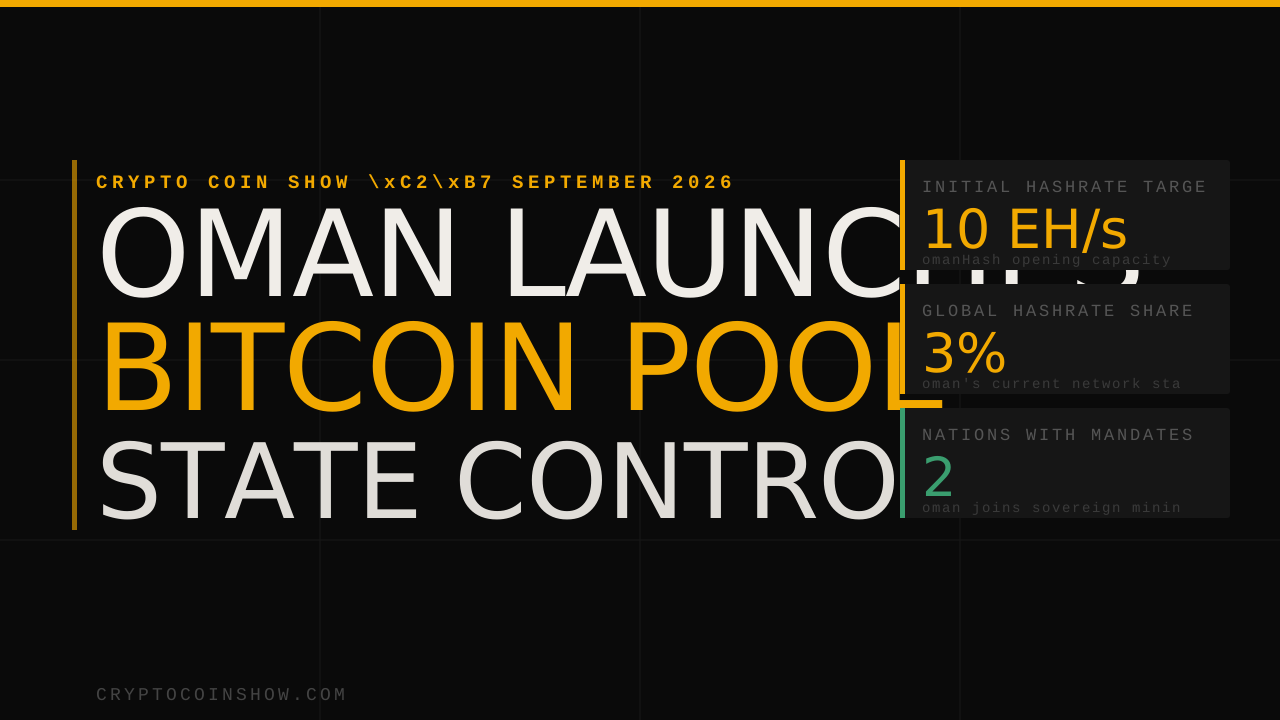
- Oman’s Ministry of Transport launched OmanHash.om as mandatory pool for all licensed miners, with 10 EH/s initial target from nation controlling 3% of global bitcoin hashrate.
- Enegix Global built the platform after successfully operating btcpool.kz in Kazakhstan since October 2023, following identical sovereign pool mandate model.
- Enegix’s combined pool operations across three jurisdictions now approach 25 EH/s, targeting 30 EH/s, a significant hashrate concentration in operator hands.
- 10 EH/s Initial target computing power for OmanHash.om versus Oman’s current 30 EH/s total hashrate.
- $700M+ Capital invested in Omani mining and data center projects since 2022, concentrated in Salalah Free Zone.
- 25 EH/s Current combined hashrate across Enegix’s three pools worldwide, approaching stated 30 EH/s goal.
Oman’s Ministry of Transport, Communications and Information Technology has mandated that every licensed bitcoin miner in the Sultanate operate exclusively through OmanHash.om, a newly established state-backed mining pool that marks the second sovereign mining infrastructure model after Kazakhstan’s btcpool.kz.
The platform, developed by digital energy company Enegix Global with local operations managed by Frontier Technologies LLC, represents a deliberate shift from taxation-based mining regulation to direct operational control.
Oman, which currently controls nearly 3% of global bitcoin network hashrate, approximately 30 exahashes per second according to Q2 2026 Hashrate Index data, has now institutionalized pool routing as a licensing requirement rather than a voluntary arrangement.
Enegix Global Replicates Kazakhstan Model in Second Sovereign Jurisdiction
Enegix Global’s pivot to operating state-mandated mining pools began in October 2023 when Kazakhstan passed a digital assets law requiring licensed miners to operate through government-accredited pools and report revenue directly to tax authorities. The company built and now operates btcpool.kz under that framework, establishing a template that Oman has adopted wholesale.
Olzhas Amirov, Enegix’s chief business development officer, framed the Oman deployment as validation of that model: “This is our second sovereign mandate, and it validates the model we have been building since Kazakhstan. Clear licensing frameworks help miners operate legally, avoid excessive taxation, and establish transparent communication with authorities.”
Clear licensing frameworks help miners operate legally, avoid excessive taxation, and establish transparent communication with authorities.
Olzhas Amirov, chief business development officer, Enegix Global
The replication across two jurisdictions signals to institutional operators that sovereign pool mandates are emerging as a standardized regulatory tool rather than an isolated experiment. Miners operating in jurisdictions without such frameworks now face a choice: accept potential future mandates in established bases, or relocate to countries with predictable licensing conditions.
Kazakhstan and Oman’s approaches suggest governments view pool concentration as a mechanism for revenue tracking and infrastructure planning rather than as an obstacle to mining operations.
For Enegix, the model also creates operational leverage, the company now manages hashrate concentration across three pools: 21pool.io, btcpool.kz, and OmanHash.om.
Oman’s $700 Million Mining Investment Now Routes Through Single Pool
Oman has invested over $700 million in mining and data center infrastructure since 2022, predominantly in the Salalah Free Zone, with two major facilities operational since 2022 and 2023 respectively. That capital deployment occurred without a mandated pool framework, allowing operators flexibility in pool selection.
The introduction of OmanHash.om as the exclusive routing mechanism for licensed miners represents a structural change to how that existing infrastructure operates, not an expansion of capacity but a consolidation of control.
The Sultanate’s rapid hashrate growth, from near-zero prominence in 2021 to approximately 3% of global bitcoin network hashrate by mid-2026, has been driven by favorable electricity costs, government support for mining as an economic diversification strategy, and investments by international operators.
Mandating OmanHash.om allows the government to monitor revenue flows, ensure tax compliance, and coordinate infrastructure expansion with hashrate growth.
OmanHash.om uses a Full Pay-Per-Share (FPPS) payout model, meaning miners receive payouts based on shares submitted regardless of block discovery, with the pool operator collecting fees, a structure familiar to institutional operators but now enforced as the sole legal option.
The pool’s initial 10 EH/s target represents approximately one-third of Oman’s current hashrate, suggesting the framework expects existing mining capacity to migrate into the mandated pool over time.
Enegix Targets 30 EH/s Across Sovereign Pools While Hashrate Concentration Grows
Enegix Global currently operates approximately 25 EH/s of combined hashrate across its three pools, with an explicit target of reaching 30 EH/s according to statements from Yersaiyn Nurtoleuov, the company’s chief product officer.
That 30 EH/s target, equal to the entire current hashrate of Oman alone, represents concentration of sovereign mining infrastructure in a single operator’s hands across multiple jurisdictions.
For institutional miners, this creates a critical dependency: if Enegix operates the government-mandated pools in the two largest mining jurisdictions by growth rate, miners cannot easily switch pools without relocating.
The hashrate concentration model diverges from how mining pools have historically operated in the United States, Europe, and other jurisdictions without mandatory pool requirements. Public pools like Foundry, AntPool, and Stratum operate competitively, allowing miners to switch pools freely or diversify hashrate across multiple providers.
Kazakhstan and Oman’s sovereign models eliminate that choice for licensed operators. Enegix’s expansion toward 30 EH/s globally means the company is positioning itself as a critical infrastructure provider for governments seeking to monetize mining operations while maintaining regulatory visibility.
Institutional miners already operating in Kazakhstan or Oman must now route through Enegix-operated pools; new entrants to those markets face the same requirement as a licensing condition.
The critical test for this model is whether other governments follow Kazakhstan and Oman’s lead, establishing similar mandates in jurisdictions like Iceland, Paraguay, or El Salvador, which have positioned themselves as mining-friendly destinations. Enegix has stated it is “actively building the infrastructure and partnerships” to reach 30 EH/s globally, indicating expansion into additional jurisdictions is planned. Institutional investors and mining operators should monitor regulatory developments in secondary mining hubs over the next 12 months to determine whether sovereign pool mandates will become a standard licensing requirement worldwide or remain confined to a small number of emerging markets.
Original reporting: cryptopolitan.com