CryptoQuant: a lasting bitcoin recovery needs USDT supply to grow
Bitcoin can still bounce while Tether’s USDT supply shrinks, but a lasting recovery will need that supply to start growing again, according to on-chain analytics firm CryptoQuant. Separately, research firm K33 says recent advances in AI-assisted mathematics justify a closer look at Bitcoin’s cryptographic security, while finding no sign it has been weakened.

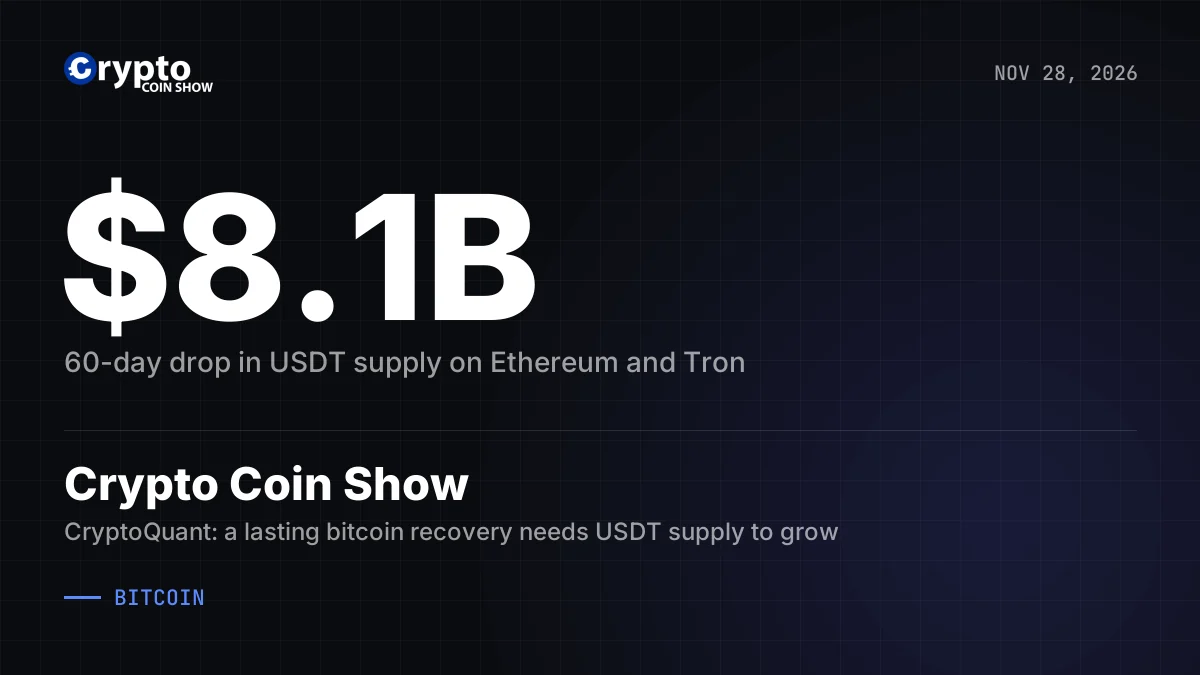
- USDT supply across Ethereum and Tron fell $8.1 billion, or 4.4%, in the 60 days to Nov. 23, the biggest decline since August 2022.
- None of bitcoin’s 39 record closes since 2022 came during a period of shrinking USDT supply, CryptoQuant found.
- K33 says AI-driven progress in mathematics warrants attention, but the proposed Riemann hypothesis proof does not enable attacks on Bitcoin’s cryptography.
- $8.1B 60-day drop in USDT supply on Ethereum and Tron
- $174.5B combined USDT supply on the two networks
- 0 of 39 bitcoin record closes since 2022 that came while USDT supply was shrinking
Stablecoin liquidity is draining
The figures come from CryptoQuant’s latest analysis, reported by The Block. Combined USDT supply on Ethereum and Tron stood at $174.5 billion, down $12.9 billion from its May peak.
Nearly all of the 60-day decline happened on Ethereum. Tether burned $8 billion of USDT there in two batches, which took supply on that network to its lowest level since August 2025. Supply on Tron was largely unchanged.
USDT is the main trading currency on crypto exchanges, so its supply works as a rough gauge of the dollars available to buy bitcoin. When supply falls, that buying power is leaving the market rather than waiting on the sidelines.
Bounces yes, a new high no
CryptoQuant’s point is about the type of rally that is possible. Short-term rebounds can still happen while supply contracts. The firm found, however, that none of bitcoin’s 39 record closes since 2022 came while USDT supply was falling. Every new high in this cycle has come with stablecoin supply expanding.
Bitcoin was trading just under $60,000 at the time of the report. Ether was near $1,665.
K33 looks at AI and Bitcoin’s cryptography
In a separate note, K33 analysts said recent advances in AI-assisted mathematics deserve closer attention from anyone responsible for Bitcoin’s security. The trigger was a proposed proof of the Riemann hypothesis that Anthropic mathematician Levent Alpöge recently announced using Claude.
K33 was clear that the proof itself does not enable attacks on cryptography, and it found no evidence that Bitcoin’s cryptography has been compromised. The analysts did outline the theoretical risk. A solution to the P versus NP problem could in principle let Bitcoin private keys be derived more efficiently, though any resulting algorithm might still be too slow to be practical.
Other networks are already acting. Zcash is urging users to move funds out of its legacy Sapling pool, which CCS covered earlier this week, and the Ethereum Foundation is doubling the size of its protocol security team.
The CCS read. The stablecoin data is the more useful signal for anyone watching price. Liquidity has to come back before a new high is realistic, and Tether’s net issuance is one of the easiest places to watch for that turn. The AI-cryptography story is worth tracking, but on K33’s own reading it is a research question for now, not a threat.
Net USDT issuance on Ethereum in the weeks ahead, whether bitcoin holds near $60,000, and any response from Bitcoin developers on long-term cryptographic upgrades.
Lead image: Crypto Coin Show. Source: Crypto Coin Show
From the CCS interview archive
All 1,000+ interviews Mark Zalan on GoMining's non-custodial Bitcoin payments for merchantsMark Zalan, GoMining · Jun 2026
- Dave Rodman on choosing the right offshore home for a crypto companyDave Rodman, The Rodman Law Group · Aug 2026
- How ZIGChain is building token economics for real-world assetsAbdul Rafay Gadit, ZIGChain · Jul 2026