
Abdul Rafay Gadit / ZIGChain
How ZIGChain is building token economics for real-world assets
In this episode
Most RWA projects tokenize the asset and forget the token. ZIGChain is building the full stack: regulated onchain infrastructure for institutional-grade real-world assets, with $ZIG's value tied directly to platform revenue through a discretionary buyback program — not a separate speculative layer bolted on top. REVENUE-BACKED TOKENOMICS built on a purpose-built Layer 1 is what separates ZIGChain from the noise in an increasingly crowded RWA market.
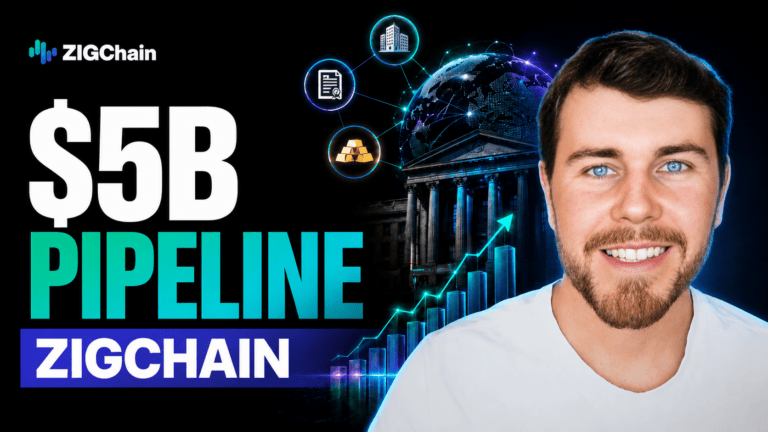
Abdul Rafay Gadit, Co-Founder of ZIGChain, joins Ashton Addison on Blockchain Interviews. ZIGChain is the next evolution of Zignaly — a platform with 600,000 registered users and $10 billion in trading volume — rebuilt as a Cosmos SDK Layer 1 with EVM compatibility, purpose-built for regulated, institutional-grade investment onchain. Rafay breaks down the $5 billion RWA pipeline including partnerships with Apex Group ($3.4T AUM) and Ellington, the Beehive integration tokenizing UAE SME private credit loans, and the ADI Chain partnership unlocking receivables financing and PayFi infrastructure. He explains why the Shariah compliance certification opens a $5+ trillion Islamic finance market that most crypto projects have never touched, how ZIG 2.0's governance-gated buyback program is structurally different from the fixed-revenue buyback models that broke down in 2026, and what it actually takes to move capital across MiCA, FINMA, MAS, and US regulatory frameworks simultaneously.
zigchain.com · Watch on Refinitiv
- ZIGChain ties token value directly to platform revenue through a discretionary buyback program rather than creating a separate speculative asset layer.
- Most RWA projects focus on tokenizing assets but neglect bringing value back to the token itself, missing a key opportunity.
- Tokenization involves four components: origination of yield, technology, regulation and compliance, and distribution; technology is the most commoditized part.
- ZIGChain's $5 billion RWA pipeline includes partnerships with Apex Group and integrations for UAE SME private credit loans and receivables financing.
- Shariah compliance certification opens access to the $5 trillion Islamic finance market that most crypto projects have not addressed.
Chapters
By the numbers
Transcript
Read the full transcript
I'm Ashton Addison from the Crypto Coin Show, and today on Blockchain Interviews we have back with us Abdul Rafay Gadit, co-founder and CCO of ZigChain. They have 5 billion in the real-world asset tokenization pipeline. But how can this tokenization tie back into crypto and provide value in both directions? We're here to dive into that, Zig, and so much more today.
Abdul, welcome to the back to the show and thanks for taking the time.
Yeah, first of all, thank you, Ashton, for inviting me today. Very exciting. I'm looking forward to the discussion.
Yeah, I've been I've been following Zig for many years and the evolution your team and the platform had, you know, over half a million users, much more with tens of billions in trading
volume before you even launched the ZigChain. And it's a nice success story to see the crypto-native platform now evolving into and merging into real-world finance, real-world asset tokenization, and excited to dive into that. I would love to hear a little bit more of it you know, fill in any of the gaps that I missed there, and then your
vision for real-world asset tokenization and how that ties into crypto.
Sure, absolutely. First of all, yeah, absolutely. It's it's something that not associated with the crypto industry is that people that launch something and they stick around with that for longest period of time. I think our industry has been plagued by this thing that
people just do things for certain time period and then move on. I'll I'll take a step back and I'll go behind the story. So, like in 2019, 2018, 2019 we started a platform called Zignaly, which was like eToro for cryptocurrencies. But why did we start it? To think about it. So, I originally am from Pakistan and my co-founder is from Spain. And we met through some
common friends and all, but coming from Pakistan, I can tell you that this is a problem with 70 to 80% of the world, which is called emerging market or developing market. It even if you have money and the knowledge, the access is something which you do not always get. Like even today, sitting in many parts of the world, buying secure equities and stocks from the US
market is just impossible in any legal way. Blockchain has actually you know, kind of changed that. And we believed in 2018, 2019 that, "Okay, using crypto, we can actually create an environment where investment opportunities can be available to anyone, anywhere, regardless of where they are born." So, the color of passport should not determine your
future of finance, basically. And with that thought, we started Zignaly. We started a subscription service. We ended as well. We said that, you know, people should pay as they go. Like, you know, if you put like a subscription fee, then you're already becoming too ex- pensive for people from most part of the world. As like the average user was paying
anything between $1,500 to $2,000, $30 or $40 a month means you are putting them in 1 and 1/2 2% kind of a negative to write write off the start, right? Which is unfair every month. We then evolved Zignaly more into a copy trading and then into a fund management platform. By 2022, the product was doing fantastically well. It's still live and it's a running product. What we started
seeing towards 2020 2 2023 is that we saw that the future of finance is going to go on chain, and there is no doubt about it. The question was that how can you bring that on chain evolution in a more accessible, trustable, and in a compliant environment. So, we went out in the market, and even for our Zignaly business, we start we ex- started with
acquiring a license out of South Africa. We became the first company ever to get the Cat 2 license out of South Africa across fiat and crypto making us one of the first you know profit sharing fund management crypto platform in the world you know at that point in time. And then we went on to into into a journey. We want we really wanted to you know aim for something higher and
this is why we decided to launch ZigChain as an extension of Zignaly and with keeping the community and the overall investor interest in mind. And I'll just give a proof point of that like for example in 2021 we launched a token for ZigCoin and it did really well. In 2023 when we were launching the chain every single VC came to us and said that why don't you launch a new
token with a new name and it's okay and we will give you good valuation because you've been a repeat founder. But we refused to do so. We still to date following the same token working with the community and we cannot be more proud of that. So we kept even in that community in front of our thought process. You know and we kind of made a pledge that this is the
only token that we will ever do in our life and whatever we do we do it around this. And that thought process then came towards the on-chain finance as well. So on one hand obviously I have a banking background myself. My partner is a tech is a tech guy and we have a very solid team of trade finance DeFi people. You know I've been in crypto for many for 10
11 years myself as well now. But we understand both the spaces and for us understanding that how do you bring finance on chain how do you make sure that you know when you talk about tokenization you're not just talking about the technology but you're actually talking about the regulatory regulated aspect as well the compliance aspect as well how the origination
happens and how the distribution happens. But more importantly how do you bring the value back into the token as well because if let's be realist let's be realistic here right? Many of the people who came into crypto they come for the simple reason that they want to be early into the opportunities right? And if you look at the examples like Ethereum and Bitcoin
and Solana and BNB and Chainlink and all that, people were able to buy these tokens very, very early in the day just by identifying the opportunity. Whereas if you look at the private market, even if someone want to someone identified a SpaceX or Anthropic or OpenAI as an outsize opportunity, it grew in front of their eyes, but they had no form of participation. This is
what token changes. And we believe that there has to be a way in a scalable way where you can bring value back into the business through the token. So, a couple of months ago, this is what we did. This is something that Hyperliquid has been doing that we decided that, you know, as a function of a blockchain, we started something called Zig Markets, which
actually does the end-to-end orchestration for tokenized assets all the way from origination, licensing, technology, distribution, servicing, and everything. And we started bringing revenue back into the into the token as well. Community [snorts] took it very positively, by the way. As we speak today, today is the first buyback of that as well. So, we started like this
thing that we are probably becoming the first blockchain that is properly having this function, which is methodol- with a with a method going into the business side of it and bringing value back. So, all [snorts] in all, the vision is simple. We want to bring every investment opportunity available to everyone in the world regardless of where they are. And then
how we capture that value, we make significant revenues, and tie it back to the token in a way that it creates a larger benefit.
That's great intro, Abdul, and you touched on a bunch of points there. Just the RWA space in general, the compliance, which I'd love to hear a little bit about, and also the token, getting back to crypto, which I think is super important. I'd love to
touch on that as well. Maybe we can dive into the RWA space and all the different blockchains, you know, they're trying to tokenize finance. You know, Ethereum chain has been called, you know, the tokenization chain. Avalanche, Polygon, they're all working on it also. Zig chain also, you guys have a great pipeline. What There's two parts there. What
do the tokenization need on the blockchain? Do they need a specific chain? And how can you differentiate between other chains to be the chain that does it best?
Yeah. So, let let's divide it into two parts. First, let's understand the tokenization as a problem, and then let's talk about what do we bring to the table and how do we differentiate. So, first up, let's talk
about what is tokenization. Tokenization is a four-sided problem, and it's origination of the yield, it's the technology, it's the regulation and compliance bit, and it's the distribution. To be honest, technology is the most commoditized bit out of it. So, whatever blockchain you use, it really does not matter. To be honest, you use whatever chain which is adaptive. We love
Ethereum, and we use it a lot as well. So, use [snorts] it. It's institutional grade, it's time tested, battle tested, amazing, right? And then even as a as a as a technology itself, tokenization is just five lines of code. It's super easy. Like, I can tokenize this phone right now. But, what does it mean? It really means nothing if I cannot back this up
with a proof of ownership, right? And this is where your compliance and regulation comes in, that how are you structuring at the back end? What are the SPVs? What are the securitization vehicles? How do you make them bankruptcy proof? What are the licensing that you have? This is where regulation comes in. We're super tight on that. We have couple of licenses in
South Africa, one in the IFC, getting one in ADGM. We are setting up of VCC structure in BVI as well. All of that stuff that you don't really see blockchains doing it themselves, we are doing it in a very methodical way. Then comes your origination part. That is also super interesting because right, I can go out tomorrow and I can say that okay, I have tokenized this
random credit or this random asset and I'm bringing it on chain and I make sure the technology is there and the compliance is there, but who's going to check the health of that? This is where your partnerships in terms of what kind of asset managers are you working with and hopefully very soon, the people will see that one of the largest curators or the investment banks in
the world is working with us to curate that asset curate those assets. And we are bringing as you say $5 billion pipeline. Like, okay, why would asset manager would even give me their pipeline if I cannot prove it to them that I have [snorts] a good governance structure on top of it. This is where origination origination works. And the most credible
part, distribution. I will take couple of minutes to explain our thoughts on distribution and this is where we start diverging a little bit from how others are thinking. If you look at most of the tokenization story today, most of the tokenization story is let's put it this way. Honestly, it's elite capture once again. Okay? Large platforms coming, trying and tokenizing
it and wrapping it up and giving it to the same people and same institutions who had this access all along. Like people in the Europe and the US and all these markets, they have all these things anyways. Like, what are you doing? The real alpha is in emerging markets. Look at what Ondo is doing. I absolutely love Ondo, right? Just as an example. So,
Binance just released a report today that 41% of the people who bought these stocks, this is their one and only experience on Binance. They have never touched any crypto asset. That means that people are coming into stablecoins using tokenized securities. Where are they coming from? 90% is from the emerging markets. Emerging markets is your 80% 70% population.
Fastest becoming rich population, youngest population, highest internet penetration. You need to go there to bridge that gap to truly embrace the concept of tokenization and blockchain. And this is where our differentiation starts coming in. We don't see distribution as a one-to-one problem. We see distribution as a structuring problem. How you take the
yield at the one end, how you work with the technology and the regulatory aspect in a way that suddenly your single yield is distributable across institutions, family offices, banks, neo banks, DeFi protocols, telecommunication companies as well. Across the stack, your distribution needs to come from a same asset. And then, if you do that, then your promise
becomes true. I am getting the same institutional grade yield to someone who is bringing $100 million and someone who is bringing $10. And it's not the pipe dream anymore. If you go to Valereum Finance or if you go to Nevara Finance,
[snorts]
there are live vaults today powered by ZigChain and ZigMarkets, where you can see that people are able to deposit even
$10 even $1 in institutional grade opportunities where they're getting double-digit yield on their dollars in a same structure where someone with $100 million is getting. This is the true democratization of the asset. This is what tokenization actually means. Now, let's talk about the chase that you that you mentioned. So, absolutely, I agree with you 100%. The
world is getting again commoditized in terms of having blockchains, right? And there is no way that I can go on to say that my chain is better or my code is better because it's not. I mean, we are built on Cosmos. We are going for EVM compatibility to go for adoption. But what is it that we are doing it different? So, we started something called ZigMarkets. We launched it 2
months 3 months ago. The concept was very simple. We said, "Listen, depending on where your asset is and where you want to distribute it, we will do it on the chain you want. Most of our assets that from an institutional grade that we are doing, we are actually doing on Ethereum. But then, what are we doing? What is our angle here? The revenue that we make all the way Okay,
what is the revenue that Ethereum going to make on this? They will make the transaction revenue and the gas fees on that. But that is very minimal. Like, the amount of money that you made on the gas fees 5 years ago, the same amount you can make today by doing 100 times more transactions because the gas fees is 99% cheaper, right? So, you have to do 100 times more transactions. There is
no way we can win on that. No layer one going to win on that. You have graveyards of blockchain out there. Graveyard of blockchains out there and we don't want to be one of them. So, we said, "Listen, why does everyone want transactions on their chain beyond just the VC play is that they want to show the revenue on chain. We will show revenue. We will
show revenue where it matters by origination, by providing the right technology, by providing the licensing infrastructure, and becoming part of the distribution strategy. This is where we're going to make revenue.
[snorts]
Wherever we can use our chain, we will use our chain, especially in the B2C environment, and then we funnel the revenue back into the token on our
chain. Hence, completing the whole loop that we are not competing with Ethereum. We are not competing with BNB chain or Solana. We want to partner with them. We are even considering to see if how we can play with our brand a little bit and be more inclusive. But this is exactly what we are doing and the proof points are right there. So, I hope that answers
both of your pointers.
Yeah, no, it's a great explanation. And the $5 billion pipeline sounds very promising, and I know that these partners have like are multi-trillion AUM. And now, talking about the future of finance, tokenizing
And that is more than $5 billion, actually. Just to be very honest, it's much more than that. To be honest, we
just announced our partnership with ADI Foundation, which is again another chain. And I think we are the first blockchain that they have partnership partnered with. People would think, why would a blockchain partner with another blockchain? But surprise, surprise, that there you are, and there are more to come. The rationale is very simple that for ADI, which is a new chain, they have
a certain set of KPIs and metrics that they want to hit. For us, it's entirely different. For us, the North Star is something else. For us, the North Star is how much revenue can we capture? For us, TVL is a secondary number. Primary number is how much revenue can we capture, so we can tie it back to the token, right? So that everyone wins. And this is why we work with more. So
ADI alone is so ADI is owned by IHC, right? This is a $1.5 trillion company. It's a sovereign grade Abu Dhabi company, right? This is one. We are about to go public with a couple of very big names, one of them being one of the largest investment bank in the world. You will you guys will see that 5 billion is a very small number. Let's put it this way.
It definitely is. And there And just looking at the equities market, you know, the top companies are worth multiple trillions by themselves. Yeah. If we can tokenize one of those, we're we're getting there. But there's def- there's many types of financial products that you can tokenize. Some are more low-hanging fruit than others. What is the What's the easy catch for
tokenization on Zig Chain right now?
Yeah, so easiest one So, there is one thing which is easiest, and another one is which I believe can be the winner, right? So, easiest one is simplest one. I think you can go and you can tokenize equities, and you can tokenize commodities, just like everyone else is doing, and you've been doing as well. It's it's a
no-brainer, and it's very commoditized. But where you can really win, okay, let me ask you something. Do you know what bonds market like Euro bonds and sovereign bonds? All these things, right?
Yeah.
You need at least $200,000 notional ticket size to participate in that. You cannot do it underneath that. But those are beautiful because once you do
that then you get coupons. So for example, let's say there's a Turkey bond which pays you I don't know 15%. There's a Saudi bond which pays you 6 and 1/2 7% on dollar so which is which is pretty decent. If I tell you this that we can convert the whole private credit market which is by the way a $17 trillion industry you can tokenize that and bring an
average yield of 10% on chain for anyone who wants to invest even $10. How would that feel? And that is the target that the market that I think should be the clear winner here. And I'll tell you the reason behind it. It's very simple. Think about Middle East. So Middle East the GCC region or the whole UAE, Saudi, Oman, this big market. The needs of the SME needs the small the
small and medium enterprise need every year for loan is almost $700 billion. But the banks are providing
[snorts]
250 billion or 3 billion 300 billion dollars. There is a $400 billion dollar gap here. It's not that these are bad companies. It's just that these companies are not able to qualify for the bank loan. If these companies were in the US they would have
been getting loans because US has a different mindset. Europe is a different mindset but not Middle East. Middle East banks are different. The same companies then go to this to the private credit market where they have to borrow at a very high rate and the LPs of those lenders are the same people who are the investors of the bank. So you see what's happening there.
We are targeting that market. So in last 3 months we have already distributed 70 million tokenized and distributed 70 million dollars and we have reduced the cost of borrowing by 30% for some of these players. And on the other hand, we are taking this yield and we are offering it to the end users. People are putting in whatever money they want and they're making 9 to 10% on their
dollars. Books are solid. So, I believe private credit market and the credit market in general, because of their velocity and because of their cash yield, is the lowest hanging is the biggest winner potentially. I would not call it lowest hanging fruit because it's structured chain that is a bit of trouble, but we like challenges. So, we have taken up this challenge and we are
long way into it. We are kind of trying to create a monopoly around it in this region in the MENA region, GCC, North Africa region, and hopefully we will win.
Yeah, no, that's really exciting. And there's so much capital there. You mentioned [snorts] a few minutes back about some of these other tokenization players just tokenizing equities and giving it
to Americans that already have access to the regular market.
Yeah, what are you doing there? Like, yeah. I mean, I mean, I mean, again, like, I love innovation. I'm I'm a banker myself from the past and I'm a tech guy myself as well at at a certain extent, but honestly, like, tokenize equities for the American users, I mean, yeah, you can talk about the composability and
all, but, you know, you cannot really differentiate there because there's so many platforms already that provides you borrowing and lending against those equities. It's it's already happening. Look at the emerging market. I know the wallets are not deep. I know that the average size is not 10,000. It's maybe 1,000. But this is where the 70 to 80% of the world is. Not
everything is about capitalism and monetization. It is. You need to run a good business, fine. But then, think look at these emerging markets where starting might be a bit tough, but if you crack it, man, that is boom, really.
Definitely. Definitely. And what do you what do you think [clears throat] will be the major catalyst to get from, you know, 5 billion to 100 billion?
You have the compliance, you have the, you know, the pieces there that maybe other companies need to catch up or maybe there needs to be more regulation in these emerging countries to wake up to the fact that we should be tokenizing more. How do we move? How do we 20X this part of the emerging development developing country industry?
Yeah, so see TAM is very big. The
accessible market is huge. It's all about the repetition model. So, for example, we are tapping very slowly and lightly into the UAE market and we already seeing billions in pipeline. We are now expanding into the Saudi market. Now we are looking at Egyptian market. We want to look at the Pakistani market. And so you increase. You go into the dense geographies, Bangladesh,
Indonesia, India, Egypt, South Africa, Argentina, Brazil, Latin America, basically. You have to go one by one because see you're not talking about generalization here. These every single market requires its every localization, it requires its local set of regulations and then you require local partners as well. We've been in this business for a long time. This is
what the advantage we had from Zingali time that we created a very diversified set of customer. So, our most So, we were most famous in Turkey and the concentration of user base was 9% only. Right? So, that shows that we were truly diversified and we want to do the same thing in terms of generating assets and distributing as well. That
[snorts]
we believe that there are certain
markets that are good for asset generation, yield generation, and there are certain markets that would really appreciate the value that they get in terms of distribution. So, I believe markets like South Asia, Southeast Asia, Africa, Latin America, these markets will truly appreciate getting dollar base yield because their local currencies are facing inflation
and depreciation and all that. On the other hand, the markets like GCC like because the currencies are stable here, the economies are much more stable and fast growing. Generating yield from these markets and passing that is great. Plus, generating certain yields in the Middle East and bringing the you know, the deployment from the European markets or
Swiss market is also amazing. And I think this is how it's going to go. I don't think that 5 billion or 100 billion and all these these numbers sound big, but to be honest, as you can imagine, these are very tiny numbers. Like the fund administration market in the world is 128 trillion dollars, right? So, what is 100 billion of that? A small fraction,
right? Yes, sounds good sounds good and big for crypto. And this is why I tell people like, yes, Bitcoin might be well, not anymore, but still it was a trillion-dollar asset, but trust me, it's it's it's essentially It's not about the price, it's the adoption. And we've seen in last one one and a half year, the amount of institutional capital in terms of deployment on tokenized assets
and everything that has come towards crypto, it's been insane. Prices have been down. That's okay, it always happens. But yes, I think I think the trick here is that how do we find the best use cases, move faster, and crack those emerging market distribution? So, it's not really a sourcing problem, it's a distribution problem. And if you can crack certain local
regulation in some markets, three to four, then it will scale to 100 200 300 billion dollars very fast.
Looking forward to seeing it and to have it funnel back into crypto. You mentioned at the beginning, you know, you really have put a focus on making sure that, you know, we're not just tokenizing the financial industry and it's the same thing that it was
before. Crypto and the blockchain rails and coins are still there and have a meaningful purpose in the ecosystem. Maybe you can touch on how Zig and the coin has developed over the years. I know there's been a lot of updates in the last month or two in how you're evolving to work within the ecosystems.
So most of the projects and most of the founders what they do is that when they
have a eureka moment or when they have a pivot moment they abandon a project, they start a new project. We don't do that. Reality is that when in 2021 we launched the coin the idea was to launch an insurance backed NFT powered by the coin. We are long long way ahead of them and now we are a blockchain, right? But all the way from there till here our community has
seen this that we always try and bring value into the token. And the only way to do that was to somehow eventually tie your revenue with this. So what we did is that I mean I would not go deep into the legal part of it and everything. We've done it properly. What is happening now that we started Zig Markets as we said which is more like a very boutique on-chain
investment bank. For us it's going out, it's doing business and we have like a proper hardcore trade fi defi people sitting there day in day out working with multiple players bringing TVL, structuring deals and you will see more and more of it. They are generating revenue and they are starting to buy back the token and sending it back to the foundation. And
not only sending it back to the foundation but has established and then foundation has established this mechanics that every time every month when the buyback is done half of the amount goes into the ecosystem growth pool and for the remaining half community votes if they want to burn it or add it into the ecosystem pool. Which actually gives a lot of governance
power to the community and every month there is like a direct impact on the token itself in terms of the bringing value back. Again, I'm not saying that
[snorts]
you do all this just to increase the value of the token and everything, but I think I think in such times where everyone is kind of looking at pivoting out of the industry and trying to find
ways to circumvent here and there, I think doubling down on this concept where we bring value back to the token is the time to be because when the market comes back and things start looking good, we really want to be at the top of the funnel. You look at Hyperliquid. Hyperliquid has proven it again and again and again that regardless of the market conditions,
regardless of everything, if you show that your token is actually at the core of your strategy, then it's game on. And it's the same case for us. Just surviving five five plus years in the market, it has taken a lot of effort and support from the community, but we will be around even in 50 years. We're not going anywhere.
Wow. Yeah, Hyperliquid definitely has been
that outlier and despite
[snorts]
what feels like the Bitcoin price sort of gatekeeping, you know, liquidity to smaller chains, Hyperliquid seems to have have pushed beyond that and it Do you think it's
It And it has done through revenue, right?
Yeah.
It has done because of the revenue, right? Not because of being a chain.
to the buybacks, to tying the revenue
into the token specifically in what Zig is doing?
Absolutely, it's the same thing. We are doing Obviously, we are doing it in a because not all our revenue is on chain, right? A lot of revenue when you work on the tokenization side is off chain as well. So, we have to keep certain things discreet. We cannot be exposing a lot of information, otherwise
it becomes a very difficult environment to compete into. But obviously, what how many tokens are we buying back and what all are all is happening that is public information and that's all is out but essentially, yes, you use your revenue to buy back. And it is just like, you know, being equity is what's happening in the in the US markets like, you know, for a very
long time, Apple was the buyer of its own stock, the biggest buyer of its own stock for a long, long time. So, if you are the biggest buyer, then that's it, you bring value.
Definitely. Yeah, if you believe in it, you'll buy it as your own company and keep it going. What's the best way to learn more about the token for the retail investors and people that
want to see how it works within the ecosystem?
So, our best best best place is to go to our Twitter, which is XCHX. And you will see everything. Our website, xchx.com, is also good, but it's getting upgraded, so I think in 2 weeks from now, I think 2 or 3 weeks from now, it will be much more appropriate. And also, xchxmarkets.com. So, you can also go there and you can
see how things are. But again, our Twitter is the best place. You will love the community vibe. I mean, we have I am very proud that we have one of the best communities in the whole space.
That's amazing. Yeah, the Twitter community is awesome. I don't know what I would do without them. But it's about finding your the crowd and the people that are sticking around and
having the same coin for over 5 years, still going strong, now with multi-billion dollar pipeline in tokenization. Things are looking up, and I think the market overall seems to be turning around right now. It's looking promising, especially for things beyond Bitcoin, Ethereum, and the rest of the chains. So, I'm I'm hoping that pushes some some more
good luck towards you guys and to prosper in the tokenization space. And let's bring more of the traditional finance world on chain, especially in these emerging and in the Middle East countries. I would love to see that and wishing you and the team all the best on this, Abdul.
Thank you very much, Ashton. Thank you for your time today. Really enjoyed
having this chat.
Related coverage
More interviews
 Why banks are building for Web3 in silenceOct 5, 2026
 How TrendTrader Pro raised $1M for a token buyback fundOct 2, 2026
 Illia Polosukhin on NEAR's privacy features and AI agents in 2026Oct 1, 2026
 How Robinhood built its own blockchain to control compliance and feesSep 29, 2026
 Geo Protocol founder Yaniv Tal launches Geo Debates, its first productSep 28, 2026
 How Brave is expanding beyond ad blocking with Drew PotterSep 27, 2026