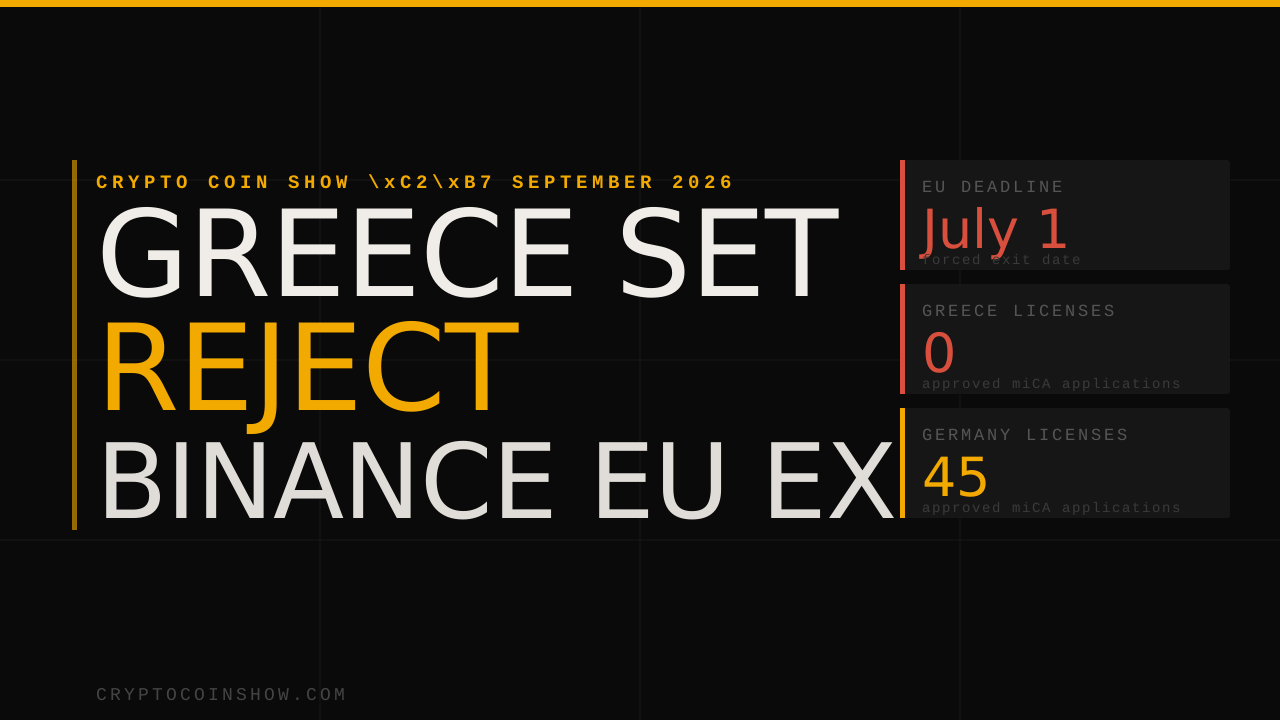
Binance will be cut off from Europe on July 1 – Removes the “best liquidity in the world” says CZ
Binance will lose the ability to serve European customers after July 1, 2024, when MiCA authorization requirements take effect, forcing a test of whether compliant competitors can absorb the world’s largest exchange’s trading volume and liquidity. The move marks the first time a major centralized exchange has faced a hard regulatory cutoff in a developed market, with institutional implications for market fragmentation and liquidity concentration.

- Binance missed the July 1 MiCA authorization deadline and withdrew its application from Greece on June 24, 2024.
- ESMA rules restrict unauthorized providers to orderly exits and transfers only after July 1, ending active trading and new onboarding in the EU.
- CEO Richard Teng stated the firm remains “committed to securing a MiCA license in the coming months” but provided no replacement authorization date.
- July 1 Deadline for MiCA authorization or EU market access restrictions begin immediately
- 75% Percentage of EU-registered crypto firms expected to lose licenses by summer 2024
- June 24 Date Binance withdrew MiCA application from Greece, signaling shift to alternative member state
Binance faces a hard regulatory cutoff that transforms Europe’s MiCA compliance debate from a policy timeline into a live market test.
Starting July 1, the European Securities and Markets Authority (ESMA) will require all unauthorized crypto service providers to halt onboarding of new EU customers, cease marketing activities in the bloc, and restrict operations to orderly exits, asset transfers, position closures, and essential custody services during transition.
The world’s largest cryptocurrency exchange, which has long dominated trading volume and liquidity across global markets, will no longer be able to function as an active trading venue for European institutional and retail customers, a restriction that forces a fundamental question: can compliant alternatives absorb both the volume and the execution quality that made Binance the default market for millions of users.
Binance formally notified European customers of the miss on June 23, according to social media statements and reporting, just days after withdrawing its MiCA license application from Greece and announcing a pivot to seek authorization in another EU Member State.
CEO Richard Teng confirmed the company’s intention to pursue authorization “in the coming months,” framing the cutoff as a temporary disruption rather than a permanent exit.
Yet Teng provided no specific replacement authorization date, timeline, or naming of which member state would serve as Binance’s new regulatory home, leaving a critical gap between July 1 restrictions and any future approval that could span months or longer.
Binance’s Withdrawal from Greece Signals Regulatory Exhaustion Across First-Wave Member States
Binance’s June 24 withdrawal of its MiCA application from Greece marks a significant pivot in the exchange’s European strategy.
The move came after Greece emerged as one of the first EU member states to move toward granting or denying MiCA licenses, and Binance’s abandonment of the Greek path suggests the regulatory terms, capital requirements, or operational restrictions demanded in early approvals were unacceptable to the firm.
Binance stated it would pursue authorization in “another EU Member State” without naming the target or explaining why Greece no longer represented a viable path forward.
The timing is critical. ESMA’s June 23 guidance made clear that July 1 is a hard regulatory line. Any exchange lacking authorization by that date must stop active service to EU customers immediately and shift to a wind-down mode focused solely on helping users exit, close positions, or transfer assets.
This creates a narrow window: Binance has until June 30 to announce a new member state and initiate that country’s authorization process, or accept that EU customers will lose trading access while the firm waits for approval elsewhere, potentially driving volume to competing platforms that hold MiCA licenses.
The broader context sharpens the stakes. Approximately 75 percent of crypto companies registered across Europe are expected to lose their MiCA licenses this summer, making this the most aggressive regulatory thinning the industry has experienced to date.
Binance’s status as the market leader makes its cutoff uniquely visible and consequential for institutional traders, market makers, and stablecoin custodians who have relied on Binance’s order-book depth and multi-asset trading pairs as a primary execution venue.
ESMA’s Orderly Exit Rule Transforms Binance from Trading Venue to Asset-Transfer Window
ESMA’s June 23 directive redefines what “cutoff” means in practice. The regulator did not order exchanges to shut down entirely; rather, it imposed a functional narrowing. Authorized crypto service providers can continue to onboard new EU clients, offer active trading services, and market products in the bloc.
Unauthorized providers, by contrast, face four permitted activities only: orderly exits (users closing accounts and removing funds), asset transfers between venues, position closures (terminating open trades), and custody operations required to facilitate the transition itself.
This distinction has immediate consequences for Binance’s European user base. An account cannot serve as a primary trading platform after July 1; it can only serve as a way out. Users seeking to continue trading will need to move to a licensed competitor, likely Kraken, Coinbase, or Bitstamp in the EU, or offshore platforms offering European access.
Users who hold stablecoins, spot assets, or leveraged positions on Binance will face the mechanics of transferring or liquidating those holdings, often at less favorable prices than they might achieve in a fully operational market.
The practical pressure on users is acute. Moving large positions or stablecoin holdings between exchanges incurs slippage, transfer fees, and time delays that are often overlooked in policy discussions but material for traders operating tight margins.
Licensed Competitors Face a Liquidity Surge Without Guarantee of Matching Binance’s Execution Quality
The institutional question now centers on whether licensed competitors can absorb Binance’s European volume and order flow without fragmentation, widening spreads, or execution degradation. Kraken, Coinbase International, and Bitstamp have all secured MiCA authorization or are on track to do so, and they will inherit a surge of migrating users and capital.
Yet authorization status alone does not guarantee equivalent liquidity or product breadth.
Binance’s dominance rests on three factors: deep order books (high volume concentrated on a single venue), broad asset coverage (hundreds of trading pairs), and efficient stablecoin rails (direct USD Coin and Tether access enabling seamless entry and exit).
Licensed competitors may gain users but face a liquidity coordination problem: if users fragment across three or four venues instead of one, order-book depth shrinks at each, spreads widen, and execution quality deteriorates.
Institutional traders and market makers, who rely on tight spreads and rapid fills to operate profitably, may find compliant alternatives costlier or slower than Binance, creating pressure to either accept lower execution or seek workarounds via offshore or non-compliant venues.
Teng’s commitment to secure “a MiCA license in the coming months” presumes that an alternative member state will grant approval faster than others have moved thus far. To date, MiCA approval timelines have stretched well beyond initial expectations, with member states still establishing rulebooks and enforcement processes even as the July 1 deadline arrives.
If Binance’s new authorization takes three to six months, the firm will be locked out of active EU trading for a quarter or more, enough time for institutional and retail users to establish new habits, relationships, and holdings elsewhere.
The Unknown Authorization Timeline Leaves Institutional Traders in a Liquidity Limbo
The core uncertainty for institutional investors is the gap between July 1 and Binance’s next authorization approval date. Teng has not named the target member state, provided a submission timeline, or outlined what regulatory concessions Binance might make to accelerate approval.
This silence suggests either that internal discussions are still ongoing or that the firm faces a choice between accepting material new restrictions or waiting longer to find a willing regulator.
Institutional traders who have built quant strategies, market-making operations, or stablecoin liquidity management workflows around Binance’s infrastructure face a forced decision. They can migrate to licensed platforms now and accept lower execution quality, fragmented liquidity, and higher operational friction. Or they can wait for Binance’s return, maintain positions in a wind-down
Original reporting: cryptoslate.com