Greece set to reject Binance’s MiCA license application, threatening EU exit by July
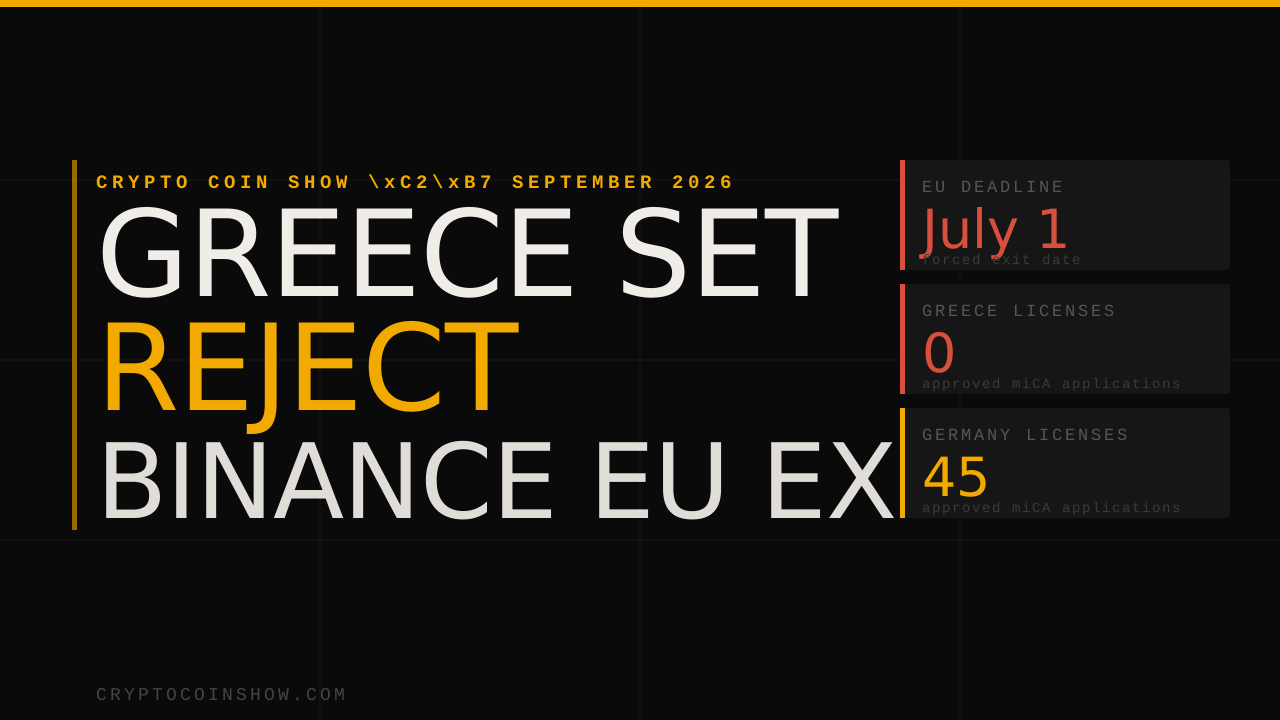
Greece’s capital markets regulator is preparing to deny Binance’s application for a Markets in Crypto-Assets (MiCA) license, potentially forcing the world’s largest crypto exchange to exit the European Union by July 1, 2026. The rejection would eliminate Binance’s sole pathway to legal operations across the 27-member bloc and mark a major test of how European regulators enforce the continent’s flagship crypto rulebook.
- Greece’s Hellenic Capital Market Commission is preparing to reject Binance’s MiCA license application ahead of the June 30, 2026 deadline
- Binance chose Greece as its European hub in January despite it having approved zero MiCA licenses, versus Germany’s 45 and the Netherlands’ 22
- A regulatory rejection would force Binance to cease all EU operations or operate illegally, setting precedent for how MiCA enforcement will work across Europe
- July 1, 2026 Mandatory compliance deadline when unregistered crypto exchanges must exit EU markets
- 45 MiCA licenses granted by Germany at time of Binance’s Greek application versus zero in Greece
- 90+ Crypto firms operating in France without proper MiCA authorization as of regulatory review
Binance faces a regulatory wall in Europe. Two people familiar with the matter told Reuters that Greece’s Hellenic Capital Market Commission (HCMC) is preparing to deny the exchange’s application for a Markets in Crypto-Assets (MiCA) license, the EU’s comprehensive rulebook for crypto-asset service providers.
The decision would come before the mandatory June 30, 2026 compliance deadline, after which any unregistered exchange operating in the bloc faces hard market access restrictions. Binance filed its application with the Athens regulator in January 2026, making a strategic bet on Greece as its European operational hub rather than choosing established financial centers like Frankfurt or Amsterdam.
The timing matters sharply for institutional investors and custody providers operating across European markets. MiCA requires every crypto-asset service provider, from exchanges to wallet providers to staking services, to hold a valid license by July 1, 2026.
For Binance, which processes billions in daily volume and serves millions of EU-based retail and institutional clients, a Greek rejection would leave no regulatory pathway forward in any EU member state, at least in the near term. The HCMC has offered no public comment on Binance’s application status, citing confidentiality rules, but the Reuters reporting signals the decision is imminent.
A Binance spokesperson told Reuters the company had worked constructively with Greek regulators over 18 months and believed it had satisfied all MiCA requirements, adding that “HCMC has given no formal indication of the contrary.”
Binance’s Gamble on Greece Despite Zero Prior MiCA Approvals
Binance’s choice of Greece as its European anchor point stands as one of the most consequential regulatory bets in crypto in recent years, and it rested on thin ground from the start. When the exchange submitted its application to Athens in January, Greece had not approved a single MiCA license.
Germany, by contrast, had already issued more than 45, and the Netherlands had granted 22, according to data from the European Securities and Markets Authority. The disparity was stark and public: any institutional investor or compliance officer reviewing jurisdictions would have seen Greece as an untested venue.
Binance co-CEO Richard Teng defended the decision at the Global Finance & Technology Network forum in Tokyo in February, explaining that the company had weighed factors beyond pure regulatory precedent.
“The license is pretty standard throughout Europe, so we have to think through many other factors, whether it’s social, whether it’s talent pool, safety and security issues,” Teng said at the time.
“Greece is where we think will be a good base for us to expand in Europe.” The rationale suggests Binance was betting on both regulatory approval and longer-term operational advantages in Greece, including cost structure and human capital access.
To anchor the European operations, Binance established a local holding company called Binary Greece around the same time as its application submission. The entity was designed to function as the regulated hub for all Binance services across the EU. However, that localization strategy appears not to have moved the needle with Greek regulators.
The HCMC rejection, if confirmed, would suggest that regulatory scrutiny in Athens has either tightened, or that Binance’s operational and compliance arrangements did not meet the regulator’s standards, despite Binance’s assertions to the contrary.
Broader EU Regulatory Pressure Already Mounting on Binance
The potential Greek rejection does not occur in isolation. France’s Autorité des Marchés Financiers (AMF) had previously identified Binance among more than 90 firms operating in the country without proper MiCA authorization.
This regulatory pressure reflects a pattern: European national regulators are beginning to enforce MiCA compliance more actively, and Binance has remained a focal point for that enforcement effort. France’s public stance placed Binance on notice that continued operations without a valid license would trigger enforcement action.
Across the EU, more than 50 crypto companies now hold valid MiCA licenses, according to ESMA data. That cumulative approval count, while growing, remains modest relative to the universe of firms seeking authorization.
The approval process has revealed variation in regulatory standards and timelines across member states: some regulators like Germany and the Netherlands have moved quickly and granted dozens of licenses, while others, including Greece, have either been more cautious or have faced capacity constraints.
This uneven landscape creates both opportunities and risks for exchanges seeking to establish European operations.
Binance’s situation also reflects a deeper challenge: the first wave of MiCA enforcement will likely involve high-profile denials that set precedent for how strictly each regulator interprets the rulebook.
What Happens to EU Crypto Markets if Binance Loses Legal Access
If Greece denies Binance’s application and no other EU member state grants an alternative license before June 30, 2026, the exchange would face a binary choice: cease all EU-regulated operations or continue serving EU customers as an unregistered entity. The first option would mark a historic retreat by the world’s largest crypto exchange from a major developed market.
The second would position Binance in direct violation of MiCA and expose it to enforcement action by national regulators and potential EU-level coordination.
For institutional investors, this scenario carries material consequences. Binance currently captures a substantial portion of EU trading volume and provides settlement and custody infrastructure relied upon by asset managers, trading firms, and market makers across the bloc.
A forced exit would fragment that liquidity, likely pushing trading volume to less-regulated offshore venues or to smaller compliant exchanges with lower trading depth. Borrowing costs, spreads, and execution quality would all likely widen in the near term as market participants adapted to Binance’s absence.
Binance itself stated on June 16 that “any delay or distortion in the MiCA authorisation process risks reducing liquidity, weakening competition and user choice, and pushing activity outside the EU.” The company committed to providing a further update before June 30, 2026, signaling that either a regulatory decision or a strategic pivot is imminent.
The exchange has also left open the possibility of appealing a Greek denial or seeking authorization in another member state, though the compressed timeline before the July 1 deadline would make that path extremely difficult.
Binance’s stated June 30 update deadline is the concrete next milestone: that announcement will reveal whether the exchange has secured approval from Greece or another EU regulator, begun a formal appeal process, or opted to exit EU operations. The decision will also establish the first major precedent for how European regulators treat large, systemically important exchanges under MiCA enforcement, a signal that will shape how other platforms and financial firms approach European regulatory compliance over the next 18 months.