
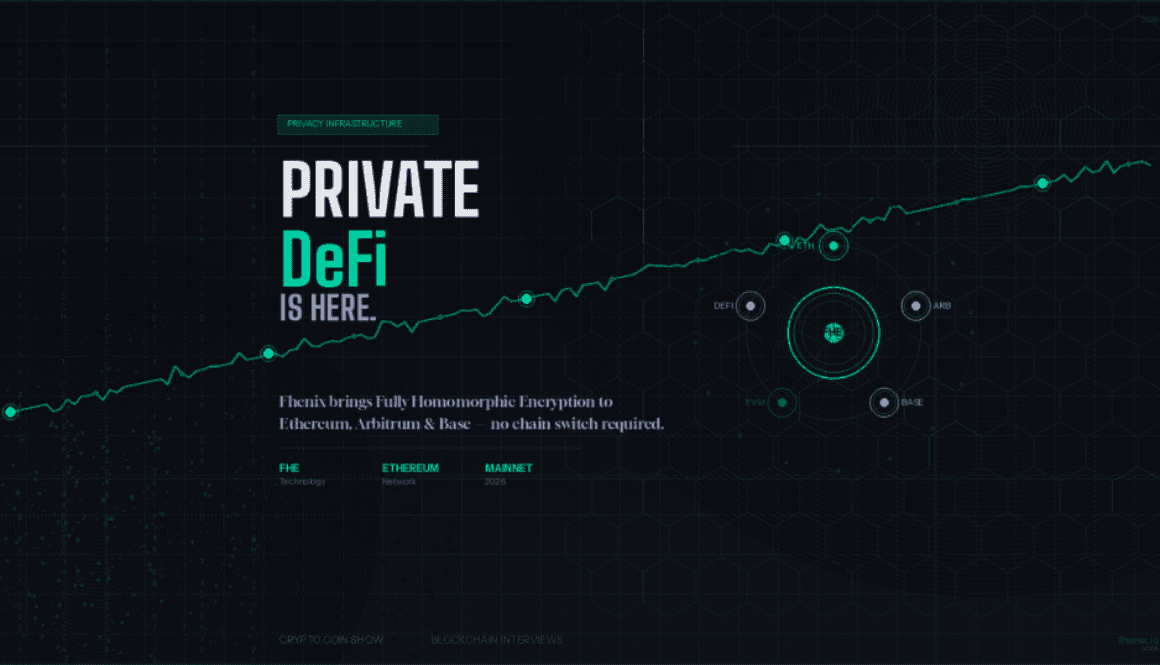
Fhenix Is Making Private DeFi a Reality — Without Asking You to Switch Chains
Fhenix Is Making Private DeFi a Reality — Without Asking You to Switch Chains
Using Fully Homomorphic Encryption, Fhenix lets developers add on-chain confidentiality to Ethereum, Arbitrum, and Base smart contracts — a few lines of Solidity away from private lending, dark pools, and compliant institutional finance.
The Privacy Problem Hiding in Plain Sight
Every transaction on a public blockchain is visible to anyone with a browser. Open Etherscan, and you can trace wallets, balances, and strategies back to the genesis block. For retail users, that might feel abstract — but for institutional players, DeFi protocols, and enterprise payments, transparent ledgers are a non-starter.
That is the gap Fhenix is building to close. Founded by Guy Itzhaki, a former Intel executive who led the company’s Trusted Execution Environment (TEE) division, and the co-founder of Secret Network, Fhenix is developing what it calls the fastest privacy infrastructure for blockchain — powered by Fully Homomorphic Encryption (FHE).
If you want to bring real money, bring the large players in, see mass adoption — there needs to be a level of maturity that includes privacy. But not just privacy: it also includes compliance.
— Guy Itzhaki, Co-Founder & CEO, FhenixWhat Is Fully Homomorphic Encryption?
Most people understand encryption as a lock: you can encrypt data to hide it, but you have to decrypt it before you can do anything useful with it. FHE breaks that assumption entirely.
The term “homomorphic” comes from mathematics — it refers to preserving structure during transformation. In practice, FHE encrypts data in a way that retains enough mathematical structure for computation to happen on the ciphertext itself. The result is decrypted only at the end, meaning no one — including the nodes processing the transaction — ever sees the raw data.
FHE has existed as a theoretical concept for decades, long regarded as too slow for real-world use. Itzhaki, who worked on hardware acceleration for FHE at Intel before leaving to co-found Fhenix, says the performance trajectory has changed dramatically — and that gap is exactly what Fhenix is engineered to close.
| Technology | What It Does | Compute on Encrypted Data? | Trust Requirement |
|---|---|---|---|
| Zero-Knowledge Proofs | Hides identity / proves a statement without revealing it | No | Math-based |
| Trusted Execution Environments (TEE) | Computes in a secure hardware enclave | Partial | Hardware trust required |
| Fully Homomorphic Encryption (FHE) | Computes directly on encrypted data — no decryption needed | Yes | Pure math — trustless |
From L2 to Co-Processor: Meeting Developers Where They Are
Fhenix did not start where it is today. The original architecture was an independent Layer 2 — another chain for developers to migrate to. Within months, the team recognized the strategic error: the market doesn’t need another L2. It needs privacy on the chains where developers already live.
The pivot led to what Fhenix now calls a co-processor architecture — or, more simply, Privacy as a Service. The Fhenix co-processor plugs into existing EVM chains (currently Ethereum, Arbitrum, and Base) and exposes a library developers can import directly into their Solidity smart contracts.
No new toolchain. No new language. No chain migration. Developers import a library, call encrypt and decrypt functions, and their contracts gain data confidentiality. Itzhaki puts the integration at roughly four lines of code for a basic private stablecoin implementation.
Use Cases Already in Development
With eight projects actively building on the testnet, early implementations span a range of confidential finance applications: private lending protocols, confidential payment rails, dark pools, and OTC settlement. Each addresses a category where on-chain transparency has historically been a dealbreaker for serious capital.
Privacy Without Sacrificing Compliance
One of the most persistent objections to blockchain privacy tools is regulatory: if transactions are opaque, how do you enforce KYC and AML? Fhenix’s architecture directly addresses this tension.
Rather than giving users a binary choice between private and auditable, Fhenix’s smart contract framework lets developers define programmable disclosure conditions. A regulator or auditor can be granted access to specific transaction data only when predefined criteria are met — without the protocol itself ever holding or exposing a master key.
This is what Itzhaki calls KYT — Know Your Transaction — a compliance primitive built natively into the privacy layer.
Institutional players still want KYC. They still want AML. You need a solution flexible enough to give them the privacy levels they need — but that doesn’t open the door for regulators to walk in and say this isn’t what we need.
— Guy Itzhaki, FhenixPrivate Stablecoins: A Dual-Mode Future
One concrete product demonstration Fhenix has already shipped is a dual-mode stablecoin framework. Rather than issuing a purely private stablecoin — which would be incompatible with most existing DeFi yield applications — Fhenix’s model allows issuers to deploy a token that users can toggle between private mode (for transfers and balance privacy) and public mode (for composability with yield-bearing protocols like lending markets).
Asked whether this could be applied to USDC or USDT, Itzhaki confirmed that Fhenix is actively in conversations with major stablecoin issuers. The technical lift, he says, is surprisingly minimal.
Why Privacy Is Having a Moment in 2026
After spending years defending privacy as a legitimate need rather than a criminal one, Itzhaki sees three structural forces finally converging:
1. Stablecoins found product-market fit. Payments with stablecoins are a real use case. Real payments demand real privacy — the question becomes obvious once money starts moving seriously.
2. Institutions are arriving with a different set of requirements. JP Morgan, Robinhood, and others entering the space are not coming with a cypherpunk ethos — they’re coming with compliance departments. Privacy infrastructure that satisfies both camps is now a prerequisite, not a nice-to-have.
3. AI agent payments are early but accelerating. The emerging narrative around agent-to-agent micropayments on stablecoin rails points toward a future where machine-speed transactions carrying confidential business logic will require privacy at the infrastructure level. Fhenix already shipped a private implementation of the x402 AI payment standard roughly three months ago.
Roadmap: Testnet Now, Mainnet by Year-End
Fhenix is currently live on testnet across Ethereum, Arbitrum, and Base. A new SDK version was shipping at the time of this writing, described by Itzhaki as a major improvement in developer experience and performance. Mainnet is targeted for later in 2026, with significant engineering work focused on security hardening and production-grade performance.
Parallel to the engineering path, Fhenix is running a builder program, a planned buildathon, and active outreach to established DeFi protocols. The team also recently co-hosted an open house with Arbitrum in New York, where projects building on Arbitrum explored FHE integrations in real time.
Developers can access documentation, SDK downloads, and testnet resources at fhenix.io. The DevRel team is available for direct support.