A Phone Call From Trump Just Earned Nvidia Stock a Potential 30% Boost
Nvidia’s stock has rallied 32% since a May 6 technical breakout, now targeting $267, after CEO Jensen Huang received a personal call from President Trump inviting him to join a Beijing delegation, restoring access to a $50 billion China AI chip market that had been shut down by export controls. For institutional investors, the convergence of technical setup, geopolitical opening, and analyst repricing creates both opportunity and execution risk heading into the company’s May 20 earnings report.
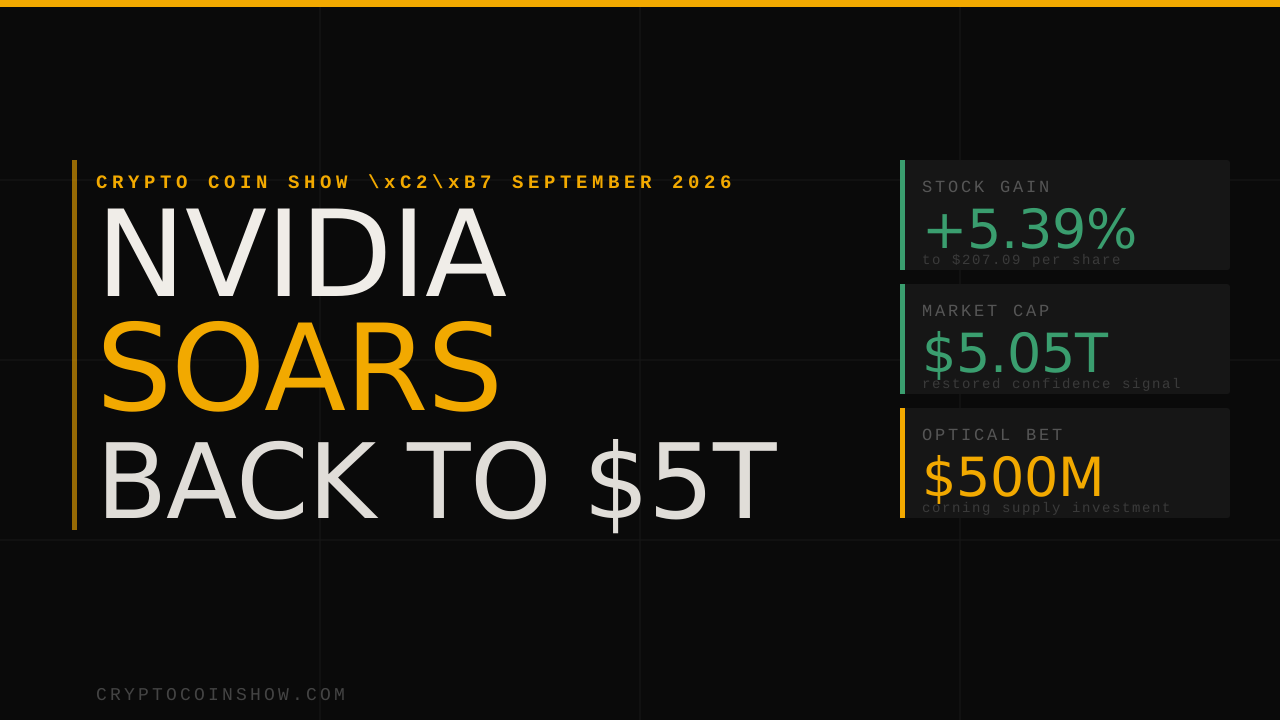
- Nvidia stock climbed to $227 by May 13, up 32% from May 6 breakout, tracking a textbook measured-move target of $267
- CEO Jensen Huang received personal call from Trump; flew to Alaska to board Air Force One for Beijing trip on May 12
- Five Wall Street firms raised price targets in 48 hours; BofA to $320, Wells Fargo to $315, citing $1.7 trillion AI data center TAM by 2030
- $50B China AI chip market opportunity at stake, previously banned under Trump export restrictions
- $320 Bank of America’s new price target, up from $300 on May 13
- 32% Seven-day rally since May 6 breakout, matching measured-move chart projection
Nvidia’s stock has entered a rare confluence of technical momentum, fundamental catalyst, and analyst validation that has institutional trading desks parsing both the upside signal and the execution risk.
The company’s share price broke out of a bull flag and pole formation on May 6 after a 31.92% rally across April and early May, then extended for seven consecutive green daily closes to $227 by May 13. The technical setup projects a 32% measured move from breakout, targeting $267, a level now endorsed by at least three major Wall Street research teams in the past 48 hours.
But the catalyst driving the repricing is a geopolitical one: on May 12, President Trump personally called CEO Jensen Huang to invite him to join a delegation traveling to Beijing, after Huang had initially been absent from the executive list.
Huang flew to Alaska to board Air Force One, placing a $50 billion China AI chip market back in play after Trump’s administration had shut down Nvidia’s access to the market through export controls.
Trump’s Personal Call Reopens $50 Billion China AI Chip Market for Nvidia
The geopolitical context matters heavily to institutional positioning. In the July quarter, Nvidia absorbed a $4.5 billion revenue hit after Trump introduced the original China license requirement, blocking sales of the company’s most advanced processors.
At the time, CEO Huang stated publicly that a multi-year ban on China chip sales would result in a $50 billion revenue headwind over two to three years. That projection shaped analyst models and institutional capital allocation across semiconductor and AI infrastructure for the next 24 months.
A reopening of that market, even partial, would materially reset growth assumptions and free cash flow forecasts.
The May 12 call represents the first concrete signal that the Trump administration may negotiate access rather than maintain an outright embargo. Huang’s willingness to board Air Force One on short notice and travel to Beijing signals Nvidia’s priority on resolving the market access question before the company reports earnings on May 20.
Institutional investors are now pricing in the possibility that Huang returns from Beijing with either explicit policy relief or at minimum a credible signal that negotiations are underway.
The timing is critical because Nvidia’s Q1 forward guidance will set the tone for analyst models through 2026. If Huang can communicate a path to restoring China business, even at reduced export levels relative to pre-ban volumes, the earnings call becomes a major re-rating event. If Beijing remains off-limits, the stock faces a steeper downside risk despite the current technical setup.
Bank of America and Wells Fargo Hike Targets to $320 and $315 on Refreshed AI Demand Models
Wall Street has moved with unusual speed to reprice Nvidia upward. Bank of America’s Vivek Arya raised the firm’s price target to $320 from $300 on May 13, citing a $1.7 trillion total addressable market for AI data center infrastructure by 2030, a baseline that implicitly assumes sustained China demand beyond current restrictions.
Wells Fargo’s Aaron Rakers raised to $315 from $265 on May 12, deploying a new gigawatt-capacity model that factors in the scale of AI cluster buildouts across cloud and enterprise customers. Susquehanna’s Christopher Rolland raised to $275 from $250, bringing his target into alignment with the technical chart projection. Citi reiterated $300, and Oppenheimer reiterated $265.
The divergence between BofA and Wells Fargo on the high end versus Oppenheimer on the low end reflects genuine uncertainty about both the China outcome and the sustainability of current AI infrastructure spending.
A $320 target implies 41% upside from current levels; a $265 target implies only 17%. The spread suggests institutional consensus has widened rather than narrowed, despite the bullish technical setup.
For portfolio managers, the question is whether the analyst repricing reflects new information or re-rating of existing assumptions. BofA’s $1.7 trillion TAM for 2030 AI data centers is not a new estimate; it reflects consensus among AI infrastructure researchers that has been building for six months.
The speed of repricing in the past 48 hours suggests that the Trump call has shifted perceived probability that Nvidia can access that TAM without China-related margin compression, rather than evidence of accelerating demand itself.
Chaikin Money Flow Showing Divergence From Price Rally, Signaling Caution Beneath Breakout
The institutional flow data tells a more cautious story. The Chaikin Money Flow indicator, which measures volume-weighted balance of buying and selling pressure as a proxy for large institutional positioning, sits at 0.24 on the Nvidia daily chart, positive territory, but peaking in late April and declining through May despite the price rally.
A rising price combined with declining or flattening money flow often signals weakening conviction behind the move, suggesting that retail or shorter-dated momentum traders may be driving the recent sessions more than large institutional buyers.
The CMF divergence is not a sell signal by itself, but it suggests that the May 6 breakout may have already captured most of the institutional interest in the immediate term.
For risk managers, this divergence matters because it implies the current 32% move may be front-running the May 20 earnings report rather than distributed across it. If Huang returns from Beijing without concrete policy wins, or if the earnings report disappoints on forward guidance despite the China topic, the stock could retrace sharply, especially if money flow has already peaked.
Conversely, if earnings deliver both strong guidance and explicit disclosure of China negotiation progress, the CMF may inflect upward and carry the price through the $267 technical target and beyond BofA’s $320 level.
May 20 Earnings Call Will Determine Whether Geopolitical Opening Translates to Actual Revenue Guidance
Nvidia’s earnings report landing on May 20 becomes the critical test for whether the current price action reflects justified repricing or momentum ahead of fundamentals. The market is now priced for Huang to provide specific color on China negotiations, and to update the company’s revenue outlook if there is tangible policy progress.
If earnings guidance remains in line with consensus (already elevated given the strong seasonal close to Q1), the stock could consolidate or pull back despite the Trump delegation backdrop.
The institutional base is watching for three specific pieces of information: first, quantified forward revenue guidance reflecting any China market assumption change; second, management commentary on the trajectory of AI infrastructure spending among hyperscale customers outside China; and third, any disclosure of policy engagement or timeline for clarification on export controls.
The absence of specific China guidance would likely be interpreted as the market getting ahead of actual policy outcomes.
The technical setup remains constructive, seven consecutive green closes, breakout on volume, and measured-move target of $267 in line with analyst repricing to $275 and $315. But the May 20 earnings report is the point at which the geopolitical catalyst either becomes embedded in fundamental assumptions or