
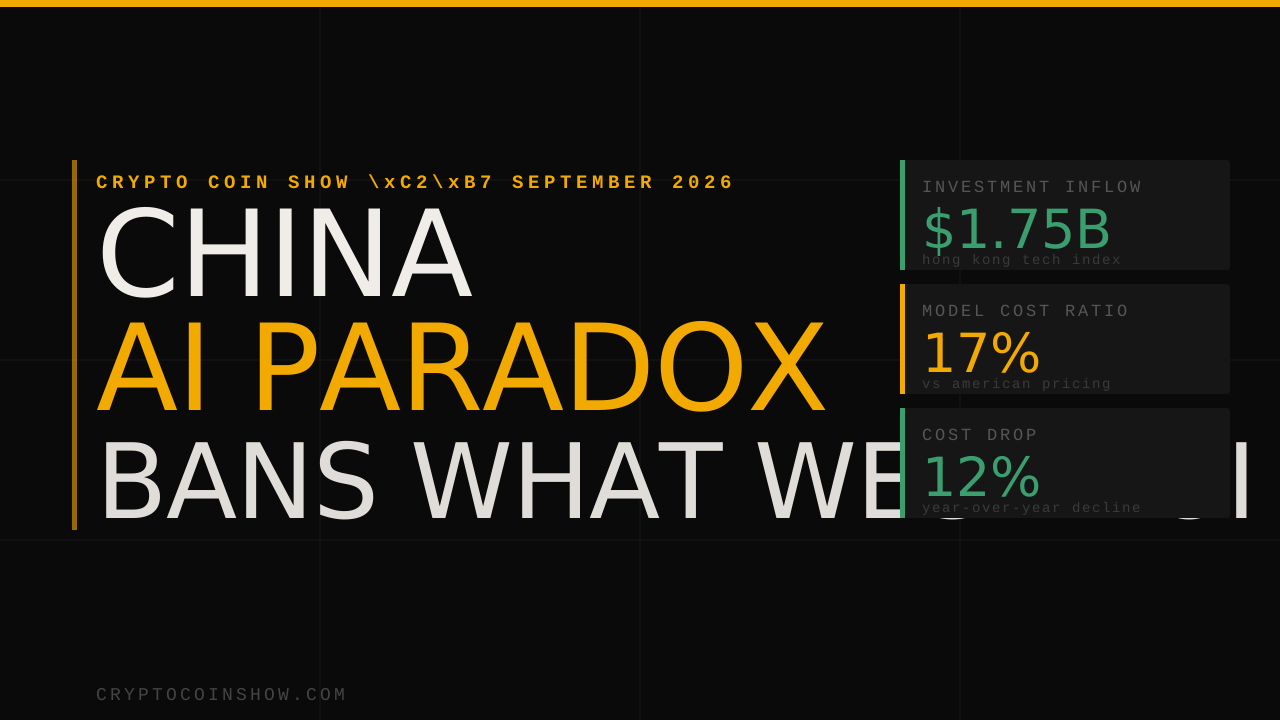
Chinese AI stocks to draw $1.75B while banning what Silicon Valley does best
Chinese regulators are simultaneously channeling $1.75 billion into AI stocks while courts ban the labor-displacement automation that has driven AI adoption in the West, raising a structural question about whether job protection could accelerate rather than constrain AI development in the world’s second-largest economy.
- Morgan Stanley projects $1.25 billion to $1.75 billion will flow into Hong Kong’s tech index when Zhipu AI and MiniMax join on June 8, 2024.
- Chinese AI model costs fell from just 5 percent of American pricing one year ago to at least 17 percent currently, narrowing the price advantage.
- Hangzhou court ruled companies cannot fire employees solely to replace them with automation, creating an enforcement ceiling on labor displacement.
- $1.75B Maximum inflow Morgan Stanley expects into Hang Seng Tech Index upon index inclusion
- 17% Chinese AI model cost as percentage of American model pricing in Q1 2024
- June 8 Scheduled date Zhipu AI and MiniMax inclusion takes effect in Hong Kong benchmark
Two Chinese artificial intelligence companies are poised to draw substantial institutional capital into Hong Kong markets in early June, even as Beijing’s courts impose restrictions on how aggressively companies can deploy automation to cut labor costs.
Morgan Stanley analysts forecast that Zhipu AI (trading as Knowledge Atlas Technology) and MiniMax will trigger between $1.25 billion and $1.75 billion in passive inflows when they join the Hang Seng Tech Index on June 8, 2024.
The projection underscores institutional confidence in Chinese AI expansion at a moment when regulators simultaneously appear to be constraining the labor-replacement use case that has justified much AI investment in Silicon Valley and Europe.
Both companies launched Hong Kong trading in January 2024, with their share prices climbing substantially since debut. Zhipu, which specializes in coding-focused language models, has seen its Morgan Stanley price target raised to 990 Hong Kong dollars from 560 dollars.
MiniMax, which offers broader multimodal capabilities including text generation and audio synthesis, saw its target price increase to 1,100 Hong Kong dollars from 990 dollars. The two represent the first major public offerings of Chinese AI model developers, a category that includes well-funded but still-private competitors like Moonshot and StepFun.
Morgan Stanley raises Chinese AI revenue forecasts as Hang Seng Tech index weighting shifts
The index inclusion comes at a critical moment for Hong Kong equities, where the Hang Seng Tech Index has fallen more than 11 percent since the start of 2024. Tencent and Alibaba, the index’s two largest constituents by market value, have both declined by double-digit percentages this year, creating a performance vacuum that AI-focused entrants may partially fill.
Morgan Stanley’s research team argues that leading Chinese AI developers will each generate at least $1 billion in revenue during 2024, with that figure more than doubling to exceed $2 billion in 2025.
The inflow projection reflects broader shifts in Hong Kong capital markets toward technology. Regulatory data shows that technology firms accounted for 40 percent of money raised through Hong Kong initial public offerings in the year to date, with another 43 percent of pending deals focused on the sector.
Morgan Stanley analysts noted strong backing from Beijing regulators, suggesting that policy support will sustain both new listings and the valuations attached to them.
Alibaba stands out as Morgan Stanley’s top pick among Chinese internet stocks, valued as a diversified AI beneficiary through cloud infrastructure and model development rather than as a pure-play AI developer.
Chinese AI pricing narrows gap with American models as adoption accelerates
The capital inflow arrives as a critical competitive marker shifts. Chinese AI models now cost at least 17 percent of what American equivalents charge in the first quarter of 2024, compared to just 5 percent one year earlier.
The rapid narrowing of this price advantage reflects both increased adoption of Chinese alternatives and rising American model pricing, driven by sustained enterprise demand and infrastructure costs.
For enterprises benchmarking total cost of ownership, Chinese vendors have begun offering feature parity at comparable pricing, a threshold that typically drives vendor consolidation in software markets.
Developers building on top of Chinese AI infrastructure have already begun migrating. OpenClaw’s AI agent tools show substantial adoption of MiniMax, partly because the pricing advantage remains material even as it compresses. The shift suggests that Chinese model makers are capturing market share not through cost arbitrage alone but through improving model quality and developer tooling.
Morgan Stanley’s revised price targets for both companies reflect this competitive maturation.
The pricing convergence also signals that scale advantages increasingly favor entrenched players, a dynamic that should accelerate consolidation in the fragmented Chinese AI market.
Hangzhou court blocks workforce replacement through automation, creating regulatory ceiling
Against this backdrop of capital inflow and competitive scaling, Chinese courts have imposed a structural constraint that diverges sharply from Western labor policy. The Hangzhou Intermediate People’s Court ruled in the past month that businesses cannot legally terminate employees simply to replace them with artificial intelligence systems.
The decision marks the first major Chinese judicial precedent on automation-driven labor displacement, establishing that job elimination cannot serve as the sole or primary justification for deploying automated alternatives.
The ruling creates an enforcement ceiling on labor substitution, the core economic driver of automation adoption in most advanced economies. Since 2018, productivity gains from AI in the West have been substantially offset by workforce reductions, creating pressure on wages and employment in certain sectors.
Chinese regulators appear to be constraining this pathway before it takes hold domestically. Instead, the court’s logic implicitly directs companies toward AI adoption models that augment rather than replace labor, a constraint that may reshape how Chinese enterprises calculate return on investment for AI infrastructure.
The policy divergence raises an unresolved question about efficiency. If Chinese companies cannot justify AI adoption through headcount reduction, they must instead justify it through revenue growth, margin expansion in remaining operations, or new product development.
This logic might actually accelerate investment in frontier AI capabilities, models powerful enough to create entirely new markets rather than merely automate existing ones. Conversely, it could slow adoption of routine automation in call centers, customer service, and clerical work, where American and European firms have seen rapid displacement.
Index inclusion and court ruling create competing pressures on investor thesis
The Morgan Stanley inflow projection assumes that June 8 inclusion will trigger passive buying across institutional portfolios tracking the Hang Seng Tech Index. However, the Hangzhou court ruling introduces execution risk into the bull case for Chinese AI returns.
If labor-replacement use cases remain off-limits, the addressable market for Chinese AI may be narrower than models trained on Western adoption patterns suggest.
Institutional investors evaluating the Zhipu and MiniMax theses must therefore reconcile two competing signals: regulatory capital support for AI as a sector, paired with regulatory constraints on the highest-return use case for AI deployment. The market is pricing this tension into current valuations, but the long-term implications remain unclear.
If Chinese AI companies can sustain revenue growth and margin expansion through augmentation-focused models, the current price targets could prove conservative. If labor-replacement constraints force companies into lower-return applications, valuations may contract once this constraint becomes binding.
Investors should monitor first earnings calls from Zhipu and MiniMax following their index inclusion to assess how management is modeling the labor-displacement constraint and whether customer pipelines reflect augmentation-focused or replacement-focused AI adoption, a distinction that will likely dominate institutional risk reassessment over the next two quarters.