Toronto, ON — July 14, 2026 — For Immediate Release
Futurist Conference returns to Toronto on July 21–22, bringing together thousands of attendees and more than 250 speakers as global leaders gather for major announcements, product demos, and discussions spanning digital assets, tokenization, artificial intelligence, payments, and the future of financial infrastructure.
Renowned for its immersive, festival-style Main Stage, Blockchain Futurist Conference has established itself as the industry’s foremost platform for revealing what’s next. This year’s edition promises to deliver on that reputation with a packed program of live demos, exclusive announcements, and new product launches across two full days in the heart of Canada’s crypto capital.
Attendees will witness the official launch of Cayman Ledger, a new magazine from FTS Cayman dedicated to blockchain, fintech, cryptocurrency, and Web3. FTS Cayman will also be available throughout the conference for one-to-one briefings on establishing ventures in the Cayman Islands.
“
We are very pleased to serve as a sponsor at Blockchain Futurist Conference this year, and our team is looking forward to meeting delegates at our booth for one-to-one briefings on setting up their ventures in Cayman and to celebrate the onsite launch of Cayman Ledger, our group’s new magazine dedicated to blockchain, fintech, crypto and Web3 sectors.
— Paul Byles, Director, FTS Cayman
Sponsors & Partners
60+ confirmed sponsors
Including Deloitte, KPMG, Wealthsimple, Robinhood, and
Polymath, Anvil.xyz, Digital Spenders Club, Krown Network, ATB Financial, and SafeBets — reflecting growing institutional participation across the digital asset ecosystem.
Media & Coverage
100+ Media Partners · Global Reach
VIP Backstage Roundtable Interviews
Genzio Media Interviews
World Boss Media Interview Area
W3BC Media
Live Podcast Stage — Chris Champion
Dozens of journalists will cover the event, amplifying conference announcements to audiences around the world. Blockchain Futurist Conference continues to set the standard for media access in the digital asset space.
Register Now for Blockchain Futurist Conference
Toronto · July 21–22, 2026 · FuturistConference.com
There are two distinct paths that the prediction market sector is taking.
Platforms are rapidly growing in the US to draw big investors and expert traders. Italy is the most recent nation to outlaw a significant prediction market platform, while other nations tighten laws.
Kalshi builds a professional trading cockpit
Kalshi has introduced Kalshi Pro, a desktop trading platform for seasoned traders, in the United States.
The platform is intended for customers who trade simultaneously in several markets, respond rapidly to real-time events, or make limit orders that are only fulfilled when a predetermined price is met. Currently in beta, Kalshi Pro is available for free.
According to the corporation, its business has been expanding quickly. Its yearly trading volume has tripled to $178 billion, with a significant portion of activity coming from quantitative trading firms and seasoned traders referred to as “sharps.”
To obtain a competitive advantage, these traders have historically depended on customized procedures, direct data linkages, and proprietary software.
All of those capabilities and tools are intended to be combined on a single platform with Kalshi Pro.
The new platform uses the same account and balance as Kalshi’s regular app. It also adds advanced trading tools that have long been available to professional stock and bond traders through traditional brokerages and exchanges.
“Kalshi’s active traders are already trading prediction markets and perpetuals like Wall Street trades equities and bonds,” said Andy Chang, the Kalshi Pro product lead. “We built Pro to give them the cockpit they deserve.”
For seasoned traders, Kalshi Pro offers a number of new tools. One tool that allows users to watch and trade numerous marketplaces simultaneously is called Canvas.
Active Markets Screener is another tool that lets traders keep an eye on around 2,000 active markets simultaneously.
Along with integrated risk management features like stop-loss and take-profit orders, it also provides everlasting futures trading with licensed TradingView charts.
Kalshi Pro’s release follows the company’s other significant accomplishment. Under the direct supervision of the Commodity Futures Trading Commission (CFTC), Kalshi just became the first trading platform in the United States to provide cryptocurrency perpetual futures. In just one week, the trading volume of these contracts hit $1 billion.
Italy blocks Polymarket for the second time
Across the Atlantic, the picture looks very different.
Polymarket, one of the biggest prediction platforms in the world, has been cut off in Italy for the second time. The Italian Customs and Monopolies Agency, known by the initials ADM, has added the website to its official list of blocked addresses, saying the platform does not comply with Italy’s gambling laws.
This is not the first time Polymarket has clashed with Italian authorities. The ADM first blocked the platform in October 2025, but that decision was reversed in December of the same year after Polymarket challenged it in the Regional Administrative Court of Lazio.
Following the Italian football team S.S. Lazio’s sponsorship deal with Polymarket, the matter gained even more attention.
The agreement raised awareness of the platform and introduced the discussion to the Italian parliament.
Compared to overseas platforms operating in Italy without authorization, licensed gambling companies contend that they must adhere to far tougher advertising regulations. Additionally, critics claimed that the nation’s current legislation should prohibit a platform that has been identified as an unlawful operator from sponsoring sports teams.
It is now anticipated that AGCOM, Italy’s communications regulator, will finish reviewing the sponsorship agreement.
Polymarket has always insisted that it provides a financial service rather than a gambling product.
According to the firm, users in Italy are only permitted to examine market data and are not permitted to trade on the platform. Even so, the ADM’s decision to blacklist Polymarket again shows a wider trend.
Regulators in several countries are increasing their scrutiny of prediction market platforms that operate without a local license. At the same time, the industry is moving in different directions around the world.
While prediction markets are becoming more popular and accepted in some countries, they are facing stricter rules and tougher regulatory action in others.
Don’t just read crypto news. Understand it. Subscribe to our newsletter. It’s free.
Meta announced today that it will expand its Richland Parish, Louisiana data center to 5 gigawatts of computing power, and the tech giant has also raised its committed investment into the site past the $50 billion mark.
The expansion of the planned data center, termed “Hyperion” by Meta, will support more than 1,000 jobs once it starts running at full capacity. This figure is double the job commitment Meta had made previously for the facility.
Meta continues outlay for data center project
Reports also claim that the $50 billion figure may understate the real cost of building this data center. Meta is reported to have committed an additional $40 billion to the campus, and a total expected outlay for the data center is about $250 billion.
Much of this amount would go toward the computing chips destined for the nearly 4,000-acre site. However, Meta has not publicly disclosed any spending beyond the $50 billion figure.
The tech giant’s first commitment towards the data center and the surrounding community was $10 billion, before the number grew by even more over time.
Alongside Meta, Blue Owl Capital owns an 80% stake in the site and has raised billions on Wall Street to fund construction. Meta CEO Mark Zuckerberg has pledged to spend at least $600 billion on US infrastructure over the next several years, with Meta currently at a count of 33 data centers built or in development. Last week, the company committed $10 billion to its first data center in Canada.
Who pays for the required power?
Running 5 gigawatts of compute takes an enormous amount of electricity. Entergy Louisiana is building 10 new gas-fired power plants to feed the data center. It is expected that more than 2 gigawatts of power will be required to cover the campus’ general electrical needs and not just the servers themselves.
Meta has said it will cover the data center’s energy, water, and infrastructure costs, stating that an accompanying energy deal was a benefit to residents. The agreement with Entergy Louisiana is expected to save their customers more than $2 billion over 20 years, the company said.
Meta also plans to spend more than $1 billion upgrading local roads, water, and wastewater systems.
Rural Parish sees reshape due to AI investment
The clearest signs of the project’s impact are in Richland Parish’s schools. Teachers there recently received annual bonuses of almost $50,000, up from $10,000 a year earlier, due to the tax revenue from the data center.
“It’s life-altering for our teachers and their families, and it’s transforming our schools,” Richland Parish School District Superintendent Sheldon Jones said in a statement quoted by Fox Business. Jones added that the money has helped the district recruit stronger teacher candidates.
Meta is also putting $5 million into Louisiana Delta Community College to fund scholarships for residents training for data center jobs. Starting with the class of 2026, every Richland Parish high school graduate will qualify for a full scholarship in a data center trade program.
This move follows Meta’s June launch of America’s Workforce Academy, a skilled-trades program that offers free tuition and guaranteed jobs to graduates.
CEO Mark Zuckerberg has said Meta is looking at acquiring as much computing power as it can get to chase what he calls AI superintelligence.
MicroStrategy, rebranded Strategy, has unveiled a Bitcoin Banking Adoption Index scoring how far big banks embrace Bitcoin (BTC). It puts overall institutional adoption at 32%.
The index ranks 25 major banks by how deeply they offer Bitcoin services. Fidelity leads at 71%, far ahead of most European and Japanese lenders, which sit below 30%.
Strategy Launches Bitcoin Banking Adoption Index, Fidelity Leads at 71%
What the Bitcoin Banking Adoption Index measures
The index works like a report card for banks. MicroStrategy scores how much of the Bitcoin economy each firm has built in, then combines those marks into one percentage. For most readers, this measures how close everyday banking now sits to Bitcoin.
Many of those products are new, since US regulators approved the first spot Bitcoin ETFs only in January 2024.
A 32% overall score means banks have taken on about a third of what MicroStrategy tracks. The score blends many services, so a firm can rank high on custody yet low on lending.
“Major-bank Bitcoin adoption is accelerating, but still early: 32% overall as measured by the index,” noted Strategy executive chair, Michael Saylor.
The company drew the numbers from public data as of July 10 and calls them approximate.
Fidelity Leads while Japanese Banks Lag
Fidelity’s lead is no accident. It set up Fidelity Digital Assets, an institutional custody and trading arm, in 2018. The firm now issues a spot Bitcoin ETF too.
The gap widens by geography. European lenders such as Banco Santander and Société Générale sit mid-table near 35%. Japan’s SMBC and the Royal Bank of Canada trail at just 13%.
Strategy has a stake in the story it is telling. The company holds 843,775 Bitcoin, the world’s largest corporate Bitcoin treasury, so wider adoption supports its core bet. It published the index itself, invited corrections, and stressed the data is approximate.
Introducing the Bitcoin Bank Adoption Index. Adoption of Bitcoin and the related digital asset ecosystem across major banks and financial institutions is accelerating, but still early at 32%.
Methodology and updates to follow. Institutions with questions, corrections, or… pic.twitter.com/BEajJPIE63
Strategy said methodology details and updates will follow. Whether banks accept or contest their scores will test how seriously Wall Street treats the ranking.
Bitcoin’s current price sat near $61,900, down more than 3% on the day. Saylor’s longer-term outlook still bets on far deeper adoption from the banks ranked here.
Crypto exchanges are increasingly becoming distribution platforms for Wall Street exposure as trading in tokenized stocks and real-world asset derivatives accelerates across crypto markets.
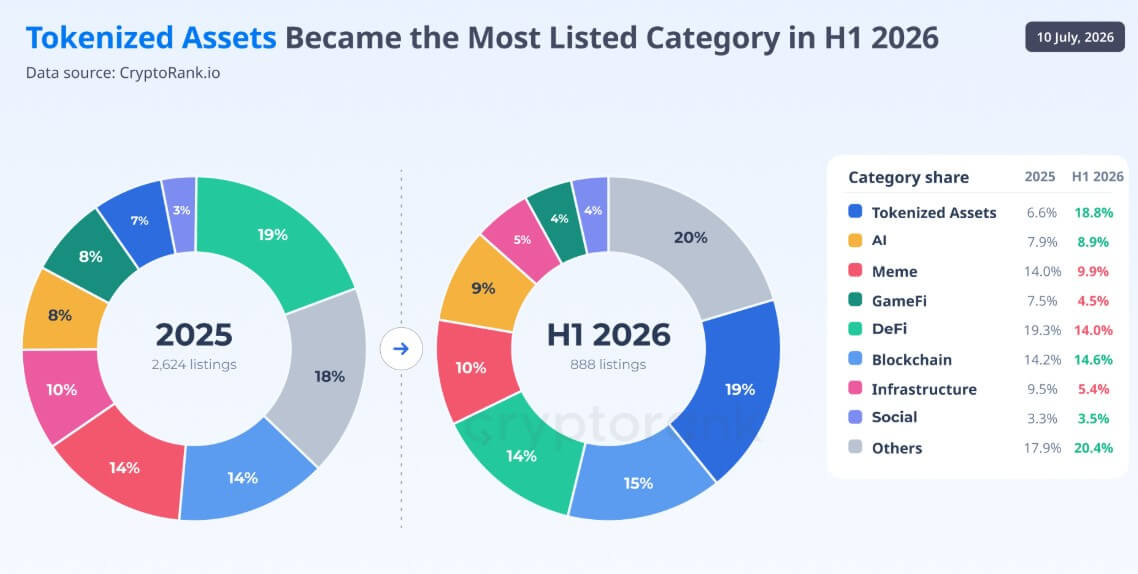
Tokenized assets became the most-listed category across major centralized exchanges in the first half of 2026, accounting for nearly one in every five new listings, CryptoRank data shows. The category represented less than 7% of listings in 2025.
The expansion was driven largely by tokenized equities issued through platforms including xStocks, bStocks and Ondo’s tokenized markets.
Their rise marks a sharp change in exchange strategy after years in which memecoins, gaming tokens and other crypto-native assets dominated listing pipelines.
The shift comes as conventional retail participation in US stocks cools. American retail investors purchased a net $13 billion in equities over the past month, the lowest total since the early stages of the COVID-19 pandemic in 2020, according to data from financial analytics firm VandaTrack.
Net purchases fell by $18 billion, or 58%, from early 2026 levels. Buying of individual stocks declined 71% to $3.2 billion.
The US figures cover a different market and investor group from the global tokenized-asset data. Crypto exchanges are nevertheless expanding stock-linked products for users seeking continuous trading, fractional access and exposure outside conventional brokerage infrastructure.
Tokenized stock trading is already scaling
The rapid growth in derivatives activity gives exchanges a clearer reason to expand their Wall Street-linked product offerings.
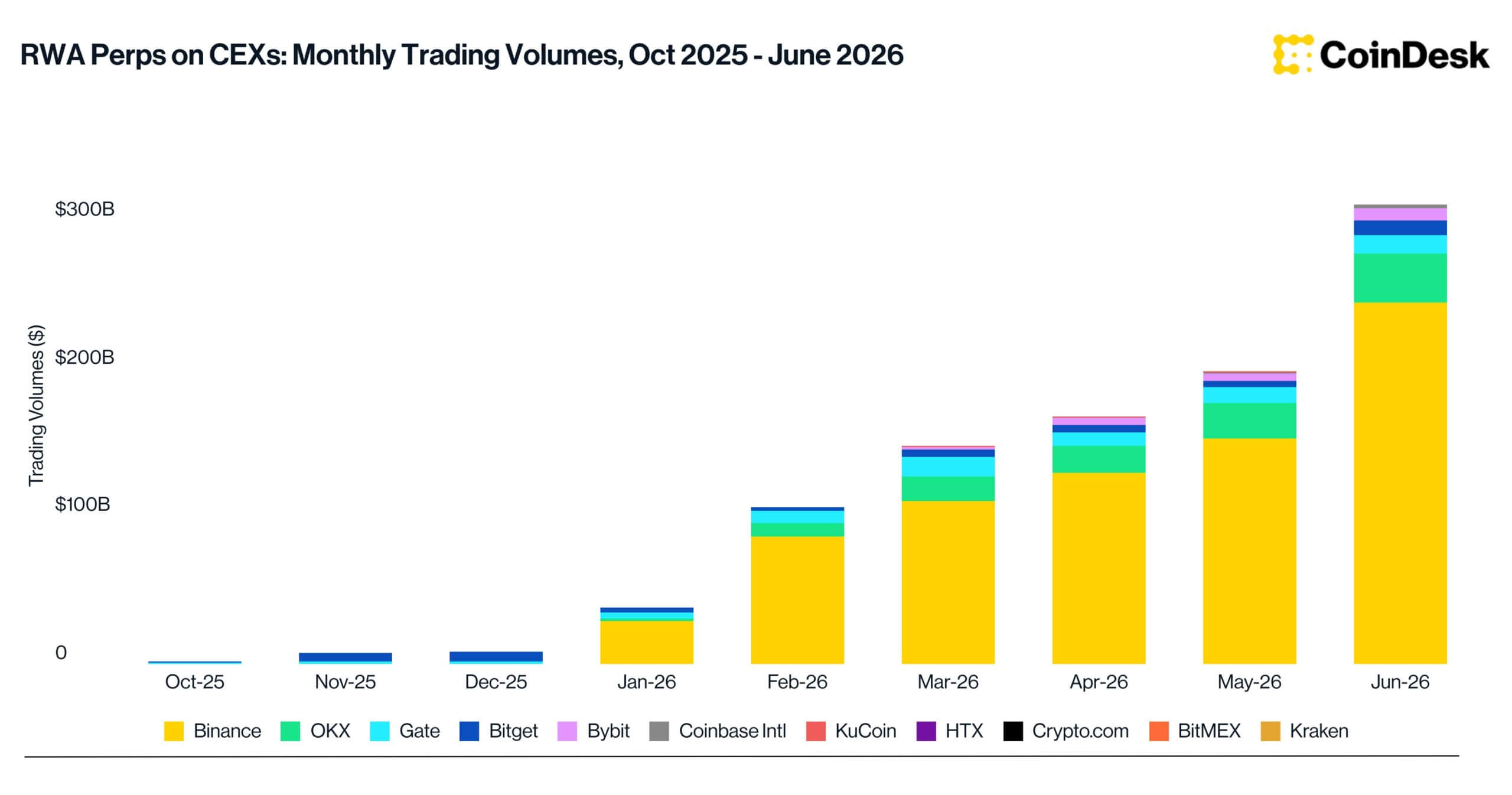
Trading volume in real-world asset perpetual futures on centralized crypto exchanges rose 57% in June to a record $311 billion, according to CoinDesk exchange data. Binance accounted for $245 billion, or 78.6% of the market.
RWA Perpetuals on Centralized Exchanges (Source: CoinDesk Data)
The category had generated negligible activity in late 2025 before expanding sharply through the first half of 2026.
The SpaceX initial public offering helped accelerate demand for crypto-based exposure to traditional financial instruments, particularly among traders seeking access outside the limits of conventional brokerage and equity-market infrastructure.
Perpetual futures allow users to speculate on an asset’s price without owning the underlying security and without an expiry date. They have become one of the most active products on crypto exchanges, where leverage and 24-hour trading can amplify both volume and volatility.
Meanwhile, the growth extends beyond derivatives.
Data from RWA.xyz shows that the tokenized stock market has grown by more than 470% in the past year to around $1.87 billion. Monthly transfer volume for these assets has also climbed to $8.4 billion, indicating that tokenized equities are attracting activity beyond the exchange-listing pipeline.
Tokenized Stock Market Cap (Source: RWA.xyz)
Kraken said in February that xStocks had surpassed $25 billion in total transaction volume. The figure included centralized and decentralized exchange transactions, as well as minting and redemptions, with more than $3.5 billion in on-chain activity.
Those figures show that the increase in listings is occurring alongside measurable activity in both tokenized equities and derivatives linked to traditional assets.
Exchanges are listing fewer tokens as Wall Street assets replace crypto’s old favorites
The rise of tokenized assets has coincided with a broader slowdown in exchange listings and a retreat from the speculative sectors that defined the previous crypto cycle.
Cryptorank stated that major centralized exchanges listed 351 tokens in the second quarter of 2026, the lowest quarterly total since the third quarter of 2023. New listings declined for a second consecutive quarter, making it only the second period since the start of 2024 in which delistings outpaced additions.
The slowdown follows a record year in 2025, when listing activity peaked alongside Bitcoin’s all-time high. Rather than replacing the lost volume with another wave of crypto-native projects, exchanges have shifted toward tokenized versions of traditional financial assets.
Tokenized assets became the largest listing category in the first half of 2026, having accounted for less than 7% of new listings in 2025. Exchanges added 42 tokenized assets in the second quarter alone, trailing only blockchain infrastructure and decentralized finance.
At the same time, the categories that dominated the previous bull market continued to lose momentum.
Memecoin listings have declined for six consecutive quarters. Exchanges added 196 memecoins in the fourth quarter of 2024, but that figure fell to 41 in the second quarter of 2026, a 79% decline and the lowest quarterly total since the third quarter of 2023.
GameFi experienced an even sharper contraction. New gaming-token listings fell 84% from their second-quarter 2024 peak to just 15 in the second quarter of 2026.
Meanwhile, CryptoRank’s broader tokenized-assets category, which includes equities, commodities and other RWAs, has shown greater persistence than many of the previous cycle’s leading narratives.
For context, around 7% of tokens listed in 2025 had been removed by mid-2026 across all categories. NFT projects recorded the highest delisting rate at 19%, followed by GameFi at 14% and memecoins at 11%.
None of the 172 assets in CryptoRank’s tokenized-assets category listed in 2025 had been delisted by mid-2026.
This lower delisting rate shows that tokenized assets have so far remained more persistent on exchanges than categories such as NFTs, GameFi and memecoins. It also supports the view that exchanges are treating products tied to established financial markets as a longer-lived listing category.
Crypto platforms push into traditional brokerage territory
The divergence between weak US net stock buying and rising global activity in tokenized equities hints that access to traditional markets is becoming more fragmented.
Crypto exchanges can combine spot trading, leveraged derivatives, tokenized assets and stablecoin settlement on a single platform. That structure allows users to move between cryptocurrency and traditional market exposure without transferring funds into a separate brokerage account.
Tokenized products can also trade continuously and provide fractional access to assets that may otherwise be difficult for some international investors to obtain.
Those advantages come with legal and structural differences.
A tokenized equity may represent a claim backed by an underlying share, a synthetic instrument tracking its price, or another contractual arrangement. Investors may not receive the voting, custody or shareholder rights associated with owning the stock directly.
Perpetual futures provide price exposure without ownership and can expose traders to leverage, funding-rate and liquidation risks.
Regulatory restrictions also limit availability in several jurisdictions. Many tokenized stock products are unavailable to US residents even when they track shares of US-listed companies.
The listing and volume data nonetheless show that centralized exchanges are broadening their role. Platforms that spent the previous two market cycles competing to distribute new crypto-native tokens are increasingly competing to distribute financial products linked to stocks, commodities and other established markets.
The next major exchange-listing cycle may depend less on launching thousands of new coins and more on listing products tied to existing financial assets on trading venues that never close.
The meme coin remains stuck in a heavy downtrend caused by the prolonged bear market and other negative factors.
Despite the grim conditions, Shiba Inu’s holders base continues to rise, recently reaching a new all-time high.
The New Record
The total number of SHIB wallets has been rising slowly recently, but at the beginning of the month there was a sharp jump. According to the X account BSCN, the meme coin saw an explosive jump of almost 75,000 new holders between July 5 and July 6 – far above its typical daily growth.
It remains unclear why the figure soared so sharply, as some speculate there might have been a technical glitch. In any case, the total number currently stands at 1,676,535, which is a new all-time high.
The growing figure contrasts with the plummeting price of Shiba Inu. As of this writing, it trades at around $0.0000042, reflecting a 15% plunge on a monthly scale and a staggering 95% crash from the historic peak witnessed in 2021.
SHIB Price, Source: CoinGecko
SHIB remains the second-largest meme coin, but only thanks to the double-digit collapse MemeCore (M) recently experienced. The market capitalization of the self-proclaimed Dogecoin killer has tumbled below $2.5 billion, making it the 36th-biggest cryptocurrency.
Further Slump Incoming?
The rising number of SHIB wallets is perhaps the only real glimmer of optimism for Shiba Inu lately. Its burning mechanism, which saw a major resurgence last week, has once again slowed, while Shibarium’s activity has fallen to near-idle levels.
The layer-2 scaling solution, designed to enhance Shiba Inu’s ecosystem by boosting speed, lowering transaction fees, and improving scalability, initially processed millions of transactions on a daily basis. Over the past months (especially after Shibarium’s exploit last year), those have tumbled to mere thousands and hundreds.
These negative factors, combined with the fading interest in the meme coin, suggest that bulls might have to suffer more pain in the near future. According to BSCN, SHIB’s daily trading volume was close to $700 million a year ago, but today (July 13) it is struggling to reach $50 million.
The sentiment among analysts and industry participants is also particularly negative. Recently, popular trader James Wynn described SHIB as “old, dead, and boring,” suggesting it may not recover for another 5-10 years until nostalgia potentially brings it back.
Two humanoid robots exchanged vows created by artificial intelligence at Moscow’s Pushkin Library. Russia’s first robot wedding, according to the organizers, was a staged demonstration intended to raise awareness of the nation’s humanoid robotics efforts.
The two robots, Robert and Matilda, were constructed by the Russian company IT-Imperial. There is no legal marital status for either. The purpose of the event, according to Deputy CEO Anna Bagdasaryan, was to demonstrate the capabilities of humanoid machines and encourage greater public interaction with technology.
The robots operate on open platforms, so anyone can create their own behavioral algorithms, she continued.
Robert plays office worker, Matilda dances as ballerina
Robert was designed to resemble a blogger and office worker. Matilda danced during the event and was dressed like a ballerina. The couple exchanged wedding bracelets for rings. They were carried onto the stage by Dogmatik, a robot dog, and the vows were AI-generated.
The ceremony was planned to take place on Russia’s Family, Love, and Fidelity Day. Prior to their library debut, the two machines made their public debut at the 2026 St. Petersburg International Economic Forum. Additionally, IT-Imperial donated a number of books on automation, robotics, and artificial intelligence to the Pushkin Library.
Images and videos from the event quickly went viral on social media, featuring the robots dancing and interacting with attendees. The event was described by the outlet as symbolic and playful, a tech demonstration with no legal significance. It stated that as robots enter the fields of education, entertainment, and customer service, the wedding reignited the online discussion about how humans and machines will coexist.
Two humanoid robots, Robert and Matilda, became the centre of attention during what organisers described as Russia’s first robotic wedding ceremony, an event designed to showcase advances in humanoid technology rather than blur the line between humans and machines pic.twitter.com/ljegdOFiyS
Nowadays, public robot theater is a common marketing strategy. Researchers in China, the US, and Russia are racing to create more machines that resemble humans. The Moscow wedding was held in the midst of competition, with businesses showcasing their advancements through demonstrations.
A Unitree G1 humanoid was captured on camera kneeling on a sidewalk in the Sichuan province of China, according to a June report from Cryptopolitan. It included a donation plate, a QR code, and an LED sign that said, “no money to recharge,” and it accepted payments via Alipay and WeChat Pay. Nobody took credit for placing it there. A G1 unit kicked a child during a martial arts demonstration in Xinjiang, and another toppled over while attempting to dance, according to separate incidents that Cryptopolitan documented.
In May, Taiwan Semiconductor Manufacturing Company chairman Wei Zhejia declared that Chinese humanoids “jump around, bounce about” and are “just for show.” Industry analysts agreed, stating that the majority of these machines are only used as props for entertainment. Without revealing a commercial timeline, IT-Imperial has now presented Robert and Matilda to two audiences: a public library and an economic forum.
Don’t just read crypto news. Understand it. Subscribe to our newsletter. It’s free.
Binance founder Changpeng “CZ” Zhao just denied rumors of secretly backing meme coins on BNB Chain, after sending 400 million spam tokens worth $1.6 million to a burn address.
The transfers sparked manipulation theories, but on-chain data reveals a routine cleanup that has been repeating for years.
CZ Burns $1.6 Million in Spam Meme Coin Tokens. Source: BscScan
Inside CZ’s $1.6 Million Token Cleanup
A burn address is a wallet without an accessible private key, so any tokens sent to it are removed from circulation forever. About a day ago, CZ moved roughly 400 million units of third-party tokens into one of these addresses.
Furthermore, the batch totaled $1.6 million. Moreover, the destination was the well-known dead address starting with 0x000, a common target for permanent token removal.
The crypto community reacted fast. On-chain researchers flagged the transfers, and theories about market manipulation quickly began circulating. However, CZ promptly clarified on X that he was simply clearing out digital garbage accumulated in his public wallet.
“I simply hadn’t checked that wallet in a long time; when I opened it, I discovered there were too many tokens (tens of thousands), and the software interface wasn’t very user-friendly. I made a suggestion and then ran a test. Instead of sending it to my address, it’s better to send it directly to a ‘black hole’ address; it saves a step and is more direct and effective: 0x000000000000000000000000000000000000dEaD,” CZ said on X.
The explanation points to a long-running problem. Creators of third-party projects had been sending spam tokens to his address for years, chasing free publicity.
As a result, the wallet interface eventually stopped displaying his balance correctly, forcing the manual cleanup.
Additionally, burning the tokens directly removes clutter in a single step, without selling or transferring each asset individually.
Why Do Projects Send Spam Tokens to Famous Wallets
The most famous precedent involved Vitalik Buterin in 2021. Shiba Inu’s team transferred an enormous share of the supply to the Ethereum co-founder without asking him. Instead of validating the project, he burned 90% of those holdings and publicly asked developers to abandon the practice.
CZ now faces the same dynamic on a recurring basis. According to Arkham, his wallet has absorbed unwanted tokens for years, forcing periodic purges of ever-increasing size. Altogether, the Binance founder has erased more than $6.24 million in spam assets over the past twelve months.
The takeaway is straightforward. The transfers carry no hidden market signal and reflect maintenance rather than manipulation.
Zhao even joked that depositing tokens into his wallet works like a shortcut to a black hole. As a result, projects hoping for free promotion simply watch their tokens vanish faster.
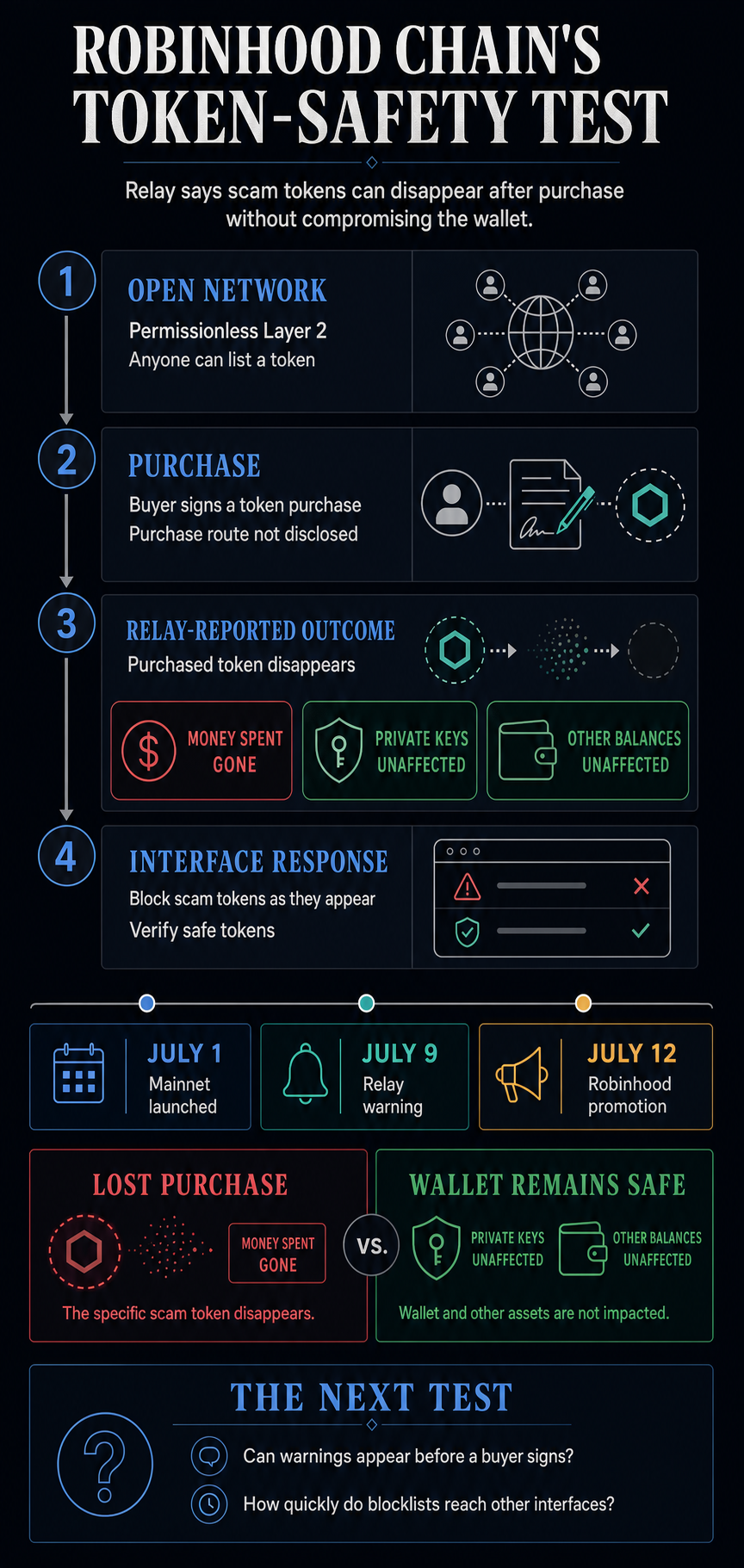
Cross-chain transaction protocol Relay has claimed that buyers on Robinhood Chain, Robinhood’s permissionless Ethereum Layer 2, lost money after tokens they purchased disappeared from their wallets.
Relay highlighted the issue and said the money was gone, without promoting the tokens or saying why they disappeared from wallets.
The incidents were reportedly not wallet or private-key compromises. Keys and balances beyond the identified tokens remained untouched, it said. Relay is blocking tokens as they appear, verifying assets it deems safe, and reminding users that anyone can list a token.
Relay linked the losses to specific, likely dubious, token purchases on the Robinhood Chain. However, it did not say the trades went through Robinhood Wallet or suggest that brokerage accounts and other Robinhood products were affected.
Relay announced,
We’re aware of reports of tokens disappearing from wallets after purchase on Robinhood Chain. There’s been an increase in scam tokens designed to remove themselves after purchase.
If you bought one, the funds you spent are unfortunately gone. We’re blocking these tokens as they show up and verifying safe ones.
Relay did not publish the affected contract addresses or transactions, leaving the reported losses independently unverified.
Robinhood launched the permissionless public mainnet on July 1. The company says it serves nearly 28 million customers across 38 countries, though that figure reflects its companywide reach rather than the number of chain users or affected buyers.
The warning arrived during Robinhood Chain’s first surge in speculative trading. Decentralized exchange volume peaked near $400 million on July 7, and Pump.fun added trading for Robinhood Chain tokens on July 8.
Open token creation allows developers to deploy contracts without Robinhood’s approval. Third-party tokens and liquidity can form around Robinhood’s brand without an app listing. Relay’s warning shifts the issue from which assets attract attention to what buyers see before they sign.
Relay operates a separate bridge and swap interface that supports Robinhood Chain. Robinhood Wallet’s own support page says its in-app swaps route through 0x API and LI.FI, and the interface used by the affected buyers remains unidentified.
0x says it supports tokens by default unless they are blocked for compliance reasons, while custom ERC-20 tokens become tradable once liquidity exists on a market the API sources. Relay says it screens transactions against sanctions and risk databases and maintains an internal blocklist.
Its warning said it was blocking the affected tokens and verifying others, but did not establish whether buyers saw a warning before signing or only after completing their purchases.
Robinhood’s general scam guidance covers malicious smart contracts, pump-and-dump schemes and rug pulls, and tells users to review transaction details before signing. The page does not explain what token screening, if any, occurs before an in-wallet swap or address tokens whose balances disappear after purchase.
The next test is how quickly warnings and blocklists move across trading interfaces, and whether a token removed from Relay remains available elsewhere. Relay’s post leaves the contract addresses, buyer count, total losses, and technical cause undisclosed. Users need an asset’s status before an irreversible purchase, when a warning can still change the outcome.