Sundar Pichai, the CEO of Google, and Brian Saluzzo, a Google executive who heads a team of developers, advised their workforce to quickly adopt AI in their operations to increase productivity as the tech giant seeks suitable ways to curb the rise in expenses.
In an audio recording obtained by CNBC, Pichai pointed out that earlier, when companies experienced a period of massive investment, they responded by adding more workforce. However, the CEO stated that this has taken a new shift with the increased adoption of AI in the sector.
In this AI era, he anticipated that the technology needs to be applied in the company’s daily operations for a firm to achieve more success in its productivity.
Several tech companies embrace AI in their productivity
There is a widespread trend among tech companies that invest significant amounts in constructing large data centers that can support huge AI models and manage heavy workloads. The companies are trying to reduce costs in other areas to achieve this significant investment.
An example of this tech company is Google. According to recently released reports, it is eyeing an investment of around $85 billion to boost capital expenditures this year. This is a 10% increase from the last investment of around $75 billion.
During a meeting, Pichai highlighted that the competition in the tech sector has become stiffer. According to his research, some firms will prioritize enhancing their employee productivity, urging that this is a good strategy; hence, they should consider it too.
Similar to Google, Amazon has also shifted its focus towards AI. Andy Jassy, the CEO of Amazon, shared a message with the employees, mentioning that since the company has increasingly adopted AI generative tools and agents, it will soon lay off some corporate staff.
In the meantime, Jassy urged the employees to quickly explore using AI tools in productivity and teach themselves how to work effectively with fewer people in their teams.
The same month, Julia Liuson, the president of the Developer Division at Microsoft, addressed employees, stating that at this time, adopting AI in their daily operations was not an option.
This came after Tobi Lutke, the CEO of Shopify, pointed out that tech companies expect their employees to learn to use AI in their daily operations quickly. Afterwards, Lutke stated that before teams request additional staff or resources, they should explain why they cannot achieve their goals using AI.
Google lays off its workforce to significantly invest in AI
Alphabet, the parent company of Google, has significantly reduced its workforce in the past few months. To illustrate, in 2023, it started off with around 191,000 full-time workers. This figure drastically dropped to around 187,000 as per last month’s data. Even if it has increased its workforce, it is only a very small percentage, reports from sources reveal.
Concerning its layoff, Google began cutting off 6% of its workforce in 2023 across various departments. This did not stop at this point; it has embraced the trend to date. Analysis from sources revealed that Google has continued reducing its workforce since the year began, while giving employees buyouts.
In a statement, Pichai expressed that this is a time to make significant investments, and therefore, caution should be exercised while managing the company’s resources. Concerning Google’s advancements in AI, the CEO mentioned that he was pleased with the progress as it aligned with his goals: to improve the firm’s effectiveness and productivity.
Google declined to respond to a request for comment immediately.
Cryptopolitan Academy: Want to grow your money in 2025? Learn how to do it with DeFi in our upcoming webclass. Save Your Spot
Australia has added YouTube to a list of online sites and apps that will be blocked as part of a proposed ban on social media for children under 16 after facing major backlash for initially leaving it out.
The ABC reported Tuesday that Australian Prime Minister Anthony Albanese and communication minister Anika Wells would announce the move on Wednesday. The move would bring YouTube abruptly into the company of major social networks, such as TikTok, Instagram, and Snapchat, as potential targets of the proposed regulations.
Due to coming into force as early as the end of 2025, the ban will prevent children from setting up or using accounts on popular social media sites where parent or guardian consent is not included as a requirement offered by the service.
The announcement comes as the internet companies face mounting pressure over young people’s safety online, including their use of social media and its effects on mental health and exposure to harmful content.
YouTube was not originally included in the roundup of platforms that the legislation would apply to. The exclusion had resulted in numerous complaints from rivals in the tech industry and safety advocates. It also raises long-term questions about the fairness and effectiveness of the law that is now being considered.
Regulators demand better protections for kids
The government’s decision to expand the codes to YouTube is a response to years of pressure from multiple quarters, including inside and outside the tech industry. Regulators, including the eSafety Commissioner, Julie Inman Grant, have warned that not including YouTube would leave a gaping loophole in shielding children from the worst of the digital world.
YouTube is often the first platform young Australians use for learning, entertainment, and social interaction. However, it has also become a major channel through which harmful content reaches this age group. Excluding it from regulation would undermine the effectiveness of the entire policy.
The row intensified last month when it was revealed that the then-communications minister, Michelle Rowland, had secretly reassured Google executives, who own YouTube, that their platform would not fall under the new rules. Thepersonal pledge, previously reported, drew outrage and questions about transparency and influence in creating policy.
Competing firms, including Meta Platforms Inc. (the parent company of Facebook and Instagram), Snap Inc. (Snapchat), and TikTok, reportedly pushed back, arguing that the law would need to be applied uniformly across all platforms to be effective.
Firms must act to restrict under-16 access
While the new restrictions aim to keep online spaces safer for children, they are also fraught with enforcement issues.
Minister Wells acknowledged that tech-savvy young users will look for a way around the restriction. “Kids will find workarounds, God bless them, we know they will,” Wells told ABC on Wednesday. “Platforms must take reasonable steps to try and stop that from happening.”
Online companies must also have the strongest age verification and parental consent system under the law. Though specific enforcement mechanisms are yet to be worked out, companies that defy the rules could be hit with hefty fines.
The ban will spare YouTube Kids, an app built not only for kids, but with parental controls and curated content. The government says it will give parents a safer alternative for finding child-friendly materials online.
The response has been mixed from digital rights activists and parents. Some celebrate it as a move to rein in cyberbullying, oversharing, and addictive content for children. Critics of these efforts argue that heavy regulation could put up barriers to popular educational and creative tools, which students use widely.
Even so, the step will put Australia at the vanguard of an emerging global trend. Governments worldwide, from the United States to the UK, from other European Union member countries, are mulling stricter digital protections for children.
Cryptopolitan Academy: Tired of market swings? Learn how DeFi can help you build steady passive income. Register Now
As the crypto market braces for another wave of gains, all eyes are on the soaring trajectory of Mutuum Finance (MUTM). The project is rapidly gaining traction among investors. The token has surpassed the $13.7 million milestone in its presale. Mutuum Finance is capturing investor attention with record-breaking gains and surging on-chain activity.
Meanwhile, Shiba Inu (SHIB) holders eagerly watch mounting token burns that could nudge the memecoin closer to the coveted $0.000050 mark. With market sentiment shifting and capital flows gravitating toward emerging ecosystems, traders are weighing whether SHIB’s deflationary push can keep pace with the unstoppable momentum of Mutuum Finance.
Shiba Inu (SHIB) The Burn Spikes Amid Drop in Price
At the moment, Shiba Inu (SHIB) is trading at about $0.000014, and after a recent short push this week due to a huge 883% increase in the rate at which SHIB tokens are being burned, seeing in excess of 21 million SHIB tokens destroyed in one day, and with over 410 trillion tokens burned so far. Irrespective of these vicious deflationary acts, the price has retreated by almost 5%, where it is trading at its current range below the $0.000014 mark.
Analysts note that although burn activity increase could improve long-term scarcity, price performance offers a typical post burn consolidation due to the traders processing the news of the burn. Within the larger context, there is also additional interest in something new like Mutuum Finance.
Phase 6 of Mutuum Finance Presale Now Live
Mutuum Finance has completed its Phase 5 presale in record time and launched Phase 6 with tokens now available at $0.035, a 16.17% increase over the last round. The upcoming price adjustment will lift the token by another 14.29% to $0.04, giving current participants the chance to secure a 71.43% return by the time it lists at $0.06. The presale has already drawn in more than 14,500 investors and raised upwards of $13.7 million, signaling strong market confidence in MUTM’s future.
Dual-Lending: Powering the Future of DeFi
Mutuum Finance utilizes a double-model mechanism to support flexibility as well as efficiency in Peer-to-Contract and Peer-to-Peer models of lending.
Peer-to-Contract utilizes self-executory smart contracts that perform the function of lending independently without any human intervention at all. They have been designed to operate according to dynamic rates in the market with an unstable rate of interest as determined by present demand and supply of an in-real-time interest.
Peer-to-Peer model removes intermediaries and offers market to be in direct contact with lenders and borrowers. That is all the more so if its use is to risky assets because it offers the range of having personalized terms of a loan and flexibility based on user will and his or her risk-tolerance levels.
Mutuum Finance Reinforces Commitment to Stability
Mutuum Finance (MUTM) will be introducing a stablecoin that will be USD pegged on the Ethereum blockchain. It will be a safe and secure investment tool to avoid risk and volatility that can be found in algorithmic stablecoins.
The project has also undergone thorough auditing by Certik to ensure blockchain security and safety of user funds. This milestone bears testimony to the ambitions of Mutuum Finance to be an institutional-grade and open DeFi protocol. It indicates that the team is also keen to remain in line with the industry’s security standards.
Mutuum Finance Rolls Out $50K Bug Bounty to Enhance Safety
Mutuum Finance has initiated its Bug Bounty Program with the size of the reward pool set at $50,000 USDT. The program features four levels of severity. They are critical, major, minor, and low. Therefore, every bug that would exist is found and rewarded. It supports the team’s vision of developing a secure, transparent, and high-quality DeFi protocol.
Shiba Inu’s burns draw attention, but Mutuum Finance (MUTM) is gaining stronger traction. Phase 6 presale runs at $0.035, raising $13.7M+ from 14,500+ investors. A 71.43% ROI awaits at launch price $0.06. Secure tokens now.
For more information about Mutuum Finance (MUTM) visit the links below:
The US Securities and Exchange Commission (SEC) has approved in-kind creations and redemptions for two crypto ETPs, which will pave the way for these products to be made available to the public on exchange platforms.
The new rule allows investors to exchange real Bitcoin or Ether for shares of the ETF, and vice versa. The shift means that digital asset ETFs will now be on the same operational status as traditional commodity ETPs, adds the SEC, and will further create a more level playing field and an element of consistency across derivative-based investment products.
SEC Chairman Paul S. Atkins confirmed the change in his statement on X: “I am pleased the Commission approved these orders permitting in-kind creations and redemptions for a host of crypto asset ETPs. Investors will benefit from these approvals, making these products less costly and more efficient.”
In its press release, Jamie Selway, the SEC’s Division of Trading and Markets director, echoed similar sentiments. He said the announcement was a positive development for the developing crypto ETP market, as this operational change offers additional flexibility and could mitigate investor costs.
The SEC’s action comes in response to a mounting push from issuers such as BlackRock, Fidelity, and Grayscale, which had lobbied for more traditional fund structures for their spot crypto ETFs. It also comes just days after the agency formally requested public comment on a Nasdaq filing for staking options for BlackRock’s spot Ethereum ETF, providing further evidence of a move toward regulatory approval of riskier crypto features.
SEC revises restrictions and expands options for crypto ETPs
The vote on in-kind redemptions was one of several significant regulatory decisions made. The SEC also cleared a new model for trading options for spot Bitcoin ETFs. That includes introducing FLEX options and customizable derivatives, allowing market participants more say in the contract characteristics, including strike price, expiration date, and exercise style.
In the most headline-catching move, the SEC raised the position limit for Bitcoin ETF options from 25,000 to 250,000 contracts. The step leads to enhanced liquidity and increased participation by institutional investors in the derivatives segment.
In apost on X, Bloomberg ETF analyst Eric Balchunas highlighted what it all means, airing comments from an anonymous ETF issuer who wrote in to say, “This is huge… and will create an explosion of option-based Bitcoin ETFs.”
The SEC said that these changes are now effective. The regulator is broadening the accessibility and range of cryptoderivative financial products to build a stronger investment framework for wading into digital assets via fiat-based, orderly markets.
Meanwhile, the market’s evolution indicates a maturing crypto ecosystem in which derivatives products and alternative structures are essential to price discovery, hedging strategies, and market growth.
SEC paves the way for altcoin wave with crypto ETPs, analyst predicts
Market watchers say the approval indicates a wider strategic pivot toward deeper crypto integration in the traditional financial system. Bloomberg’s James Seyffart pointed out that by approving in-kind processes on Bitcoin and Ethereum ETFs, the SEC paves the way to future altcoin ETFs—such as those based on Solana, Avalanche, or Cardano—to follow suit.
In-kind redemption and creation features could be built in for new ETF applications from the beginning, making them more interesting to sophisticated investors and offering the cost-efficient arbitrage and better price tracking they offer.
This new attitude comes amid mounting political and institutional support for regulating crypto. The recently enacted Genius Act, which was signed into law by President Donald Trump, brings financial accountability into the 21st century and embraces technology-centric policy. This legislation likely incentivizes the SEC to become more accommodating and creative on digital assets.
The in-kind decision also promotes price transparency and makes it easier for ETFs to represent the real-time value of their underlying crypto assets. That’s a win for investors, who enjoy narrower bid-ask spreads and fewer tracking errors.
Your crypto news deserves attention – KEY Difference Wire puts you on 250+ top sites
US Senator Cynthia Lummis of Wyoming has introduced a groundbreaking bill that could reshape how Americans finance their homes. Titled the 21st Century Mortgage Act, the bill proposes that cryptocurrency be recognized as a legitimate asset for mortgage applications, allowing digital asset holders to use their crypto as collateral when applying for single-family loans.
This legislative action comes after the US Federal Housing Finance Agency (FHFA) issued a June directive advising federal mortgage agencies to explore crypto assets in reviewing mortgage applications. Lummis’s bill would enshrine this guidance into law, officially incorporating digital assets into the American housing finance system.
Lummis said on Tuesday that the bill adopts a modern approach to building wealth and highlighted that, even for those who do not invest in digital assets, they likely know someone who does. She added that the bill aims to promote economic inclusion and reflects current trends in accumulating wealth, particularly among younger investors.
Lummis cited a recent US Census Bureau report that found, as of the first quarter of 2025, just 36% of Americans aged 35 and younger own homes compared with older age groups. She contends that permitting crypto to count as mortgage collateral could carve out new avenues to homeownership for this digitally savvy segment of Americans.
If approved, borrowers would not be required to convert their crypto holdings into fiat currency. Instead, the value of the crypto assets could be directly valued or considered when assessing the mortgage application. This could enable buyers to not risk out on potential asset growth by selling their tokens to be eligible for a home loan.
Democrats question crypto risk in housing loans
That logic does not go over well with some lawmakers, however. Senate Democrats push back on proposed implementation of digital assets in the US housing market. They say cryptocurrency is still far too volatile, illiquid, and unpredictable for it to be considered stable collateral for long-term loans, such as mortgage payments.
In a letter dated July 24, a group of Senate Democrats expressed concern to FHFA Director William Pulte about the potential financial risks of the policy. They warned that, even as the crypto market matures, ongoing volatility and liquidity issues could make it difficult for borrowers to exit their crypto positions and convert assets into cash at prices sufficient to support their mortgage obligations.
The members requested a full risk assessment, recommending that the FHFA consider the broader implications of digital assets in the traditional housing finance system. They also cautioned that crypto-based mortgage lending could inadvertently drive up the price of homes, exacerbate speculation in the market, or destabilize parts of the economy if the values of cryptocurrencies unexpectedly plummet.
Congress pushes forward crypto mortgage bills
Other crypto-centric bills are currently making their way through Congress, as part of a larger trend toward regulating and mainstreaming digital assets in US financial law.
Ms. Lummis also sponsored a separate Republican bill to establish a full market structure for digital assets. That bill carves out SEC and CFTC roles and offers regulatory clarity for crypto exchanges, token issuers, and investors.
Another bill gaining traction — especially among conservatives — would prohibit the Federal Reserve from creating a central bank digital currency (CBDC) based on privacy and government overreach concerns. The House passed this bill and may come up in the Senate in the fall, after the August recess.
The House version of Lummis’ mortgage bill, which is also called theAmerican Homeowner Crypto Modernization Act, was introduced on July 14 by Representative Nancy Mace. Mace’s legislation requires mortgage lenders to consider digital assets in their underwriting if borrowers have assets in crypto brokerage accounts.
Global events are stoking momentum as well. In July, Australian company Block Earner said it would offer Bitcoin-backed mortgages. The rollout was facilitated by a legal victory after the Federal Court of Australia decided that the firm’s crypto loan products should not be regarded as financial products under the current legislation.
Cryptopolitan Academy: Tired of market swings? Learn how DeFi can help you build steady passive income. Register Now
Singapore’s central bank is expected to keep its monetary policy unchanged at its upcoming review on July 31. This comes amid persistent global economic uncertainty. According to a Bloomberg survey, 14 of 19 economists anticipate that the Monetary Authority of Singapore (MAS) will maintain its current policy stance. The MAS previously eased policy in January and April, marking its most accommodative position in five years.
Singapore’s approach to its monetary policy is quite exceptional. Unlike central banks that alter interest rates, MAS uses the exchange rate as its main instrument. It conducts monetary policy by adjusting the width, midpoint, and slope of a policy band for the Singapore dollar. This way, a small and open economy like Singapore can better deal with imported inflation and external shocks.
Five economists predict more easing, including those at Goldman Sachs Group Inc. and Bank of America. They said MAS may choose to “slightly” lower the slope of its policy band to provide a little more leeway for an economy already facing external shocks.
Strong growth and stable inflation strengthen the case for MAS policy hold
One of the big reasons the markets had anticipated the hold in policy is that Singapore’s economic performance in the recent past has been quite strong.”
Earlier this month, estimates indicated Singapore skirted a technical recession. The economy expanded more than expected in Q2 2025, driven by strong growth in manufacturing, construction, and exports of services.
That has boosted economists’ confidence, with many believing the worst may be over. Chua Hak Bin, an economist at Maybank Securities, said the growth outlook appeared to have bottomed out. He noted that given the economy’s resilience and stable core inflation, their team had projected that MAS would keep policy unchanged in the second half of the year, despite lingering downside risks.
Inflation has also been tepid in Singapore, with core prices up 0.6% in June. Although MAS does not have an explicit target for inflation, it has signaled that a 2% rate is consistent with price stability. With prices stable and growth back on track, the central bank has some time before it needs to continue to act.
However, not all analysts are persuaded that standing pat is the right path. What if they’re too tight? Some say that they believe inflation expectations remain very weak and that the Singapore dollar is quite strong, so that export competitiveness could be hit further.
Global risks drive MAS’s cautious outlook
Though domestic data looks increasingly optimistic, global risks remain a major factor in Singapore’s economic prospects. The escalating trade showdown between the United States and its economic partners worldwide is on everyone’s minds.
Singapore’s trade-independent centrality to the whirling tensions of global commerce was showcased this week as US President Donald Trump proposed new import tariffs on the United States from China, and 10% of those imports could affect the trade-reliant city-state. Although that rate is lower than that endured by some of Singapore’s neighbors, it could still be a significant drag on one of the world’s most open economies.
MAS Managing Director Chia Der Jiun has publicly recognized this risk, saying earlier this month that although core inflationary pressures are still mild, policymakers must be alert to risks in both directions. He cautioned that a resurgence in global trade protectionism could damage Singapore’s export-oriented industries, such as electronics, logistics, and finance.
If global downside risks materialize, seven of nine economists, who answered a follow-up question to the survey, expect MAS to move towards easing in 2025-2026.
Central banks worldwide have been growing increasingly worried that structural changes in global trade, such as Trump’s reshoring ambitions, could slow investment and trade over the long term. If these changes persist, Singapore could be steered into renewed economic contractions, even if inflation is kept in check.
Flow coin price prediction for 2025 could reach a maximum value of $ 0.9203.
By 2028, FLOW could reach a maximum price of $1.77.
In 2031, FLOW will range between $4.59 to $5.54.
Flow coin, the native token of the Flow blockchain created by Dapper Labs, is essential for powering decentralized applications (dApps) and digital assets. Flow aims to provide a high-performance, user-friendly platform that tackles scalability without sacrificing decentralization. Its unique architecture allows developers to build secure and efficient smart contracts.
FLOW, its native token, has several key uses within the ecosystem, including paying transaction fees, staking, and participating in network governance. The growing number of dApps and users on the platform drives demand for Flow coin, influencing FLOW’s price movements.
Given Flow coin’s strong fundamentals and growing support levels in the ecosystem, the question arises: how high can FLOW go? What will FLOW price be in 2025?
Overview
Cryptocurrency
Flow
Token
FLOW
Price
$0.3943
Market Cap
$630.1M
Trading Volume
$34.82M
Circulating Supply
1.59B FLOW
All-time High
$46.16
All-time Low
$0.2916
24-hour High
$0.4298
24-hour Low
$0.3932
Flow coin technical analysis
Metric
Value
Volatility (30-day Variation)
11.08%
50-Day SMA
$0.3698
14-Day RSI
62.55
Sentiment
Neutral
Fear & Greed Index
75 (Greed)
Green Days
19/30 (63%)
200-Day SMA
$0.4319
Flow coin (FLOW) price analysis
TL;DR Breakdown
FLOW broke below key support at $0.406 with MACD turning negative.
Short-term indicators show heavy selling volume.
The critical support for FLOW lies at $0.380-$0.385.
Flow coin 1-day price analysis: FLOW sees a breakdown from consolidation pattern
The FLOW/USDT 1-day price chart for July 28 shows that the coin has experienced a significant technical breakdown, falling from $0.458 to the current level of $0.394. The token has broken below critical support levels that had been holding since mid-July, with the price now trading beneath the middle Bollinger Band at $0.406.
The breakdown occurred after FLOW failed to sustain momentum above the upper Bollinger Band resistance near $0.458, creating a classic rejection pattern that has now led to a cascade lower. The MACD indicator has turned decisively bearish with the signal line crossing below the MACD line, while the histogram shows increasing negative momentum that suggests the selling pressure is accelerating.
FLOW maintains its bearish pattern on the 4-hour timeframe, with price action showing a clear breakdown from what appeared to be a consolidating range between $0.420-$0.425. The token has fallen through the 20-day SMA at $0.414 and is now testing the psychological support level at $0.390, which coincides with recent swing lows.
The On-Balance Volume indicator has plummeted to -37.93M, indicating that the recent selling has been accompanied by substantial volume, which adds credibility to the bearish move and suggests distribution. The price structure shows lower highs and lower lows forming, with each bounce getting weaker and failing to reclaim previous support levels that have now turned into resistance.
FLOW technical indicators: Levels and action
Daily simple moving average (SMA)
Period
Value
Action
SMA 3
$0.3934
SELL
SMA 5
$0.4088
SELL
SMA 10
$0.4235
SELL
SMA 21
$0.4042
SELL
SMA 50
$0.3698
BUY
SMA 100
$0.3882
BUY
SMA 200
$0.4319
SELL
Daily exponential moving average (EMA)
Period
Value
Action
EMA 3
$0.3887
BUY
EMA 5
$0.3798
BUY
EMA 10
$0.3752
BUY
EMA 21
$0.3797
BUY
EMA 50
$0.4151
SELL
EMA 100
$0.4846
SELL
EMA 200
$0.5644
SELL
What to expect from Flow?
FLOW appears positioned for further downside testing, with immediate support at $0.380-$0.385 and potential deeper retracement toward $0.350 if current support fails. The combination of broken trend support, bearish momentum indicators, and high-volume selling suggests this move lower has legs, though oversold conditions may provide temporary bounces that should be viewed as selling opportunities rather than reversal signals.
Is FLOW a good investment?
Flow coin has potential as an investment due to its strong partnerships with major brands and its focus on powering decentralized applications, especially in the NFT and gaming spaces. However, like all cryptocurrencies, it carries significant volatility and risks, so investors should carefully consider market conditions and risk tolerance before investing.
Will FLOW reach $1?
The $1 price mark is within range, having reached that level in early December 2024. Renewed buyer interest could push FLOW to $1 and above in the coming months.
Will FLOW reach $5?
This level has not been achieved since February 2022. For FLOW to recapture the $5 levels, significant cash inflows will be required.
Can FLOW reach $50?
FLOW has previously reached an all-time high (ATH) of $46.16, so reaching $50 is achievable. However, a significant bull run and tangible ecosystem updates are required to achieve this feat, as the coin is currently 98% below its ATH.
Is Flow a good blockchain?
Flow is a solid blockchain, especially for gaming and NFTs. It is designed for scalability, fast transactions, and low fees. The network’s unique multi-role architecture improves efficiency without compromising decentralization.
However, it faces fierce competition, and adoption levels are not as high as those of Ethereum and Solana.
Does FLOW have a good long-term future?
Projections suggest substantial growth over the coming years, with a potential peak of $3-$4 by 2031. This positive outlook reflects a strong potential for sustained value appreciation and continued market relevance.
Flow blockchain is seeing massive growth in DeFi, with TVL reaching $80.53M and wrapped FLOW at 46.64M. Additionally, Flow has gone live on the multi-chain DEX @hitdex, expanding DeFi capabilities with non-custodial wallets.
Plus, Flow is live on @hitdex — a multi-chain DEX with non-custodial wallets via social platformshttps://t.co/lpRnhfa14I
— Token Relations 📊 (@Token_Relations) July 3, 2025
Flow coin price prediction July 2025
Per expert opinion, the Flow predictions for July 2025 suggest a minimum price of $0.3100, an average price of $0.3747, and a maximum price of $0.482.
FLOW price prediction
Minimum Price
Average Price
Maximum Price
FLOW price prediction July 2025
$0.3100
$0.3747
$0.482
Flow price prediction 2025
The price of Flow in 2025 is a minimum price of $0.2900, an average price of $0.4315, and a maximum price of $0.9203.
FLOW price prediction
Minimum Price
Average Price
Maximum Price
FLOW price prediction 2025
$0.2900
$0.4315
$0.9203
Flow coin price predictions 2026 – 2031
Year
Minimum Price ($)
Average Price ($)
Maximum Price ($)
2026
0.5085
0.7282
1.17
2027
0.89
1.05
1.25
2028
1.55
1.6
1.77
2029
2.2
2.28
2.69
2030
3.19
3.31
3.79
2031
4.59
4.76
5.54
Flow coin price prediction 2026
Flow’s price prediction indicators for 2026 indicate a potential peak of $1.17, a minimum price of $0.5085, and an average trading price of $0.7282.
Flow coin price prediction 2027
Flow network price predictions for 2027 suggest a prevailing bullish market sentiment. Investors can anticipate a maximum price of $1.25, a minimum price of $0.89, and an average market price of $1.05.
Flow coin price prediction 2028
Investors could see significant profit opportunities based on the 2028 Flow coin price prediction. Expert projections anticipate the asset’s price reaching a peak price of $1.77, maintaining an average price of $1.6, and a minimum price of $1.55.
Flow coin price prediction 2029
The Flow cryptocurrency price prediction for 2029 suggests a maximum trading price of $2.69, an average price of $2.28, and a minimum price of $2.2.
Flow price prediction 2030
The Flow price forecast suggests a notable appreciation in value in 2030, with a projected peak price of $3.79. Additionally, traders can expect an average FLOW price of $3.31 and a minimum price of $3.19.
Flow crypto price prediction 2031
The Flow prediction for 2031 suggests a maximum trading price of $5.54, an average price of $4.76, and a minimum price of $4.59.
Cryptopolitan’s FLOW forecast highlights a positive outlook over the coming years. For 2025, the coin is expected to range from $0.38 to $0.92. By 2028, the Flow price forecast suggests the coin could reach as high as $2 while maintaining an average price of $1.52. Looking forward to 2031, investors can expect FLOW to reach a maximum price of $5.2 and an average price of $4.30.
FLOW coin showed early potential in 2020, with prices ranging from $0.30 to $29.96 and closing the year at $9.75.
In 2021, the price peaked at $46.16 in March but declined to $8.8 by year-end. The volatility continued in 2022, fluctuating between $1.5 and $8.11, with a close at $2.71.
In 2023, the price ranged from $0.4372 to $1.27, closing at $0.8994.
The coin started in 2024 at $0.6538 and $1.69, experiencing highs and lows before stabilizing at $0.58 – $0.61 by August. In September, FLOW reached $0.6367; in October, it traded between $0.5073 and $0.5175.
In November 2024, Flow reached a peak price of $1.0242; in December, it reached a maximum price of $1.271 and closed the year at $0.697.
In January 2025, FLOW maintained a range of $0.599 – $0.851; in February, it peaked at $0.555; in March, it dipped, trading between $0.3739 and $0.3899. April and May showed some gains, with FLOW reaching as high as $0.4161 and $0.4765, respectively. Prices were flat in June, maintaining a trading range of $0.2915 and $0.3996.
In July 2025, FLOW is trading between $0.3939 and $0.4297.
Cardano (ADA) may be making another push to reclaim bullish momentum, but analysts and investors are shifting toward Mutuum Finance (MUTM) the rising DeFi coin. Phase 5 of the Mutuum Finance presale recently sold out quicker than anticipated. Over 14,500 investors have already participated, with Mutuum Finance raising more than $13.7 million to date.
The project has now entered Phase 6 of its presale at $0.035, a 16.67% increase from Phase 5. The upcoming Phase 7 will see another price jump of 14.29% to $0.04. Investors who buy in now can secure a 71.43% ROI when the token launches at $0.06. With ADA struggling to maintain its rally amid a competitive DeFi landscape, the spotlight now turns to whether Mutuum Finance can sustain its early traction and become the next breakout story in decentralized finance.
Cardano (ADA) Rebounds, Holding Mid‑$0.80s Support
Cardano is currently trading around $0.83, having rallied roughly 37% in July and retesting critical support near $0.78, which now appears to serve as a launchpad for sustained recovery. Technical indicators like EMAs and the formation of a golden cross are signaling bullish structure, with resistance in sight near $0.94 and upside potential toward $1.19 or even $1.31 if momentum holds.
However, a break below $0.78 could expose ADA to downside risks around $0.70 or lower. At a time when attention is often shifting to newer DeFi entrants, Cardano continues to command interest for its technical setup and ETF-driven speculation. However, investors are now looking elsewhere.
Mutuum Rolls Out Advanced Dual-Lending Platform
Mutuum Finance (MUTM) is a lending platform built for both passive and active DeFi users. Passive income can be generated from lending users’ USDT in stable passive income-generating smart contract pools. This lending is known as Peer-to-Contract (P2C) lending.
Other than that, a Peer-to-Peer (P2P) system allows lenders and borrowers to swap as much as they want because there is no intermediary. That is usually typical with users of volatile assets like meme coins.
Phase 6 Presale Begins as Mutuum Finance Gains Traction
Following the complete sell-out of its Phase 5 presale, Mutuum Finance has entered Phase 6 with tokens now priced at $0.035, reflecting a 16.17% rise from the previous round.
The next price milestone is set at $0.04, marking a further 14.29% increase. Early backers at this stage have the potential to secure a 71.43% return when MUTM launches at $0.06. To date, the presale has raised more than $13.7 million and attracted over 14,500 unique investors, underscoring the growing demand for the project.
Secured by CertiK, Reinforced with $50K Bug Bounty
Mutuum Finance (MUTM) will launch a stablecoin pegged to USD on the Ethereum blockchain. Apart from that, the project is audited by CertiK with a 95.0 trust score. Mutuum Finance has also put in place a $50,000 USDT Bug Bounty. It will reward on a four-level severity threshold: critical, major, minor and low.
$100,000 in MUTM Tokens Up for Grabs
Mutuum Finance has started a $100,000 giveaway that will give 10 winners a total of $10,000 MUTM in gratitude for the investor’s first time believing in the project.
Mutuum Finance is proving to be one of the fastest-rising DeFi opportunities, having already raised over $13.7 million from 14,500+ investors as its presale gains speed. Phase 6 tokens remain priced at $0.035, with a 14.29% increase locked for Phase 7 and a guaranteed 71.43% ROI at launch. Backed by a $100,000 giveaway, a $50,000 CertiK-audited bug bounty, and a rapidly expanding holder base, MUTM is cementing itself as a top contender for the next DeFi breakout. Get in before the next price hike hits.
For more information about Mutuum Finance (MUTM) visit the links below:
On Monday, July 28, Jamieson Greer, a US Trade Representative under the Trump administration, expressed cautious optimism about ongoing trade talks between the United States and China. While he welcomed the willingness of both countries—longtime rivals—to engage in negotiations, he tempered expectations by suggesting that any agreement reached this week would likely be modest rather than a sweeping breakthrough.
Greer emphasized that he did not anticipate a major deal, noting that his role involved closely monitoring the implementation and progress of trade agreements.
The latest round of talks took place in Sweden, where senior officials from both nations convened. This marked the third high-level engagement between the US and China since the Trump administration introduced tariff threats aimed at US trading partners.
Scott Bessent anticipates the US and China achieving a common ground in their trade talks
The US and China are facing a severe trade war that Trump’s tariff policies have ignited. Trump imposed threatening tariffs on Chinese goods, and the country responded with retaliatory tariffs on US goods. The main agenda of the recent US-China trade talks is to address the trade war that nearly caused a significant economic crisis.
Therefore, to end the trade war, the two countries are expected to discuss their terms to extend the 90-day break they had set on the tariffs. Notably, the due date for the pause on the tariffs is set to expire on August 12.
The US and China decided to hold the trade talks in May when US President Donald Trump and Chinese President Xi Jinping met in Switzerland.
Despite Greer’s speculations, Scott Bessent, US Treasury Secretary, has demonstrated optimism on the US-China trade deal. Bessent anticipated that this week’s trade talks would promise that the two nations would reach a common ground and extend the tariff break.
This came after the US Treasury Secretary expressed that they will be working out what is likely to be a tariff pause extension in an interview. He further pointed out that the US and China have demonstrated a solid link-up.
Still, Greer sticks to his speculations of a minor outcome in the trade talks. He, however, stated that what the US is after in these talks is to move in a positive direction. “Our discussions with the Chinese are always friendly and helpful,” Greer added.
The US Trade Representative further stated that this marked the third trade talk between the two nations in three months. Seeing the consistency in the talks, Greer mentioned that this was a good sign that the US will achieve its desire to move in a positive direction.
Greer highlights Trump’s satisfaction with his tariff system
Apart from China, several US trading partners have tried to conduct trade talks with the US before the August 1 tariff deadline takes effect. Examples of these trading partners include the EU and Japan.
Greer mentioned that the US cannot strike any further deals regarding the trade talks.
He stated that they do not see the need to strike further trade deals even in scenarios where other countries are eager to engage in talks with the US. According to Greer, the US aims to strike deals to enhance trade.
However, he brought up the point that Trump prefers to impose tariffs the way they are rather than make deals, echoing his previous remarks that he was pleased with his tariff system.
Cryptopolitan Academy: Want to grow your money in 2025? Learn how to do it with DeFi in our upcoming webclass. Save Your Spot
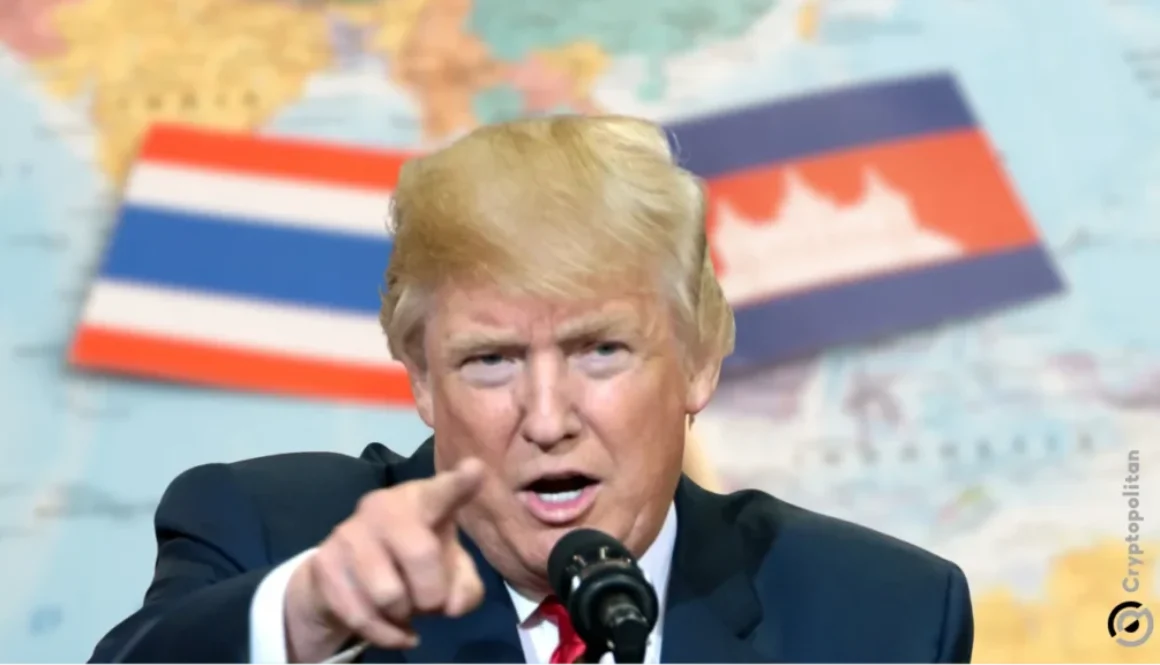
US President Donald Trump has announced that both Thailand and Cambodia are ready to end their violent border conflict. Speaking from Turnberry, Scotland, Trump said his intervention prompted a shift toward peace.
He said, “I spoke to both of the prime ministers, and I think by the time I got off, I think they want to settle now.”
The fighting, which entered its fourth day, has left at least 35 people dead and forced more than 218,000 people to flee on both sides of the border. The confrontation began with a landmine blast that wounded five Thai soldiers and snowballed into artillery duels, rocket strikes, and cross-border incursions.
A special emergency meeting has been scheduled for Monday in Kuala Lumpur, Malaysia. Thailand’s acting Prime Minister Phumtham Wechayachai and Prime Minister Hun Manet have confirmed their participation. Malaysian Prime Minister Anwar Ibrahim, who holds the rotating ASEAN chair, is hosting the talks.
Trump seeks peace through trade leverage
The turning point may have been Trump’s involvement. On Saturday, in a post on Truth Social, he said he made clear to both governments that the United States would break off ongoing trade talks if both sides did not halt hostilities.
Shortly afterwards, Cambodia announced its willingness to cease fire unconditionally and immediately. Trump personally told Hun Manet that Thailand was allowed to halt all attacks after talking to Phumtham, Hun Manet said.
Thailand partially confirmed the ceasefire, with its foreign ministry stating that it had accepted it “in principle.” However, Thai officials emphasized that lasting peace would only be possible if Cambodia demonstrated what they described as “genuine sincerity” in its intentions.
The US State Department was committed to promoting future dialogue to support global peace and long-term stability. Department spokesperson Tammy Bruce made the remarks while affirming Washington’s support for diplomatic efforts. Secretary of State Marco Rubio was also reported to have spoken directly with the foreign ministers of Thailand and Cambodia, urging them to de-escalate tensions and agree to an immediate ceasefire.
It is one of the most potent examples of US diplomatic muscle flexing in the region since the Obama-era pivot to Asia.
Thai and Cambodian forces clash amid mass evacuations
Fighting raged on Sunday despite the flurry of diplomatic activity. Each side blamed the other for fresh shelling, for violations of territorial integrity, and intentional targeting of civilian areas.
Thai army authorities said Cambodian troops fired artillery shells into Surin province, hitting homes and trying to retake territory near the contested Ta Muen Thom temple. Thai soldiers returned with longer-range counterfire.
Cambodian attacks have been sporadic and may constitute violations of the rules of engagement, according to the Thai army—the military plans to establish monitoring teams to protect civilians until formal peace talks begin.
In the meantime, a Thai military report issued Sunday evening indicated that Cambodia might be poised to engage in a large operation before coming to the table — a common strategy before negotiations to gain leverage.
Cambodia rejected these claims. Lt. Gen. Maly Socheata, a spokeswoman for the Cambodian Defense Ministry, said Thailand had begun a “large-scale incursion” that included using tanks and infantry. The Thai bombardment dashes peace initiatives and shows they want to intensify, not solve, the crisis.
Thailand reported one new death among soldiers on Sunday, for a total of 22. Most victims are civilians. Cambodia’s official death toll jumped to 13, but it is uncertain whether that includes Lt. Gen. Duong Samnieng, whose combat death was also made public the same day.
Mass evacuations are ongoing. More than 139,000 people have fled Thai villages along the border, and more than 79,000 have left three Cambodian provinces. Whole towns have become vacant and schools and hospitals abandoned, as the military takes over once-bustling towns.
Cryptopolitan Academy: Tired of market swings? Learn how DeFi can help you build steady passive income. Register Now