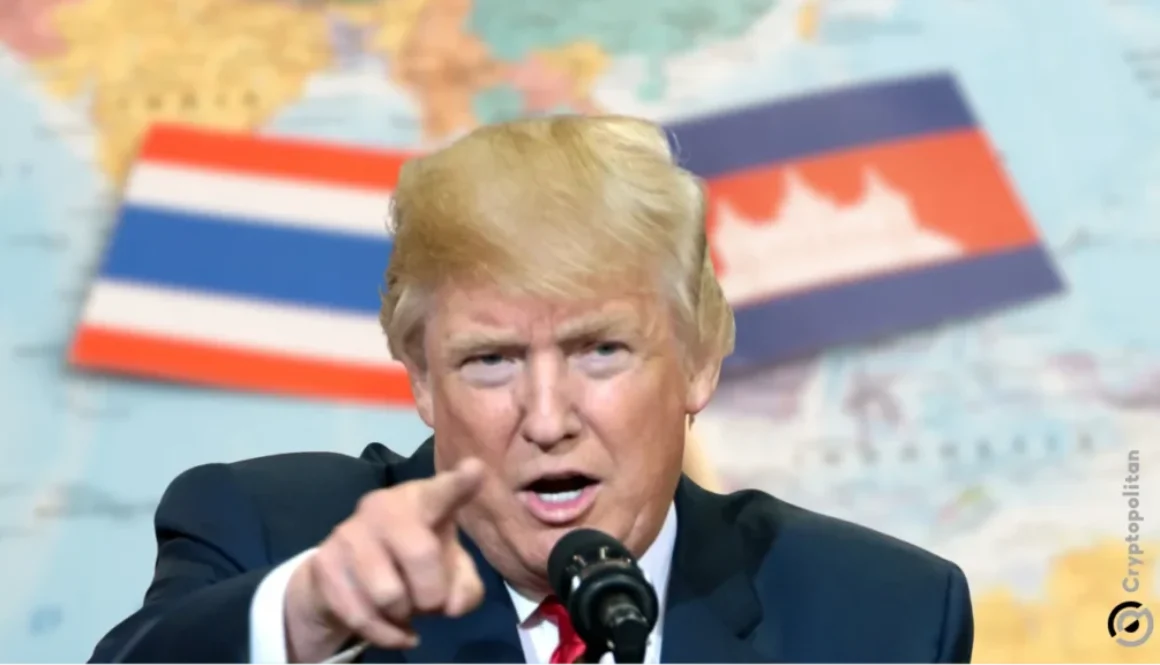
US President Donald Trump has announced that both Thailand and Cambodia are ready to end their violent border conflict. Speaking from Turnberry, Scotland, Trump said his intervention prompted a shift toward peace.
He said, “I spoke to both of the prime ministers, and I think by the time I got off, I think they want to settle now.”
The fighting, which entered its fourth day, has left at least 35 people dead and forced more than 218,000 people to flee on both sides of the border. The confrontation began with a landmine blast that wounded five Thai soldiers and snowballed into artillery duels, rocket strikes, and cross-border incursions.
A special emergency meeting has been scheduled for Monday in Kuala Lumpur, Malaysia. Thailand’s acting Prime Minister Phumtham Wechayachai and Prime Minister Hun Manet have confirmed their participation. Malaysian Prime Minister Anwar Ibrahim, who holds the rotating ASEAN chair, is hosting the talks.
Trump seeks peace through trade leverage
The turning point may have been Trump’s involvement. On Saturday, in a post on Truth Social, he said he made clear to both governments that the United States would break off ongoing trade talks if both sides did not halt hostilities.
Shortly afterwards, Cambodia announced its willingness to cease fire unconditionally and immediately. Trump personally told Hun Manet that Thailand was allowed to halt all attacks after talking to Phumtham, Hun Manet said.
Thailand partially confirmed the ceasefire, with its foreign ministry stating that it had accepted it “in principle.” However, Thai officials emphasized that lasting peace would only be possible if Cambodia demonstrated what they described as “genuine sincerity” in its intentions.
The US State Department was committed to promoting future dialogue to support global peace and long-term stability. Department spokesperson Tammy Bruce made the remarks while affirming Washington’s support for diplomatic efforts. Secretary of State Marco Rubio was also reported to have spoken directly with the foreign ministers of Thailand and Cambodia, urging them to de-escalate tensions and agree to an immediate ceasefire.
It is one of the most potent examples of US diplomatic muscle flexing in the region since the Obama-era pivot to Asia.
Thai and Cambodian forces clash amid mass evacuations
Fighting raged on Sunday despite the flurry of diplomatic activity. Each side blamed the other for fresh shelling, for violations of territorial integrity, and intentional targeting of civilian areas.
Thai army authorities said Cambodian troops fired artillery shells into Surin province, hitting homes and trying to retake territory near the contested Ta Muen Thom temple. Thai soldiers returned with longer-range counterfire.
Cambodian attacks have been sporadic and may constitute violations of the rules of engagement, according to the Thai army—the military plans to establish monitoring teams to protect civilians until formal peace talks begin.
In the meantime, a Thai military report issued Sunday evening indicated that Cambodia might be poised to engage in a large operation before coming to the table — a common strategy before negotiations to gain leverage.
Cambodia rejected these claims. Lt. Gen. Maly Socheata, a spokeswoman for the Cambodian Defense Ministry, said Thailand had begun a “large-scale incursion” that included using tanks and infantry. The Thai bombardment dashes peace initiatives and shows they want to intensify, not solve, the crisis.
Thailand reported one new death among soldiers on Sunday, for a total of 22. Most victims are civilians. Cambodia’s official death toll jumped to 13, but it is uncertain whether that includes Lt. Gen. Duong Samnieng, whose combat death was also made public the same day.
Mass evacuations are ongoing. More than 139,000 people have fled Thai villages along the border, and more than 79,000 have left three Cambodian provinces. Whole towns have become vacant and schools and hospitals abandoned, as the military takes over once-bustling towns.
Cryptopolitan Academy: Tired of market swings? Learn how DeFi can help you build steady passive income. Register Now
As Solana (SOL) hovers in the $200 range, traders are split on whether the next big move will propel it toward the coveted $250 mark or send it sliding back to $150 in August. Meanwhile, a new performer, Mutuum Finance (MUTM), is quietly stealing the spotlight with its rapidly expanding DeFi ecosystem and growing community buzz.
Mutuum Finance is selling at $0.035 in phase 6 of its presale. Phase 5 has recently sold out earlier than projected. The next phase price will climb 14.29% to $0.04. Investors joining today are guaranteed a 71.43% ROI when the project launches at $0.06. MUTM has raised over $13.5 million and attracted more than $14,300 investors. Mutuum Finance could hit $2 post launch.
Solana (SOL) Holds Near $180 Range Amid Mixed Outlook
Solana (SOL) is currently trading around $180, with the most recent data placing it near $179– $180. While the token recently flirted with the $200 level during a brief rally, it has since pulled back slightly and is consolidating just below that threshold. Market observers remain divided: some technical projections see SOL edging toward $250 in Q3 or August, while cautious scenarios argue it could retrace toward $150 if support falters heading into August.
At present, trading remains range-bound, with price action suggestive of a wait‑and‑see phase ahead of possible catalyst. Interest is also growing in projects beyond SOL, including entrants like Mutuum Finance.
Mutuum Finance Presale Gains Momentum with Promising ROI
Mutuum Finance is currently priced at $0.035 in phase 6 of its presale, following the faster-than-expected sell-out of phase 5. The upcoming phase will see the token price rise by 14.29% to $0.04. Early investors who join now stand to gain a projected return of 71.43% when the token launches at $0.06. So far, Mutuum Finance has raised more than $13.5 million, drawing over 14,300 investors, with projections suggesting the token could potentially reach $2 post-launch.
Revolutionizing DeFi Lending with Mutuum Finance
Mutuum Finance offers a liquidity protocol where users maintain full ownership of assets while benefiting from decentralized lending. The project utilizes a double-model approach entailing Peer-to-Contract and Peer-to-Peer lending in an attempt to promote greater flexibility and efficiency.
Peer-to-Contract platform utilizes smart contracts to facilitate human-less lending in a self-automated process and, on the other hand, the smart contracts follow the market’s lead by offering dynamic interest rates.
Peer-to-Peer architecture eliminates intermediaries and offers direct access among the lenders and the borrowers. The architecture is most utilized by the users for volatile assets like meme coins.
Enhancing Security with $50K Bug Bounty and Reward Program
Mutuum Finance (MUTM) is hosting a $100,000 giveaway. 10 winners will get $10,000 in MUTM tokens each. The project also introduced a new leaderboard where the top 50 token holders will get bonus tokens for maintaining their positions.
To further secure its platform, Mutuum Finance has initiated a $50,000 Bug Bounty Program with CertiK. All vulnerabilities will be rewarded, and the bounty will prioritize four levels: critical, major, minor, and low.
Mutuum Finance is shaping up to be the dark horse of 2025, already securing $13.5 million from 14,300+ early holders. The project has advanced through its presale at $0.035 in Phase 6, with a 14.29% price increase to $0.04 imminent. Backed by a $50,000 CertiK bug bounty, a $100,000 community giveaway, and its game-changing dual lending protocol, Mutuum Finance is rapidly capturing the spotlight. Buy your tokens now before the next price jump locks out Phase 6.
For more information about Mutuum Finance (MUTM) visit the links below:
In 2021, El Salvador became the first country in the world to make Bitcoin legal tender. President Nayib Bukele said the decision would help the country break free from relying on the US dollar and lower the high costs of sending and receiving money.
The government launched the Chivo Wallet, set up Bitcoin ATMs, promised a tax-free “Bitcoin City,” and planned to raise $1b through “Volcano Bonds” to advance its digital agenda. But what stood out the most was the president’s promise to buy one Bitcoin every day starting in November 2022, and for more than two years, his administration claimed it did.
On top of that, the government constantly highlighted its commitment to Bitcoin by posting updates about new purchases every week on social media. They used sites like Nayib Tracker to show off the country’s growing reserves and convince everyone that El Salvador wasn’t backing down.
Bitcoin circles praised the country for standing up to traditional finance systems and leading the way for other developing nations, while crypto enthusiasts said its boldness was visionary.
In reality, El Salvador urgently needed money. The country faced rising debt, a growing budget gap, and increasing pressure to rebuild trust with international lenders. The financial situation was more fragile than it seemed, so the government quietly worked out a $1.4 billion loan deal with the International Monetary Fund (IMF), agreeing to follow strict conditions to get the support it needed.
In July 2025, the IMF review revealed El Salvador hadn’t bought any new Bitcoin since February, just weeks after finalizing the deal. This shocking news raised a big question: Did El Salvador believe in Bitcoin, or was it just putting on a show to get money from the IMF?
Officials told one story to the IMF and another to the public
El Salvador faced growing debt and economic pressure by late 2024. Its bold Bitcoin experiment grabbed headlines but failed to attract the broad economic relief the government expected. While tourism rose slightly and a few Bitcoin influencers showed interest, issues like rising deficits, weak public trust, stalled projects, and a broken Chivo Wallet remained unresolved.
The government had no choice but to turn to the IMF (an organization it once resisted) for help because it urgently needed to secure reliable funding.
After months of talks, El Salvador secured a 40-month, $1.4 billion loan from the IMF in December 2024. The deal aimed to stabilize the economy and rebuild trust with global partners and investors, but also came with strict conditions.
The country agreed to stop buying more Bitcoin, make its use optional instead of mandatory, limit government control of the Chivo Wallet, and increase transparency in all state-run crypto activities.
The government quietly told the IMF it had stopped buying Bitcoin in February 2025 but kept that information from the public. Instead, President Bukele and the National Bitcoin Office kept posting on social media as if they were still buying Bitcoin every day.
The new IMF report released in July 2025 revealed that there had been no new public Bitcoin purchases for months. A letter was attached to the review stating that “the stock of Bitcoins held by the public sector remains unchanged.” Worse, it was signed by the country’s central bank president and the finance minister.
A small but telling detail in footnote nine revealed that the rise in El Salvador’s Bitcoin reserve came from moving existing Bitcoin between wallets and not from new purchases or market gains. In short, the government was just shifting Bitcoin between its own wallets, rearranging its holdings without adding anything new.
The government carefully followed the IMF’s rules to unlock funding and keep creditors happy, while still pretending to the public that it was fully committed to Bitcoin and daily buys.
Leaders faked Bitcoin buys to secure a $1.4b loan
Did the government knowingly mislead the public about buying Bitcoin, or was it just using a smart strategy to get funding while keeping its crypto image alive? That’s the question at the heart of El Salvador’s Bitcoin saga.
It was clear that President Bukele’s team and top financial advisors entered IMF talks knowing the loan required big changes to their digital asset policies. Yet they kept making public claims that told a different story, even after agreeing to the terms and confirming compliance in official documents sent to the IMF in early 2025.
The government’s mixed messaging showed a clear strategy: win over both the public and global lenders. It not only cooperated with the IMF, accepted strict conditions, and secured not just the $1.4 billion loan in private, but also got over $2 billion more from the World Bank and IDB.
The government faced public pressure to protect its crypto image as it met IMF demands behind the scenes. Bukele had used Bitcoin to brand El Salvador as a bold, tech-driven nation challenging global powers since 2021. The story drew media attention, crypto tourists, and praise from Bitcoin supporters. Admitting it had stopped buying Bitcoin or was following IMF rules could damage that image, show weakness, and change their story from rebellion to retreat.
For this reason, the government likely chose to balance truth and image out of political and economic need and not out of malice. It protected its brand, energized supporters, and postponed the fallout of changing course by keeping the Bitcoin buying story alive. It also unlocked vital funding, kept creditors calm, and avoided deeper economic trouble by quietly following IMF rules.
This double strategy offered short-term rewards but relied on a fragile illusion that could fall apart if people saw the gap between what the government said and what it actually did.
El Salvador’s story sends a warning to other countries
El Salvador never said it had stopped using Bitcoin, but behind the scenes, it quietly let key parts of the story fade while still showing strong support in public. This double strategy worked for a while because the IMF got its reforms, and the crypto world kept believing.
But in July 2025, the IMF report confirmed the government hadn’t bought any Bitcoin since February. That revealed the truth and showed how weak the Bitcoin experiment was when real economic pressure hit.
El Salvador’s example is a warning for countries in Africa, Southeast Asia, and Latin America, considering similar experiments. It tried to lead the way in using Bitcoin as national policy, but the bold experiment gave way to quiet retreat when debt, weak systems, and real-world demands hit. Bitcoin didn’t fail because the technology still works. But without transparency, solid rules, and reliable infrastructure, the plan was never built to last.
This raises a bigger question: Can Bitcoin really work as national policy, or is it too unstable and risky to last? Are governments serious about change, or just using crypto to distract the public, delay tough choices, and polish their image?
In El Salvador’s case, the picture is clear. Bitcoin brought attention, boosted the president’s popularity, and created an image of progress. But once that image collapsed, the country was still deep in debt, reliant on foreign loans, and left to fix the confusion it helped create.
Cryptopolitan Academy: Want to grow your money in 2025? Learn how to do it with DeFi in our upcoming webclass. Save Your Spot
Beijing and Washington plan to tack another 90 days onto their trade war truce as the two countries prepare to begin another round of negotiations in Stockholm on Monday, the South China Morning Post (SCMP) reports, citing sources familiar with the matter.
This third round of high-stakes negotiations represents the latest attempt by the two countries to stabilize one of the world’s most important economic relationships. It builds on previous talks in Geneva and London, which were aimed at checking the rapid advance of tariffs and laying a foundation for a broader de-escalation of trade tensions.
According to the SCMP article, the US and China will commit not to levy new tariffs or take aggressive actions during the 90-day proposed extension. The announcement indicates that both sides want to keep talking and avoid a fresh flare-up in the tensions roiling global markets for years.
The White House has not publicly confirmed the planned truce extension, and the US administration was not immediately available for comment.
Beijing demands tariff review on fentanyl chemicals
A key new hiccup to these talks is that they extend far beyond traditional trade issues: They also involve threats to restrict exports of fentanyl, a potent and deadly synthetic opioid.
The Chinese delegation will also demand during the discussions with US officials that the Trump administration remove tariffs on components of a chemical used to make fentanyl, according to people familiar with the matter.
The synthetic opioid has been a leading driver of overdose deaths in the United States. America has blamed Chinese suppliers for adding to the crisis by shipping out precursor chemicals. In retaliation, tariffs were placed on certain chemical imports that were suspected to be in the fentanyl supply chain.
Beijing, though, says that these tariffs set back the cooperative fight to reduce illegal drug flows. Chinese officials are also likely to argue for a more collegial approach, including technical collaboration and intelligence sharing, rather than punitive tariffs.
Although the fentanyl crisis has been a significant focus for the US regarding domestic policy, it is uncertain whether the Biden trade team would agree to modify the tariff approach in the space at a time of domestic election, including amid widespread frustration with Chinese policies.
US and China pause new tariffs for 90 days
If the 90-day cease-fire that was reported comes to pass in Stockholm, it would mark a deliberate halt in one of the longest trade wars of modern times.
The US and China have levied tariffs on more than $700 billion worth of each other’s goods since 2018. The trade war disrupted supply chains worldwide, affected the agriculture and technology industries, and changed how global multinationals arrange their operations.
An interim pause, analysts say, would give businesses that have been ensnared in the crossfire for years a chance to breathe. It would also allow both sides to work on thornier long-term issues like intellectual property protection, digital trade, and forced technology transfers.
The 90-day period is not a permanent solution but a window of opportunity. Its success will depend largely on the political will of both the United States and China to move the negotiations forward or risk renewed tensions.
The timing of the Stockholm meetings is also crucial. The United States is heading into a ferocious election cycle, and neither side may want to appear as if it is soft on trade, for China, where a slowing economy and increasing pressure from domestic industries are probably fueling a more practical approach to diplomacy.
Although there is optimism about the meeting, experts warn that many core structural issues have yet to be resolved. The truce over tariffs might help defuse tensions, but it is anything but a permanent solution.
What unfolds this week in Stockholm could decide whether the world’s two biggest economies are on a path to rekindled cooperation — or merely deferring the next round of confrontation.
KEY Difference Wire helps crypto brands break through and dominate headlines fast
The US is set to announce the findings of a national security investigation into semiconductor imports, with the results expected within two weeks.
Commerce Secretary Howard Lutnick announced the move on Sunday after a high-level meeting between President Donald Trump and European Commission President Ursula von der Leyen.
Known as a Section 232 investigation, the inquiry examines whether the US government’s heavy dependence on foreign-made semiconductors threatens national security. If the findings bear out those risks, the White House will likely slap new tariffs on imported chips, potentially redrawing the global tech supply chain.
The move is part of a continuing effort by President Trump to use tariff policy aggressively as both an economic and political weapon in his second term. Former President Joe Biden hoped to draw manufacturers back by offering federal subsidies through the CHIPS and Science Act. Still, Trump is pursuing protectionist endeavors to repatriate chipmaking to American shores.
Europe eases pain with a new trade pact
The semiconductor probe is not just a house matter — it has international ripple effects. However, the European Union, cognizant of the potential blowback, quickly engaged in last-minute trade talks with Washington to shield itself from any blowback.
Shortly after their meeting, President Trump and the EU Commission President Ursula von der Leyen revealed a new framework trade deal. The agreement includes a 15% generic rate on all EU imports to the US, and a 25% rate on European autos.
The ongoing semiconductor investigation motivated the European Union to pursue a swift trade agreement with the United States. European leaders aimed to address several pressing trade issues simultaneously, with semiconductor tariffs a top priority.
The US administration used the investigation as a strategic advantage in negotiations. European Commission President took steps to avoid potential chip-related tariffs through diplomatic engagement, though similar outcomes may not be guaranteed for other trading partners.
US prepares to announce more tariffs
The semiconductor probe is just the latest part of a broader effort by the Trump administration to overhaul US trade policy. And since returning to office in January, Trump has reinstituted a number of these 232 investigations, not only for chips, but also for pharmaceuticals, copper, and lumber; an investigation into automobiles remains open.
These sectors are considered critical to national security, particularly in light of global supply disruptions caused by the COVID-19 pandemic and rising geopolitical tensions. The administration argues that bringing production back to the United States will enhance the country’s economic resilience and strategic strength.
Already, the administration has placed a 10% tariff on most imports, and rates are scheduled to surge after August 1 for some of America’s largest trading partners, including China, South Korea, and parts of Latin America. A fresh round of duties could soon cover more electronics, industrial machinery, and rare earths categories.
His supporters say these are policies aimed at restoring American industrial muscle. Critics say they drive up consumer prices and risk retaliation from friends and foes.
Analysts are watching Taiwan closely. The island is responsible for over 60% of the world’s semiconductors and almost 90% of advanced chips used in smartphones, servers, AI, and defense systems. An abrupt duty on Taiwanese chips could increase production costs across industries, including automotive, military, and other sectors, and foment diplomatic tension.
At the same time, domestic chipmakers like Intel, GlobalFoundries, and Texas Instruments have been increasing their US manufacturing capabilities. Industry leaders, however, say the process will take years and sustained government support.
Building domestic semiconductor capacity is a long-term challenge. Industry leaders note that cutting chip imports abruptly is unrealistic, as constructing fabrication plants takes years, requires substantial financial investment, and depends on a highly skilled workforce.
Full results of the investigation will be released before mid-August. It could be a first step toward broader decoupling from global supply chains.
Your crypto news deserves attention – KEY Difference Wire puts you on 250+ top sites
Our Bitcoin price prediction expects BTC’s price to reach $160K by the end of 2025 due to the bullish sentiment following the halving event.
By 2031, BTC might touch $350,548 following increased institutional adoption.
Since the beginning of 2024, Bitcoin’s price has doubled, but it has seen a notable 45% increase in just the two weeks following the presidential election. This boost has solidified Bitcoin’s role in the so-called “Trump trade,” with the president-elect’s positive stance on the cryptocurrency industry fueling investor optimism about this emerging asset class.
As Bitcoin’s on-chain activities surge, questions arise, such as: “Does Bitcoin have the potential to hold above the $100K mark?” or “Will Bitcoin go up?” or “Where will Bitcoin be in 5 years?” Let’s answer them using our Bitcoin price prediction.
Overview
Cryptocurrency
Bitcoin
Ticker
BTC
Price
$118,100 (+1.1%)
Market cap
$2.11 Trillion
Trading volume (24-hour)
$42.13 Billion (+18.9%)
Circulating supply
19.87 Million BTC
All-time high
$111,970; May 22, 2025
All-time low
$0.04865; Jul 15, 2010
24-hour high
$118,544
24-hour low
$117,700
Bitcoin price prediction: Technical analysis
Metric
Value
Current Price
$118,100
Price Prediction
$ 128,009 (10.76%)
Fear & Greed Index
64 (Greed)
Sentiment
Bullish
Volatility
1.77%
Green Days
17/30 (57%)
50-Day SMA
$ 106,055
200-Day SMA
$ 87,760
14-Day RSI
54.56
Bitcoin price analysis
TL;DR Breakdown:
BTC price analysis shows that Bitcoin surges above $118K.
Resistance for BTC is at $119,883
Support for BTC/USD is at $114,519
The BTC price analysis for 26 July confirms that BTC faces a surge in volatility as the price moved toward $118K. The price is now aiming for a consolidation above Fib levels.
Analyzing the daily Bitcoin price chart, we see that Bitcoin faced minor bullish recovery as it surged toward $118K after a strong rejection. Currently, buyers are triggering minor domination, resulting in a move above immediate Fib levels. The 24-hour volume has surged to $950 million, showing a surge in trading interest today. BTC is trading at $118,100, surging by over 1.1% in the last 24 hours.
The RSI-14 trend line has surged from its previous level and trades around the bullish region at 60, hinting that a bullish correction is on the edge. The SMA-14 level suggests volatility in the next few hours.
BTC/USD 4-hour price chart: Bearish domination rises around EMA trend lines
The 4-hour Bitcoin price chart suggests that bulls are strengthening their position to hold the price above the EMA trend lines. However, sellers are aiming for a trend continuation below $116K.
The BoP indicator trades in a negative region at 0.12, showing that short-term sellers are taking a chance to accelerate a downward trend.
However, the MACD trend line has formed green candles above the signal line, and the indicator aims for positive momentum, strengthening long-position holders’ confidence.
Bitcoin technical indicators: Levels and action
Daily simple moving average (SMA)
Period
Value
Action
SMA 3
$ 98,932
BUY
SMA 5
$ 103,614
BUY
SMA 10
$ 103,974
BUY
SMA 21
$ 105,042
BUY
SMA 50
$ 106,055
BUY
SMA 100
$ 97,560
BUY
SMA 200
$ 87,760
BUY
Daily exponential moving average (EMA)
Period
Value
Action
EMA 3
$ 105,503
BUY
EMA 5
$ 103,787
BUY
EMA 10
$ 98,961
BUY
EMA 21
$ 93,313
BUY
EMA 50
$ 90,453
BUY
EMA 100
$ 90,298
BUY
EMA 200
$ 86,428
BUY
What to expect from BTC price analysis next?
The hourly price chart confirms that Bitcoin is attempting to drop below the immediate support line; however, bulls are eyeing a recovery rally in the coming hours. If BTC’s price holds momentum above $119,883, it will fuel a bullish rally to $123,344.
If bulls fail to initiate a surge, the BTC price may drop below the immediate support line at $114,519, beginning a bearish trend to $107,425.
Is Bitcoin a good investment?
The rising institutional demand for Bitcoin etfs makes it a good investment option in the crypto market. However, Bitcoin has a short investment history filled with very volatile market value. Whether it is a good investment depends on your financial profile, investment portfolio, risk tolerance, and investment goals. It is suggested to conduct investment advice of the financial markets and understand the financial system risks.
Why is Bitcoin up today?
Bitcoin faced a surge in bullish pressure as buyers accumulated heavily around recent lows. This pushed the BTC price toward $118,100.
Will the BTC price reach $100K?
Bitcoin price broke its much-anticipated mark of $100K, aiming for a new ATH. The price currently prepares to maintain its buying demand above $120K.
Will BTC reach $1 million?
$1 million is a significant milestone for the BTC price. However, it is achievable if Bitcoin continues to attract institutional interest in the coming years.
Is Bitcoin a good long-term investment?
As several institutions continue to accumulate BTC and Bitcoin faces a rise in global recognition, Bitcoin has a solid long-term future.
Recent news/opinions on BTC
Bitcoin ETF volume is on a rising trend, recording $102.14 million in daily total net inflows on June 30, marking day 15 of a gigantic inflow streak that now totals $4.73 billion. It also marks the third consecutive month of total net inflows totaling $12.8 billion since April.
Bitcoin price prediction July 2025
Bitcoin’s price jumped to $109,000, making Q2 its best quarter since 2020. In the second quarter of 2025 alone, it went up by 31%, showing strong market activity and growing investor trust. This rise is partly because, in the past, Bitcoin has often grown a lot after its “halving” events. Analysts think the current market is following the same pattern, which could mean we’ll see a peak around September 2025.
Bitcoin’s price might attempt to maintain an average price of $105,000 and be pushed further, at least $113,000 if strong downward pressures are not seen. However, we might see a rejection on the bearish side, leading to a consolidation at around $101,000.
Bitcoin Price Prediction
Potential Low
Potential Average
Potential High
Bitcoin Price Prediction July 2025
$101,000
$105,000
$113,000
Bitcoin price prediction 2025
Historically, Bitcoin has been a significant crypto coin in the year following a halving, and it is expected to push up its price. Bitcoin miners might play a crucial role in holding bullish sentiment for future price movements.
Spot Bitcoin ETFs are projected to be a key driver of Bitcoin prices and the broader cryptocurrency market in 2025. As a result, Bitcoin’s trajectory might follow a bullish trend ahead with rising treasury term premium.
Furthermore, there is an increasing bullish sentiment that the base interest rates could be cut in the US, and thus, help to further the upward movement of Bitcoin. An outcome of which the 2025 year could be positive for Bitcoin, with its crypto-price perhaps touching $160,000 at the highest and the low could be around $68,000.
Bitcoin Price Prediction
Potential Low
Potential Average
Potential High
Bitcoin Price Prediction 2025
$68,000
$120,000
$160,000
Bitcoin Price Predictions 2026-2031
Year
Minimum Price
Average Price
Maximum Price
2026
$115,000
$130,000
$185,000
2027
$140,491
$170,100
$216,738
2028
$164,063
$185,068
$244,142
2029
$195,629
$200,312
$255,321
2030
$225,903
$248,568
$270,593
2031
$285,058
$303,555
$350,548
Bitcoin price prediction 2026
Bitcoin might witness slow growth after 2025’s halving surge, resulting in a surge in selling pressure. However, more financial products including a surge in ETF flows might hold BTC prices within a bullish region. The digital assets market sentiment shows bullish signals for Bitcoin hit new highs. As the overall sentiment gives a bullish outlook, one should research more about Bitcoin before investing.
We might see a maximum price of $185,000, with a minimum price of $115,000 and average price of $130,000. However, BitMEX Ceo Arthur Hayes predicted the BTC price to touch $700K in 2026.
Bitcoin price prediction 2027
Based on a detailed technical analysis of past Bitcoin price data, it is projected that in 2027, Bitcoin could see a minimum price of $140,491. The potential maximum price is estimated to be $216,738, with an average value of $170,100.
Bitcoin price prediction 2028
By 2028, Bitcoin’s price is expected to reach a low of $164,063. Maximum price projections are as high as $244,142, averaging about $185,068 for the year.
Bitcoin price forecast 2029
Projections for 2029 suggest that Bitcoin could be valued at a minimum of $195,629. The price may peak at as much as $255,321, with an average throughout the year expected to be around $200,312.
Bitcoin (BTC) price prediction 2030
The forecast for 2030 suggests that Bitcoin’s price could start at a minimum of $225,903 and potentially rise to a maximum of $270,593. The average price is anticipated to stabilize at about $248,568 throughout the year.
Bitcoin price prediction 2031
The forecast for 2030 suggests that Bitcoin’s price could start at a minimum of $285,058 and potentially rise to a maximum of $350,548. The average price is anticipated to stabilize at about $303,555 throughout the year.
CoinCodex predicts Bitcoin’s price could reach $158,827 by 2025, using the Bitcoin Rainbow Chart based on past volatility and the cyclical nature of Bitcoin Halving events.
Cathie Wood of Ark Invest forecasts Bitcoin may hit $600,000 by 2030, with a potential rise to $1.5 million in her bull case scenario after Bitcoin ETF approval (Bitcoin exchange traded funds).
Cryptopolitan’s Bitcoin (BTC) Price Prediction
A surge in bitcoin adoption and the expansion of the Bitcoin ecosystem might end the controversy of “Bitcoin bubble” in future. This might boost the Bitcoin cost and strengthen the Bitcoin network. At Cryptopolitan, we are bullish on Bitcoin’s future price as the historical market sentiment is extremely impressive. By the end of 2025, Bitcoin might record a maximum of $160,000, with a minimum price of $68,000 and an average price of $120,000.
However, Bitcoin’s future market potential entirely depends on its buying demand, regulation, and investor sentiment regarding long-term holdings. Crypto analysts provide a positive sentiment as macroeconomic trends turn promising.
We expect Bitcoin price to surpass a high of $216,000 by the end of 2027.
Bitcoin historic price sentiment
BTC price history: Coinmarketcap
Satoshi Nakamoto created Bitcoin in 2009, marking the first use of blockchain technology.
Bitcoin was initially of little value, gaining significant traction and hitting over $15,000 during the 2017 boom, with further highs reached in 2019 and 2021.
In 2021, Bitcoin peaked at $68,789.63 but dropped to $15,760 by December 2022 amid economic pressures, including inflation and geopolitical conflicts.
By April 10, 2023, Bitcoin’s price surged 83%, breaking the $30,000 resistance level.
Throughout mid-2023, Bitcoin’s value hovered around $30,000, nearly reaching $32,000 due to positive market sentiments and potential ETF approvals.
Bitcoin experienced a significant price drop in mid-August 2023, falling to $25,000. However, its prices remained volatile, fluctuating between $26,000 and $29,500 in October.
Bitcoin closed 2023 above $42,000, a 155% increase from the year’s start.
In early 2024, Bitcoin rose above $45,000 on ETF anticipation but briefly dipped below $40,000 after approvals. It broke its 2021 all-time high in March, reaching $73,750.07 on March 14, before dropping below $60,000 in April. May saw another surge above $70,000, while June and July brought heavy fluctuations between $70K and $55K.
Bitcoin rallied to $66K in September after a Fed rate cut, climbed to $70K in October’s Uptober rally, and surged toward $108K following Donald Trump’s victory in the November US elections. BTC ended 2024 consolidating below $95K.
At the start of January 2025, BTC was trading between $92,788.13 and $95,824.39. However, it formed an ATH at $109,114 on January 20.
In the weeks of February, the price of BTC dropped heavily as it dropped toward the $78K low.
In March, the price of Bitcoin declined heavily and dropped toward a low of $76.6K. In April, the price of Bitcoin started recovering. By the end of April, it neared the critical $95K zone.
In May, Bitcoin price skyrocketed and it formed a new ATH at $111,970. However, the price declined later, toward $104K.
By the end of June, BTC price reclaimed the $108K level.
Faced with the looming prospect of a 50% U.S. tariff set for Aug. 1, officials in Brazil’s richest state are rushing to soften the blow on local companies and jobs.
Governor Tarcísio de Freitas said on Saturday that as many as 120,000 positions could disappear and gross state product might fall 2.7 % if the U.S. goes ahead with the tariff.
Speaking at a forum hosted by XP Inc. in the state capital, he warned that “the possibility of Caterpillar moving its output to another country” is worrisome, along with the ripple effects on small coffee growers, the orange sector, and aircraft maker Embraer.
According to a Bloomberg report state will give five‑year loans to help firms with cash needs. The governor said his team is also talking to U.S. lawmakers, companies, and officials to explain the danger and push for changes.
Brazilian governors criticize Lula over tariff dispute
Freitas shared the stage with governors Ratinho Junior of Paraná and Ronaldo Caiado of Goiás. They asked the federal government to talk with the U.S., saying the tariff could hurt meat plants and organic sugar producers in their states.
They criticized President Luiz Inácio Lula da Silva’s handling of relations with U.S. President Donald Trump, noting they had not been consulted before key decisions.
“Governors were not consulted by the federal government on these decisions,” Caiado said.
Ratinho Junior added that former president Jair Bolsonaro “is not more important than the trade relationship between Brazil and the U.S.” All three leaders are seen as potential challengers to Lula in next year’s election.
Meanwhile in the U.S the Trump administration is preparing a fresh emergency declaration to justify the tariff, according to people familiar with internal discussions.
Because Brazil runs a goods trade deficit with the United States, unlike most targets of earlier tariff actions, officials are said to be seeking a different legal basis. Staff from the Office of the U.S. Trade Representative briefed congressional aides this week on the plan, the sources said.
Neither USTR nor the White House commented publicly. The news sent the Brazilian real down as much as 1% against the dollar on the day.
Lula urges calm before the U.S tariff storm
President Luiz Inácio Lula da Silva spoke lightly about the threat of U.S. duties, saying Brazil will respond if the tariffs take effect but won’t pick fights it doesn’t need.
At a July event in São Paulo, he stressed the need to safeguard Brazil’s sovereignty and economy. If Washington imposes its planned charges, Lula said Brazil will act, yet always in keeping with its values and global partnerships.
His new finance minister echoed former President Haddad’s assurance that Brazil will not go after U.S. firms on Brazilian soil.
He added that Brazil’s aim is fair trade, not tit‑for‑tat retaliation.
The tariff threat, first aired earlier this month, is widely viewed as support for Bolsonaro, who faces trial over an alleged effort to overturn his 2022 loss.
Trump has urged Lula to drop what he calls a “witch hunt” against his ally. Lula, for his part, has insisted the judiciary is independent and has hinted at retaliatory steps if duties are imposed.
In a Friday address, the Brazilian president said Trump had been “misled” about the case. “If President Trump had called me, I certainly would have explained to him what’s happening with the former president,” Lula said. “Bolsonaro is not being persecuted; he is being tried.”
Two Brazilian officials familiar with the situation argue that drafting a new emergency order shows the 50% rate is “a sanction in search of legal justification.”
While Trump could still alter the number, the levy, if enacted, would take effect in less than a week, keeping state and federal authorities on both sides of the dispute working against the clock.
Investors are moving out of government bonds and putting that money into corporate debt across the U.S. and Europe. The flow began picking up at the end of last year and hasn’t slowed.
In June, $3.9 billion was pulled out of U.S. Treasuries while $10 billion went into high-grade corporate bonds on both continents.
By July, another $13 billion was added just to U.S. investment-grade corporate debt—making it the largest monthly buy since 2015, according to Bloomberg.
This is no minor reallocation. For decades, U.S. government debt was the most trusted instrument in global markets. But now, rising fiscal deficits and ballooning interest costs are making Treasuries less appealing to institutional investors.
Michaël Nizard, who manages portfolios at Edmond de Rothschild Asset Management, began pulling away from sovereign debt late last year. He said he’s kept that position steady ever since.
Wall Street sees credit strength while governments pile on debt
The U.S. government’s spending problem isn’t new, but the pressure has been increasing. Donald Trump’s tax cut bill, signed during his first term and now continuing to impact revenue during his second presidency, is projected to add about $3.4 trillion to the federal deficit over the next decade.
This projection came from the Congressional Budget Office. At the same time, interest costs are climbing. By 2035, debt payments could consume 30% of the country’s revenue. That compares with 18% expected this year and just 9% four years ago.
Those numbers contributed to a major downgrade. In May, Moody’s Ratings stripped the U.S. of its last AAA rating, bringing it down to Aa1. The agency specifically cited the growing deficit and the government’s rising interest burden. That rating cut has added to the sense that Treasuries are no longer untouchable.
Still, the shift toward corporate debt hasn’t been rapid. The U.S. government doesn’t borrow in foreign currency and has the ability to print dollars. That gives it flexibility that most countries don’t have.
Even during the tariff standoff in April, Treasuries performed better than company bonds, even though both markets saw falling prices. Foreign demand also hasn’t dried up—international holdings of Treasuries increased in May.
But corporate bonds have started to look more attractive for other reasons. While governments rack up obligations, companies have posted relatively strong earnings.
More U.S. firms have beaten Wall Street estimates this earnings season than during the same stretch last year. That’s been enough for major asset managers like BlackRock to favor credit. In a note last week, their team wrote, “Credit has become a clear choice for quality.”
Spreads tighten, but demand for company debt holds
Valuations for company bonds have been running high, which points to strong demand. U.S. high-grade corporate spreads have stayed below 80 basis points through July.
That’s well below the 10-year average of 120 basis points based on Bloomberg index data. In Europe, euro-denominated investment-grade spreads averaged around 85 basis points for the same period, lower than the 123 basis point average over the past decade.
But not everyone is sold on this rally. Gershon Distenfeld, who runs funds at AllianceBernstein, has already started cutting back on credit exposure. He reduced his position that favored corporate risk over rate risk earlier in July.
Dominique Braeuninger at Schroders echoed that view. She said spreads were too tight to justify the risk of diving further into corporate debt.
BlackRock may be backing credit overall, but even they’re taking a cautious approach. The firm is avoiding long-term high-grade notes because of how little they pay relative to risk. Instead, they’ve gone overweight on short-term corporate credit, where the balance looks more favorable.
Still, for many fund managers, the picture is shifting. Governments aren’t offering the same sense of security they used to. Jason Simpson, a senior fixed income strategist at State Street, said, “What we’ve seen on the government fiscal side is not great news. Corporates seem to be chugging along nicely.”
Microsoft is probing whether a leak from its Microsoft Active Protections Program (MAPP)—an early warning system for cybersecurity partners—may have enabled Chinese hackers to exploit unpatched vulnerabilities in its SharePoint server software.
The tech firm’s latest patch failed to fully resolve a critical flaw, exposing the tech giant’s systems to a sophisticated global cyber espionage campaign.
In a blog post on Tuesday, Microsoft said the exploitation is being carried out by two Chinese state-affiliated groups, Linen Typhoon and Violet Typhoon, alongside a third group, also believed to be based in China.
Microsoft probes suspected leak from cybersecurity partner program
The company is now investigating whether details from its MAPP program—shared with partners ahead of public patch releases—may have been leaked, accelerating the spread of these attacks.
Microsoft confirmed that it “continually evaluates the efficacy and security of all of our partner programs and makes the necessary improvements as needed.”
The SharePoint vulnerability first came to light in May when Vietnamese security researcher Dinh Ho Anh Khoa demonstrated it at the Pwn2Own cybersecurity conference in Berlin, organized by Trend Micro’s Zero Day Initiative. Khoa was awarded $100,000, and Microsoft issued an initial patch in July.
However, Dustin Childs, head of threat awareness at Trend Micro, said that MAPP partners had been informed of the vulnerability across three waves—June 24, July 3, and July 7. Coincidentally, Microsoft noted the first exploit attempts began on July 7.
Childs suggested the most likely scenario is that “someone in the MAPP program used that information to create the exploits.” While he didn’t name any vendor, he noted the exploit attempts originated mostly from China, making it “reasonable to speculate” the leak came from a company in that region.
Chinese state-backed hackers exploit unpatched SharePoint vulnerability
This is not the first time Microsoft has dealt with this kind of MAPP-related leak. A decade ago, the firm jettisoned China-headquartered Hangzhou DPTech Technologies Co., Ltd., for violating its nondisclosure agreement. Microsoft admitted at the time that there were risks and understood that vulnerable data could be abused.
The MAPP program, which debuted in 2008, was intended to provide security vendors with advance notice of the technical details of vulnerabilities — and, on occasion, sample proof-of-concept code — so they could better protect their customers. A leaked breach now would fly directly in the face of the program’s mission—empowering defenders, not attackers.
Microsoft has not disclosed whether it has identified the source of the leak, but emphasized that any NDA breach would be taken seriously.
Past breaches resurface as Microsoft reconsiders MAPP program integrity
In 2021, Microsoft suspected at least two other Chinese MAPP partners of leaking information about vulnerabilities in its Exchange servers. This led to a global hacking campaign that Microsoft attributed to a Chinese espionage group called Hafnium. It was one of the firm’s worst breaches ever—tens of thousands of exchange servers were hacked, including at the European Banking Authority and the Norwegian Parliament.
After the 2021 incident, the company considered revising the MAPP program. But it did not disclose whether any changes were ultimately made, or whether any leaks were discovered.
Under a 2021 Chinese law, companies and security researchers must report newly discovered vulnerabilities to the Ministry of Industry and Information Technology within 48 hours, according to a report by the Atlantic Council. Some Chinese firms still involved in MAPP, such as Beijing CyberKunlun Technology Co Ltd., also participate in the China National Vulnerability Database—run by the Ministry of State Security—raising further concerns about dual reporting obligations.
Eugenio Benincasa, a researcher at ETH Zurich’s Center for Security Studies, points to the lack of transparency in how Chinese companies reconcile Microsoft’s confidentiality rules with state reporting mandates. “We know some of these firms work with security agencies, and China’s vulnerability management is highly centralized,” he said. “This is an area that clearly needs more scrutiny.”
Your crypto news deserves attention – KEY Difference Wire puts you on 250+ top sites
On Friday, Intel shares tumbled 8.5% as remarks from CEO Lip‑Bu Tan prompted concerns that he’s emphasizing expense reductions at the expense of the company’s technical supremacy.
In the Q2 earnings call, Tan said he’s pausing some factory projects and being more cautious with spending. He criticized the investments made under former CEO Pat Gelsinger as “excessive and unwise,” adding on a conference call, “I do not subscribe to the belief that if you build it, they will come.”
Under Gelsinger’s leadership, Intel had pursued a transformation into a prominent foundry for third‑party clients, particularly emphasizingthe development of the advanced 14A node. However, during Thursday’s conference, Tan signaled that Intel’s deployment of that process will proceed in a limited, step‑by‑step fashion.
He said they won’t start full-scale 14A production until enough customers are on board. According to Bloomberg that announcement triggered asell‑off, driving the stock to $20.70 in New York, its largest single‑session decline in more than a quarter‑year.
Investors worry that putting off new manufacturingsteps means Intel is giving up its long‑held lead in chipmaking.
Intel’s plans stir acquisition talk
Intel’s recent challenges have fueled speculation about potential divestitures or acquisitions, yet no definitive suitor has surfaced. Interested parties for its fabrication facilities, such as TSMC, have reportedly withdrawn their interest. Tan reiterated his intention to maintain an integrated manufacturing and design organization, while divesting smaller subdivisions.
This week, Intel announced plans to carve out its networking group as an independent entity. The company added that it is courting strategic backers, without disclosing identities, a move initially revealed by CRN.
In the filing, Intel projected Q3 revenue between $12.6 billion and $13.6 billion, yet fell short of profit targets. It warned of narrower margins leading to a forecasted breakeven quarter, below the 4‑cent per share gain analysts anticipated.
In Q2, Intel reported revenue of $12.9 billion, virtually unchanged year‑over‑year and surpassing the $11.9 billion consensus. The quarter’s results included a 10 cent per share loss versus the 1 cent profit Wall Street analysts had anticipated.
Intel lags behind rivals despite 13% stock gain
By Thursday’s market close, Intel’s share performance had risen 13% year‑to‑date, in line with the broader chip manufacturing sector. But Nvidia and AMD have done even better, thanks to their lead in AI chip design.
Tan’s immediate focus remains on stabilizing Intel’s balance sheet. To date, he has enacted widespread layoffs and reduced capital expenditure plans. The firm announced it would suspend its planned facilities in Germany and Poland and decelerate development at the Ohio site. Management confirmed approximately $18 billion of capital investment for new fabrication sites and machinery in 2025, with less spending next year.
Since his March appointment, Tan conceded that Intel must rebuild its competitiveness in PC and server CPU markets. He is likewise formulating a strategy to enter the AI accelerator arena, currently led by Nvidia.
Intel said PC demand got a boost because manufacturers stocked up in advance of possible tariffs, but it still lost market share in both its PC chip business and its outside foundry operations. CFO Dave Zinsner added that the expected economic slowdown never arrived, helping lift orders, and noted some customers pulled orders forward to avoid those tariffs.
Intel’s PC division delivered $7.9 billion in sales, exceeding the $7.3 billion consensus figure. Data‑center revenue came in at $3.9 billion versus $3.7 billion anticipated, and the foundry segment recorded $4.4 billion, in line with estimates.
Previously, Intel established goals to reduce operating expenses to roughly $17 billion in 2025 and $16 billion in 2026, targets it still expects to meet. During Gelsinger’s tenure, Intel invested tens of billions in new fabs to attract external clientele and reclaim its process leadership. In an internal memo sent Thursday, Tan criticized that strategy as overly aggressive, noting that rapid outlays lacked sufficient demand and left production capacities underused.
Cryptopolitan Academy: Tired of market swings? Learn how DeFi can help you build steady passive income. Register Now