GTA 6 Leakers Demand a Physical Disc Release. Will Rockstar Accept?
Rockstar Games’ refusal to address physical disc demands in its first public statement since the GTA 6 leaks creates a direct confrontation between consumer ownership rights and digital licensing models, a battle with implications for how institutional publishers will defend their increasingly code-locked software strategies. The leak group’s escalating demands and Rockstar’s calculated silence signal a deeper fracture over who controls purchased entertainment, one that will test whether traditional intellectual property enforcement can coexist with consumer activism on this scale.
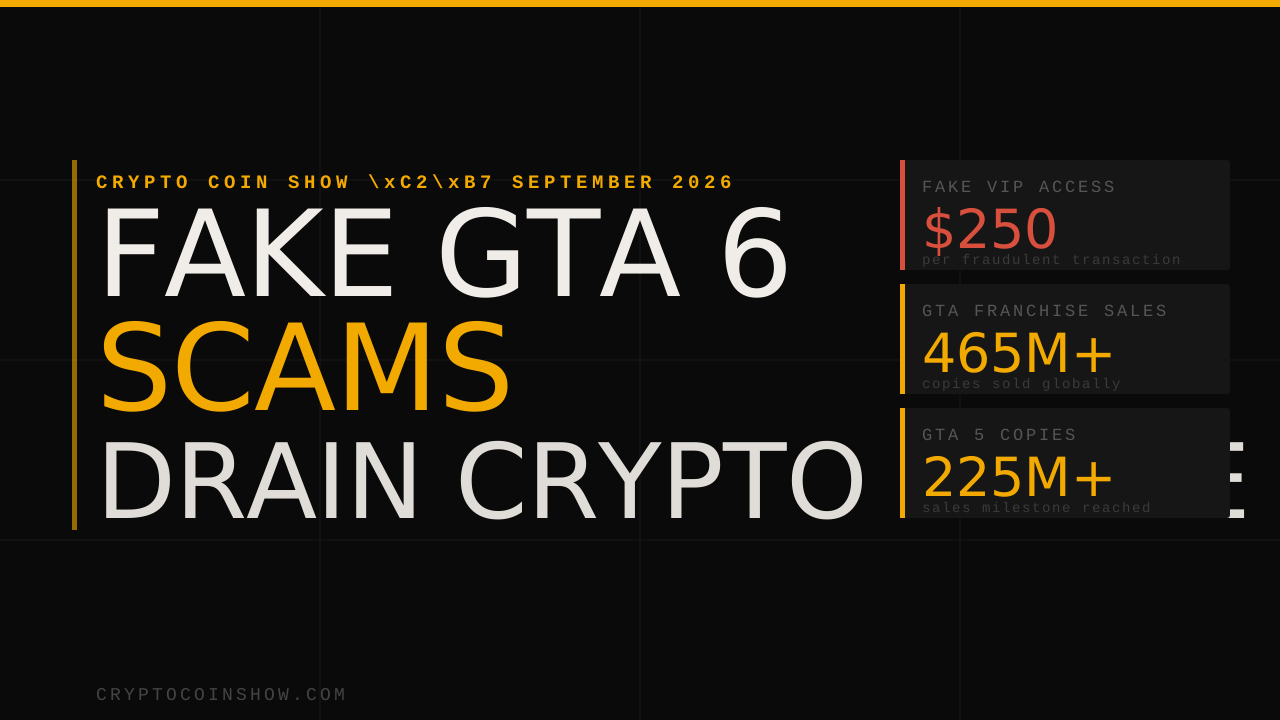
- CyberLeek demanded pressed discs for GTA 6 pre-orders and offline single-player access since June, escalating with daily gameplay leaks since August 18.
- Rockstar’s August 26 statement apologized for the leak but pointedly omitted any response to the physical disc demand or acknowledgment of CyberLeek.
- Take-Two CEO stated discs no longer make sense for consumers, while Sony plans to cease game disc production entirely by January 2028.
- Nov. 19 Confirmed GTA 6 launch date, reaffirmed in Rockstar’s statement
- 400 XMR Fee CyberLeek charges brands to open advertising conversation about leak placement
- Jan. 2028 Date Sony will stop pressing physical game discs entirely
Rockstar Games broke its silence on Wednesday with a carefully worded public letter to the community, but the statement’s most striking feature was what it deliberately excluded.
While the studio acknowledged the emotional toll of the Grand Theft Auto VI leak on its team and confirmed the game’s November 19 launch date, it made no mention of the central demand driving the leak campaign: the return of physical discs.
CyberLeek, the account orchestrating the daily release of gameplay footage since August 18, responded within hours by accusing Rockstar of playing the victim while evading accountability on ownership rights.
The timing and tone of the exchange revealed a fundamental disagreement over how software should be sold and controlled, one that extends far beyond a single game and touches on questions of digital preservation and consumer property rights that institutional publishers will face with increasing frequency.
Rockstar’s Silence on Discs Triggers Immediate Backlash From Leak Group
Rockstar’s statement, released on Wednesday, struck a tone of contrition toward fans and the development team.
The studio wrote that having GTA 6 footage leak “this way has been heartbreaking for our team, and this is obviously not how we intended for you to see the game.” The message thanked supporters for their patience through the game’s extended development cycle and warned that exposure to leaked spoilers might diminish the intended experience.
Critically, however, the letter never named CyberLeek, never addressed the physical disc dispute that has been central to the leak campaign since June, and offered no response to the group’s demands for offline single-player access or an end to what it calls “fake single-player expansions”, post-launch content already embedded in game files and locked behind paywalls.
That omission was deliberate, and CyberLeek interpreted it as evasion.
The leak group’s response, posted to X on August 26, reframed the entire dispute. CyberLeek stated: “Rockstar are trying to act like the victims here. Do they really think that we’ll forget how they’re trying to scam the whole community?
Where’s the discs @RockstarGames? We’re done with your games. We will not stop fighting for our rights.
We deserve it to own what we buy.” The counter-statement signaled that the leak campaign would not be mollified by apologies and that demands for physical media represented a non-negotiable line for the group.
Since the initial June announcement that boxed GTA 6 copies would contain download codes rather than actual discs, CyberLeek has framed the shift as a loss of consumer ownership and a violation of purchase parity across platforms.
Take-Two and Industry Pivot Away From Discs Collides With Preservation Movement
The disc question is not new, but Rockstar’s parent company Take-Two Interactive has committed firmly to the digital-only direction.
During an August 7 earnings call with analysts, Take-Two CEO Strauss Zelnick stated plainly that “discs no longer make sense for consumers.” That statement reflected a broader industry consensus: publishers have moved to digital-first distribution because it reduces manufacturing costs, enables instant patches and updates, and prevents used-game sales that bypass publisher revenue.
Rockstar confirmed in June that all physical copies of GTA 6, including pre-orders, would ship with a download code instead of a playable disc, meaning buyers receive a license to access the game rather than a discrete product they own outright.
Sony’s decision to halt game disc production entirely by January 2028 signals the industry’s direction with institutional certainty. The move affects PlayStation 5 games and underscores that major platform holders no longer view physical media as a core business.
Yet the announcement triggered a backlash: a PlayStation disc preservation petition gathered hundreds of thousands of signatures within weeks, reflecting consumer concern over digital access dependence and the risk that licensed content could vanish if servers shut down or licensing agreements expire.
A competing preservation group, Stop Killing Games, vocally rejected CyberLeek’s leak tactics even while advocating for continued physical media and consumer ownership rights. In a statement, Stop Killing Games wrote: “Using illegal means to make a point is unacceptable to us and does nothing to protect our right to keep using what we paid for.”
That friction exposes a genuine divide within the consumer movement itself. Some advocates support the ownership principle but oppose the leak tactics as illegitimate; others, like CyberLeek, view leaks as necessary pressure when traditional channels fail.
Rockstar’s silence on the disc question sidesteps this debate rather than resolving it, leaving institutional publishers without a clear precedent for how to respond when activism and intellectual property conflict collide.
CyberLeek’s Monetized Leak Campaign Complicates the Consumer Rights Narrative
A complicating factor in the dispute is CyberLeek’s commercial model. The group does not simply distribute leaked footage; it sells advertising space within those releases. Brands must transmit 400 Monero, a privacy-focused cryptocurrency worth approximately $172,000 at current exchange rates, to open negotiations for potential placement.
That fee does not guarantee an ad slot; it merely buys a response from the group. The use of Monero, a coin specifically designed to obscure transaction sources and recipient identities, shields both the advertiser and CyberLeek from public scrutiny.
At a trading price near $431 per coin, the $172,000 barrier is high enough to filter casual inquiries but low enough to be accessible to brands with modest marketing budgets.
That commercial infrastructure undermines CyberLeek’s positioning as a grassroots consumer advocate.
Rockstar and Take-Two can now frame the leak campaign not as principled activism but as extortion masked in consumer-rights language, a narrative that will dominate conversations with institutional investors and regulators. The monetization model also creates perverse incentives: CyberLeek’s revenue stream depends on the leak campaign continuing and maintaining media attention.
A rapid settlement with Rockstar would eliminate the group’s leverage and its income source. That misalignment between stated goals and financial interest weakens the moral authority of the demands and gives Rockstar legal and reputational grounds to refuse engagement.
Rockstar’s November Launch Deadline Constrains the Window for Resolution
GTA 6 is scheduled for release on November 19, 2024, just under three months from the August leak. That deadline creates urgent pressure on Rockstar but paradoxically limits its negotiating flexibility.
A reversal on the disc decision this late in production would require reprinting physical media in quantities sufficient to meet pre-order demand, coordinating with manufacturing and distribution partners, and revising marketing materials already distributed to retailers.
The cost and logistical complexity would be substantial, but not insurmountable for a franchise expected to generate billions in revenue.
However, the real risk to Rockstar is reputational and precedent-setting. If the company capitulates to CyberLeek’s demands under pressure from leaks, it signals to other activist groups that similar tactics, public demands paired with leaked intellectual