
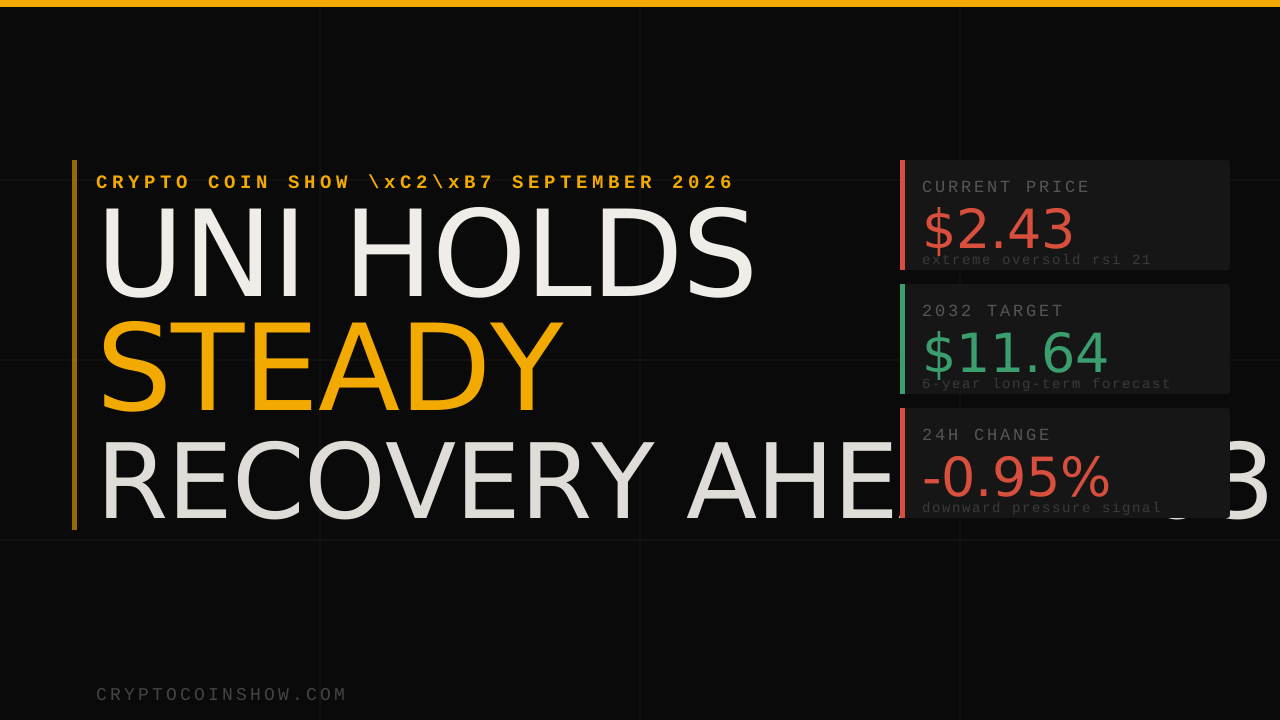
Uniswap price prediction 2026-2032: Will UNI keep steady?
Uniswap’s governance token UNI is trading near $2.43 with technical indicators signaling extreme oversold conditions, while long-term price forecasts suggest potential recovery to $11.64 by 2032, a critical distinction for institutional investors evaluating DeFi protocol exposure amid current market weakness. Understanding the gap between near-term technical headwinds and multi-year fundamental catalysts is essential for positioning in decentralized exchange governance assets.
- UNI trading at $2.43, down 0.95% in 24 hours with RSI at 21.10, indicating extreme oversold territory
- Long-term forecasts predict UNI reaching $11.64 average price in 2032, with maximum range of $12.40
- Current Fear and Greed Index at 12 signals extreme fear, contrasting with bullish multi-year price trajectory
- $2.43 Current UNI price versus $44.97 all-time high from May 2021
- $11.64 Predicted 2032 average price, representing 379% gain from current levels
- 21.10 14-day RSI reading versus 30 threshold marking oversold condition
Uniswap’s UNI token is caught between immediate technical weakness and long-term structural opportunity. As of June 6, the token trades at $2.43, down fractionally over the past 24 hours, while the broader altcoin market corrects and institutional risk appetite remains subdued.
The Relative Strength Index stands at 21.10, well below the 30 threshold that signals extreme oversold conditions, suggesting that near-term sellers have exhausted momentum and a tactical bounce may be imminent.
Yet the more significant question for institutional investors is whether current price action represents a buying opportunity within a multi-year recovery arc or another leg down in a structural bear market for governance tokens.
Oversold RSI and Bollinger Band Compression Signal Potential Reversal
The daily technical structure reveals a token under acute selling pressure but exhibiting the early markers of a reversal setup. UNI is trading near its immediate support level of $2.28, having failed to hold higher resistance around $2.49 in the previous 24-hour session.
The Bollinger Bands, measuring volatility and price range, show considerable expansion, with the upper band shifted to $3.82 and the lower band broken through to $2.41, indicating that volatility intensity has spiked sharply and buyers have temporarily abandoned the token.
The RSI reading of 21.10 is the most critical technical signal.
In traditional and crypto markets alike, RSI values below 30 historically precede trend reversals, as they indicate that selling has become indiscriminate rather than driven by fundamental deterioration. The 50-day simple moving average stands at $3.32, roughly 36% above current price, while the 200-day SMA sits at $4.26, suggesting that UNI has broken through intermediate-term support structures.
This confluence of oversold momentum and elevated volatility has traditionally preceded 5-15% bounce rallies in DeFi tokens once capitulation selling exhausts itself. Market sentiment is marked as bearish, and the Fear and Greed Index sits at 12, labeled as extreme fear, a reading that frequently coincides with tactical entry points rather than prolonged declines.
Multi-Year Forecasts Anticipate Recovery to $11.64 by 2032
The disconnect between current technicals and longer-duration price targets reflects a fundamental split among market participants about Uniswap’s trajectory. Analyst estimates place UNI’s average price at $11.64 in 2032, with a maximum target of $12.40, implying a 379% gain from current levels over eight years.
These forecasts assume that Uniswap, founded in 2018 by former mechanical engineer Hayden Adams, will continue to capture an expanding share of decentralized exchange volume and that governance token utility will command a proportional valuation multiple as institutional adoption of on-chain trading infrastructure matures.
Near-term price predictions diverge sharply from this thesis. Current technical analysis estimates UNI could decline to $2.20, a further 9.5% drop from existing levels, before any meaningful consolidation takes hold. For 2026, six years hence, predictions suggest UNI could reach as high as $3.51, representing recovery to just 44% above where it trades today.
Estimates for 2028 average price range from $5.10 to $5.87, implying a compound annual growth rate of roughly 22-28% if those midpoint forecasts hold.
The wide variance between near-term technical targets and multi-year fundamental predictions highlights a critical institutional consideration: token holders must absorb further volatility and potentially flat-to-negative returns for several years to capture the longer-duration upside embedded in 2032 price projections.
Uniswap’s utility as a 100% on-chain automated market maker protocol on Ethereum underpins these long-term assumptions. The protocol solves a fundamental liquidity problem by allowing traders to swap ether and any ERC-20 token without intermediaries or counterparty risk, a feature that has driven Uniswap to dominance in spot DEX market share.
The UNI governance token’s attraction to traders and investors rests on this infrastructure utility rather than pure speculation, yet the current market environment suggests that governance token valuations have compressed regardless of underlying protocol strength.
UNI’s all-time high of $44.97, set in May 2021, now appears to reflect a period of peak DeFi enthusiasm that has not returned; the all-time low of $1.03 in September 2020, by contrast, predates institutional awareness of the protocol and offers limited relevance to current valuation.
Green Days at 30% Underscores Extended Bearish Pressure on UNI
Only 9 of the past 30 trading days have closed in green, indicating sustained seller dominance.
This metric, showing green close days at just 30% of the sample period, underscores that UNI’s current decline is not a single session correction but rather an extended period of distributional pressure.
Trading volume over the past 24 hours reached $140.38 million against a market capitalization of $1.51 billion, indicating that depth remains adequate for institutional positions but that buyer conviction has visibly weakened.
The circulating supply of 622.67 million UNI creates a large float, and governance token holders who received allocations during the 2020-2021 bull run and have held through the subsequent bear market are now facing mark-to-market losses of up to 95% from peak valuations.
For institutional investors, the structural question becomes whether to interpret current oversold conditions as a bottom-formation process or as a warning that DeFi governance tokens face structural headwinds regardless of protocol quality.
The Fear and Greed Index at 12 suggests that options markets are pricing in sharply lower volatility expectations and that tail-risk hedging has compressed to historically cheap levels, typically a contrarian buy signal.
However, the 200-day SMA at $4.26 indicates that even if UNI rallies back to its 50-day moving average at $3.32, the token remains well below intermediate-term price structures, suggesting that mean reversion will take multiple months to complete rather than weeks.
Institutional Entry Points Depend on Conviction in 2028-2032 Thesis
The practical decision facing portfolio managers is whether the current oversold setup on a 2-4 week timeframe justifies taking a position that will likely remain underwater for 12-18 months before any meaningful recovery becomes evident. A $2.43 entry point capturing the current panic does not guarantee capital preservation; if UNI declines to the technical target of $2.20, a position opened here would still face a 9.5% drawdown before stabilizing. Conversely, patient accumulation at higher technical targets around $5.10-$5.87 would align with the 2028 forecast range but would require institutional investors to wait for a recovery that may not materialize until late 2025 or 2026.