Washington moves to cut China out of the machines powering US Bitcoin mining
The U.S. controls 37-38% of global Bitcoin mining capacity but sources 97% of its mining hardware from Chinese manufacturers, a supply-chain imbalance that Senators Bill Cassidy and Cynthia Lummis now aim to reverse through legislation. The Mined in America Act, introduced March 30, would establish domestic hardware manufacturing incentives, create a voluntary certification program, and codify President Trump’s Strategic Bitcoin Reserve into law, reshaping how Washington treats crypto infrastructure as a matter of industrial policy.
- U.S. Bitcoin mining represents 37-38% of global hashrate at approximately 400 exahashes per second, while Chinese manufacturers supply 97% of all mining hardware equipment.
- The Mined in America Act proposes voluntary Commerce Department certification, federal manufacturing support through NIST and the Manufacturing Extension Partnership, and statutory codification of Trump’s Strategic Bitcoin Reserve.
- Legislation ties hardware sourcing to federal balance-sheet strategy for the first time, framing cryptocurrency mining as critical infrastructure requiring upstream supply-chain oversight comparable to semiconductors.
- 37-38% U.S. share of global Bitcoin mining hashrate versus Chinese hardware supply dominance at 97%
- 400 EH/s Current U.S. Bitcoin mining capacity measured in exahashes per second according to January 2026 data
- Mar. 30 Date Mined in America Act introduced by Cassidy and Lummis in the Senate
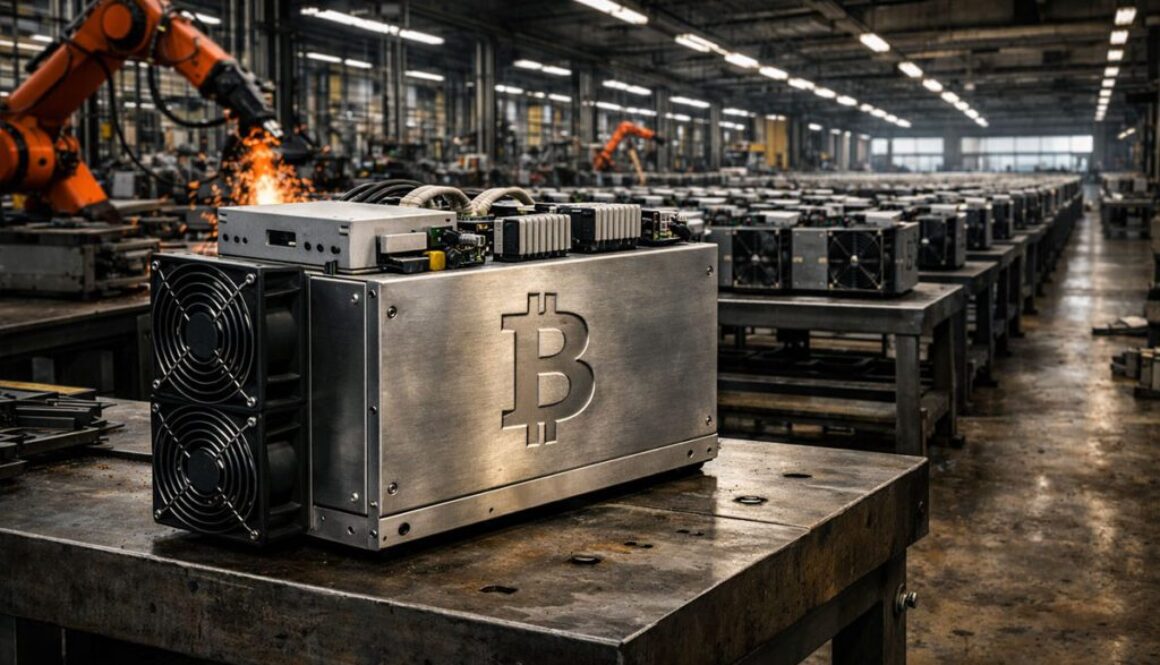
The United States has built the world’s largest Bitcoin mining footprint, commanding more than one-third of global mining capacity, a position of dominance that masks a critical vulnerability. Every major mining operation running across American data centers depends on specialized application-specific integrated circuit (ASIC) hardware manufactured almost entirely in China.
That concentration creates a structural risk: the nation leading the world in an activity that generates billions in revenue and consumes significant electrical capacity has outsourced control of the technology that makes it possible to a country the U.S. government classifies as a strategic adversary.
On March 30, Senators Bill Cassidy, a Louisiana Republican, and Cynthia Lummis, a Wyoming Republican with long-standing interest in cryptocurrency policy, introduced the Mined in America Act to attack this gap directly.
The bill assembles three policy mechanisms, certification, manufacturing support, and legislative entrenchment of a presidential Bitcoin reserve, into a coherent strategy to domesticate mining hardware production and bind it to federal asset strategy.
Chinese Hardware Dominance Creates National Vulnerability That U.S. Mining Dominance Cannot Offset
The supply-chain asymmetry is stark. Cassidy’s office cites data showing that 97% of mining hardware originates from Chinese manufacturers, a figure that aligns with independent benchmarking from Hashrate Index’s January 2026 assessment placing U.S. Bitcoin mining capacity at roughly 37-38% of global total, or approximately 400 exahashes per second.
Both measurements describe the same underlying problem: American miners operate the machines but do not build them. This dependency inverts the typical pattern of strategic industry policy. Washington protects supply chains for semiconductors, rare earth elements, and energy infrastructure through tariffs, subsidies, and sourcing restrictions.
Bitcoin mining hardware, the physical machines that secure and validate transactions on a network now worth trillions, has remained outside that framework, left to market allocation despite its strategic importance.
The argument the bill makes is industrial vulnerability framed through national security logic rather than environmental or financial regulation.
By concentrating mining hashrate domestically while importing hardware from foreign sources, the U.S. invites supply-chain disruption at scale. A geopolitical fracture, export controls, or deliberate sabotage of Chinese-manufactured equipment could degrade American mining operations overnight.
Worse, Chinese manufacturers could embed surveillance, backdoors, or hardware kill-switches into the machines they export, concerns that have animated U.S. policy toward Chinese telecommunications and semiconductor imports for over a decade. The bill positions mining equipment in that same threat category: critical infrastructure requiring domestic control, not mere commodity procurement.
Cassidy-Lummis Bill Proposes Three-Tier Approach to Domesticate Hardware Supply and Codify Bitcoin Reserve
The legislation operates through three levers working in concert. First, it establishes a voluntary “Mined in America” certification program administered by the Commerce Department.
Mining facilities that achieve certification would commit to phasing out hardware linked to foreign adversaries, creating a market incentive for operators to source domestically once domestic suppliers reach competitive price and performance.
Second, the bill mobilizes federal manufacturing support through the National Institute of Standards and Technology (NIST) and the Manufacturing Extension Partnership, existing agencies tasked with modernizing American manufacturing across sectors.
Rather than creating new bureaucratic infrastructure, the legislation draws on established energy and rural development programs already funded and operational, according to Cassidy’s office, keeping implementation costs within existing authorities.
The third component ties hardware sourcing directly to federal asset strategy by writing Trump’s Strategic Bitcoin Reserve into statute. In March 2025, President Trump issued an executive order establishing the reserve using Bitcoin seized or forfeited by the government, with the constraint that any future acquisitions remain budget-neutral, imposing no new taxpayer cost.
Moving the reserve from executive action to legislation would anchor it beyond a single administration, giving it the permanence and political weight of law. Critically, it creates the first explicit federal mechanism linking hardware procurement to a balance-sheet asset, effectively making the composition and sourcing of mining equipment a matter of federal financial policy.
The reserve codification is the novel element: it makes Bitcoin mining hardware part of America’s official asset management framework, not merely industrial policy.
U.S. Port Seizures of Chinese Mining Equipment Signal Enforcement Shift Preceding Legislative Action
The legislative push follows enforcement activity that began in late 2024, when U.S. authorities started seizing Chinese-manufactured mining equipment at American ports on Federal Communications Commission (FCC) and Customs grounds. The seizures were not uniform; some equipment was released after review, creating ambiguity about which hardware actually violates existing rules and which does not.
That inconsistency underscores why the Cassidy-Lummis bill frames certification and statutory clarity as necessary: without clear standards, port enforcement becomes ad hoc, creating compliance uncertainty for miners and manufacturers who lack definitive guidance on what hardware is permissible.
The bill’s certification approach would resolve that ambiguity by establishing transparent criteria for acceptable equipment. Facilities that meet the Mined in America standard would gain predictable clearance; those that do not would face gradually increasing pressure to transition.
This carrot-and-stick structure matches the regulatory template Washington has used for semiconductors and critical minerals: set a standard, provide incentives to comply, and let market forces and compliance pressure drive adoption rather than imposing mandatory sourcing bans that could trigger retaliation.
Statutory codification also prevents future administrations from reversing course. An executive order, including Trump’s Bitcoin Reserve directive, can be rescinded by the next president. Converting the reserve to law requires legislative action to undo, raising the political bar for any reversal.
For institutional miners and Bitcoin-holding entities evaluating long-term capital allocation and regulatory risk, that shift from executive order to statute reduces policy uncertainty and signals durable government commitment to the sector as essential infrastructure.
Mining Equipment Manufacturing Incentives Target Economic Viability of Domestic ASIC Production at Scale
The core challenge the bill must solve is economic. Chinese ASIC manufacturers have achieved economies of scale, cost leadership, and supply-chain integration that American competitors cannot yet match. Bitmain, Canaan, and Whatsminer dominate the market not through regulatory protection but through established manufacturing footprints and capital efficiency.
Simply certifying American hardware or creating compliance pressure will not overcome that advantage unless domestic production can achieve comparable or superior cost and delivery.
The bill’s reliance on NIST and the Manufacturing Extension Partnership aims at that problem by funneling federal technical expertise and existing subsidy programs toward American manufacturers attempting to scale ASIC production.
The legislation bets that federal manufacturing support can compress the cost and timeline for domestic ASIC producers to reach competitive parity with Chinese incumbents.
That bet carries risk. The semiconductor and battery industries show that federal support can accelerate domestic manufacturing (the CHIPS and Science Act, the Inflation Reduction Act’s battery provisions),