
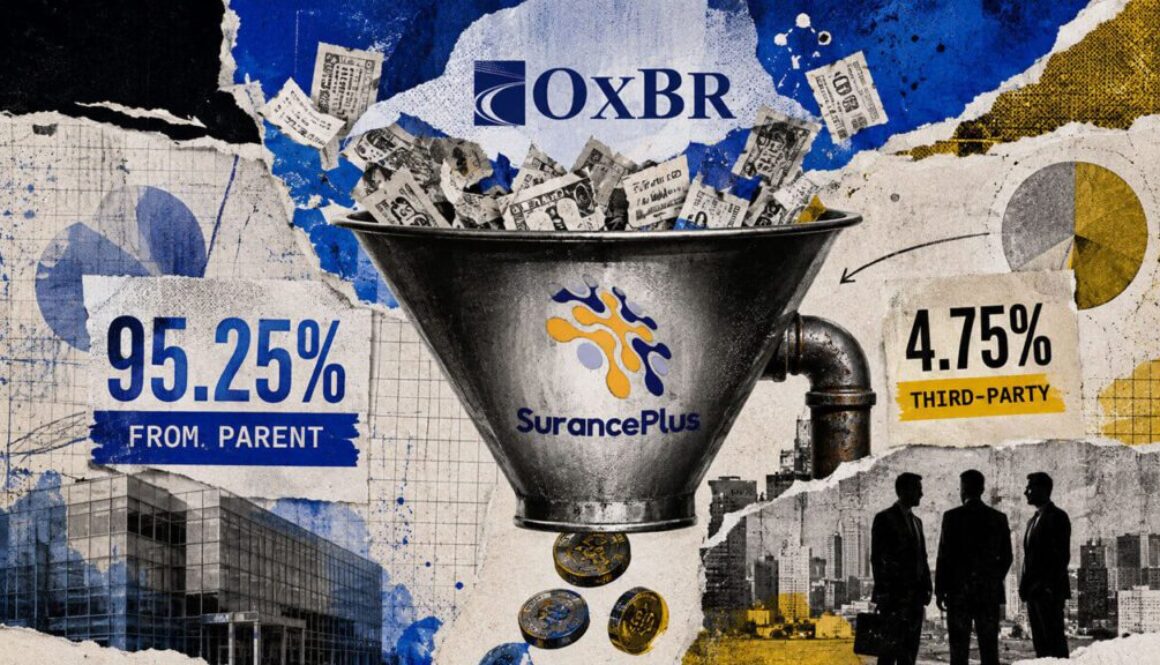
Inside the Solana reinsurance sale where parent company Oxbridge supplied 95% of public token demand
Oxbridge Re Holdings supplied approximately 95% of the capital raised in its Solana-based reinsurance token offerings, raising questions about the depth of independent institutional demand for tokenized insurance products. The concentration underscores the structural challenge facing blockchain-native financial instruments: difficulty attracting third-party capital without parent-company backstopping.
- Oxbridge contributed $744,623 of the $781,767 raised by SurancePlus’s T20 and T42 token offerings, leaving only $37,143 from external investors
- The $7.1 million aggregate figure combined two Solana-based Oxbridge placements with three HCI-linked securities, but filings did not clarify HCI investor identity or third-party participation
- SurancePlus, Oxbridge’s 80%-owned subsidiary, consolidated the parent-funded subscription into group accounts without separately disclosing the elimination of intercompany transactions
- 95.25% of T20 and T42 proceeds sourced from parent company versus third-party investors
- $781,767 total raised across two Solana tokenized reinsurance placements by SurancePlus
- $7.1M aggregate headline figure combining five separate placements across Oxbridge portfolio
Oxbridge Re Holdings, a publicly traded reinsurance and financial technology company, disclosed in its August 13 filing that its 80%-owned subsidiary SurancePlus raised capital through two Solana blockchain-based tokenized insurance products designated T20 and T42. The combined offerings generated $781,767 in gross subscription proceeds.
However, approximately $744,623, or 95.25% of that total, came directly from Oxbridge itself rather than independent market participants.
This concentration of parent-company funding within the broader $7.1 million capital raise highlights a structural friction in the tokenized finance ecosystem: the difficulty of attracting institutional third-party capital without substantial internal capital commitment to anchor demand.
Oxbridge supplied 95% of token demand while subsidiary maintained consolidated accounting structure
The two Solana offerings were part of SurancePlus’s broader product suite, which the subsidiary positioned as blockchain-native reinsurance instruments.
Under the offering terms, the T20 and T42 tokens conferred contractual rights to specified reinsurance participation but carried no ownership, voting, dividend, preemptive or conversion rights, a structure designed to isolate them as synthetic exposures rather than equity stakes.
Oxbridge’s contribution of $744,623 flowed from parent to subsidiary, while only $37,143 came from external investors, leaving third-party participation at 4.75% of the total raise.
Because Oxbridge owns 80% of SurancePlus and exercises control over the subsidiary, it consolidates the entity’s accounts under standard accounting rules.
The filing does not explain how the company’s consolidated financial statements handled the elimination of the intercompany transaction, a standard consolidation adjustment that removes internal transfers from group results to avoid double-counting. This opacity creates a gap between the headline capital figure and the actual externally verified demand signal the market received.
For institutional investors evaluating tokenized financial products, the distinction matters. Parent-company backstopping can stabilize a new product but does not prove market demand or investor appetite independent of the originating firm’s strategic objectives.
The 95% concentration suggests SurancePlus relied on internal capital allocation rather than competitive external demand to launch its Solana offerings.
HCI-linked securities raised $6.3 million but filings obscured third-party investor identities
The $7.1 million headline figure combined the T20 and T42 proceeds with three additional securities tied to HCI Group’s reinsurance business. Those three HCI-series placements generated $6.323 million in gross subscription proceeds, representing the larger portion of the aggregate raise.
However, the filing identified purchasers only as “investors” without naming them or disclosing how much came from related parties versus independent institutions.
Oxbridge identified HCI as a related entity through common directorship.
HCI contributed approximately $6.19 million directly to three trust accounts that held the collateral backing the offerings, and a separate HCI deposit of approximately $5.8 million in net token proceeds was attributed to “the Company.” The filing’s failure to distinguish between gross subscriptions, net deposits, collateral contributions, and trust assets created ambiguity about whether the $6.323 million truly represented external capital or internal group capital recycled across related entities.
This structural opacity presents a transparency concern for institutional buyers. Without explicit disclosure of third-party purchaser identity and capital source, investors cannot independently verify whether the HCI placements attracted genuine external demand or consisted of related-party allocations.
The distinction carries implications for pricing, duration risk, and confidence in the underlying market for tokenized reinsurance products.
Consolidated subsidiary structure shields parent-funded capital flows from separate line-item disclosure
SurancePlus’s status as an 80%-controlled subsidiary allowed Oxbridge to consolidate its accounts without separately reporting the internal capital contribution to T20 and T42.
Standard consolidation accounting eliminates intercompany transactions to show only external revenues and costs, but the filing provided no detail on how that elimination was executed or what the underlying external demand would look like on a standalone basis.
For tokenized financial instruments, this accounting treatment creates a visibility gap. An investor reading Oxbridge’s earnings release might see the $7.1 million headline and assume it reflected market-tested demand across multiple offerings.
The actual composition, 95% parent-funded in the Solana products, undisclosed third-party mix in the HCI products, tells a different story about institutional adoption and independent capital deployment into blockchain-based insurance derivatives.
The filing also noted that HCI’s tokens represented “synthetic contractual exposure that mirrors specified participations in Fortex Reinsurance’s program without affecting HCI’s or Fortex Re’s underlying reinsurance arrangements.” This layered structure, tokens as exposures to reinsurance participations, themselves derived from third-party reinsurance programs, introduces additional counterparty and basis risk that buyers would need to model separately.
Transparency gap leaves unresolved questions about independent institutional demand for tokenized insurance
The August 13 filing raised but did not answer a critical question for the tokenized reinsurance market: how much of the $7.1 million capital raise reflected genuine institutional demand versus internal group capital optimization. The T20 and T42 transparency is clear, 95% parent-funded. The HCI side remains opaque, with no disclosed breakdown between related and unrelated parties.
For institutional investors considering exposure to tokenized insurance products, the disclosure pattern signals a need for deeper diligence. Headline capital figures should be interrogated for parent-company concentration. Filings should specify purchaser identity and relationship to the issuer.
Consolidated accounting structures should be unwound to show standalone external demand. Until tokenized reinsurance offerings demonstrate the ability to attract material third-party capital without parent-company backstopping, the asset class remains dependent on internal capital allocation rather than proven external market appetite.
The next test will emerge from future offerings by Oxbridge or other tokenized reinsurance issuers. Investors should watch whether subsequent placements show materially higher third-party participation rates, or whether parent-company and related-party funding remains the dominant source of capital. Until disclosure standards improve, or until a standalone offering by an unaffiliated tokenized reinsurance platform demonstrates strong external demand, the data point from this raise will benchmark expectations for the broader sector’s institutional adoption.