
What Solana’s failed fee vote reveals about Anatoly Yakovenko’s power
Solana’s failed August 28 fee governance vote reveals a critical imbalance in the network’s decision-making architecture: despite majority support for a proposal, founder Anatoly Yakovenko’s preferred policy was rejected due to governance rule design that amplifies abstention voting power. This outcome signals to institutional investors that Solana’s on-chain governance framework may not function as intended, with potential implications for how economic reforms are implemented across the network.
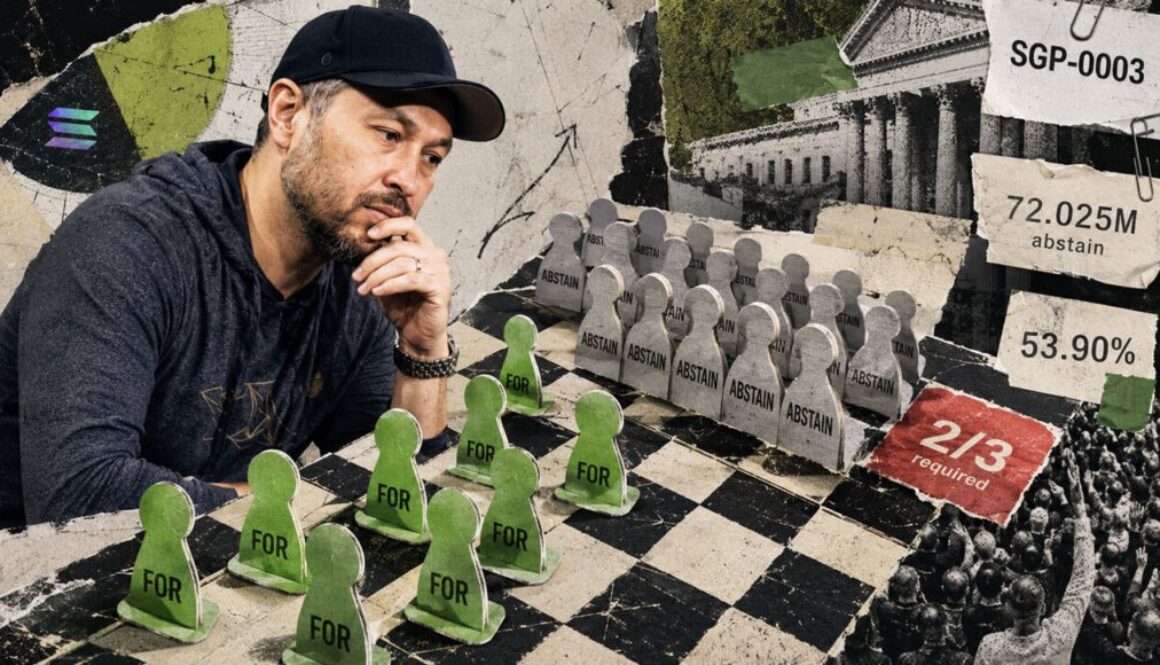
On August 28, the Solana network voted on SGP-0003, a significant fee restructuring proposal that appeared headed for approval based on initial metrics. The ballot received 142.844 million SOL in favor against 50.146 million opposed, representing a 74% margin among voters who chose a clear position. Yet the proposal failed. With 72.025 million SOL abstaining across 1,152 voters, total participation reached 265.015 million SOL, or 61.14% of the 433.486 million SOL snapshot—well above quorum requirements. The decisive factor was the governance framework’s calculation methodology: the system counted abstentions in the approval denominator, requiring two-thirds of all participating stake for passage. This increased the approval threshold to 53.90%, leaving the pro-fee-reform coalition 33.83 million SOL short of victory. The result demonstrates how governance rule design can override apparent consensus and raises questions about the actual distribution of influence between Solana’s co-founder and the broader validator and staking community.
How Governance Architecture Inverted the Majority Vote
The mechanics of Solana’s governance structure transformed a substantial affirmative vote into a rejection, illustrating a fundamental tension in the network’s decision-making apparatus. When SGP-0003 was initially drafted, the frozen proposal text specified that no quorum applied and excluded abstentions from the approval calculation. Under those original terms, the 142.844 million SOL in favor would have achieved an approximately 74% approval rate—well above any reasonable threshold. However, between the proposal’s submission and the vote’s execution, Solana ratified an updated governance Constitution that modified these parameters. The revised framework, reflected in the current governance FAQ, counts For, Against, and Abstain votes equally toward both quorum participation and the two-thirds approval denominator. This shift fundamentally changed how abstention functioned in the voting mechanism.
For token holders and validators, abstention suddenly became a strategically significant choice rather than a passive default. By abstaining, participants could effectively reduce the approval threshold without joining the explicit opposition. This created an unexpected incentive structure where voters uncertain about or divided on SGP-0003’s merits could resist the proposal without registering formal opposition. The 72.025 million SOL that abstained—representing 27.2% of participating stake—thus exercised decisive influence despite taking no clear position. The outcome exposes a governance design flaw: the system converted a large middle ground of undecided or lukewarm voters into a blocking coalition. For institutional investors evaluating Solana’s governance maturity, this suggests that future votes may not reflect authentic preference intensity but rather participation rule artifacts.
Notably, the official system applied the inclusive counting rule, not the original frozen proposal text, and Solana governance officials confirmed this interpretation follows both the ratified Constitution and current FAQ. This consistency demonstrates that governance administrators implemented the rules as written. However, the discrepancy between the ballot text and the operative framework highlights a broader concern: voters may not have fully anticipated how governance rule changes would interact with their specific proposal. Solana’s governance infrastructure requires careful attention to these technical details, particularly for economic proposals with material consequences for the network’s operating costs and revenue distribution.
Yakovenko’s Advocacy and the Broader Fee Reform Agenda
The failing vote on SGP-0003 is particularly instructive because it involved explicit, high-profile support from Anatoly Yakovenko, Solana’s co-founder and a figure who maintains substantial informal influence over network direction. On August 25, just three days before the vote, Yakovenko publicly backed a specific starting fee rate of one-tenth of a lamport per requested cost unit, according to public records maintained by Solana Compass. This advocacy demonstrated Yakovenko’s continued engagement with granular economic policy decisions rather than abstract network principles. However, the proposal voters faced was substantially broader than the single parameter Yakovenko highlighted. SGP-0003 bundled the entire three-stage fee ramp into a single vote, with feature gates scheduled to increase the resource-fee rate to one-quarter and then one-half of a lamport in subsequent phases. Voters were thus endorsing not merely Yakovenko’s preferred starting point but a complete distributional framework with implications extending well beyond his public statements.
This bundling strategy created a coalition problem. Validators and stakers who supported Yakovenko’s preferred opening rate might nonetheless harbor concerns about the later stages of the ramp, the mechanics of the proposed 2,500-lamport inclusion fee per transaction (replacing the existing 5,000-lamport per-signature model), or the specific revenue allocation outlined in the related technical specification SIMD-0553. By forcing a take-it-or-leave-it choice on the complete package, the proposal made it difficult to assemble the supermajority required under Solana’s governance framework. Some holders undoubtedly abstained because they supported Yakovenko’s position but doubted the wisdom of the full multi-stage implementation. Others may have withheld support to signal concerns about centralizing fee policy around founder preferences, even if they agreed on specific technical parameters. The failed vote thus reveals constraints on founder influence in on-chain governance: Yakovenko’s advocacy was substantial enough to shape the agenda but insufficient to guarantee passage when proposals require broad coalition support.
From an institutional perspective, this dynamic introduces uncertainty into Solana’s economic governance. Future proposals tied to founder preferences will face heightened scrutiny, as validators and stakers now recognize that public backing from the co-founder does not guarantee passage. This may encourage more robust deliberation around network economics but could also create friction between Yakovenko’s vision for Solana’s development and the broader community’s willingness to implement it. The vote outcome does not indicate that validators rejected Yakovenko’s fee philosophy outright—the 74% support among those voting either for or against suggests substantial agreement on the direction. Rather, it reflects genuine reservations about implementation scope and pace, conditions that founder advocacy alone cannot overcome in a decentralized governance context.
Implications for Institutional Participation and Governance Evolution
The failed SGP-0003 vote offers institutional investors critical insights into how Solana’s governance framework actually functions under real economic pressure. The network demonstrated that a formal supermajority requirement remains binding even when founder support and majority sentiment align, suggesting that Solana’s on-chain governance is not a rubber stamp for insider preferences. This is positive from a decentralization perspective—it indicates that validator and staker coalitions retain genuine veto power over economic reforms. However, the governance mechanism’s reliance on abstention counting introduces unnecessary complexity and creates opportunities for sophisticated actors to manipulate outcomes through participation engineering. Institutional investors need to understand these technical details to accurately assess their own voting power and predict proposal outcomes in future governance cycles.
The episode also highlights the tension between Solana’s formal governance structures and the informal influence networks that inevitably develop in blockchain communities. Yakovenko’s advocacy mattered—it put the fee reform squarely on the agenda and shaped the specific parameters up for vote. Yet his influence proved insufficient to overcome coalition dynamics that his own public position could not resolve. This suggests that Solana’s governance, despite its decentralized rhetoric, operates within a framework where founder preferences are consequential but not determinative. Institutional holders participating in Solana governance should recognize that effective influence requires building genuine coalitions around substantive concerns, not merely relying on founder endorsement or community sentiment. The 72 million SOL of abstentions demonstrates that many participants prefer fence-sitting to explicit commitment—a pattern that will likely persist as the network’s governance matures and proposals become more economically contested.
Looking forward, Solana’s governance framework faces a critical decision about how to interpret and potentially modify the abstention-counting mechanism. Future proposals may trigger similar coalition fragmentation if stakeholders perceive that bundled changes prevent incremental feedback and iteration. Institutional investors should monitor whether Solana’s governance community moves toward finer-grained voting structures, sunset provisions, or modified quorum rules that better reflect authentic preference distributions. The SGP-0003 outcome, though technically a failure for the fee reform, may ultimately strengthen Solana’s governance infrastructure by exposing rule design flaws before they calcify into permanent governance norms. For institutional participants evaluating Solana’s long-term