
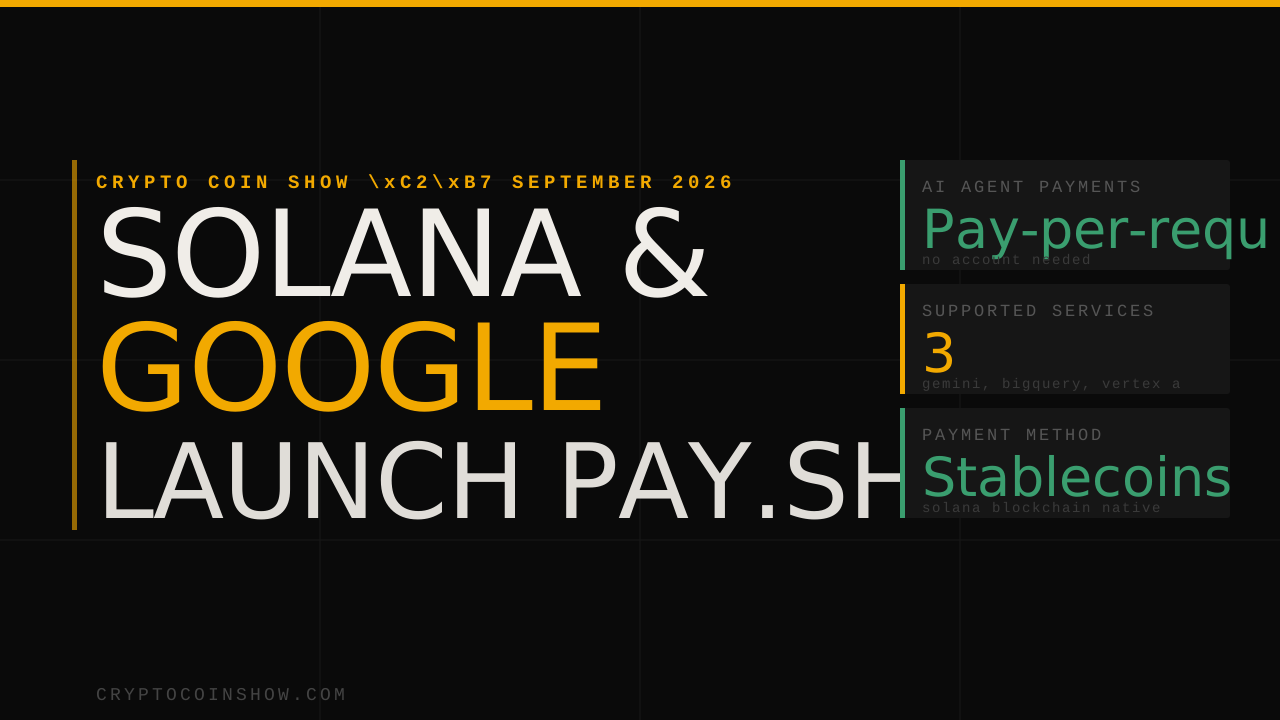
Solana and Google have launched Pay.sh to enable agentic payment
Solana Foundation and Google Cloud have launched Pay.sh, a blockchain-based payment gateway enabling artificial intelligence agents to autonomously purchase APIs and services using stablecoins without traditional account creation or subscription requirements. The move signals institutional adoption of machine-to-machine commerce infrastructure and positions Solana’s ecosystem as a foundational layer for enterprise AI deployments.
- Pay.sh eliminates account creation, identity verification, and billing setup, allowing AI agents to pay-per-request for Google Cloud services including Gemini, BigQuery, and Vertex AI using Solana stablecoins.
- Solana Foundation head of AI growth Rishin Sharma identified legacy payment networks as structurally incapable of supporting autonomous agent transactions, citing x402 standards as emerging solutions.
- The platform represents the first commercial integration of Google Cloud infrastructure with blockchain-based autonomous payment rails, establishing a precedent for enterprise AI payment systems.
- Pay.sh First live system pairing Google Cloud services with on-chain autonomous payments
- x402 Emerging protocol standard addressing limitations of legacy payment networks for agents
- 4 services Initial Google Cloud APIs available: Gemini, BigQuery, Vertex AI, plus aggregated discovery layer
The Solana Foundation and Google Cloud have jointly launched Pay.sh, a payment gateway that fundamentally restructures how artificial intelligence agents access and purchase cloud services.
Rather than requiring agents to undergo the conventional onboarding process, account creation, identity verification, billing setup, Pay.sh allows autonomous software to connect a wallet, discover available APIs, and settle payments on a per-request basis using stablecoins deployed on the Solana blockchain.
The system functions as both an API aggregation layer and a payment settlement protocol, enabling machine-to-machine commerce without intermediaries or subscription commitments. Google Cloud’s initial service offerings on the platform include Gemini, BigQuery, Vertex AI, and a broader set of computational and data services accessible through the gateway’s discovery mechanism.
Google Cloud integration signals enterprise blockchain adoption beyond cryptocurrency speculation
Google Cloud’s participation in Pay.sh represents a material shift in how major technology firms approach blockchain infrastructure deployment. The company has previously demonstrated commitment to Solana ecosystem integration by incorporating Solana blockchain data into BigQuery, its enterprise analytics platform.
This prior work created a technical and organizational foundation for Pay.sh, enabling Google engineers to design payment protocols compatible with Solana’s transaction finality and fee structure. The move is not a speculative blockchain venture but a direct response to genuine infrastructure gaps in current payment systems.
Dan Albert, executive director of the Solana Foundation, framed the initiative within a broader ecosystem expansion narrative. “The Solana ecosystem is growing rapidly,” Albert stated, emphasizing that improved data access and payment capabilities can drive developer adoption and business applications.
This positioning reflects institutional confidence in Solana’s technical stack and network effects, contrasting with earlier perceptions of Solana as a retail-focused trading platform.
The timing of this launch coincides with intensifying enterprise interest in AI agent infrastructure. Major cloud providers including Amazon Web Services, Microsoft Azure, and Google Cloud have all accelerated investment in AI deployment frameworks, recognizing that autonomous systems will require payment mechanisms absent from traditional financial infrastructure.
Pay.sh addresses this gap directly, offering a production-ready alternative to closed ecosystems.
Autonomous payment systems reveal structural incompatibility with legacy financial rails
Rishin Sharma, head of AI growth at the Solana Foundation, articulated a core technical constraint driving Pay.sh’s development: traditional payment networks were architected for human-initiated transactions and cannot accommodate agent-driven autonomous commerce at scale.
“Agents aren’t able to transact in the same way over traditional card networks,” Sharma explained, pointing to structural limitations that make Visa, Mastercard, and ACH systems unsuitable for machine-initiated micropayments.
Card networks require identity verification, account establishment, and fraud detection mechanisms designed around human purchasing patterns, all steps that create latency and operational overhead incompatible with real-time agent commerce.
Payment protocols are starting to be built. Agents aren’t able to transact in the same way over traditional card networks.
Rishin Sharma, head of AI growth, Solana Foundation
The emergence of x402, an open protocol standard for machine-to-machine payments, provides the technical specification layer enabling systems like Pay.sh. Sharma identified x402 as foundational to the next generation of payment infrastructure, noting that “you can pay using a stablecoin” within these standards.
Unlike centralized payment processors that require merchant accounts, kyc documentation, and settlement agreements, x402-based systems allow any service provider to accept payments directly from any agent wallet, reducing friction and operational complexity.
Stablecoins serve as the unit of account because they provide price certainty and eliminate currency volatility, critical for agents executing automated transactions without human judgment. Traditional cryptocurrency assets would introduce unnecessary exchange rate risk for routine service payments.
Competitive agent payment market crystallizing with fragmented technical standards and implementation approaches
Pay.sh enters a landscape where multiple organizations are simultaneously building agent payment infrastructure, each making distinct architectural choices. Coinbase and partner organizations are developing competing x402 ecosystem implementations focused on cryptographic wallet standards and open protocol adoption.
Stripe, the dominant enterprise payment processor, has introduced agent billing tools within its existing payment framework, attempting to extend its infrastructure to autonomous transactions while maintaining backward compatibility with traditional merchant accounts and subscription billing.
Pay.sh’s differentiator lies in its elimination of subscription models and account-based onboarding. Stripe’s agent billing tools still require merchant setup and billing configuration; Coinbase’s x402 ecosystem implementations prioritize protocol openness but lack direct enterprise cloud service integration.
Pay.sh bridges this gap by combining Solana’s transaction infrastructure with Google Cloud’s API catalog and enterprise distribution, creating a closed-loop system that works immediately for enterprise use cases.
The competitive dynamics reveal an underlying market structure emerging around agent commerce. Infrastructure providers with existing enterprise relationships, Google Cloud, Stripe, Amazon Web Services, can leverage those relationships to accelerate adoption. Pure-play blockchain organizations like Solana must compensate through technical superiority and eliminating friction points.
Pay.sh’s approach of removing traditional payment requirements entirely represents a deliberate choice to compete on experience and simplicity rather than feature parity.
Stablecoin payment volume and institutional blockchain adoption represent the critical metrics to monitor
The success of Pay.sh will be measured by two distinct but related indicators: transaction volume flowing through the gateway and institutional adoption of similar payment architectures across other cloud providers.
Early adoption will likely concentrate in data-intensive AI workloads where cost per API call matters significantly, machine learning training, large-scale analytics queries, and real-time data processing. These use cases generate sufficient transaction volume to justify per-request billing models rather than subscription tiers.
The broader institutional question remains whether other major cloud providers will adopt similar blockchain-based payment systems or develop proprietary alternatives.
Amazon Web Services, Microsoft Azure, and others have made preliminary moves toward blockchain integration but have not yet committed to autonomous agent payment infrastructure. The competitive pressure from Google Cloud’s public commitment to Pay.sh may accelerate timeline decisions across the cloud industry.
Additionally, regulatory clarification around stablecoins, particularly whether they will face restrictions in enterprise financial applications, will influence enterprise adoption velocity.
Watch for announcement of which additional Google Cloud services will be onboarded to Pay.sh beyond the initial four, and whether AWS, Azure, or other cloud infrastructure providers publicly commit to similar autonomous payment systems within the next 18 months. The scale and timing of these commitments will determine whether blockchain-based machine-to-machine payment protocols become a standard enterprise infrastructure layer or remain a Solana-specific implementation.