Aave governance proposes native Bitcoin collateral via Babylon vaults
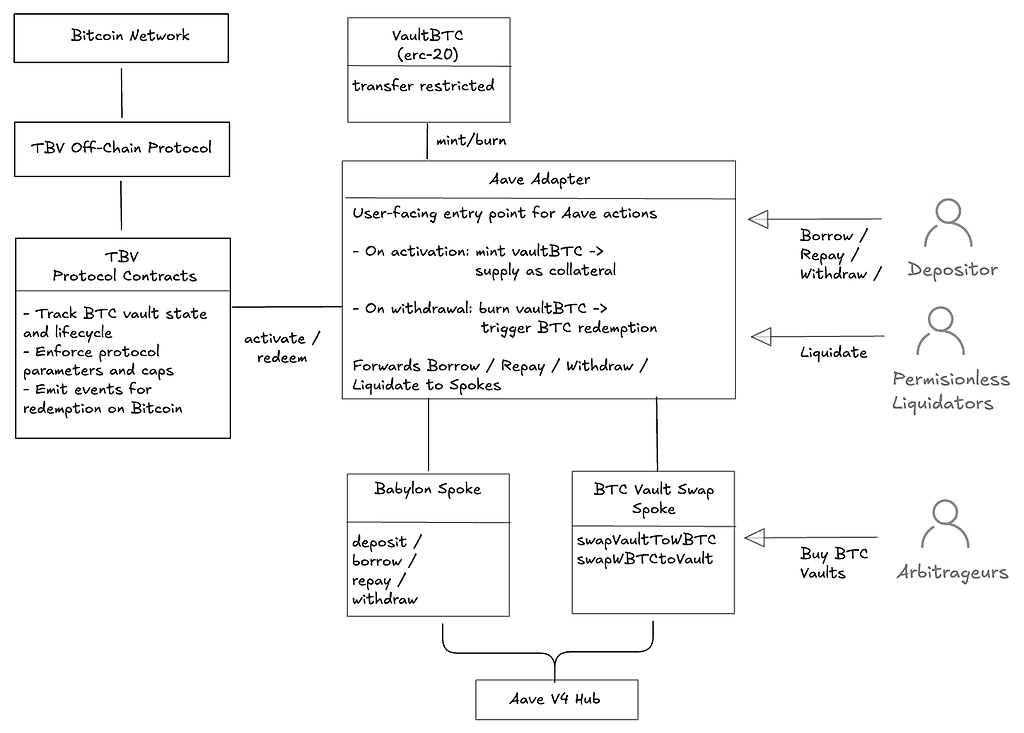
Aave governance posted a proposal Wednesday to onboard native Bitcoin as collateral on Aave V4 through Babylon’s Trustless Bitcoin Vaults protocol, enabling borrowers to pledge Bitcoin held on the Bitcoin network itself without transferring custody to any third party. The integration would deploy two new Aave V4 Spokes: the Babylon Spoke, which accepts native BTC as its sole collateral asset, and the BTC Vault Swap Spoke, which handles liquidations and converts seized vaults to wrapped Bitcoin for immediate settlement.
- Native BTC locked in Taproot scripts on Bitcoin, not wrapped or bridged to Ethereum
- Depositors borrow allowed stablecoins against BTC collateral through adapter contracts
- Liquidations use permissionless liquidators settling in wrapped BTC; arbitrageurs redeem actual Bitcoin on Bitcoin’s timeline
- 40,772 BTC currently staked via Babylon’s Bitcoin staking protocol, worth ~$3.37B
- 100,000 BTC activated cumulatively since Babylon staking launched August 2024
- 8 decimals in native BTC collateral token, matching satoshi denomination
The governance post describes the technical architecture for the integration, following a passed temperature check in September 2026. In Babylon’s Trustless Bitcoin Vaults (TBV) protocol, a depositor locks BTC in a Taproot UTXO on the Bitcoin network. Redemption is governed entirely by on-chain cryptographic rules, specifically, zero-knowledge proofs of loan repayment or other events on Ethereum, and settlement occurs directly to a Bitcoin address controlled by the redeeming party. The BTC never leaves the Bitcoin blockchain.
How native BTC becomes Aave collateral
Aave V4 accepts only ERC-20 tokens as collateral. To integrate native Bitcoin, the protocol creates a non-transferable ERC-20 representation token that exists solely within the integration’s smart contracts. This token is minted when a BTCVault activates and burned when the vault is withdrawn or liquidated.
Transfers of the representation token are restricted to a fixed allowlist: the Aave V4 Hub, the adapter contract, and per-user position proxy contracts. The token cannot be traded, transferred between users, or held outside the integration.
A depositor locks BTC on Bitcoin by creating a Taproot UTXO, then supplies it through an adapter contract on Ethereum. The adapter exposes standard Aave position-management actions: supply, borrow, repay, and liquidation entry points.
When the BTCVault activates after all protocol actors pre-sign its transaction graph, the representation token is minted directly into the depositor’s position on the Babylon Spoke.
Liquidations decouple from Bitcoin settlement timing
Babylon Spoke liquidations differ from standard Aave mechanics. Only the adapter contract acts as the liquidation manager; permissionless external liquidators cannot call the Spoke directly. When a position becomes unhealthy, a liquidator calls the adapter to seize a single BTCVault and receive the representation token.
The adapter then routes that token through the BTC Vault Swap Spoke, which swaps it for wrapped Bitcoin (WBTC at launch) drawn from an Aave V4 Hub.
This design separates immediate settlement for liquidators from actual Bitcoin redemption. The wrapped BTC is held as debt against the escrowed BTCVault, accruing interest on the Hub. A permissioned set of arbitrageurs can then purchase individual escrowed BTCVaults by repaying the Hub debt and handle Bitcoin redemption through Babylon’s multi-day claim and challenge window on the Bitcoin network.
Governance structure splits between protocols
Aave DAO controls Aave-side parameters: it lists collateral and borrowable assets, sets supply and borrow caps, configures interest rate strategies, and manages oracle configuration. A separate 2-of-3 multisig of Llama Risk, Babylon Labs, and Aave Labs configures the BTC Vault Swap Spoke’s parameters, including the sell discount applied to liquidations and the arbitrageur margin.
Babylon governance controls the TBV protocol itself: it manages vault actor sets (vault providers, application vault keepers, universal challengers), sets protocol configuration, and holds pause and freeze controls. All TBV governance actions execute through a public timelock with on-chain advance notice.
Technical trust model relies on actor participation
Before a BTCVault can activate, three types of actors must acknowledge the locked BTC and pre-sign its transaction graph: the vault provider (an infrastructure operator chosen by the depositor, which can be the depositor themselves), all application vault keepers designated by Babylon for the Aave integration, and all universal challengers in the protocol.
Acknowledgments occur only after Bitcoin confirmation. If any actor fails to acknowledge within a timelocked window, the depositor can reclaim the BTC unilaterally.
The depositor can act as a challenger themselves by operating their own vault provider, so they need not trust any third party to secure their BTC.
Governance post
The proposal does not disclose the identity of vault providers or application vault keepers that Babylon intends to appoint for the Aave integration, nor does it specify the timelocked windows for activation or the specific threshold for universal challengers. These details remain open and will likely be addressed in further governance or technical documentation.
What changes for Aave users and the protocol
BTC holders gain access to Aave’s stablecoin borrowing markets without transferring custody. Aave V4’s Hub-and-Spoke architecture isolates this collateral type and its liquidation mechanics to a dedicated Spoke, protecting other Aave markets from novel technical or liquidation risks.
The WBTC reserve, Aave’s largest Bitcoin holding and currently underutilized on the borrow side, gains new demand from wrapped BTC drawn to cover liquidated vaults.
The integration exposes Aave to three operational dependencies: Babylon’s trustless vault protocol, the appointed vault providers and keepers, and the arbitrageur set that handles Bitcoin redemption.
Aave DAO can freeze or pause the Babylon Spoke’s collateral or any borrowable asset individually, and can pause all activity if needed, but cannot directly control the underlying BTCVaults on Bitcoin, only Babylon governance can.
The CCS read. This integration expands Aave’s addressable market into Bitcoin-native DeFi while preserving the trustless self-custody model Bitcoin holders demand. It also creates new borrow demand for WBTC without requiring Aave to custody Bitcoin itself. The separation of liquidation (Ethereum, immediate) from redemption (Bitcoin, multi-day) is elegant but adds operational complexity: arbitrageurs must exist and function to prevent liquidated vaults from accumulating on the Hub as unresolved debt. Babylon’s peer-reviewed cryptography (BaBe) and the pre-signed transaction graph make this practical, but the actor coordination layer, vault providers and keepers, remains a governance and operational question mark.
The next step is a formal Aave Improvement Proposal (AIP) vote by Aave DAO. The proposal does not state a vote date or timeline. Babylon and Aave Labs will also need to operationalize the vault provider and keeper actor sets before launch.
Lead image: governance.aave.com