Aave’s yield collateral creates liquidation risk with illiquid exit paths
Aave’s October 9 risk review reveals that high-leverage borrowers using yield-bearing collateral face liquidation buffers so thin they leave little room for price swings, while the liquidity needed to exit those positions during a forced sale can take hours to access. For institutional lenders and liquidators, this creates a mismatch between oracle-priced collateral value and real-world recovery cost that could make some positions unprofitable to unwind.

- PT-AUSD borrowers on Monad have median health factors of 1.03, meaning a 3% price move triggers liquidation eligibility.
- Two syrupUSDC positions on Arc hold 97% of that collateral, creating concentration risk and limiting exit liquidity to a single venue.
- Redemption via Ethereum queue can take up to 30 days; a liquidator must fund that wait before recovering collateral proceeds.
- 1.03 Median health factor for top PT-AUSD suppliers versus 1.01 safety threshold
- 97% Supply concentration in two syrupUSDC positions versus protocol distribution norm
- 30 Maximum days for Maple redemption queue versus two-to-five minutes for bridge transfer
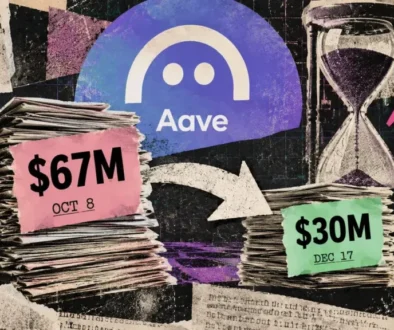
LlamaRisk, the risk service provider for Aave, recommended cap increases for two yield-bearing collateral markets on October 9 (Friday) after detecting positions at material liquidation risk. The Monad instance’s PT-AUSD-17DEC2026 reserve, a Pendle principal token backed by USD-backed stablecoin AUSD maturing December 17, was 100% utilized and carried borrowers with median health factors of 1.03, leaving them three percentage points above liquidation eligibility. On Arc, Aave’s cross-chain hub for Ethereum and other networks, two positions in syrupUSDC, a yield wrapper tied to Maple’s Ethereum vault, held 97% of all supplied collateral at health factors of 1.02 and 1.01. Both markets present the same structural problem: oracle valuations do not account for the time and cost required to convert seized collateral into the borrowed stablecoin during a liquidation.
PT-AUSD maturity forces pre-December market sale with uncertain liquidity
The Monad collateral is a principal token representing a claim on AUSD at its December 17, 2026 maturity. Before that date, liquidators must sell the PT through Pendle’s AMM, convert it into a standardized yield token (SY), then redeem that into AUSD, steps that expose the exit to market slippage. The Pendle pool on Monad holds 3.88 million dollars in total liquidity split 47% PT and 53% SY. A large PT sale draws from the opposite side of the pool, so the actual recovery depends on both pool depth and the price impact of the intended sale size.
The risk review noted that collateral value uses a linear discount oracle on the AUSD/USD feed, which follows a predictable path toward maturity independent of AMM prices.
A liquidator’s realized proceeds, however, depend on market buyers’ willingness to absorb seized PT. LlamaRisk recommended a 95% liquidation threshold and 2.62% bonus for the stablecoin E-mode, meaning liquidators receive 2.62% more collateral than debt repaid, but must still convert that PT into USDC or USDT0, the borrowed assets.
If exit costs exceed the 2.62% incentive, the liquidation becomes unprofitable, creating a gap between protocol design and economic reality.
Arc concentration and redemption queue extend liquidation timeline to 30 days
The Arc syrupUSDC market depends on either local buyers on Uniswap V4 or a two-stage exit: bridge from Arc to Ethereum, then request redemption from Maple’s vault via a first-in-first-out queue. LlamaRisk’s September assessment found that the local Uniswap V4 venue’s USDC liquidity was exhausted near 500,000 dollars, meaning any position larger than that requires the Ethereum path.
The bridge transfer itself takes two to five minutes at normal throughput of about 10 million dollars per hour. The real delay is Maple’s withdrawal queue: requests are processed as liquidity becomes available, with most completing under 24 hours but some taking up to 30 days.
A liquidator who repays the Arc loan must fund the 30-day redemption gap from working capital before syrupUSDC recovery pays them back. Arc’s Core Hub USDC reserve held 59.63 million dollars available for borrowing on October 9, sufficient for a single large liquidation but not for multiple concurrent ones.
If two or three major positions became eligible for liquidation simultaneously, available stablecoin liquidity could be exhausted, forcing liquidators to source USDC externally and finance the carry cost.
LlamaRisk proposes doubling caps while acknowledging execution risk remains unresolved
LlamaRisk recommended increasing PT-AUSD’s supply cap from 30 million to 60 million on Monad and doubling both the USDC draw cap and syrupUSDC add cap on Arc’s Maple Spoke, citing user demand and acceptable risk parameters. The proposals place both reserves at approximately 50% post-change utilization, creating room for collateral growth. However, the risk review does not quantify the liquidation cost for a typical position size at full cap, nor does it specify who bears the financing cost if a redemption queue extends to 30 days. It also does not model what happens if liquidators compete for the same limited pool exit liquidity during market stress, or whether Arc’s shared Hub architecture, where the Maple Spoke draws from the same USDC reserve as the Core Hub, creates contagion risk if Ethereum redemption delays strand liquidation capital.
The CCS read. We see that Aave’s risk framework prices collateral by oracle rather than by liquidation-realistic cash recovery. Institutional lenders should model their own exit costs before deploying into these markets. Cap increases reward growth but do not solve the mismatch between health factor thresholds and real-world liquidation economics, particularly under concurrent demand for the same redemption venue.
LlamaRisk’s recommendations move through Aave’s Risk Stewards process, which has authority to implement cap changes without full governance. The open question is whether Pendle’s PT liquidity and Maple’s redemption queue will remain functional once PT-AUSD borrowing doubles and multiple syrupUSDC positions approach liquidation simultaneously, a stress scenario the October 9 review did not address.
Original reporting: cryptoslate.com