Germany approves 42 crypto providers in Q3 2026, exceeding EU average
Germany’s regulators approved 42 crypto service providers in Q3 2026 alone, more than half of all new EU authorizations, as traditional banks flood into the MiCA-regulated market. For institutional investors, this signals both opportunity in Europe’s largest economy and execution risk for platforms that fail the compliance bar, as Bitcoin.de’s rejection demonstrates.

- Germany issued 42 MiCA licenses in Q3 2026, compared with 72 across all of Europe in the same quarter.
- 65 of 100 registered crypto service providers in Germany are banks, including Deutsche Bank, which won approval last month.
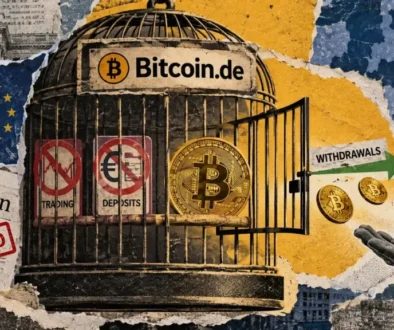
- Bitcoin.de operator futurum bank AG’s MiCA application was rejected in October after a 15-month review delay.
- 42 German MiCA approvals in Q3 2026, exceeding 58 in the prior quarter
- 65 licensed banks among 100 crypto service providers registered in Germany
- 15 months review delay before Bitcoin.de’s MiCA license rejection by BaFin
Germany has emerged as Europe’s dominant hub for crypto regulation under MiCA, issuing more than half of all new authorizations across the EU in the third quarter of 2026, according to reporting by Cryptopolitan citing data from BaFin and the European Securities and Markets Authority. Of the 42 entities licensed in Germany during that period, all but one were banking institutions seeking to operate in the regulated digital asset market. The broader EU issued 72 new authorizations in the same quarter, placing Germany at the center of institutional adoption of MiCA’s framework.
Traditional banks dominate German crypto licensing as Deutsche Bank wins approval
The surge in German approvals reflects a fundamental shift in the crypto market’s infrastructure. Out of 100 total entities registered as crypto asset service providers (CASPs) in Germany, 65 are now banks, according to FinPlanet’s CASP Radar report for Q3 2026.
This concentration of traditional financial institutions marks a departure from crypto’s peer-to-peer origins and signals institutional confidence in the regulatory regime. Deutsche Bank, the Frankfurt-headquartered financial services giant, obtained its MiCA license last month, joining cooperative banks and smaller regional lenders in the approved list.
The accelerating pace of German approvals contrasts sharply with slowdown elsewhere. New MiCA authorizations across Europe fell to 72 in Q3 from 105 in the prior quarter, suggesting that other EU member states face either tighter compliance standards or lower institutional demand.
Beyond Germany’s 42 approvals, another 120 entities licensed in other EU nations have been granted passporting rights to operate within Germany under MiCA’s cross-border provisions. The regulatory competence gap has turned Berlin into a de facto gateway for European crypto finance.
Bitcoin.de rejection reveals MiCA’s execution risk after 15-month review delay
Not all applicants clear the bar. BaFin refused the MiCA license application filed by futurum bank AG, the operator of Bitcoin.de, one of Europe’s oldest and largest crypto trading platforms serving over 1 million users. The rejection came in early October 2026, after the company submitted its application on June 27, 2025, a delay of more than 15 months that left the platform’s management preparing for this outcome.
The refusal signals that approvals in Germany, while numerous, remain subject to rigorous substantive scrutiny. BaFin’s reversal of its previous tolerance for futurum bank AG’s crypto services forced the platform to halt its core trading business as of June 12, 2026.
Bitcoin.de’s parent company, Bitcoin Group SE, is exploring a workaround: partnering with another regulated German bank to act as counterparty to users’ trades, while a separate regulated entity serves as custodian. The filing leaves open whether BaFin will accept this intermediary structure or whether Bitcoin.de faces permanent operational constraints.
Bitcoin Group is entitled to file an appeal within one month and may reapply in future.
Berlin delays abolition of one-year tax hold on crypto gains as public pressure mounts
A second regulatory threat to German crypto investors stalled this week. Chancellor Friedrich Merz’s cabinet indefinitely postponed a planned vote on legislation that would scrap the country’s long-standing tax exemption for digital asset gains held over one year.
The Finance Ministry bill, which would impose a 25% capital gains tax on all crypto profits regardless of holding period, had been set for cabinet consideration but was pulled after mounting resistance within the ruling coalition.
More than 44,000 people backed a parliamentary petition opposing the tax change, and at least twelve Bundestagsabgeordnete from the governing parties publicly opposed the abolition.
Experts surveyed by BTC-ECHO pegged the probability of the tax reform passing within six months at 65 percent, while grassroots community sentiment reached 69 percent, indicating continued uncertainty despite this week’s delay.
Under the current proposal, holdings acquired before 2027 would retain their tax-free status, but new investments would face immediate taxation on exit, regardless of duration.
The CCS read. We see a two-speed Germany: regulators opening the door to institutional bank entry via MiCA approval while the political system debates raising taxes on retail holders. For fund managers and custodians expanding into German operations, the licensing path is clear but narrow, Bitcoin.de’s experience shows that platforms cannot assume approval. Retail tax risk remains real despite this week’s reprieve, making the one-year hold a fragile advantage.
The cabinet has set no new date for a vote on the crypto tax abolition bill. Merz’s coalition partners must resolve their internal disagreement within the next few weeks to either confirm or formally abandon the proposal; parliamentary recess and the fragility of the three-party coalition mean that delay itself constitutes a form of defeat for tax reform advocates. Meanwhile, Bitcoin Group must file its administrative appeal to BaFin within one month or accept that Bitcoin.de will operate only through licensed intermediaries.