Ethena allocates majority of USDe backing to DeFi lending, creating redemption risk
Ethena’s USDe stablecoin has 51.2% of its $4.76 billion backing allocated to lending markets rather than liquid reserves, creating a direct dependency on DeFi borrowing demand and institutional counterparty recall terms to sustain redemptions. For institutional investors, the key test is whether Aave and Morpho liquidity mechanics, and Ethena’s institutional lending agreements, can reliably convert those positions back to settlement assets when holders seek an exit.
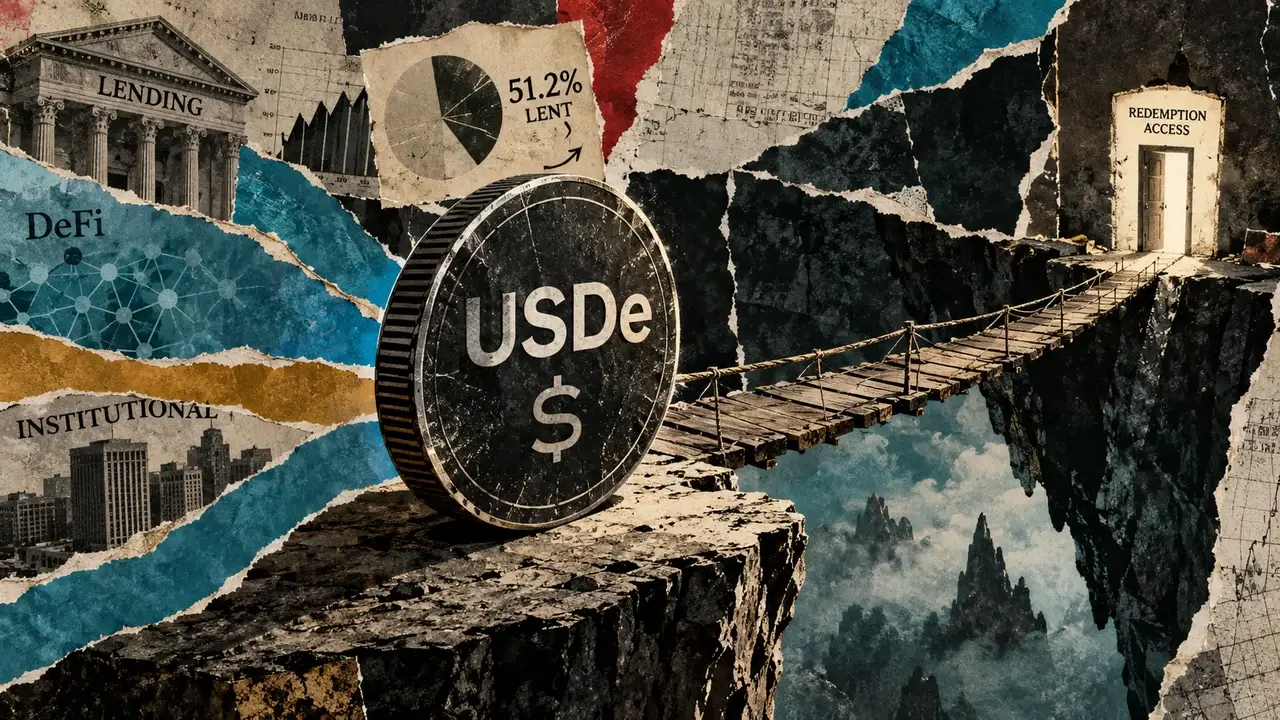
- 51.2% of USDe backing sits in DeFi (36.9%) and institutional lending (14.3%), versus 24.9% in liquid stablecoins as of October 12.
- Aave and Morpho withdrawals depend on available pool liquidity; under-borrowed collateral cannot be withdrawn if the asset is fully lent out.
- Eligible counterparties can redeem USDe directly with Ethena, but most holders must exit via secondary markets or convert staked sUSDe through a 1-7 day unstaking process.
- 51.2% of USDe backing allocated to lending, higher than liquid stablecoins.
- $4.76B total backing against 4.76 billion USDe outstanding as of October 12.
- $62.1M reserve fund balance to absorb revenue shortfalls and backing gaps.
USDe, Ethena’s dollar-pegged synthetic stablecoin, carries a redemption backstop that depends on its ability to convert lending positions and collateralized institutional loans into spendable assets on demand. According to LlamaRisk’s October 12 assessment, the protocol has deployed more than half its $4.76 billion backing into yield-generating lending, a diversification that boosts returns but narrows the margin for error when redemptions spike. The shift raises a structural question: whether the liquidity available in Aave’s lending pools and Morpho’s market design can reliably deliver assets fast enough to honor all redemptions at the peg.
LlamaRisk’s October 12 assessment breaks Ethena’s reserves into five categories, with lending now the largest single bucket
The October 12 snapshot allocates USDe backing to DeFi lending (36.9%), liquid stablecoins (24.9%), crypto basis trading (17.6%), institutional lending (14.3%), and real-world assets (6.0%). The lending combined, 51.2% of reserves, marks a shift from the liquid-heavy model that underpinned USDe’s earliest months.
Ethena’s March governance discussions already flagged the lending strategy, but the realized allocation now places real-world asset delivery at the mercy of two separate mechanisms: Aave and Morpho’s withdrawal rules for DeFi positions, and contractual recall and redelivery provisions for institutional counterparties.
For a holder, allocation and drawdown are not the same. A lending position can sit fully collateralized while the underlying stablecoins remain borrowed, making the assets inaccessible until a borrower repays the loan or the market has unused capacity. Ethena’s DeFi lending policy specifies that eligible markets carry conservative loan-to-value parameters and exposure limits subject to governance and Risk Committee review, but does not establish how much liquidity must remain available in each market for Ethena to withdraw its full supply.
Aave and Morpho liquidity constraints mean Ethena’s exit depends on borrower redemptions, not just its own redemption terms
Under Aave’s withdrawal mechanics, a supplier can withdraw only the amount of its deposit that has not been borrowed by other users. Morpho’s market design enforces the same rule: sufficient liquidity is a condition for withdrawal.
In a high-redemption event, if Ethena needs to liquidate its DeFi lending positions fast and borrowers do not repay, the protocol faces a lag between requesting a withdrawal and receiving assets.
LlamaRisk’s September assessment mapped Ethena’s exposure across Aave, Morpho, Jupiter Lend, and Kamino venues, identifying concentration risk but stopping short of a liquidity stress test under redemption spikes.
Institutional lending routes assets back through contract language. Ethena’s institutional agreements, reviewed by Aave governance, include stable-asset loans backed by collateral worth more than the amount borrowed, typically liquid Bitcoin and Ethereum held in qualified custody and triparty arrangements.
The March Aave governance discussion found no material contractual deficiencies in agreements with Maple and Anchorage, but the exact timetable for recovering lent assets under recall and redelivery provisions remains confidential. For a holder, the protection of recovery value and the timing of delivery must be assessed together.
Direct redemption is limited to whitelisted counterparties; other holders exit via secondary markets or staked sUSDe
Ethena restricts primary minting and redemption to eligible counterparties who have cleared know-your-customer and anti-money-laundering checks and completed whitelisting.
An approved participant can transfer a supported digital asset, PYUSD, USDC, USDG, USDT, USDm, USDtb, or DAI, and receive USDe in a single atomic transaction, subject to per-block caps: 20 million USDe per block for redemptions versus 200 million for minting, with DAI capped at 2 million in each direction. These are contract ceilings, not available cash.
Ethena can suspend both minting and redemption without delay via a whitelisted function.
For ordinary holders, two routes exist. Secondary-market sales depend on the liquidity of the trading venue and the willingness of buyers, with the arbitrage spread between USDe and its backing assets serving as the incentive for counterparties to close any gap.
Holders staking USDe into sUSDe, an ERC-4626 vault share, face an additional step: a governance-set dynamic cooldown of 1 to 7 days before unstaked USDe can be withdrawn from the USDeSilo contract, followed by the same redemption or secondary-market exit.
Ethena’s reserve fund, at $62.1 million as of September, is intended to absorb negative protocol revenue and backing shortfalls but does not function as a liquidity buffer for immediate settlements. The protocol’s ongoing allocation of new revenue to the reserve fund is 0%, meaning the fund exists only as a rainy-day balance rather than growing to absorb future losses.
The CCS read. We see Ethena’s lending strategy as a maturity play, not a risk. Crypto-native stablecoins that generate yield through institutional lending and DeFi overcollateralization are closer to how tokenized stock loans will function than to the fully liquid reserves that define yesterday’s dollar stablecoins. The real friction point is not the lending itself but the mechanical guarantees around exit speed and collateral quality under stress.
Ethena’s next critical test arrives when redemptions exceed secondary-market supply or when a DeFi lending market approaches full utilization. The October 12 assessment itself does not publish current Aave or Morpho utilization figures for the specific markets where Ethena supplies, nor does it model a redemption spike scenario. Institutional investors should watch for Ethena’s next public liquidity stress test, publication of per-venue utilization floors required by the Risk Committee, and any signal from Aave governance that the Ethereum Aave V3 instance has approached capacity in markets where Ethena holds large positions.