Kraken launches CFTC regulated perpetual futures
Kraken has launched CFTC-regulated perpetual futures to US traders through its Bitnomial subsidiary, addressing a $60 trillion global market that has largely operated outside US regulatory oversight. The move signals a shift toward institutional-grade derivative trading infrastructure within compliant US venues, potentially reshaping capital flows in crypto derivatives.
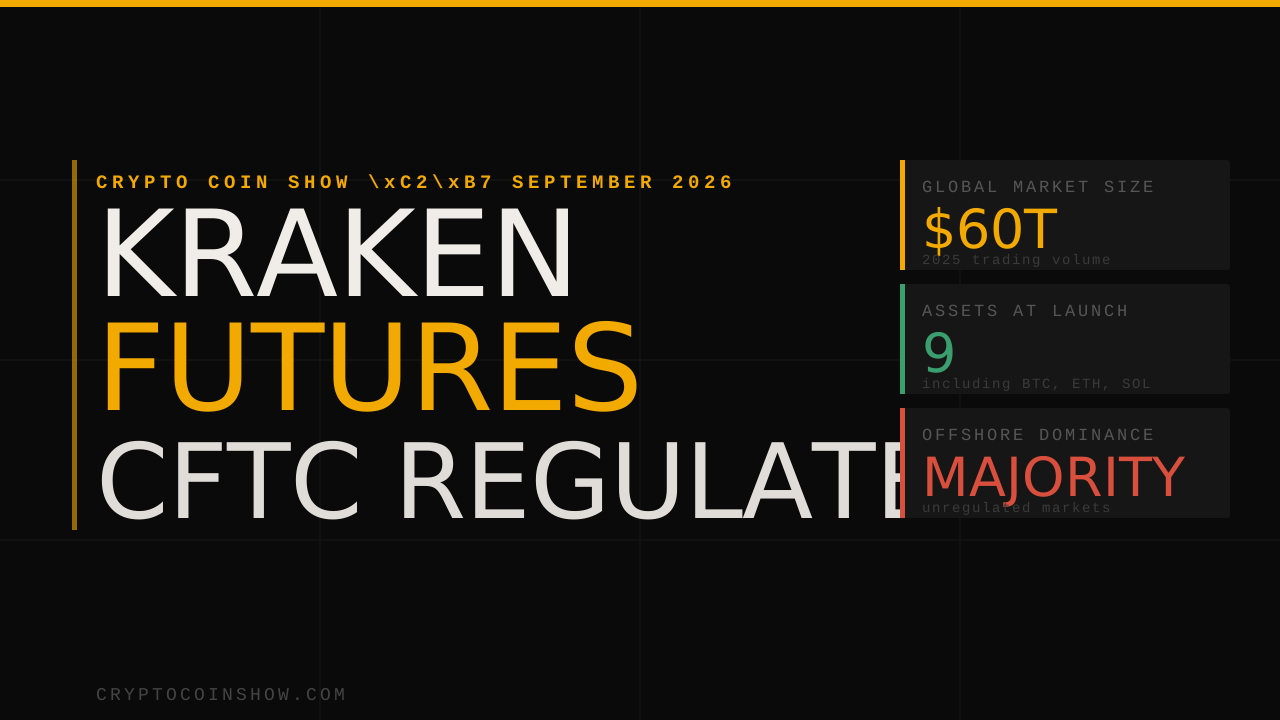
- Kraken launched perpetual futures on Monday through Bitnomial with full CFTC regulation, covering nine assets including Bitcoin, Ether, and Solana at launch.
- The global perpetual futures market exceeded $60 trillion in trading volume in 2025, with the vast majority running through offshore platforms beyond US regulatory reach.
- Kraken unified perpetual contracts with existing CME-listed futures products in a single wallet, allowing traders to manage both derivative types with shared collateral.
- $60T Global perpetual futures trading volume in 2025, concentrated on offshore platforms
- 9 Cryptocurrencies covered at launch, with plans to expand asset offerings over time
- May 2025 Date CFTC signaled approval for regulated venues to list perpetual futures contracts
Kraken moved to capture US demand for perpetual futures derivatives on Monday by launching the product through its CFTC-regulated Bitnomial subsidiary. The exchange opened trading to eligible US customers via Kraken Pro, offering leveraged long and short positions on nine cryptocurrencies without expiration dates.
The launch reflects a long-standing gap in US crypto infrastructure: while global perpetual futures markets generated over $60 trillion in volume last year, most of that activity flowed through offshore exchanges operating beyond the reach of American regulators.
Kraken’s entry into the space signals that institutional-grade derivatives infrastructure can now operate domestically under regulatory supervision, potentially anchoring US capital in compliant venues rather than sending it overseas.
Kraken acquired Bitnomial and NinjaTrader to build regulated derivatives backbone for US market
Payward, Kraken’s parent company, acquired derivatives exchange Bitnomial in May 2026, then purchased futures brokerage NinjaTrader a year earlier and rebranded it as Kraken Derivatives US with CFTC registration as a Futures Commission Merchant.
The infrastructure strategy reflects a deliberate build-out of regulated on-ramps for institutional traders who previously had no compliant option in the US for perpetual contracts. By housing perpetual futures in the same wallet as Kraken’s existing CME-listed products, the exchange unified spot, margin, and derivatives trading under one account with shared collateral management.
The most useful thing an exchange business can do for a serious trader is to put everything in one place. Spot, margin, futures, and now perpetuals all live in the same account at Kraken.
Arjun Sethi, Payward and Kraken co-CEO
Kraken Derivatives US head Darius Tabatabai emphasized that Bitnomial’s existing regulatory relationships and market structure work accelerated the launch timeline. Integrating that infrastructure with Kraken’s distribution reach and technology platform allowed the exchange to bring perpetual futures to US traders “at scale,” he said.
The unified account approach mirrors how traditional derivatives brokers operate, reducing friction for traders moving between product types and enabling efficient use of risk capital across positions.
CFTC opened regulatory pathway for perpetuals in May after years of offshore dominance
Kraken’s launch follows explicit signals from the CFTC that cleared the way for regulated US venues to list perpetual futures contracts. In May 2025, the agency approved Bitcoin perpetual contracts from prediction market Kalshi and authorized Coinbase to connect US customers to global options and perpetual markets.
Those moves represented a material policy shift, as perpetual futures had operated almost entirely outside the US regulatory perimeter for over a decade. Kalshi’s Bitcoin perpetuals alone recorded more than $1 billion in trading volume in their first months of operation, demonstrating latent US demand for the product under CFTC oversight.
The regulatory opening reflects broader CFTC willingness to permit derivatives trading on platforms under its direct supervision rather than ceding the market entirely to unregulated competitors.
For institutional investors and traders, the distinction matters considerably. CFTC-regulated venues require customer segregation, margin standards, and market surveillance systems that unregulated offshore platforms do not. US banks and institutional capital have legal and compliance constraints that make offshore derivative trading problematic; regulated US venues remove that friction.
Kraken’s entry combines that regulatory legitimacy with competitive incentives to offer tighter spreads and better execution than offshore alternatives, potentially capturing volume at the margin from traders previously choosing between regulatory compliance and market access.
Nine initial assets with funding rates reset every eight hours to keep contracts tethered to spot
Kraken’s perpetual futures structure uses an eight-hour funding rate reset cycle at 7 p.m., 3 a.m., and 11 a.m. Central Time. Long position holders pay short holders when the perpetual contract price trades above the underlying spot price, with the mechanism reversing when the contract trades below spot.
This funding mechanism is standard across perpetual futures markets and serves as a price discovery anchor, compelling the contract to track the actual asset price rather than diverge into speculation-driven extremes.
At launch, Kraken covered Bitcoin, Ether, Solana, Ripple, Cardano, Chainlink, Dogecoin, Litecoin, and Avalanche. The exchange announced plans to expand both the asset menu and collateral options over time, implying that institutional demand may drive additions beyond the current nine tokens.
The initial basket represents the most liquid and established cryptocurrencies by market cap and derivatives volume, a conservative but sufficient starting point for traders with existing crypto derivative experience moving from offshore venues.
Kraken has not disclosed initial leverage caps or detailed margin requirements for the product, leaving an open question about how aggressively traders can lever positions relative to competitors.
Regulatory opening creates window for US exchanges to recapture derivatives volume from offshore competitors
The CFTC’s May 2025 policy shift represents a turning point in US crypto derivatives regulation. For nearly a decade, US traders had only two practical choices: trade spot markets domestically or route derivative orders to offshore platforms like Bybit, OKX, or Deribit.
That geographic arbitrage benefited unregulated exchanges while keeping US-regulated venues out of the derivatives business entirely. Kalshi’s May approval and Coinbase’s connection to global perp markets signaled CFTC appetite to permit derivatives trading under its own oversight rather than leave the market to offshore competitors.
Kraken’s launch directly addresses the infrastructure gap that created that arbitrage. By offering perpetual futures under CFTC regulation with unified account management and tight integration to spot markets, Kraken removes the compliance and operational friction that previously made offshore platforms the default choice for serious traders.
Institutional investors subject to regulatory constraints on offshore trading can now access perpetual derivatives without crossing jurisdictional lines.
Kraken has not disclosed initial trading volumes or stated a timeline for adding additional assets to the perpetuals offering; watch for Kraken earnings reports or announcements revealing adoption metrics and for announcements of new tokens added to the perpetuals menu, which will signal whether the CFTC’s regulatory opening translates into sustained institutional migration from offshore venues to regulated US platforms.
Original reporting: cryptopolitan.com