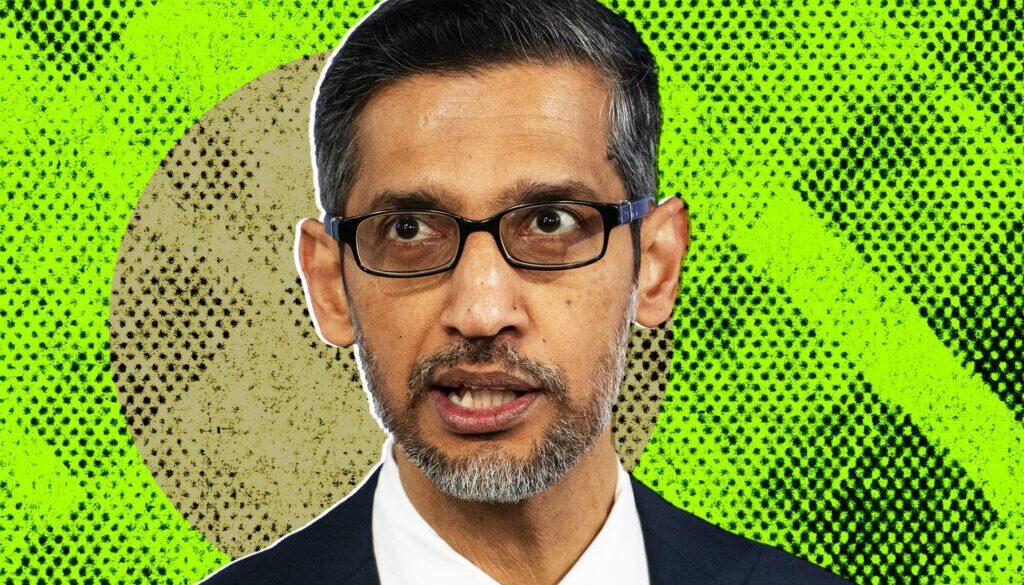
Google CEO Humiliated by Graduating Stanford Students as They Walk Out of His Speech in Protest
Google CEO Sundar Pichai faced a coordinated walkout by approximately 200 Stanford University graduates during commencement, signaling that institutional opposition to tech companies’ defense and law enforcement contracts has moved beyond campus activism into mainstream credentialing events. For institutional crypto investors, this underscores mounting regulatory and reputational risk facing the largest technology firms that have historically dominated blockchain infrastructure partnerships and cloud services contracts.
- 200 Stanford graduates, representing 10 percent of the class, staged coordinated walkout during Pichai’s commencement speech over military and police contracts.
- Protest centered on Google’s Project Nimbus contract with Israeli Defense Forces, ICE deportation enforcement partnerships, and Pentagon AI agreements.
- Organizers held alternative “People’s Commencement” featuring detained activist Mahmoud Khalil, arrested by ICE in March 2025 after 104 days in custody.
- 200 Stanford graduates walked out; represents ten percent of annual undergraduate class.
- 104 days detained for commencement speaker Khalil without conviction or formal charges.
- 2,000 total Stanford undergraduates per year make protest visibility exceptionally high.
The Stanford commencement walkout represents a qualitative escalation in how institutional opposition to technology sector partnerships manifests at elite universities.
On the weekend of Stanford’s graduation ceremony, approximately 200 undergraduates coordinated a departure from the main auditorium as Google CEO Sundar Pichai approached the podium, replacing applause with jeers, whistles, and unfurled banners. The act constituted roughly 10 percent of Stanford’s annual undergraduate cohort, making the dissent impossible to dismiss as a fringe gesture.
Organizers had prepared a written pledge circulated before the ceremony, explicitly naming Google’s Project Nimbus contract with the Israeli Defense Forces, the company’s partnerships with U.S. Immigration and Customs Enforcement, and recently approved Pentagon AI contracts as focal points for their opposition.
The timing placed the protest within a broader pattern of commencement disruptions at major research universities, but with a crucial difference: rather than targeting artificial intelligence as an abstract concern, Stanford protesters fixed on specific, documented commercial relationships between Google and military or law enforcement entities.
Stanford’s 10 Percent Graduation Class Walkout Marks Sharpest Commencement Defection at Elite University
The scale of participation distinguishes the Stanford event from smaller, isolated commencement protests that have punctuated the 2024-2025 graduation season. Because Stanford confers approximately 2,000 undergraduate degrees annually, a coordinated departure involving 200 students represented a visible, undeniable fraction of the graduating class rather than a handful of activists.
This proportion signal that opposition to Google’s defense sector relationships extends beyond organized protest networks into broader peer sentiment among elite university graduates.
The protesters did not attempt to disrupt Pichai’s remarks through heckling alone; instead, they executed a physical departure timed to his arrival, creating a stark visual statement that portions of the graduating cohort rejected his presence as a speaker.
Pichai’s response revealed awareness of the reputational exposure facing technology executives at academic institutions. Rather than defend Google’s defense and law enforcement contracts, he reportedly steered his remarks entirely away from artificial intelligence, a topic that has triggered hostile receptions at multiple prior commencement ceremonies.
By emphasizing personal biography over technology policy, Pichai attempted to neutralize ideological objections through a narrative strategy focused on individual achievement. The tactic failed to prevent the walkout, suggesting that opposition to Google’s institutional partnerships has matured beyond positions that can be managed through careful speech construction.
Project Nimbus and ICE Contracts Drive Protest, Not AI Ethics Concerns
The content of the Stanford protest pledge illuminates a shift in how student activists frame opposition to major technology companies. Rather than center on the abstract risks of artificial intelligence advancement, a concern that dominated earlier commencement disruptions, the Stanford organizers emphasized concrete, documented commercial arrangements.
Their written statement explicitly cited “Project Nimbus,” Google’s multibillion-dollar cloud infrastructure contract with the Israeli Defense Forces, as a direct driver of the protest.
They further indicted Google’s work with ICE on immigration enforcement capabilities and flagged the recent approval of a Pentagon AI contract by Google DeepMind, framing the Pentagon deal as a reversal of earlier internal researcher commitments to avoid military applications.
This specificity in targeting reflects a maturation of institutional critique. Rather than debating whether artificial intelligence poses existential risks, the Stanford organizers demanded accountability for Google’s choice to commercialize surveillance, military targeting, and immigration enforcement capabilities.
The protest pledge declared, “Google has actively enabled and profited from Israel’s apartheid and genocide of Palestinians through Project Nimbus,” and asserted that the company “has also enabled ICE’s persecution of our neighbors.” The language moved beyond ethical concern into explicit economic and political argument: that Google derives revenue and market position from partnerships that facilitate military operations and deportation enforcement.
Mahmoud Khalil, selected as the keynote speaker for the alternative “People’s Commencement” held adjacent to the official venue, embodied the protest’s focus on concrete harms over abstract principle.
Khalil, an Algerian-Palestinian activist and former Columbia University student organizer, was arrested by plainclothes ICE agents in March 2025 and held for 104 days despite never being charged with or convicted of any crime.
His detention illustrates the intersection of the two primary targets of the Stanford protest: he represents both Palestinian activism and exposure to ICE enforcement, making his presence as an alternative commencement speaker a direct counterfactual to Pichai’s legitimacy as an institutional speaker.
Tech Industry Faces Sustained Reputational Challenge Across Graduating Class Demographics
The Stanford event joins a broader pattern of commencement disruptions that suggest opposition to major technology firms has penetrated elite university graduating classes at scale.
Earlier reports documented protesters outside Anthropic offices warning of self-improving artificial intelligence risks, indicating that activism directed at technology sector leadership operates across multiple venues and multiple companies.
However, the Stanford protest’s focus on military and law enforcement contracts rather than abstract AI safety concerns marks a distinct ideological position: that the problem with major technology companies is not primarily that their products are dangerous in the future, but that their current business model depends on surveillance, military, and immigration enforcement applications that produce measurable immediate harms.
For institutional investors monitoring technology sector reputation and regulatory exposure, the Stanford protest signals that opposition has moved beyond fringe activism into mainstream elite institutional settings.
A 10 percent walkout by Stanford undergraduates cannot be dismissed as unrepresentative sentiment; these graduates will enter positions across finance, law, policy, and business where their opposition to Google’s institutional partnerships may influence hiring decisions, procurement policies, and regulatory advocacy.
The protest organizers’ articulate framing around specific contracts and documented harms creates a narrative template that may prove replicable at other major university commencements and corporate forums.
Institutional Investors Face Emerging Reputational Risk From Technology Sector Defense Contracts
The Stanford commencement walkout holds specific implications for institutional capital allocation and risk management within the technology sector. Google’s defense and law enforcement contracts represent material revenue streams, and the company’s willingness to pursue such agreements despite consistent activist pressure suggests that financial returns justify reputational cost.
However, the visible opposition from graduating cohorts at elite universities creates contingent risk: venture capital, private equity, and institutional equity portfolios that depend on continued access to top talent from these institutions may encounter friction if those graduates view certain technology companies as systemically complicit in military or enforcement operations they oppose.
The alternative commencement featuring Khalil also represents an institutional innovation in protest strategy. Rather than simply disrupting Google’s event, organizers created a parallel credentialing ceremony, signaling that they offer their own legitimacy framework for graduating students.
This dual-institution approach may prove more durable and replicable than disruption alone, as it does not depend on access to the official commencement or continuous media attention to maintain its impact.
For institutional investors, the emergence of competing institutional narratives around technology company legitimacy creates uncertainty around long-term reputational positioning and access to elite talent pools.
The immediate signal for institutional investors is whether other elite universities’ 2025 commencement ceremonies will produce similar walkouts, and whether technology company boards begin adjusting defense and law enforcement contract strategies in response to sustained graduate-level opposition. Google has not issued a public response to the Stanford protest beyond Pichai’s apparent effort to avoid the