Fake GTA 6 early access websites are draining crypto wallets of eager players
Fraudsters are operating fake Grand Theft Auto VI preorder websites that demand cryptocurrency payments for non-existent “VIP early access,” exploiting both the massive cultural appetite for the game and crypto’s irreversible transaction finality. For institutional investors tracking crypto adoption risk, this represents a widening attack surface where mainstream entertainment IP meets unrecoverable digital assets, a pattern likely to repeat across other high-demand consumer launches.
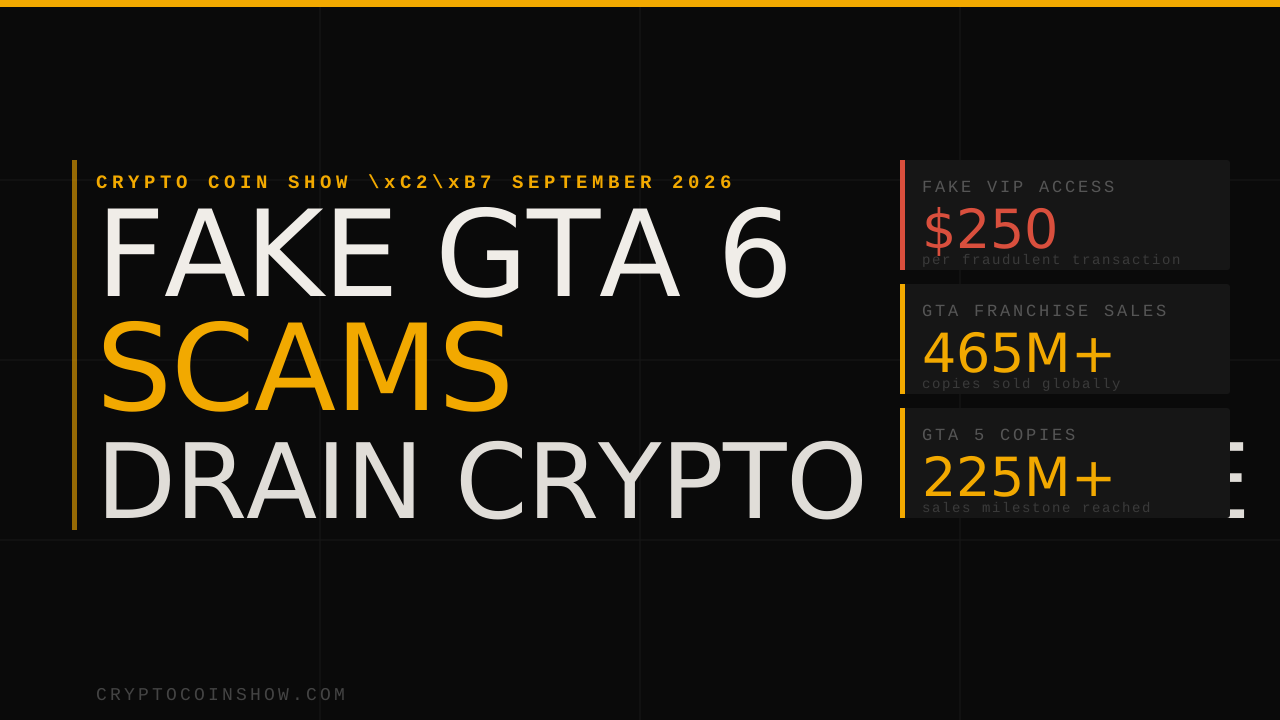
- Malwarebytes identified scam websites charging $250 in BTC, USDT, or Ether for fake “VIP Digital Access” to GTA 6 ahead of official June 25 preorders.
- Grand Theft Auto franchise has sold over 465 million copies globally, with GTA 5 alone exceeding 225 million units since its 2013 launch.
- Cryptocurrency payment model chosen by scammers because blockchain transactions are irreversible, unlike credit card chargebacks, leaving victims with no recovery path.
- $250 Price per fake VIP access package demanded in crypto by fraudulent GTA 6 websites
- 465M Total copies of Grand Theft Auto franchise sold worldwide across all titles and platforms
- 456% Increase in generative AI scam reports year-over-year between May 2024 and April 2025
Malwarebytes security researchers have documented a coordinated fraud campaign targeting Grand Theft Auto VI fans through counterfeit preorder websites that closely mimic legitimate digital game storefronts.
The scam sites, which surfaced just days before Rockstar Games announced official preorders beginning June 25, 2025, are systematically extracting cryptocurrency from victims by promising exclusive early access to a game that Rockstar has explicitly stated will not have an early access program.
According to security expert Stefan Dasic at Malwarebytes, the fake storefronts feature high-production graphics, Vice City-themed artwork, and authentic-looking GTA 6 branding, then demand $250 in Bitcoin, Ethereum, or USDT for what they call “VIP Digital Access.” Once victims complete the cryptocurrency transfer, they receive instructions to enter their transaction ID into a nonexistent download portal, at which point the scammers disappear with the funds.
GTA 6’s 13-year franchise drought and 465 million lifetime sales create ideal conditions for mass-scale crypto fraud
The timing and scale of this scam campaign directly reflect the cultural magnitude of Grand Theft Auto VI. The franchise has sold 465 million copies globally across all titles and platforms, with GTA 5 alone generating more than 225 million in sales since its September 2013 release.
That 13-year gap between GTA 5 and its sequel, the longest interval between mainline entries in the series, has cultivated an unusually intense anticipation among both casual and hardcore gamers, making the audience particularly vulnerable to urgency-based social engineering.
Take-Two Interactive, the publisher, saw its stock price crater 18 percent when Rockstar delayed GTA 6 from its original Fall 2025 target window to November 19, 2026, underscoring how central this single release has become to investor expectations and gaming culture writ large.
As of late 2025, Take-Two shares have recovered modestly, trading at $244.95 on the NASDAQ under ticker TTWO and gaining 2.25 percent, but the volatility itself signals the outsized attention the title commands.
That combination, hundreds of millions of franchise devotees, years of pent-up demand, and legitimate uncertainty around access models, creates an unusually large and emotionally motivated target pool for social engineering attacks.
The fake websites exploit a psychological mechanism already familiar to gaming audiences. Early access programs, closed beta tests, and founder editions have become standard in the industry, so claims of exclusive pre-launch access do not immediately trigger skepticism.
The scammers have weaponized that normalcy, combining professional design and Vice City theming with the most basic confidence scheme: promise a scarce good just before official channels make it unavailable, collect payment, and vanish.
Cryptocurrency’s irreversibility becomes the scammers’ core technical advantage over credit card fraud
The choice of cryptocurrency as the only accepted payment method is not incidental to the scam’s design, it is central to its profitability and why victims face total loss. Traditional credit card payments can be challenged through chargeback mechanisms, which force merchants to prove legitimate delivery or face automatic reversal and fraud penalties.
Blockchain transactions, by contrast, are final. Once cryptocurrency leaves a victim’s wallet and enters the scammers’ address, there is no fraud department to contact, no payment processor to dispute with, and no mechanism short of law enforcement action to recover the funds.
This technical asymmetry has become a primary driver of cryptocurrency adoption in fraud. TRM Labs’ Chainabuse database shows that generative AI-powered crypto scams increased 456 percent between May 2024 and April 2025 alone.
More tellingly, Chainalysis research reveals that approximately 60 percent of deposits now flowing into known scam wallets involve operations leveraging AI tools, a sharp increase from prior-year baselines.
The GTA 6 fraud campaign does not appear to rely on deepfakes or AI-generated celebrity endorsements, but it employs the same psychological levers: artificial urgency (“get access before everyone else”), scarcity (“exclusive VIP tier”), and polished design that mimics legitimate enterprise infrastructure.
The distinction is the hook. Rather than impersonating a trading bot or crypto exchange, these scammers are exploiting one of the most anticipated entertainment properties in modern history, reducing friction in the decision to pay. When a victim believes they are securing early access to a game that 225 million people have bought in its prior iteration, the cognitive override is substantial.
The $250 entry point is low enough to feel like a justified splurge for exclusive access, yet high enough to extract meaningful capital in aggregate across thousands of potential victims.
Rockstar’s official preorder date and stated absence of early access eliminate any ambiguity for informed consumers
Rockstar Games has attempted to close the scammers’ operating window by making official preorder procedures explicit and widely public. The company announced that legitimate preorders will begin June 25, 2025, through authorized digital storefronts and select physical retailers, a fixed date that allows consumers to verify any preorder claim against the official timeline.
More critically, Rockstar stated unambiguously that no early access program exists for GTA 6, eliminating the premise on which the scam operates.
The challenge is reach and timing. Most sophisticated gamers will cross-reference suspicious claims against official Rockstar channels before paying. But the massive scale of GTA 6’s audience, hundreds of millions of potential players of varying technical literacy, means that even a small conversion rate on fake websites can generate significant criminal revenue.
A scam operation need not fool the informed majority; it needs only to capture the impatient, the geographically distant from English-language official announcements, or the younger players unfamiliar with how digital storefronts actually operate.
Malwarebytes warns that any website claiming to offer early GTA 6 access is fraudulent by definition. The official launch date is November 19, 2026, more than a year away, creating an extended window during which scammers can operate. Each month closer to release, anticipation and impatience will intensify, potentially driving more victims toward fake preorder sites.
The convergence of entertainment IP, cryptocurrency irreversibility, and AI-assisted social engineering has already proven potent across crypto scams broadly; GTA 6 represents a peak-efficiency test case where cultural demand amplifies the attack surface.
Institutional investors should monitor whether law enforcement or payment processors take coordinated action against known GTA 6 scam wallet addresses before the June 25 official preorder date, and whether Rockstar or Take-Two issue formal fraud warnings to mainstream gaming media. More broadly, this incident signals that entertainment IP tied to billion-dollar consumer launches will become systematic targets for cryptocurrency fraud, particularly where AI-enhanced impersonation and urgency mechanics remain difficult for average consumers to distinguish from legitimate commerce. Watch for whether blockchain analysis firms publish public tracing of stolen GTA 6 scam proceeds and whether any regulatory body or gaming platform announces new verification standards for digital preorders.
Original reporting: cryptopolitan.com