Ripple’s dollar-backed RLUSD stablecoin is now available in Japan through SBI VC Trade, adding a regulated Asian market to Ripple’s stablecoin push.
TL;DR
Ripple says RLUSD is live in Japan following regulatory approval.
SBI VC Trade is the distribution route for the launch.
The rollout gives Ripple a regulated Asian stablecoin foothold while competition in tokenized payments intensifies.
Ripple Brings RLUSD Into Japan
Ripple’s RLUSD stablecoin has moved into Japan through a rollout with SBI Group, giving the dollar-backed token a regulated route into one of Asia’s most closely watched crypto markets. The announcement matters because Japan has been relatively cautious with stablecoins, requiring clear structures around issuance, custody and consumer protection before foreign stablecoin products can reach users.
According to Ripple’s public announcement, RLUSD is now available in Japan after approval from the country’s Financial Services Agency. The company said the token will be offered through SBI VC Trade, the crypto arm of SBI Group, extending a long-running partnership between Ripple and one of Japan’s most active digital asset financial groups.
Why Japan Matters For Stablecoins
Japan’s stablecoin rules are important because they separate regulated payment instruments from the looser offshore stablecoin market that dominated earlier crypto cycles. That makes Japan a useful test market for companies trying to prove that stablecoins can operate inside bank-like or payment-service frameworks rather than purely through offshore exchanges.
The RLUSD launch also lands as stablecoins are becoming a central piece of the broader crypto policy debate. In the United States and Europe, lawmakers are still drawing the line between payment tokens, bank liabilities and securities-like products. Japan’s framework gives Ripple a practical example of how a foreign-issued stablecoin can enter a major market without relying only on informal liquidity.
Ripple’s Bigger Payments Push
For Ripple, RLUSD is not just another token listing. The company has been trying to expand beyond XRP-linked payment corridors and into broader enterprise settlement, treasury and tokenization services. A regulated dollar-backed stablecoin gives it a product that can be used by institutions that may not want direct volatility exposure to XRP but still want blockchain-based settlement.
The market question is whether RLUSD can attract meaningful liquidity outside Ripple’s existing partner network. Launching through SBI gives the stablecoin a credible distribution channel in Japan, but adoption will still depend on exchange depth, corporate use cases and whether users see a practical reason to move from existing stablecoin giants.
The main point is not that one headline settles the direction of the market by itself. It is that the same themes keep showing up across the tape: regulation is becoming more specific, institutional products are moving closer to normal financial rails, and traders are reacting quickly whenever liquidity thins out. That is why the source detail matters here. The development gives the market one more data point at a time when Bitcoin, Ethereum and the wider altcoin complex are already being judged through the lens of leverage, policy risk and institutional participation.
This coverage is based on information from Ripple.
This article was written by the News Desk and edited by Samuel Rae.
This report is based on information from Ripple, available at Ripple
Ripple’s RLUSD Debuts in Japan After Regulatory Approval
StablecoinsJune 25, 2026 · cryptocoinshow.com
Ripple’s RLUSD Debuts in Japan After Regulatory Approval
Japan’s Financial Services Agency greenlights Ripple’s dollar-backed stablecoin — distributed through SBI VC Trade in one of Asia’s most tightly regulated crypto markets.
cryptocoinshow.comCategory: MarketsJune 25, 2026
$1.7BRLUSD market cap
10yr+Ripple–SBI partnership
Type 4Classification under Japan’s Payment Services Act
Ripple and Japan’s SBI Holdings have officially launched RLUSD in the Japanese market after receiving approval from the Financial Services Agency. The dollar-backed stablecoin has been classified as a Type 4 foreign-issued electronic payment instrument under Japan’s Payment Services Act — the same regulatory framework updated on June 1, 2026, to allow qualifying foreign stablecoins to operate inside one of Asia’s most controlled financial markets.
Distribution is handled through SBI VC Trade, a subsidiary of SBI Holdings. The exchange was already licensed to distribute USDC in Japan, meaning the infrastructure for dollar-denominated stablecoins was in place before RLUSD arrived.
“Japan has long been a leader in digital asset adoption, underpinned by both regulatory clarity and financial innovation. Through our collaboration with SBI Group, RLUSD will serve as a bridge for payments, tokenization and collateral management.”
Jack McDonald, SVP Stablecoins, Ripple
The launch marks a key milestone in Ripple’s effort to grow RLUSD beyond the US. Since debuting in late 2024, the stablecoin has reached a market capitalization of roughly $1.7 billion. Ripple and SBI expect RLUSD to play a role in cross-border payments, tokenized financial products, and institutional liquidity management — areas where stablecoins are gaining traction among regulated financial institutions globally.
Key Facts
Regulatory approvalJapan Financial Services Agency (JFSA), June 24, 2026
ClassificationType 4 Electronic Payment Instrument under Japan’s Payment Services Act
DistributorSBI VC Trade (subsidiary of SBI Holdings)
BlockchainEthereum (not Ripple’s own XRP Ledger at launch)
SBI Holdings has been one of Ripple’s most prominent institutional partners globally since 2016, collaborating across cross-border payments, digital asset custody, and now stablecoin distribution. The Japan launch represents more than a new market — it validates the regulatory pathway Ripple spent months building through its dual-jurisdiction structure: NYDFS oversight on the issuance side, FSA approval on the distribution side.
The timing also puts RLUSD directly alongside SBI’s own JPYSC yen stablecoin, which launched the same week. With Metaplanet backing JPYC and the three Japanese megabanks progressing toward their own joint stablecoin, Japan’s on-chain currency stack is being built quickly — and Ripple now has a formal seat at the table.
Despite crypto’s volatility, XRP is still viewed by some investors as a long-term asset that could help them retire or protect their capital from inflation and currency devaluation.
But is there any math behind that argument? Some analysts have projected paths to $1 million by 2035, while others warn that XRP still faces extreme volatility and questions over its DeFi and institutional utility.
XRP is the native token of the Ripple network, designed for fast, low-cost international transactions. Supporters highlight real-world adoption by financial institutions and positioning within ISO 20022 messaging standards, making it one of the few crypto assets directly tied to traditional banking infrastructure currently in use.
— The Wolf Of All Streets (@scottmelker) June 15, 2026
The retirement math depends entirely on the price scenario the investor assumes for the next decade. Some long-term prediction models describe paths to a $1 million portfolio by 2035 under three sets of price assumptions. The token currently trades near $1.34, and projections vary widely among analysts and time horizons.
The conservative scenario assumes XRP reaching around $3.13 by 2035. Under this projection, an investor would need approximately 319,000 tokens to hit the $1 million target.
The equivalent investment today would be around $428,000 in XRP, accumulated through purchases over time at current prices.
A more bullish range of $9 to $10 per XRP changes the math dramatically. Investors would need only between 100,000 and 105,000 tokens to reach the same target by 2035.
The required upfront capital drops significantly because each token contributes more to the final portfolio value.
The most aggressive scenario considers XRP reaching $20 to $40 per token. Under these assumptions, just 25,000 XRP (currently valued at around $33,000) could grow into a retirement nest egg.
The asymmetric upside is what attracts speculative investors to the token despite mainstream advisor warnings.
“You understand Bitcoin’s scarcity and have watched it become the best performing asset of the last 15 years. You understand XRP’s utility and why many believe it could become significantly more valuable if adoption continues to grow. The question is, does your retirement account reflect that conviction?,” Bri Teresi said on X.
Why Mainstream Analysts Warn Against XRP as a Core Holding
Mainstream financial voices urge caution about treating XRP as a primary retirement vehicle. Motley Fool analysts note that the token has experienced multiple drawdowns greater than 50% throughout its trading history. For investors nearing retirement, this volatility could permanently impair capital just when liquidity matters most.
The risk profile suits investors with long time horizons and a high tolerance for swings. Younger savers with 20 or 30 years until retirement can withstand major drawdowns without compromising their financial future.
Older investors with less than a decade left should treat XRP as a small satellite position only.
Executive actions that open 401(k) plans to alternative assets create new pathways for crypto in retirement accounts in 2026. The shift could legitimize XRP exposure within traditional retirement vehicles, but does not eliminate the underlying volatility risk for individual portfolios.
What Could Go Wrong: The Risks XRP Community Must Accept
Beyond price volatility, treating XRP as a retirement asset requires honest acknowledgment of structural risks. Investors who entered at previous peaks waited years before recovering principal, a timeline incompatible with anyone needing liquidity within the next decade.
Regulatory uncertainty persists despite recent clarity milestones in the United States. Future administrations could reverse current frameworks, or new global treaties could restrict cross-border crypto flows.
Stablecoins backed by major institutions and emerging central bank digital currencies (CBDCs) also compete directly for the same payment use cases that justify the bull case.
Custody adds another layer of risk, often underestimated by new investors. Exchange hacks have wiped out years of accumulated savings overnight throughout crypto history.
Self-custody via hardware wallets is essential but introduces operational complexity that retirees particularly need to master before committing significant capital.
In times when investors are pulling funds out of the spot exchange-traded funds tracking ETH and especially BTC, their behavior toward XRP, HYPE, and SOL has been entirely contrasting.
The ETFs following the three altcoins’ performances continue to see more net inflows even as the market stagnates and uncertainty builds.
XRP, SOL, HYPE ETFs Keep Gaining Capital
CryptoPotato has repeatedly reported on the Ripple ETFs’ impressive performance over the past several weeks, in which most assets, including XRP, recorded fresh losses and dipped to multi-year lows. However, investors using the Wall Street-trading financial vehicles have remained active, with net inflows dominating for months. In fact, there have been only two weeks in the red since mid-March.
The last one, which had only four trading days, also ended in the green. The ETFs attracted $2.82 million on Monday, $5.30 million on Tuesday, and $2.55 million on Thursday. Since Wednesday was a $0.00 day, according to SoSoValue data, that means that the week ended with net inflows of $10.66 million. The cumulative net inflows have tapped a new all-time high of $1.45 billion.
The Solana ETFs also attracted over $7 million in net inflows in the past week, following a red one with $2.58 million in net outflows. HYPE and its ETFs continue to be the current market superstar. The funds saw their third-best week to date, with almost $28 million entering. Moreover, the HYPE ETFs have been on a six-week streak of net inflows since their inception in mid-May.
Their performance has been particularly promising since they have attracted nearly $185 million in net inflows in six weeks. The same six weeks have been highly emotional and full of FUD for the entire crypto market, especially June’s start when most assets tumbled to multi-year lows.
Net Inflows Spot HYPE ETFs. Source: SoSoValue
BTC, ETH ETFs Deep in Red
And while the aforementioned altcoins continue to enjoy fresh ETF capital, the same cannot be said for the funds tracking the two largest cryptocurrencies by market cap. As reported earlier, the spot BTC ETFs bled more than $226 million in the past week, and are down by roughly $5 billion in the same six weeks in which the HYPE and XRP ETFs have been only in the green.
The spot Ethereum ETFs are in no better shape. In fact, they are on the same six-week negative streak, pushing the total inflows down by nearly $1 billion. So the question now is whether investors are simply seasonally rotating from larger-cap digital assets into smaller altcoins, or have they completely abandoned BTC and ETH for the new kids on the block.
AI agents have begun completing complicated tasks, including transacting on their own by paying for services or purchasing computing power, all of which is far superior to AI’s early methods of generating texts, images, or simple code.
Ripple wants to have a bigger role, and its latest update, published earlier this week, explains how its native tokens could be at the forefront.
XRP, RLUSD to Power AI
In an attempt to position itself at the center of this emerging machine-to-machine economy, the new update to the XRP Ledger ecosystem, called AI Starter Kit, serves as a suite of tools designed to help developers build autonomous payment apps powered by Ripple’s two tokens, XRP and RLUSD.
The announcement reads that the new product line will allow developers to build such AI agents capable of making and receiving payments through the XRPL. It includes support for X402-powered payments, allowing agents to pay for API access, AI model inference, cloud computing resources, and other digital services using either XRP or RLUSD.
Ripple tries to differentiate itself from other blockchain networks that rely mainly on variable transaction fees and smart contract execution. Instead, XRPL provides settlement finality within 3-5 seconds, predictable transaction costs, and built-in payment functionality.
Developers are aware of the transaction costs in advance, while the AI agents can complete transfers without dealing with gas fee auctions or uncertain settlement times.
The announcement added that XRPL’s native decentralized exchange could be particularly attractive to most devs. An AI agent can send RLUSD while the recipient receives XRP (or vice versa), with a single transaction. The conversion is handled directly by the protocol.
Safety First
Ripple believes its enhanced levels of security are another major selling point. The XRP Ledger has operated continuously for 14 years without transaction rollbacks, while its protocol-level payment system removes many of the smart contract risks that have led to billions of dollars worth of cryptocurrency exploits across many different projects.
The first phase of the new starter kit will include documentation access through AI assistants such as Claude, wallet and payment tools for agent-based apps, and support for the X402 protocol following a collaboration with t54.
SBI Shinsei Bank is reportedly offering crypto deposit rewards to customers, with vouchers worth 20% of their interest payments redeemable for BTC, ETH, or XRP through SBI VC Trade.
A three-month campaign launched on June 10, with a broader rollout planned for fall, covering ordinary deposits and time deposits from three months to five years, roughly 4.33 million individual accounts.
The mechanics reveal SBI using digital asset vouchers to make a conventional yen deposit stickier at a moment when Japanese savers have real alternatives for the first time in decades.
The Bank of Japan’s policy rate now sits at 0.75%, the highest level in decades, with three board members on record in favor of 1.0%.
A Reuters poll published June 10 found that 94% of economists expected the BOJ to raise the rate to 1.0% by the end of June, with over 75% projecting 1.25% by the fourth quarter.
Japan’s loan-to-deposit ratio reached 65.7% by September 2025, its highest point since March 2020, as banks face more domestic lending demand. NISA investment accounts reached 28.26 million, with cumulative purchases totaling roughly $442 billion by the end of 2025, already surpassing the government’s $349 billion target for 2027.
Together, these numbers describe a deposit market where banks can no longer assume household cash will sit still, and where the competitive logic demands something beyond a marginally better rate.
That makes the campaign less a standalone crypto promotion and more a test case in Japan’s deposit competition.
Pressure point
Latest figure
Why it matters for SBI’s crypto voucher campaign
BOJ policy rate
0.75%
Higher rates make savers more sensitive to where cash sits. Banks now need retention tools beyond passive deposit inertia.
Expected BOJ hike
94% of economists expected 1.0% by end-June
If rates rise again, banks face more pressure to compete for deposits without repricing their entire book.
Further rate expectations
75%+ expected 1.25% by Q4
A higher-rate Japan makes small loyalty perks more strategically useful as low-cost add-ons.
Loan-to-deposit ratio
65.7%
Banks have more reason to defend deposits as domestic lending demand rises.
NISA accounts
28.26 million
Retail cash has a tax-advantaged alternative to sitting in bank accounts.
NISA cumulative purchases
~$442 billion
Household savings are already moving into investment channels at scale.
Household financial assets
~$14.65 trillion
Japan’s household balance sheet is the prize banks are competing to keep inside their groups.
Cash and deposits
~$7.10 trillion
SBI’s voucher is aimed at a huge pool of conservative cash that can be nudged into adjacent products.
The mechanics reveal the motive
Japan’s household financial assets stood at approximately $14.65 trillion at end-2025, with $7.10 trillion held in cash and deposits, compared with 10% in the US and 35% in the UK.
For decades, zero rates gave banks captive depositors in the form of savers with nowhere better to go and no reason to move. Rising rates, tax-advantaged investing through NISA, and recovering equity markets have changed the arithmetic.
Deposits are now a product battlefield, and banks like SMFG and MUFG are bundling banking, securities, and payments to hold retail funds inside their groups.
SBI’s response to that pressure is to keep the deposit in yen, pay interest in yen, and offer crypto as an optional voucher redeemable only through SBI VC Trade, a condition that reflects the product’s architecture.
Customers who want the crypto reward must open an SBI VC Trade account, which converts bank deposits into a customer-acquisition funnel for the group’s crypto exchange.
The structure borrows directly from credit card rewards and airline miles by layering a small, high-perceived-value perk onto a low-margin financial product to make switching feel costly and cross-selling feel natural.
A $6,231 one-year deposit at 1.0% earns roughly $50 in net interest after Japan’s standard 20.315% withholding. The 20% crypto voucher on that interest amounts to approximately $10, or about 16 basis points of principal.
At the same rate, the three-month deposit of $1,850 comes to around $0.75. At those levels, the reward functions as a customer-acquisition coupon priced to move depositors through a funnel at a cost well below what raising deposit rates across the entire book would require.
Deposit example
Term
Assumed rate
Net interest after tax
20% crypto voucher
Voucher as share of principal
~$1,850
3 months
1.0%
~$3.75
~$0.75
~0.04%
~$6,231
1 year
1.0%
~$50
~$10
~0.16%
~$62,300
6 months
Campaign example
~$174
~$62
~0.10%
Three campaigns on one architecture
In September 2025, SBI VC Trade and SBI Shinsei ran a campaign offering eligible customers $6 in XRP vouchers, plus a share of $623,000 in XRP, contingent on opening an SBI Hyper Yokin account and meeting balance requirements.
In February 2026, SBI Shinsei ran another campaign offering up to $124 in XRP vouchers on six-month PowerDirect yen time deposits, with SBI VC Trade framing the program explicitly as a way to “experience XRP” through conventional deposits.
A $62,300 example deposit earned roughly $174 after tax, plus a $62 XRP voucher, with the voucher exceeding 20% of the interest, reflecting a campaign focused on tiers.
SBI’s tokenized retail bond used the same logic in parallel in February 2026, with XRP vouchers serving as a one-time rebate that required an SBI VC Trade account.
SBI Ripple Asia, a joint venture between SBI Holdings and Ripple, has positioned XRP within SBI’s group infrastructure since its founding. In these campaigns, XRP serves as a redeemable reward object chosen because it is already familiar within SBI’s reward architecture and incurs no additional integration cost for the group.
Two ways this plays out
If Japanese depositors prove more conservative than the reward design assumes, preferring cash bonuses over crypto vouchers as rivals compete on headline rates, activation stays modest.
At 0.5% to 1% redemption across 4.33 million eligible accounts, SBI converts roughly 22,000 to 43,000 new exchange customers. The program stays as a promotional layer, and XRP retains its role as a marketing asset with no measurable effect on exchange volumes or token demand.
If crypto rewards prove effective at a lower cost than competing on rates, and a meaningful share of new exchange customers become repeat users of SBI’s cards, securities, and broader financial products, the calculus shifts materially.
At 7% to 12% redemption, SBI generates between 303,000 and 520,000 SBI VC Trade activations.
At that scale, the proof SBI is actually building toward is whether crypto-linked rewards can function as a standing retention layer across deposits, bonds, and securities simultaneously, establishing crypto-as-loyalty-infrastructure as a repeatable group-wide model.
Scenario
Redemption rate across 4.33M eligible accounts
Estimated SBI VC Trade activations
What it means
Conservative
0.5%
~22,000
Promo layer with limited exchange impact
Low base
1.0%
~43,000
Useful campaign, but not a platform shift
High base
7.0%
~303,000
Crypto rewards become meaningful customer acquisition
Bull case
12.0%
~520,000
Crypto becomes a repeatable loyalty layer across SBI products
The actual prize
Japan’s banking groups are competing to own the full financial relationship with the country’s household savers: deposits, investments, brokerage, cards, and crypto exposure.
SBI’s voucher program is one entry into that contest, keeping the deposit conventional, the interest conventional, and the crypto appearing at the edge as a hook designed to pull customers one step deeper into the group.
Whether that hook is strong enough to work depends on whether Japanese savers find crypto upside compelling enough to act on a $1 voucher.
SBI bets the distinction between a crypto-native product and a crypto-flavored one stays invisible to customers and defensible to regulators.
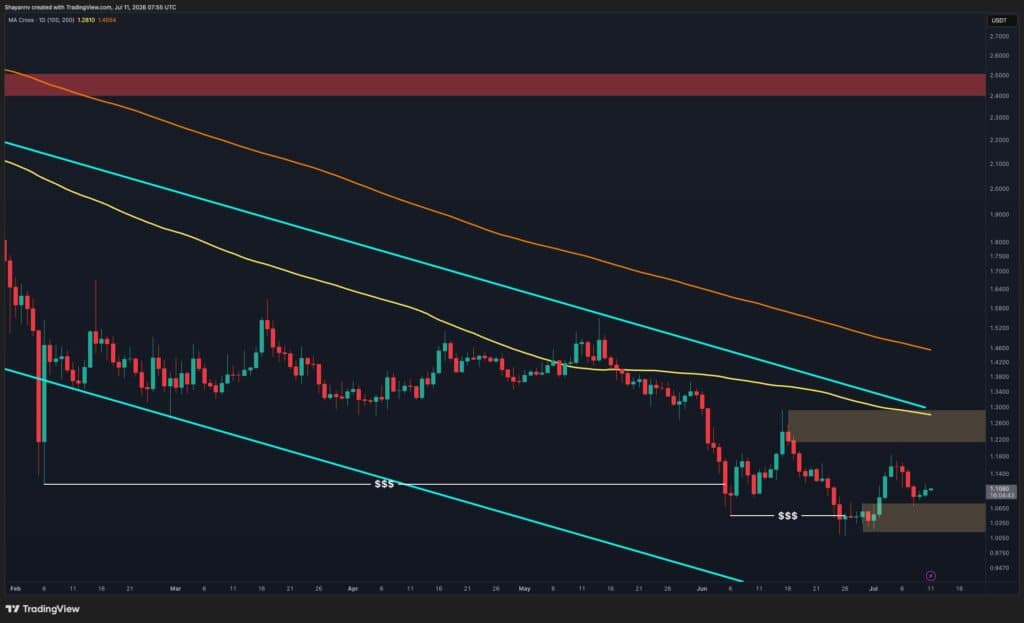
XRP has entered one of its most uncomfortable technical zones in months. The cryptocurrency has now broken below a support base that had held since February, but the selloff has not yet turned into a collapse below $1.
Instead, the daily chart shows the XRP price landing on a much older descending channel support that has guided it lower since August 2025. That leaves the cryptocurrency in a difficult position that shows the breakdown is real, but so is the possibility that the latest liquidation has simply carried XRP into a deeper support line that still gives bulls a chance.
XRP Breaks February Support, But Finds A Lower Channel Floor
Technical analysis of the daily XRP chart shows a clear loss of the straight support range that had held the market together since February. For months, XRP moved mostly sideways between $1.25 and $1.55, with buyers repeatedly stepping in each time the price returned to the lower boundary.
That structure finally gave way in early June, and XRP fell within the range with a daily candle that pushed the price into $1.10. This move was accompanied by various on-chain signals dropping to bear levels and the XRP profit/loss ratio falling to its lowest levels since 2024.
However, an interesting part of the price action is where the selloff stopped. XRP seems to have found support on the lower line of a broader descending channel that has been active since August 2025. This larger channel has contained nearly every major XRP move for months, and the latest liquidation wick landed almost exactly where buyers needed it to land to keep that bigger structure alive.
Bulls Still Have A Chance
According to crypto analyst Guy on the Earth, XRP finding support at this descending channel could be something or it could be nothing. In order for this move to mean something, the first level that matters is $1.10. A loss of $1.10 would weaken the channel-support argument. Therefore, the XRP price needs to hold above $1.10. So far, bulls are doing well to that effect, with XRP currently trading at $1.12 and an intraday high of $1.17.
The next upside level to watch is $1.27. That price level is important because it was close to the lower boundary of the February to May range before the breakdown. Former support often becomes resistance once price loses it, and a return to $1.27 would therefore be the first real test of whether XRP is only bouncing from oversold conditions or beginning to repair the damage from the breakdown.
Crypto analyst Guy on the Earth believes XRP could soon put traders in a difficult position with a quick move toward $1.96, suggesting that the next major rally may arrive with explosive force after months of persistent downside.
Ripple’s global payments narrative may be gaining fresh momentum as one of its key partners, Thunes, unveils a new development that could further strengthen cross-border settlement infrastructure. As the demand for faster, cheaper, and more efficient international payments continues to rise, strategic partnerships like Thunes play a crucial role in expanding real-world utility across the XRP ecosystem.
Thunes Expands Its Role In The Global Payments Ecosystem
A recent announcement from Thunes could significantly strengthen XRP’s position in the global payments landscape. Analyst XFinanceBull on X has revealed that the company has officially launched real-time payment capabilities in the United States through a direct connection with a Tier 1 financial institution, enabling access to ACH, Same-Day ACH, and all real-time payment rails.
The development comes as Thunes continues to strengthen its international footprint. Thunes holds 50 Money Transmitter Licenses, allowing it to operate across every US state and territory, mirroring Ripple’s regulatory reach. Both companies now independently have institutional-grade access to US clearing systems.
Thunes network already spans 140 countries, supports 90 currencies, and connects to more than 12 billion mobile wallets, stablecoin wallets, and bank account endpoints. Following its expanded partnership with Ripple in September 2025, Thunes integrated blockchain and digital asset technology into its direct global network, leveraging Ripple payments to enhance its SmartX Treasury System.
Meanwhile, Thunes has plugged real-time US settlement into the same network that uses the Ripple blockchain payments infrastructure and XRP as a bridge asset. Over 140 countries can now send money to the US through rails connected to Ripple technology.
Ripple payments have near-global coverage with over 90 payout markets processing more than $70 billion in volume. This integration gives XRP a direct pathway into Tier 1 US banking through a partner that holds licenses in every state.
Institutional Interest Fuels XRP Ledger’s Next Phase Of Growth
The XRP Ledger real-world asset (RWA) ecosystem officially surpassed $3 billion in tokenized value in April. According to an analyst known as BankXRP on X, the incredible insights shared by Luke Judges, Partner Director at RippleX, at Istanbul Blockchain Week, break down exactly where the momentum is heading for real-world asset tokenization. Furthermore, the $3 billion milestone is driven by a highly diversified mix of assets, underscoring Ledger’s expanding institutional utility across multiple segments of finance.
Looking ahead, the next big wave of growth is expected to center around cash and cash-equivalent assets. Money market funds and US Treasury bills, alongside tokenized equities, are being viewed as prime targets for infrastructure disruption. The broader vision is moving toward a globally distributed financial system where regulated assets can trade seamlessly across asset classes through a unified order book.
XRP bull Jake Claver argues that Ripple’s RLUSD stablecoin does not weaken the case for XRP, but may instead reinforce it by bringing more institution-friendly dollar liquidity onto the XRP Ledger. In a thread on X, Claver said the two assets are built for different roles: RLUSD as a compliant digital dollar, and XRP as the neutral bridge asset that allows value to move between otherwise fragmented markets.
The argument responds to a recurring question in the XRP community: if RLUSD can move money in seconds, why does XRP still need to exist? Claver said that framing misses the distinction between a settlement asset and a routing asset.
“RLUSD is not the finish line. It is the front door,” Claver wrote. “Institutions come for a compliant digital dollar. Once they are on the ledger they start asking bigger questions. Can we tokenize securities here? Settle trades instantly? Drop the 3 day wait.”
XRP As The Ledger’s “Money Changer”
To explain the point, Claver used the analogy of an old trading port where merchants arrive with silk, spices, wool, salt and gold, but rarely hold exactly what another trader wants. A silk trader looking for pepper may first need to trade into wool before finally reaching the spice seller. With only ten goods, he noted, that creates 45 possible trading pairs; with a hundred goods, the number rises to almost 5,000.
His conclusion is that markets need a neutral asset in the middle to reduce friction. On the XRP Ledger, Claver said, that role is played by XRP.
“On the surface that looks like one trade. Underneath it is two. He buys your silk and sells you silver, both at once. Remove that money changer and the whole port slows to a crawl. On the XRP Ledger, XRP plays that exact role,” he wrote.
Claver gave the example of someone swapping a tokenized Treasury bill for a euro stablecoin. In his framing, the user may only see one asset going in and another coming out, but the routing path can move through XRP in between. “The trader never sees the XRP step. Asset goes in, the one they want comes out. XRP sits quietly in the middle making it work,” he said.
Why RLUSD Does Not Replace XRP
Claver described RLUSD as a digital dollar designed to remain stable at one dollar and backed by real reserves in a bank. That makes it useful when both sides of a transaction want dollar exposure. But he argued that many future XRP Ledger use cases may not end in dollars at all, including tokenized Treasuries moving into euro funds, lending markets in non-dollar currencies, or other asset-to-asset transactions.
“RLUSD is perfect anytime both sides of a trade want dollars at the end. Plenty of trades do,” Claver wrote. “But plenty do not. Tokenized Treasuries swapping into euro funds. Lending in other currencies. Any trade where neither side is USD. There, a dollar coin cannot sit in the middle.”
He then pointed to three limitations that, in his view, prevent RLUSD from becoming the ledger’s universal bridge asset. First, RLUSD has an issuer and therefore carries issuer-specific risk. If the company behind it faces legal, banking, or operational problems, the stablecoin could be affected. XRP, by contrast, is not minted by an issuer and cannot be switched off by a single company, he argued.
Second, Claver said a global routing asset needs to be neutral. Regulated stablecoins must comply with sanctions, blacklists and regional rules, and can freeze tokens or block certain users. That may be appropriate for a regulated dollar product, but Claver argued it is less suitable for a base-level bridge asset.
Third, liquidity pools need two different assets. RLUSD can sit in pools against euro stablecoins, tokenized Treasuries or other instruments, but it cannot be both sides of the market. Claver said the asset most likely to become the primary routing layer is one that is liquid, neutral, free of issuer risk and already proven over time. His answer was XRP.
XRP is giving traders a contradiction that separates flow data from actual market control.
The token has been trading around the low-$1.30s after hitting its weakest level in roughly 15 weeks, even as two data points bulls often treat as supportive moved in the other direction.
Spot XRP ETFs have continued to attract money, with cumulative inflows around $1.42 billion, while late-May exchange-flow data showed more than 25 million XRP moving off exchanges after a prior inflow.
That combination would normally invite a simple accumulation case. Less XRP on exchanges can mean less immediately available sell-side supply. ETF inflows can show that regulated wrappers are still drawing capital.
Yet price action points to something colder: neither signal has been enough to stop sellers from setting the marginal price.
CryptoSlate’s XRP market page showed the asset near $1.30 on June 1, with a market cap around $80.87 billion and roughly $1.62 billion in 24-hour volume.
The token remains a top-five crypto asset by market value, but that size has not protected it from a market where rebounds are still being sold.
ETF demand remains indirect
The ETF side of the story has the clearest bullish potential.
SoSoValue data puts late-May spot XRP ETF inflows at roughly $11.8 million on May 29, taking cumulative net inflows to about $1.4 billion. Investor demand for XRP exposure through regulated products has continued during the latest drawdown.
ETF inflows are separate from immediate control of the spot market. They show that capital is entering a wrapper. They do not prove that enough aggressive buying is hitting exchange order books at the moment sellers are pressing sell orders through the market.
XRP has already spent much of May showing the same disconnect.
A recent analysis of XRP’s bullish signals found that ETF inflows, exchange withdrawals, and rising ledger activity had built a constructive setup, while price action still failed to follow.
The June 1 low moves that setup forward from a stalled bullish case to a clearer test of whether those flows can support the token before traders give up on the support zone.
Signal
Bullish case
Offsetting pressure
Spot XRP ETF inflows
Regulated-product demand remains visible
Wrapper demand has yet to overpower spot selling
Late-May exchange outflows
Less XRP may be available for immediate selling
The flow followed a large exchange inflow and covers a short window
XRP still near the top of market rankings
Liquidity and attention remain deep relative to most altcoins
The token is still near a 15-week low
Prior accumulation signals
Bulls can argue that supply is being absorbed
Price keeps treating rebounds as sell zones
The table shows the risk in reading ETF demand in isolation. Each constructive signal has a plausible bullish interpretation, but each also has an offsetting pressure that carries more weight for price right now.
What traders need to ask now is whether those flows are strong enough, direct enough, or immediate enough to change who controls spot trading.
Santiment showed a 22.80 million XRP exchange inflow before the balance reversed, with about 25.24 million XRP moving off exchanges in late May.
The second part of that sequence can look constructive. Coins leaving exchanges often reduce the supply available for fast selling and can point to custody, accumulation, or positioning away from trading venues.
In a stronger market, such a move could help confirm a bounce.
A 22.80 million XRP inflow shows that meaningful supply had also moved toward exchanges before the reversal.
The outflow that followed carries weight, but it leaves the earlier sign of sell-side pressure in the picture. It also cannot prove by itself that buyers are willing to absorb spot supply at higher prices.
The price response shows why the distinction counts. If XRP moves off exchanges and the price still falls to a multi-month low, visible exchange balances are only one part of the pressure.
Spot demand, order-book depth, leverage, and trader confidence can all carry more weight in the immediate window.
CryptoSlate’s XRP data also shows why centralized exchange behavior can be impactful: XRP’s 24-hour CEX volume was around $1.62 billion, compared with DEX volume of about $1.4 million.
For this market, the main price signal is still being formed on centralized venues, so exchange flows and liquidity conditions are where the ETF and accumulation narratives meet live selling.
The sell-zone pattern has been building for months. An earlier analysis found that XRP losses were forcing late buyers out and turning rebounds into fresh selling areas.
The latest low suggests that behavior has not fully cleared. Outflows can reduce potential supply, but they cannot repair sentiment if traders keep using every bounce to exit.
The strongest explanation for the contradiction is market structure.
XRP can keep some bullish signals and still leave sellers in control when liquidity is thin enough, and spot conviction weak enough, for marginal selling to push through supportive flow headlines.
A recent look at XRP liquidity found that Binance’s 30-day XRP liquidity index was near 0.043, its lowest level since January 2020, while all-exchange open interest hovered near $2.9 billion and futures volume ran at about 6.8 times spot volume.
Under those conditions, price can move sharply even when the broader story contains bullish data points.
Thin liquidity changes how flow signals should be understood. In a deep market, ETF inflows and exchange outflows may help absorb selling pressure over time.
In a less liquid market, a smaller burst of spot selling can still move price, especially if derivatives activity is high and traders are leaning on the same levels.
Broader ETF rotation is less important here than it might look at first. XRP inflows have stood out at times while Bitcoin and Ethereum products faced pressure, and CryptoSlate has covered that ETF rotation.
Relative ETF strength is different from outright price strength. XRP can attract capital through one channel and still fall if the spot market is weaker, less liquid, or more leveraged than the inflow headline suggests.
For now, the next test is price, rather than another bullish data point. Buyers need to make the supportive flow signals visible in the chart.
A recovery through the low-$1.30s and a reclaim of the $1.34 area would show that buyers are finally absorbing visible sell pressure.
A loss of the $1.31 area while ETF inflows and exchange outflows remain constructive would strengthen the opposite case: XRP can have institutional wrapper demand and apparent accumulation without giving bulls control of the spot market.
So there is still a contradiction here. The flows say some capital is still moving toward XRP. The price says sellers are still winning.