
SPX6900 price prediction 2026-2032: Will SPX6900 soar 10x or crash?
Key takeaways:
- SPX6900 may reach $0.5078 by the end of 2026, according to the forecast.
- By 2028, SPX could peak at $0.7917, with an average price near $0.7006.
- SPX6900’s long-term outlook places its 2032 target between $1.44 and $1.87.
SPX6900 (SPX) operates mainly on the Ethereum network and was initially created as an entertainment-focused meme token. The project has no direct connection to stocks, equities, or securities, with its value largely influenced by community engagement, social media activity, and market speculation.
The token attracts traders through spot markets, speculative activity, and perpetual contracts on centralized and decentralized exchanges. However, leveraged trading carries significant risks due to meme coins’ high volatility and is generally unsuitable for inexperienced traders. SPX can be stored through wallets such as Trust Wallet, Bitget Wallet, and hardware wallets including Ledger Nano S Plus.
SPX6900 is traded across multiple platforms, with Bybit among the leading exchanges by trading volume for the token. The meme coin currently has a circulating supply of 930.99 million SPX, matching its total supply, while its maximum supply is capped at 1 billion tokens.
Although launched as a non-serious meme project, SPX6900 gained attention after becoming one of the notable-performing meme tokens in 2024. The token recorded a sharp rally of nearly 9,000% within a month, attracting continued interest from traders as the market looks ahead to SPX6900’s price outlook for 2026 and beyond.
Overview
| Cryptocurrency | SPX6900 |
| Token | SPX |
| Price | $0.3690 |
| Market Cap | $347.98M |
| Trading Volume (24-hour) | $7.94M |
| Circulating Supply | 930.99M SPX |
| All-time High | $2.28 (July 28, 2025) |
| All-time Low | $0.000002634 (August 16, 2023) |
| 24-hour High | $0.3933 |
| 24-hour Low | $0.3674 |
SPX6900 price prediction: Technical analysis
| Metric | Value |
| Price Prediction | $ 0.2781 (-25.13%) |
| Price Volatility | 9.40% (High) |
| 50-Day SMA | $ 0.3479 |
| 200-Day SMA | $ 0.3715 |
| Market Sentiment | Bearish |
| Fear & Greed Index | 20 (Extreme Fear) |
| Green Days | 15/30 (50%) |
| 14-Day RSI | 59.65 (Neutral) |
SPX6900 price analysis
- SPX6900 trades under pressure as sellers dominate after the token fails to sustain its recent recovery attempt.
- The price remains between key support and resistance zones, with buyers watching the daily low for potential stabilization.
- Short-term momentum weakens on the 4-hour chart as SPX struggles to regain its previous upward trend.
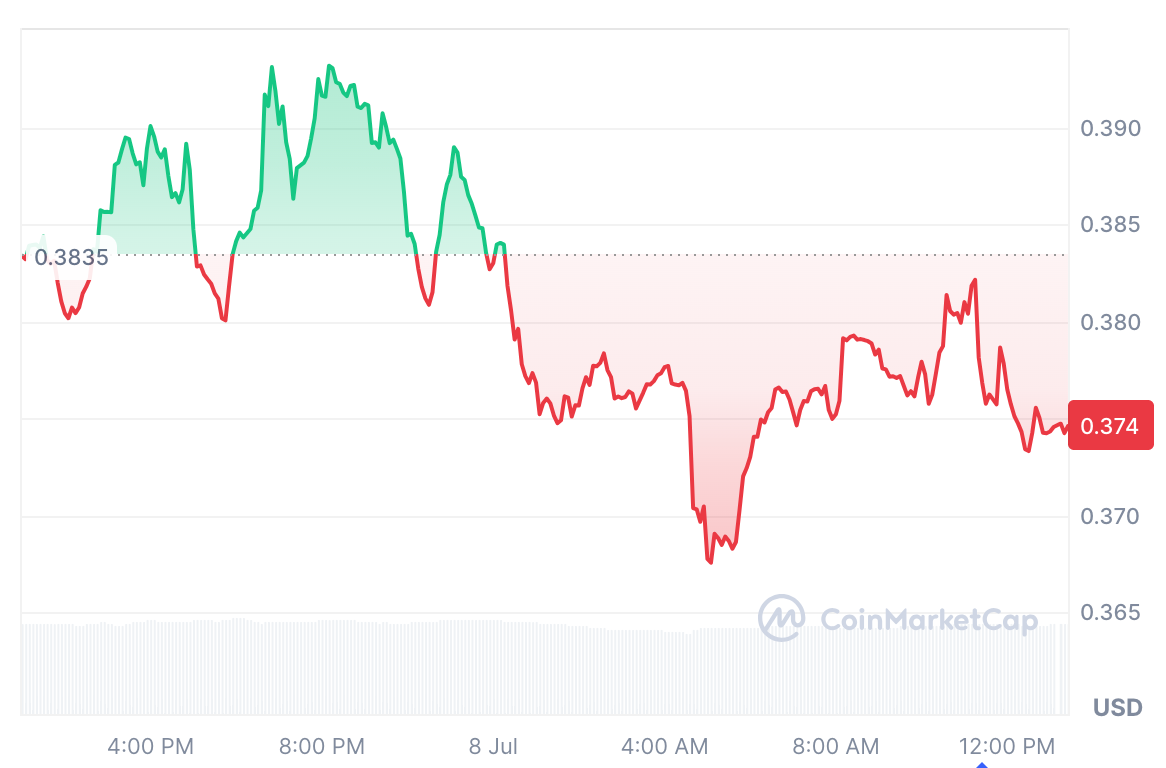
On July 8, 2026, the price of SPX6900 (SPX) is trading at $0.3690, marking a 1.76% decline in the last 24 hours. The most significant support level is at $0.3674, while the immediate resistance is at $0.3933.
SPX6900/USD analysis on the 24-hour timeframe
The daily chart shows SPX6900 starting with early buying strength before sellers regain control near the upper trading range. The token fails to maintain its upward momentum, creating a lower-high pattern as price gradually moves toward the lower end of the session range.
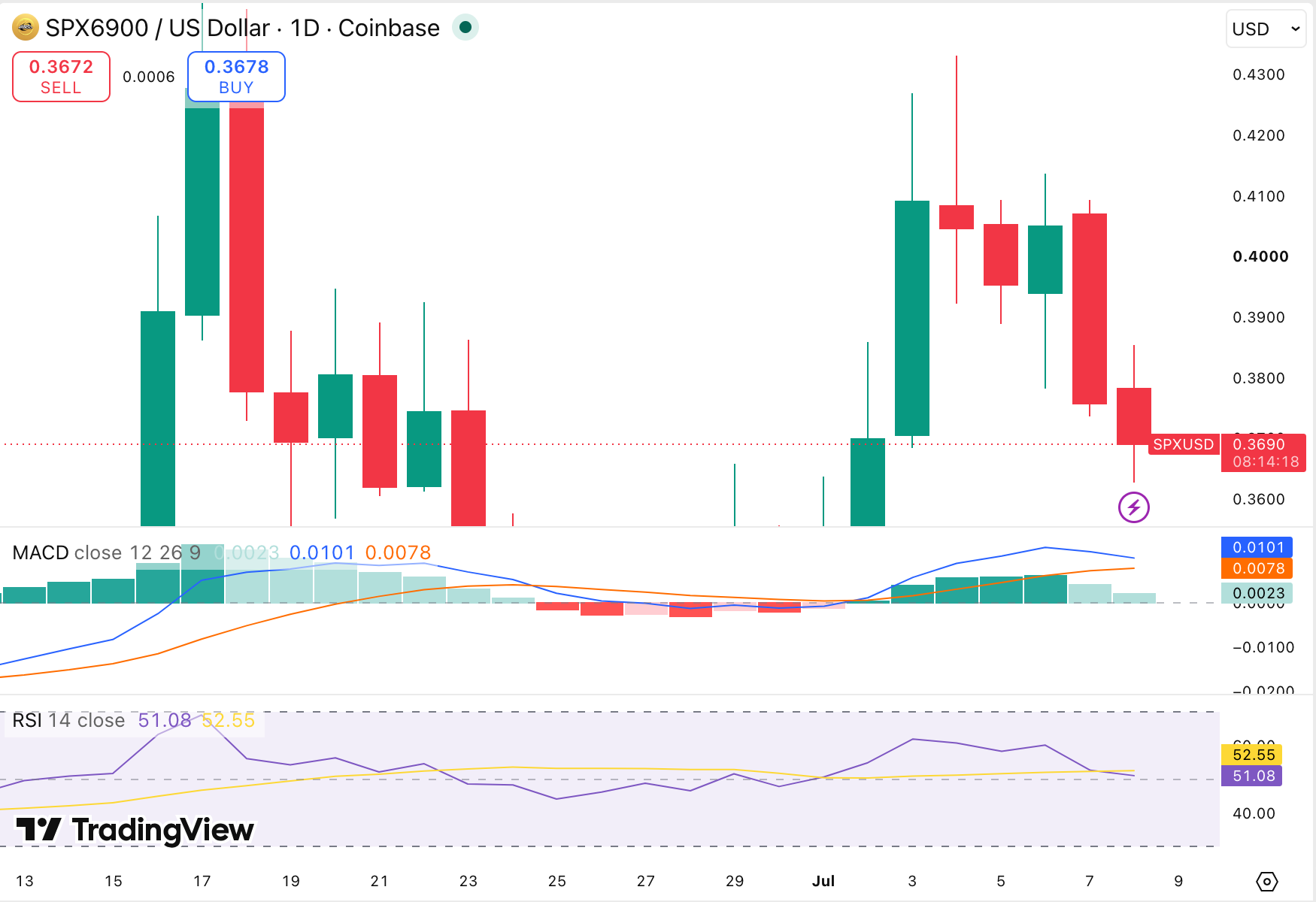
The price of SPX6900 (SPX) is currently trading at $0.3690 on the daily chart, where sellers are starting to gain the upper hand following a recent bounce in the token. RSI 14 is at 51.08, which is a neutral market state with a balance between buyers and sellers.
The MACD is still positive as the MACD line is 0.0101 above the signal line and the histogram is declining, indicating weakening bull market momentum. If SPX is to turn up the heat and get some upward momentum, it may require more buying pressure in the short-term.
SPX6900 analysis on the 4-hour chart
The 4-hour structure suggests sellers still have the upper hand as the SPX6900 breaks out of the previous recovery zone. The token has to gain buying momentum in order to make a comeback and make it better in the short term.
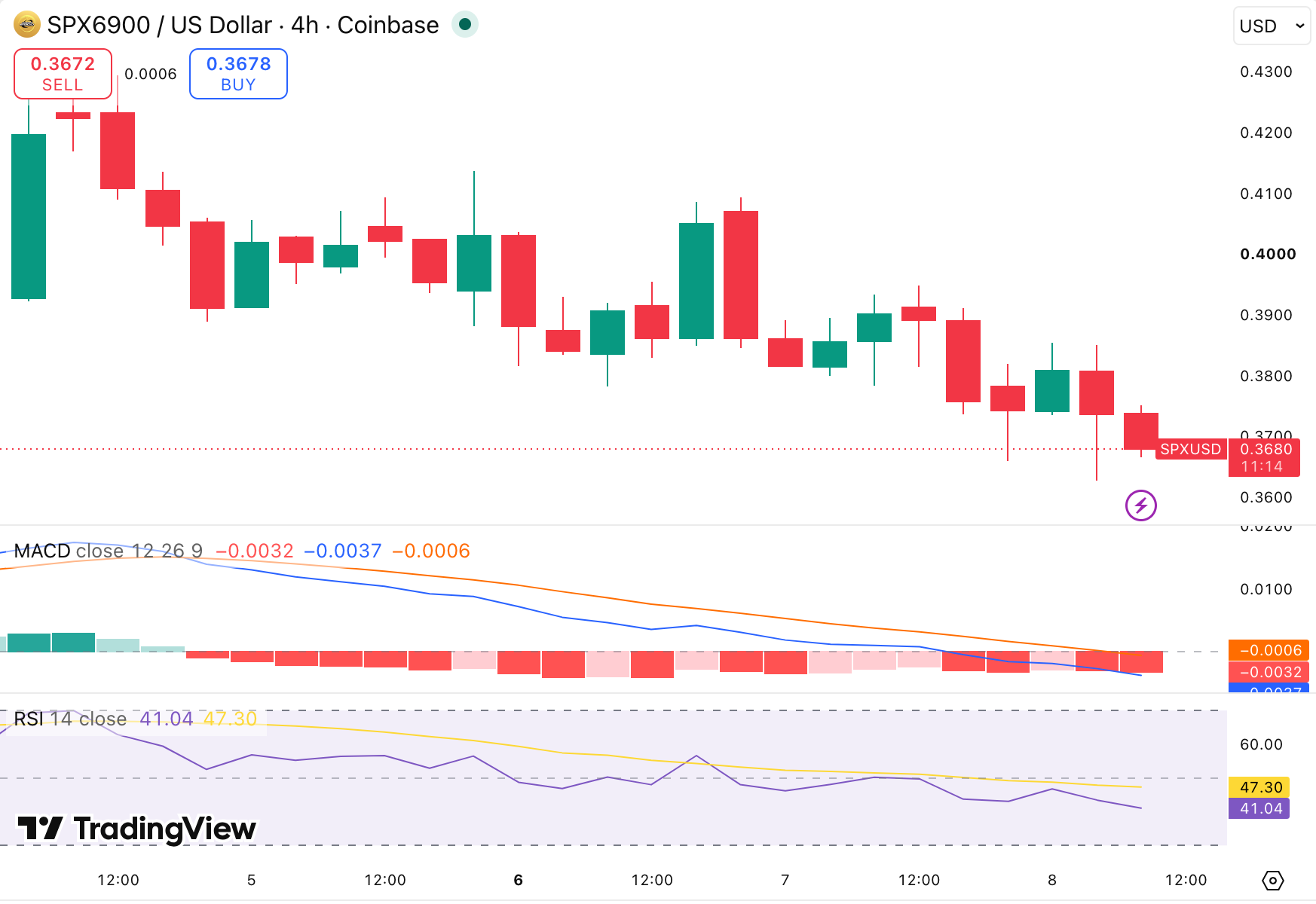
On the 4-hour chart, SPX6900 (SPX) is still under selling pressure, as the token has fallen below its previous recovery levels. RSI 14 levels have fallen to 41.04, which is below the oversold level but still not strong momentum, implying that sellers still dominate and buyers are trying to level the market.
The MACD indicator continues to be bearish, with the MACD line remaining below the signal line, indicating a downward trend. Red bars are the current trend of waning purchasing power, and unless it turns around, SPX could continue to move lower.
SPX6900 technical indicators: Levels and action
Daily simple moving average (SMA)
| Period | Value | Action |
| SMA 3 | $ 0.4011 | SELL |
| SMA 5 | $ 0.3968 | SELL |
| SMA 10 | $ 0.3705 | BUY |
| SMA 21 | $ 0.3673 | BUY |
| SMA 50 | $ 0.3479 | BUY |
| SMA 100 | $ 0.3514 | BUY |
| SMA 200 | $ 0.3715 | BUY |
Daily exponential moving average (EMA)
| Period | Value | Action |
| EMA 3 | $ 0.3988 | SELL |
| EMA 5 | $ 0.3924 | SELL |
| EMA 10 | $ 0.3792 | SELL |
| EMA 21 | $ 0.3659 | BUY |
| EMA 50 | $ 0.3576 | BUY |
| EMA 100 | $ 0.3638 | BUY |
| EMA 200 | $ 0.4570 | SELL |
What to expect from SPX6900 price analysis?
SPX6900 is still trying to work out if buyers are able to hold the current support zone following the recent breakdown. If the token recovers well, it may test higher resistance levels, and if the selling pressure continues, SPX will be heading towards lower price levels.
The near-term picture will rely on whether buyers gain control and bring about a reversal in the positive trend. If SPX maintains its price range, then the token might try to rally again, but without finding new buying interest, it could continue to be under pressure for the short term.
Why is SPX down?
SPX6900 is trending down because those who are selling take over control while the token is unable to sustain its recent recovery rally. The price is under selling pressure as buyers are unable to hold onto higher price levels, causing a reversal down to the lower end of the trading range.
The weakness also indicates lower short-term demand, as traders remain more conservative as a result of the slow momentum in the market. Once the first bounce off the wall fades, SPX begins to consolidate and puts buyers to the test to avoid additional bear market pressure.
Is SPX6900 a good investment?
SPX6900’s future value could benefit from its limited supply and growing market interest, as scarcity can influence demand over time. However, price movements remain uncertain and depend on market conditions, investor sentiment, and broader crypto trends.
Investors should consider the risks associated with volatile assets and conduct thorough research before making investment decisions. Only allocate funds that match individual risk tolerance and financial circumstances.
Will SPX reach $5?
SPX6900 would require a substantial increase in both price and market capitalization to reach the $5 level. While achieving this target is challenging, it remains possible if the token experiences strong adoption and market growth. Current projections suggest SPX could approach this range after 2032, supported by a significantly higher market valuation.
Will SPX6900 reach $10?
SPX6900 is not expected to reach the $10 price level based on current prediction models. According to the forecast algorithm, the token’s highest projected value could reach approximately $8.06 by 2046, suggesting a long-term growth trajectory that falls below the $10 milestone.
Does SPX6900 have a good long-term future?
Long-term forecasts suggest a gradual increase in SPX6900’s value, with projections indicating stronger upward momentum toward 2029. By 2032, SPX is expected to trade above $1.3, with a projected fully diluted valuation (FDV) of around $427.33 million.
SPX6900’s growth is primarily driven by community support, meme culture, and market speculation rather than traditional utility. The token is a satirical project that uses phrases like “scientific utilization” to parody finance and crypto concepts, while its S&P 500 references highlight its humorous approach to market valuation.
SPX6900 price prediction July 2026
SPX is projected to trade within a range this month, with a potential high of $0.3980, an average price of $0.3720, and a minimum trading level of $0.3590.
| SPX6900 price prediction | Minimum price | Average price | maximum price |
| SPX6900 price prediction July 2026 | $0.3590 | $0.3720 | $0.3980 |
SPX6900 price prediction 2026
SPX6900 is expected to reach a minimum price of $0.4690 in 2026 based on price projections and technical analysis. The SPX price could rise to a maximum of $0.5078, with an average trading price of around $0.4760.
| SPX6900 price prediction | Minimum price | Average price | maximum price |
| SPX6900 price prediction 2026 | $0.4690 | $0.4760 | $0.5078 |
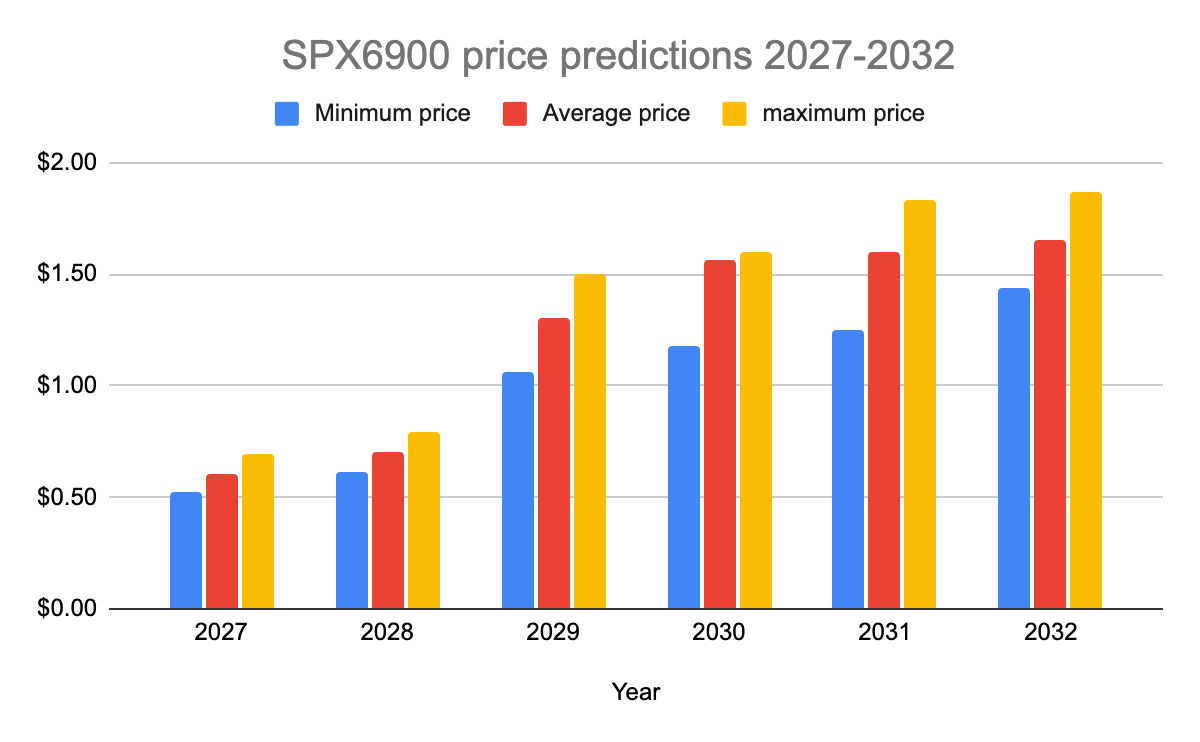
SPX6900 price predictions 2027-2032
| Year | Minimum price | Average price | maximum price |
| 2027 | $0.522 | $0.6069 | $0.6919 |
| 2028 | $0.6095 | $0.7006 | $0.7917 |
| 2029 | $1.06 | $1.30 | $1.50 |
| 2030 | $1.18 | $1.56 | $1.60 |
| 2031 | $1.25 | $1.60 | $1.83 |
| 2032 | $1.44 | $1.65 | $1.87 |
SPX6900 price prediction 2027
SPX6900 is expected to trade at a minimum price of $0.522 in 2027, with a maximum projected value of $0.6919 and an average trading price of $0.6069.
SPX6900 price prediction 2028
SPX6900 is projected to reach a minimum price of $0.6095 in 2028, with a potential maximum price of $0.7917 and an average trading price of around $0.7006 throughout the year.
SPX6900 price prediction 2029
SPX6900 is projected to trade at a minimum value of $1.06 in 2029, with the potential to reach a maximum price of $1.50. The average trading price during the year is estimated at around $1.30.
SPX6900 price prediction 2030
SPX6900 is projected to reach a minimum price of $1.18 in 2030, with the potential to climb to a maximum value of $1.60 and an average trading price of $1.56 throughout the year.
SPX6900 price prediction 2031
SPX6900 is expected to reach a minimum price of $1.25 in 2031, with a potential maximum value of $1.83 and an average trading price of around $1.60 throughout the year.
SPX6900 price prediction 2032
SPX6900 is projected to reach a minimum price of $1.44 in 2032, with a potential maximum level of $1.87 and an average trading price of around $1.65 based on technical analysis of historical price data.
SPX6900 market price prediction: Analysts’ SPX price forecast
| Firm Name | 2026 | 2027 |
| DigitalCoinPrice | $0.4480 | $0.5068 |
| CoinCodex | $0.4350 | $0.4987 |
Cryptopolitan’s SPX6900 price prediction
SPX is projected to reach a high of $0.5078 by the end of 2026. In 2027, the token could trade between $0.522 and $0.6919, while the 2032 outlook places SPX within a range of $1.44 to $1.87, with an average price of $1.65. These estimates may change based on market conditions, and investors should conduct their own research and due diligence before making decisions in the volatile crypto market.
SPX6900 historic price sentiment
- SPX6900 was launched in August 2023 by its primary creators with an opening price of $0.003 but remained under the radar for over a year.
- In October 2023, SPX’s value spiked to $0.023 under bullish control, which was a considerable growth trajectory, but it still remained far from market attention.
- December of 2023 saw a low price of $0.008, which was quite low compared to the price in October, as per crypto market historical data.
- SPX6900 saw a stagnating price movement from January to May 2024, only to rise periodically to $0.015.
- In September 2024, SPX6900 gained an enormous 5600% from September 12 to October 14, reaching $0.913, resulting in a massive market capitalization.
- The token made higher spikes till November 7, 2024, adding significantly to its market cap; however, the token’s price has deteriorated afterwards.
- On November 21, SPX6900 stooped to $0.450, losing 50% of its value, which made holders cautious. However, the token regained its lost value and ended the year at $0.856.
- The meme token entered January 2025 with a price tag of $0.866, but it soon jumped to $1.55 as its circulation and acceptance increased.
- It corrected strongly in search of support at the start of February, attaining an average price of $0.66, but came down to the 0.46 range in March.
- In April, the coin was trading near $0.386 on the lower side, while in May, it saw a fabulous recovery, peaking at $1.11 along with some other cryptocurrencies.
- On June 11, the meme coin attained its all-time high of $1.73, and on July 28, it marked another ATH at $2.27.
- SPX maintained a trading range of $1.06 to $2 in August under complete bullish dominance, proving itself a reliable asset, and was trading at an average price of $1.16 in September.
- In October 2025, SPX6900 was trading near $1.6, and in November, it fell to $0.78 after losing 50% of its value. In December, the downtrend continued as the token touched $0.63.
- At the start of January 2026, SPX6900 was trading near $0.648, but in March, it slipped to $0.336.
- In April, SPX6900 was trading near $0.28, and in May it increased to $0.42, but it decreased to $0.316 again in June, as the current market sentiment turned bearish to neutral.
- According to the latest data, SPX is trading near $0.3770 as July begins, reflecting its current market position at the start of the month.