Samsung Electronics Co.’s semiconductor division posted a disappointing profit for the June quarter, underscoring mounting challenges at the world’s largest memory chipmaker.
The critical business unit recorded an operating profit of just 400 billion won ($288 million), far below analysts’ consensus estimate of 2.73 trillion won. The shortfall was largely attributed to mounting losses at its foundry division and tightening US export controls on high-bandwidth memory (HBM) chips.
South Korea’s tech giant, which had issued a downbeat profit and revenue guidance earlier in July, reported net income of 4.93 trillion won—missing the 6.37 trillion won expected by analysts.
Samsung’s foundry losses deepen as US export controls bite
The profit slump stemmed partly from a one-time inventory write-down at Samsung’s foundry business, which was impacted by weak demand from China and delayed chip shipments due to export restrictions. Declining utilization rates also weighed on earnings. The company said this came despite sustained demand for premium memory chips used in servers.
Samsung Electronics reported a more than 15-fold surge in operating profit for the second quarter of 2024, buoyed by a rebound in semiconductor prices fueled by strong demand from the artificial intelligence sector.
The world’s leading maker of memory chips, smartphones, and TVs estimated its operating profit reached 10.4 trillion won ($7.54 billion) for the three months ending June 30, up sharply from just 670 billion won ($482 million) in the same period last year.
The result surpassed the 8.8 trillion won SmartEstimate compiled by LSEG, which prioritizes forecasts from historically accurate analysts. It also marked Samsung’s most profitable quarter since Q3 2022.
Analysts noted that, beyond rising chip prices, the strong performance was likely aided by the reversal of previous inventory write-downs, as the accounting value of Samsung’s chip stock recovered.
For now, the tech firm anticipates that foundry losses will narrow in the second half of 2025, buoyed by a gradual rebound in demand.
Samsung rallies on Tesla chip deal as AI ambitions intensify
The lackluster quarterly results arrived just days after Samsung secured a $16.5 billion contract to manufacture AI chips for Tesla Inc. at its upcoming Taylor, Texas, facility. The deal has boosted investor sentiment, sending the company’s shares up 10% since Monday and over 20% for July—marking its strongest monthly performance in over four years.
To regain ground in the booming AI memory space, Samsung is ramping up investments in research and expanding front-end capacity. The company is also intensifying efforts to land contracts with major clients like Tesla to revive its struggling foundry operations.
If the multi-year Tesla agreement proceeds successfully, it could open doors to more high-profile clients and serve as validation for Samsung’s next-gen 2-nanometer process technology.
Struggles in AI memory market highlight SK Hynix’s growing lead
Investors are also watching closely to see if Samsung will benefit from Nvidia’s resumption of H20 AI chip sales to China. Samsung’s HBM3 memory has previously been paired with Nvidia’s H20 model, although it trails behind in performance compared to SK Hynix’s HBM3E.
Construction of Samsung’s Taylor plant has faced delays, with production now slated to begin in 2026. The company continues to face stiff competition from Taiwan Semiconductor Manufacturing Co. (TSMC), which is expanding US production at its Arizona facility.
Samsung’s position in the advanced HBM chip segment remains tenuous. It has struggled to secure Nvidia’s certification for its latest offerings, allowing rival SK Hynix to establish a dominant lead in the rapidly expanding AI memory market.
Your crypto news deserves attention – KEY Difference Wire puts you on 250+ top sites
As the crypto market braces for another wave of gains, all eyes are on the soaring trajectory of Mutuum Finance (MUTM). The project is rapidly gaining traction among investors. The token has surpassed the $13.7 million milestone in its presale. Mutuum Finance is capturing investor attention with record-breaking gains and surging on-chain activity.
Meanwhile, Shiba Inu (SHIB) holders eagerly watch mounting token burns that could nudge the memecoin closer to the coveted $0.000050 mark. With market sentiment shifting and capital flows gravitating toward emerging ecosystems, traders are weighing whether SHIB’s deflationary push can keep pace with the unstoppable momentum of Mutuum Finance.
Shiba Inu (SHIB) The Burn Spikes Amid Drop in Price
At the moment, Shiba Inu (SHIB) is trading at about $0.000014, and after a recent short push this week due to a huge 883% increase in the rate at which SHIB tokens are being burned, seeing in excess of 21 million SHIB tokens destroyed in one day, and with over 410 trillion tokens burned so far. Irrespective of these vicious deflationary acts, the price has retreated by almost 5%, where it is trading at its current range below the $0.000014 mark.
Analysts note that although burn activity increase could improve long-term scarcity, price performance offers a typical post burn consolidation due to the traders processing the news of the burn. Within the larger context, there is also additional interest in something new like Mutuum Finance.
Phase 6 of Mutuum Finance Presale Now Live
Mutuum Finance has completed its Phase 5 presale in record time and launched Phase 6 with tokens now available at $0.035, a 16.17% increase over the last round. The upcoming price adjustment will lift the token by another 14.29% to $0.04, giving current participants the chance to secure a 71.43% return by the time it lists at $0.06. The presale has already drawn in more than 14,500 investors and raised upwards of $13.7 million, signaling strong market confidence in MUTM’s future.
Dual-Lending: Powering the Future of DeFi
Mutuum Finance utilizes a double-model mechanism to support flexibility as well as efficiency in Peer-to-Contract and Peer-to-Peer models of lending.
Peer-to-Contract utilizes self-executory smart contracts that perform the function of lending independently without any human intervention at all. They have been designed to operate according to dynamic rates in the market with an unstable rate of interest as determined by present demand and supply of an in-real-time interest.
Peer-to-Peer model removes intermediaries and offers market to be in direct contact with lenders and borrowers. That is all the more so if its use is to risky assets because it offers the range of having personalized terms of a loan and flexibility based on user will and his or her risk-tolerance levels.
Mutuum Finance Reinforces Commitment to Stability
Mutuum Finance (MUTM) will be introducing a stablecoin that will be USD pegged on the Ethereum blockchain. It will be a safe and secure investment tool to avoid risk and volatility that can be found in algorithmic stablecoins.
The project has also undergone thorough auditing by Certik to ensure blockchain security and safety of user funds. This milestone bears testimony to the ambitions of Mutuum Finance to be an institutional-grade and open DeFi protocol. It indicates that the team is also keen to remain in line with the industry’s security standards.
Mutuum Finance Rolls Out $50K Bug Bounty to Enhance Safety
Mutuum Finance has initiated its Bug Bounty Program with the size of the reward pool set at $50,000 USDT. The program features four levels of severity. They are critical, major, minor, and low. Therefore, every bug that would exist is found and rewarded. It supports the team’s vision of developing a secure, transparent, and high-quality DeFi protocol.
Shiba Inu’s burns draw attention, but Mutuum Finance (MUTM) is gaining stronger traction. Phase 6 presale runs at $0.035, raising $13.7M+ from 14,500+ investors. A 71.43% ROI awaits at launch price $0.06. Secure tokens now.
For more information about Mutuum Finance (MUTM) visit the links below:
Flow coin price prediction for 2025 could reach a maximum value of $ 0.9203.
By 2028, FLOW could reach a maximum price of $1.77.
In 2031, FLOW will range between $4.59 to $5.54.
Flow coin, the native token of the Flow blockchain created by Dapper Labs, is essential for powering decentralized applications (dApps) and digital assets. Flow aims to provide a high-performance, user-friendly platform that tackles scalability without sacrificing decentralization. Its unique architecture allows developers to build secure and efficient smart contracts.
FLOW, its native token, has several key uses within the ecosystem, including paying transaction fees, staking, and participating in network governance. The growing number of dApps and users on the platform drives demand for Flow coin, influencing FLOW’s price movements.
Given Flow coin’s strong fundamentals and growing support levels in the ecosystem, the question arises: how high can FLOW go? What will FLOW price be in 2025?
Overview
Cryptocurrency
Flow
Token
FLOW
Price
$0.3943
Market Cap
$630.1M
Trading Volume
$34.82M
Circulating Supply
1.59B FLOW
All-time High
$46.16
All-time Low
$0.2916
24-hour High
$0.4298
24-hour Low
$0.3932
Flow coin technical analysis
Metric
Value
Volatility (30-day Variation)
11.08%
50-Day SMA
$0.3698
14-Day RSI
62.55
Sentiment
Neutral
Fear & Greed Index
75 (Greed)
Green Days
19/30 (63%)
200-Day SMA
$0.4319
Flow coin (FLOW) price analysis
TL;DR Breakdown
FLOW broke below key support at $0.406 with MACD turning negative.
Short-term indicators show heavy selling volume.
The critical support for FLOW lies at $0.380-$0.385.
Flow coin 1-day price analysis: FLOW sees a breakdown from consolidation pattern
The FLOW/USDT 1-day price chart for July 28 shows that the coin has experienced a significant technical breakdown, falling from $0.458 to the current level of $0.394. The token has broken below critical support levels that had been holding since mid-July, with the price now trading beneath the middle Bollinger Band at $0.406.
The breakdown occurred after FLOW failed to sustain momentum above the upper Bollinger Band resistance near $0.458, creating a classic rejection pattern that has now led to a cascade lower. The MACD indicator has turned decisively bearish with the signal line crossing below the MACD line, while the histogram shows increasing negative momentum that suggests the selling pressure is accelerating.
FLOW maintains its bearish pattern on the 4-hour timeframe, with price action showing a clear breakdown from what appeared to be a consolidating range between $0.420-$0.425. The token has fallen through the 20-day SMA at $0.414 and is now testing the psychological support level at $0.390, which coincides with recent swing lows.
The On-Balance Volume indicator has plummeted to -37.93M, indicating that the recent selling has been accompanied by substantial volume, which adds credibility to the bearish move and suggests distribution. The price structure shows lower highs and lower lows forming, with each bounce getting weaker and failing to reclaim previous support levels that have now turned into resistance.
FLOW technical indicators: Levels and action
Daily simple moving average (SMA)
Period
Value
Action
SMA 3
$0.3934
SELL
SMA 5
$0.4088
SELL
SMA 10
$0.4235
SELL
SMA 21
$0.4042
SELL
SMA 50
$0.3698
BUY
SMA 100
$0.3882
BUY
SMA 200
$0.4319
SELL
Daily exponential moving average (EMA)
Period
Value
Action
EMA 3
$0.3887
BUY
EMA 5
$0.3798
BUY
EMA 10
$0.3752
BUY
EMA 21
$0.3797
BUY
EMA 50
$0.4151
SELL
EMA 100
$0.4846
SELL
EMA 200
$0.5644
SELL
What to expect from Flow?
FLOW appears positioned for further downside testing, with immediate support at $0.380-$0.385 and potential deeper retracement toward $0.350 if current support fails. The combination of broken trend support, bearish momentum indicators, and high-volume selling suggests this move lower has legs, though oversold conditions may provide temporary bounces that should be viewed as selling opportunities rather than reversal signals.
Is FLOW a good investment?
Flow coin has potential as an investment due to its strong partnerships with major brands and its focus on powering decentralized applications, especially in the NFT and gaming spaces. However, like all cryptocurrencies, it carries significant volatility and risks, so investors should carefully consider market conditions and risk tolerance before investing.
Will FLOW reach $1?
The $1 price mark is within range, having reached that level in early December 2024. Renewed buyer interest could push FLOW to $1 and above in the coming months.
Will FLOW reach $5?
This level has not been achieved since February 2022. For FLOW to recapture the $5 levels, significant cash inflows will be required.
Can FLOW reach $50?
FLOW has previously reached an all-time high (ATH) of $46.16, so reaching $50 is achievable. However, a significant bull run and tangible ecosystem updates are required to achieve this feat, as the coin is currently 98% below its ATH.
Is Flow a good blockchain?
Flow is a solid blockchain, especially for gaming and NFTs. It is designed for scalability, fast transactions, and low fees. The network’s unique multi-role architecture improves efficiency without compromising decentralization.
However, it faces fierce competition, and adoption levels are not as high as those of Ethereum and Solana.
Does FLOW have a good long-term future?
Projections suggest substantial growth over the coming years, with a potential peak of $3-$4 by 2031. This positive outlook reflects a strong potential for sustained value appreciation and continued market relevance.
Flow blockchain is seeing massive growth in DeFi, with TVL reaching $80.53M and wrapped FLOW at 46.64M. Additionally, Flow has gone live on the multi-chain DEX @hitdex, expanding DeFi capabilities with non-custodial wallets.
Plus, Flow is live on @hitdex — a multi-chain DEX with non-custodial wallets via social platformshttps://t.co/lpRnhfa14I
— Token Relations 📊 (@Token_Relations) July 3, 2025
Flow coin price prediction July 2025
Per expert opinion, the Flow predictions for July 2025 suggest a minimum price of $0.3100, an average price of $0.3747, and a maximum price of $0.482.
FLOW price prediction
Minimum Price
Average Price
Maximum Price
FLOW price prediction July 2025
$0.3100
$0.3747
$0.482
Flow price prediction 2025
The price of Flow in 2025 is a minimum price of $0.2900, an average price of $0.4315, and a maximum price of $0.9203.
FLOW price prediction
Minimum Price
Average Price
Maximum Price
FLOW price prediction 2025
$0.2900
$0.4315
$0.9203
Flow coin price predictions 2026 – 2031
Year
Minimum Price ($)
Average Price ($)
Maximum Price ($)
2026
0.5085
0.7282
1.17
2027
0.89
1.05
1.25
2028
1.55
1.6
1.77
2029
2.2
2.28
2.69
2030
3.19
3.31
3.79
2031
4.59
4.76
5.54
Flow coin price prediction 2026
Flow’s price prediction indicators for 2026 indicate a potential peak of $1.17, a minimum price of $0.5085, and an average trading price of $0.7282.
Flow coin price prediction 2027
Flow network price predictions for 2027 suggest a prevailing bullish market sentiment. Investors can anticipate a maximum price of $1.25, a minimum price of $0.89, and an average market price of $1.05.
Flow coin price prediction 2028
Investors could see significant profit opportunities based on the 2028 Flow coin price prediction. Expert projections anticipate the asset’s price reaching a peak price of $1.77, maintaining an average price of $1.6, and a minimum price of $1.55.
Flow coin price prediction 2029
The Flow cryptocurrency price prediction for 2029 suggests a maximum trading price of $2.69, an average price of $2.28, and a minimum price of $2.2.
Flow price prediction 2030
The Flow price forecast suggests a notable appreciation in value in 2030, with a projected peak price of $3.79. Additionally, traders can expect an average FLOW price of $3.31 and a minimum price of $3.19.
Flow crypto price prediction 2031
The Flow prediction for 2031 suggests a maximum trading price of $5.54, an average price of $4.76, and a minimum price of $4.59.
Cryptopolitan’s FLOW forecast highlights a positive outlook over the coming years. For 2025, the coin is expected to range from $0.38 to $0.92. By 2028, the Flow price forecast suggests the coin could reach as high as $2 while maintaining an average price of $1.52. Looking forward to 2031, investors can expect FLOW to reach a maximum price of $5.2 and an average price of $4.30.
FLOW coin showed early potential in 2020, with prices ranging from $0.30 to $29.96 and closing the year at $9.75.
In 2021, the price peaked at $46.16 in March but declined to $8.8 by year-end. The volatility continued in 2022, fluctuating between $1.5 and $8.11, with a close at $2.71.
In 2023, the price ranged from $0.4372 to $1.27, closing at $0.8994.
The coin started in 2024 at $0.6538 and $1.69, experiencing highs and lows before stabilizing at $0.58 – $0.61 by August. In September, FLOW reached $0.6367; in October, it traded between $0.5073 and $0.5175.
In November 2024, Flow reached a peak price of $1.0242; in December, it reached a maximum price of $1.271 and closed the year at $0.697.
In January 2025, FLOW maintained a range of $0.599 – $0.851; in February, it peaked at $0.555; in March, it dipped, trading between $0.3739 and $0.3899. April and May showed some gains, with FLOW reaching as high as $0.4161 and $0.4765, respectively. Prices were flat in June, maintaining a trading range of $0.2915 and $0.3996.
In July 2025, FLOW is trading between $0.3939 and $0.4297.
Cardano (ADA) may be making another push to reclaim bullish momentum, but analysts and investors are shifting toward Mutuum Finance (MUTM) the rising DeFi coin. Phase 5 of the Mutuum Finance presale recently sold out quicker than anticipated. Over 14,500 investors have already participated, with Mutuum Finance raising more than $13.7 million to date.
The project has now entered Phase 6 of its presale at $0.035, a 16.67% increase from Phase 5. The upcoming Phase 7 will see another price jump of 14.29% to $0.04. Investors who buy in now can secure a 71.43% ROI when the token launches at $0.06. With ADA struggling to maintain its rally amid a competitive DeFi landscape, the spotlight now turns to whether Mutuum Finance can sustain its early traction and become the next breakout story in decentralized finance.
Cardano (ADA) Rebounds, Holding Mid‑$0.80s Support
Cardano is currently trading around $0.83, having rallied roughly 37% in July and retesting critical support near $0.78, which now appears to serve as a launchpad for sustained recovery. Technical indicators like EMAs and the formation of a golden cross are signaling bullish structure, with resistance in sight near $0.94 and upside potential toward $1.19 or even $1.31 if momentum holds.
However, a break below $0.78 could expose ADA to downside risks around $0.70 or lower. At a time when attention is often shifting to newer DeFi entrants, Cardano continues to command interest for its technical setup and ETF-driven speculation. However, investors are now looking elsewhere.
Mutuum Rolls Out Advanced Dual-Lending Platform
Mutuum Finance (MUTM) is a lending platform built for both passive and active DeFi users. Passive income can be generated from lending users’ USDT in stable passive income-generating smart contract pools. This lending is known as Peer-to-Contract (P2C) lending.
Other than that, a Peer-to-Peer (P2P) system allows lenders and borrowers to swap as much as they want because there is no intermediary. That is usually typical with users of volatile assets like meme coins.
Phase 6 Presale Begins as Mutuum Finance Gains Traction
Following the complete sell-out of its Phase 5 presale, Mutuum Finance has entered Phase 6 with tokens now priced at $0.035, reflecting a 16.17% rise from the previous round.
The next price milestone is set at $0.04, marking a further 14.29% increase. Early backers at this stage have the potential to secure a 71.43% return when MUTM launches at $0.06. To date, the presale has raised more than $13.7 million and attracted over 14,500 unique investors, underscoring the growing demand for the project.
Secured by CertiK, Reinforced with $50K Bug Bounty
Mutuum Finance (MUTM) will launch a stablecoin pegged to USD on the Ethereum blockchain. Apart from that, the project is audited by CertiK with a 95.0 trust score. Mutuum Finance has also put in place a $50,000 USDT Bug Bounty. It will reward on a four-level severity threshold: critical, major, minor and low.
$100,000 in MUTM Tokens Up for Grabs
Mutuum Finance has started a $100,000 giveaway that will give 10 winners a total of $10,000 MUTM in gratitude for the investor’s first time believing in the project.
Mutuum Finance is proving to be one of the fastest-rising DeFi opportunities, having already raised over $13.7 million from 14,500+ investors as its presale gains speed. Phase 6 tokens remain priced at $0.035, with a 14.29% increase locked for Phase 7 and a guaranteed 71.43% ROI at launch. Backed by a $100,000 giveaway, a $50,000 CertiK-audited bug bounty, and a rapidly expanding holder base, MUTM is cementing itself as a top contender for the next DeFi breakout. Get in before the next price hike hits.
For more information about Mutuum Finance (MUTM) visit the links below:
Beijing and Washington plan to tack another 90 days onto their trade war truce as the two countries prepare to begin another round of negotiations in Stockholm on Monday, the South China Morning Post (SCMP) reports, citing sources familiar with the matter.
This third round of high-stakes negotiations represents the latest attempt by the two countries to stabilize one of the world’s most important economic relationships. It builds on previous talks in Geneva and London, which were aimed at checking the rapid advance of tariffs and laying a foundation for a broader de-escalation of trade tensions.
According to the SCMP article, the US and China will commit not to levy new tariffs or take aggressive actions during the 90-day proposed extension. The announcement indicates that both sides want to keep talking and avoid a fresh flare-up in the tensions roiling global markets for years.
The White House has not publicly confirmed the planned truce extension, and the US administration was not immediately available for comment.
Beijing demands tariff review on fentanyl chemicals
A key new hiccup to these talks is that they extend far beyond traditional trade issues: They also involve threats to restrict exports of fentanyl, a potent and deadly synthetic opioid.
The Chinese delegation will also demand during the discussions with US officials that the Trump administration remove tariffs on components of a chemical used to make fentanyl, according to people familiar with the matter.
The synthetic opioid has been a leading driver of overdose deaths in the United States. America has blamed Chinese suppliers for adding to the crisis by shipping out precursor chemicals. In retaliation, tariffs were placed on certain chemical imports that were suspected to be in the fentanyl supply chain.
Beijing, though, says that these tariffs set back the cooperative fight to reduce illegal drug flows. Chinese officials are also likely to argue for a more collegial approach, including technical collaboration and intelligence sharing, rather than punitive tariffs.
Although the fentanyl crisis has been a significant focus for the US regarding domestic policy, it is uncertain whether the Biden trade team would agree to modify the tariff approach in the space at a time of domestic election, including amid widespread frustration with Chinese policies.
US and China pause new tariffs for 90 days
If the 90-day cease-fire that was reported comes to pass in Stockholm, it would mark a deliberate halt in one of the longest trade wars of modern times.
The US and China have levied tariffs on more than $700 billion worth of each other’s goods since 2018. The trade war disrupted supply chains worldwide, affected the agriculture and technology industries, and changed how global multinationals arrange their operations.
An interim pause, analysts say, would give businesses that have been ensnared in the crossfire for years a chance to breathe. It would also allow both sides to work on thornier long-term issues like intellectual property protection, digital trade, and forced technology transfers.
The 90-day period is not a permanent solution but a window of opportunity. Its success will depend largely on the political will of both the United States and China to move the negotiations forward or risk renewed tensions.
The timing of the Stockholm meetings is also crucial. The United States is heading into a ferocious election cycle, and neither side may want to appear as if it is soft on trade, for China, where a slowing economy and increasing pressure from domestic industries are probably fueling a more practical approach to diplomacy.
Although there is optimism about the meeting, experts warn that many core structural issues have yet to be resolved. The truce over tariffs might help defuse tensions, but it is anything but a permanent solution.
What unfolds this week in Stockholm could decide whether the world’s two biggest economies are on a path to rekindled cooperation — or merely deferring the next round of confrontation.
KEY Difference Wire helps crypto brands break through and dominate headlines fast
The US is set to announce the findings of a national security investigation into semiconductor imports, with the results expected within two weeks.
Commerce Secretary Howard Lutnick announced the move on Sunday after a high-level meeting between President Donald Trump and European Commission President Ursula von der Leyen.
Known as a Section 232 investigation, the inquiry examines whether the US government’s heavy dependence on foreign-made semiconductors threatens national security. If the findings bear out those risks, the White House will likely slap new tariffs on imported chips, potentially redrawing the global tech supply chain.
The move is part of a continuing effort by President Trump to use tariff policy aggressively as both an economic and political weapon in his second term. Former President Joe Biden hoped to draw manufacturers back by offering federal subsidies through the CHIPS and Science Act. Still, Trump is pursuing protectionist endeavors to repatriate chipmaking to American shores.
Europe eases pain with a new trade pact
The semiconductor probe is not just a house matter — it has international ripple effects. However, the European Union, cognizant of the potential blowback, quickly engaged in last-minute trade talks with Washington to shield itself from any blowback.
Shortly after their meeting, President Trump and the EU Commission President Ursula von der Leyen revealed a new framework trade deal. The agreement includes a 15% generic rate on all EU imports to the US, and a 25% rate on European autos.
The ongoing semiconductor investigation motivated the European Union to pursue a swift trade agreement with the United States. European leaders aimed to address several pressing trade issues simultaneously, with semiconductor tariffs a top priority.
The US administration used the investigation as a strategic advantage in negotiations. European Commission President took steps to avoid potential chip-related tariffs through diplomatic engagement, though similar outcomes may not be guaranteed for other trading partners.
US prepares to announce more tariffs
The semiconductor probe is just the latest part of a broader effort by the Trump administration to overhaul US trade policy. And since returning to office in January, Trump has reinstituted a number of these 232 investigations, not only for chips, but also for pharmaceuticals, copper, and lumber; an investigation into automobiles remains open.
These sectors are considered critical to national security, particularly in light of global supply disruptions caused by the COVID-19 pandemic and rising geopolitical tensions. The administration argues that bringing production back to the United States will enhance the country’s economic resilience and strategic strength.
Already, the administration has placed a 10% tariff on most imports, and rates are scheduled to surge after August 1 for some of America’s largest trading partners, including China, South Korea, and parts of Latin America. A fresh round of duties could soon cover more electronics, industrial machinery, and rare earths categories.
His supporters say these are policies aimed at restoring American industrial muscle. Critics say they drive up consumer prices and risk retaliation from friends and foes.
Analysts are watching Taiwan closely. The island is responsible for over 60% of the world’s semiconductors and almost 90% of advanced chips used in smartphones, servers, AI, and defense systems. An abrupt duty on Taiwanese chips could increase production costs across industries, including automotive, military, and other sectors, and foment diplomatic tension.
At the same time, domestic chipmakers like Intel, GlobalFoundries, and Texas Instruments have been increasing their US manufacturing capabilities. Industry leaders, however, say the process will take years and sustained government support.
Building domestic semiconductor capacity is a long-term challenge. Industry leaders note that cutting chip imports abruptly is unrealistic, as constructing fabrication plants takes years, requires substantial financial investment, and depends on a highly skilled workforce.
Full results of the investigation will be released before mid-August. It could be a first step toward broader decoupling from global supply chains.
Your crypto news deserves attention – KEY Difference Wire puts you on 250+ top sites
Cardano (ADA) has entered headlines with forecasts hinting at a potential 400% climb by year’s end, placing the spotlight back on one of crypto’s most established ecosystems. Yet beneath the noise, Mutuum Finance (MUTM) is quickly emerging as the real story, a fast‑moving DeFi project gaining traction. Mutuum Finance is in presale phase 5 of which 85% has been sold out as investors pile in. The token stands at its lowest possible value of $0.03.
A 16.7% increase will follow with the onset of phase 6. More than $12.9 million has been raised so far, and more than 13900 investors have entered the presale. As market attention pivots, Mutuum Finance is increasingly being mentioned as the altcoin to watch in 2025.
Cardano forecasts a 400% increase by the year-end.
At a current price of $0.88, Cardano (ADA) has once again gained the attention of traders with some market forecasts indicating a possible 400% surge before 2026. Analysts cite the increasing activity on the network, breakthroughs in scaling, such as Hydra, and the fact that Cardano shot to be among the leading Layer-1 protocols, as evidence to back the bullish sentiment. Although these predictions are always dependent on the general market tone, ADA keeps gaining the interest of traders who place their bet on it to shine in 2025, and their interest increases in discussing newer projects like MUTM.
Mutuum Presale Blasts into Over $12.9M as Interest Builds
Mutuum Finance (MUTM) is one of the most interesting DeFi tokens by 2025. Given that the presale has already raised more than $12.9 million and has more than 13900 investors on board, MUTM is gaining strong traction. The sixth phase will raise the price to $0.035 from $0.03 and given that the launch price is already pegged at $0.06, current investors are already standing at 100%.
Unlocking the Future of Finance with DeFi Lending
Mutuum Finance offers a liquidity protocol where users enjoy absolute ownership of assets while leveraging decentralized lending. The project utilizes a double-model approach that encompasses Peer-to-Contract and Peer-to-Peer lending in an effort to promote greater flexibility and efficiency.
Peer-to-Contract platform utilizes smart contracts to achieve automated lending without human involvement and, on the other hand, the smart contracts respond to the market by offering dynamic interest rates.
Peer-to-Peer framework eliminates middlemen and offers direct access between the borrowers and the lenders. The framework is most utilized by the users for volatile assets like meme coins.
Improving Security with $50K Bug Bounty and Reward Program
Mutuum Finance (MUTM) is hosting a $100,000 giveaway. 10 people will get $10,000 in MUTM tokens each. The project also revealed a new leaderboard in which the top 50 token holders will get bonus tokens for maintaining their positions.
To further secure its platform, Mutuum Finance has introduced a $50,000 Bug Bounty Program with CertiK. All vulnerabilities will be rewarded, and the bounty will focus on four levels: critical, major, minor, and low.
Mutuum Finance (MUTM) is setting the stage for exponential growth, with $12.9 million raised, 13,900+ investors, and Phase 5 already 85% sold out at $0.03 before a 16.7% price jump in Phase 6. With a launch price locked at $0.06, early buyers stand to gain 100% ROI on listing, and analysts believe this DeFi disruptor could outpace ADA’s 400% rally in 2025. Secure your Mutuum Finance tokens now, Phase 5 won’t last long, and the next wave of gains belongs to those who act early.
For more information about Mutuum Finance (MUTM) visit the links below:
Polymarket, the crypto-powered prediction market, is considering entering the stablecoin market with two options on the table. The first one is to introduce its own customized stablecoin, or accept a revenue-sharing deal with Circle based on the amount of USDC held on the platform.
According to reports, Polymarket’s main drive for launching its stablecoin is to earn yield from the reserves that currently benefit Circle. By issuing a native token, the platform could keep that revenue in-house.
Polymarket considering its own stablecoin.
Stablecoin entry could enhance liquidity in prediction markets, providing native economic incentives.
If executed well, this move could expand Polymarket’s ecosystem and increase retention by creating new DeFi opportunities. pic.twitter.com/qheRiixv0Q
Stablecoins have become the main beneficiaries of Polymarket’s rising activity. All transactions on the platform settle in USDC on the Polygon network. This ensures a steady transaction flow and sustained demand for the token.
A deal with Circle or customize its stablecoin?
Legislation around stablecoins passed in the US last week makes issuing a stablecoin an attractive business proposition for crypto native firms and more traditional finance players alike.
To that end, launching a stablecoin is hard for many companies. For instance, Circle, the company that created USDC, is known to be ending revenue-sharing deals with exchanges, payment companies, and other fintechs. The reason behind this is to stay competitive in a field that is changing so quickly.
A Polymarket representative said no decision has yet been made on the stablecoin question. However, of the two options, for Polymarket, issuing its own stablecoin is a much easier lift from a regulatory standpoint.
According to a person familiar with the matter, “In the case of Polymarket, it’s a closed ecosystem and all they really need to do is to be able to exchange USDC or USDT into whatever their custom stablecoin is. They don’t have to worry about the last mile on ramp and off ramp. That’s a very simple thing to build, and easy to secure and control.”
In addition, Polymarket has grown in popularity. According to SimilarWeb, over $8 billion in bets were placed during last year’s US election cycle, and the site saw nearly 16 million visits in May. Also, Polymarket announced plans to overhaul its reward and oracle-resolution system.
The new framework, part of its 2028 Election Holding Rewards program, will offer more accurate pricing and easier migration for users.
Meanwhile, Polymarket wants to buy QCEX, a CFTC-licensed exchange and clearinghouse, in a $112 million deal that clears the path for regulated operations in the world’s largest financial market. It is based in the US. This follows the closure of civil and criminal investigations into its allowing US-based customers to place bets on its platform.
Polymarket has handled more than $14 billion in trades since its launch. It had more than $1 billion in monthly volume in May alone, with 20,000 to 30,000 active daily traders. After Trump’s re-election in November 2024, the platform moved $2.5 billion in a single month, making it one of its busiest times.
During that surge, there were a lot of USDC transfers and more action on the bridges to move money around.
Cryptopolitan Academy: Tired of market swings? Learn how DeFi can help you build steady passive income. Register Now
China has released its first set of rare earth mining quotas for 2025 quietly, marking a move to tighten state control over an industry vital to everything from electric cars to military hardware.
Reuters reported that Beijing issued the initial quotas just last month, without any formal announcement or public notice. Companies granted permission to mine and process these critical minerals were asked to keep the figures confidential, reportedly for security. Neither the volume nor the specific breakdown of mining versus smelting allowances has been disclosed.
For years, China’s Ministry of Industry and Information Technology has published its first quarterly quota on its website, usually in the opening months of the year. In contrast, this year’s decision came in silence, underlining Beijing’s growing caution about releasing data that reflects its grip on global supplies.
Analysts watch these quotas closely, as they signal how many rare earths, 17 metals essential to electric vehicles, wind turbines, robots, and missiles, will enter the market. China alone accounts for the lion’s share of global production. Delays to the usual spring announcement had fuelled speculation that authorities were reassessing how tightly to hold the reins.
When asked why the figures were not shared publicly this time, the Industry Ministry didn’t respond to requests for comments. Observers say the decision fits a broader trend of Beijing using rare earths as leverage in trade talks, notably with the United States and the European Union.
China issued two rounds of mining quotas last year, totalling 270,000 metric tons. That output allowance represented a slowdown in annual growth to 5.9 percent, down from a 21.4 percent increase in 2023. Smelting and separation permits for 2024 were also set in two batches, amounting to 254,000 tons, up 4.2 percent on the previous year.
China’s rare earth shipments to the US rebounded in June
In a related development, China’s shipments of rare earths and magnets to America rebounded sharply in June. The General Administration of Customs data shows exports climbed to 353 metric tons, a 660 percent jump compared with May’s 46 tons.
That surge followed late‑June agreements aimed at clearing a backlog of export licences for magnets and rare earths bound for U.S. customers. As part of the same talks, chipmaker Nvidia said it plans to restart sales of its H20 artificial intelligence processors in China.
Earlier this year, Beijing had added several rare earth items and related magnets to its export restriction list in early April, a response to American tariffs. The move stalled shipments in April and May, disrupting supply chains. Some overseas automakers reportedly scaled back production amid the squeeze.
Globally, China exported 3,188 tons of permanent rare earth magnets in June, up 157.5 percent from May’s 1,238 tons. Despite the rebound, June’s total remained 38.1 percent below the 5,158 tons shipped in June 2024.
Market watchers expect exports to climb further in July as more firms secure the necessary licences. Still, for the first half of 2025, China’s magnet exports were down 18.9 percent year‑on‑year, at 22,319 tons.
Your crypto news deserves attention – KEY Difference Wire puts you on 250+ top sites
With its presale already surpassing $14 million and a growing community rallying behind it, XYZVerse ($XYZ) is quickly attracting the attention of investors and crypto lovers.
But does it have the fundamentals to sustain the hype? In this guide, we’ll explore what XYZVerse is, how its ecosystem creates real utility, and whether it stands out in a crowded meme coin market.
Is XYZVerse.io the next breakout token? Let’s dive in and find out.
What Is XYZVerse?
Coin
XYZVerse ($XYZ)
Contract Address
0xD75Ab4b69F2eDfb072fDFD7e2D15a875f95Ae5ae
Current Presale Raise
$14M+
Type
Meme token
Launch Date
Q4 2025 (Listing target: $0.10)
Price Increase (At Time of Writing)
>3200% (from $0.0001 to current stage price of $0.003333)
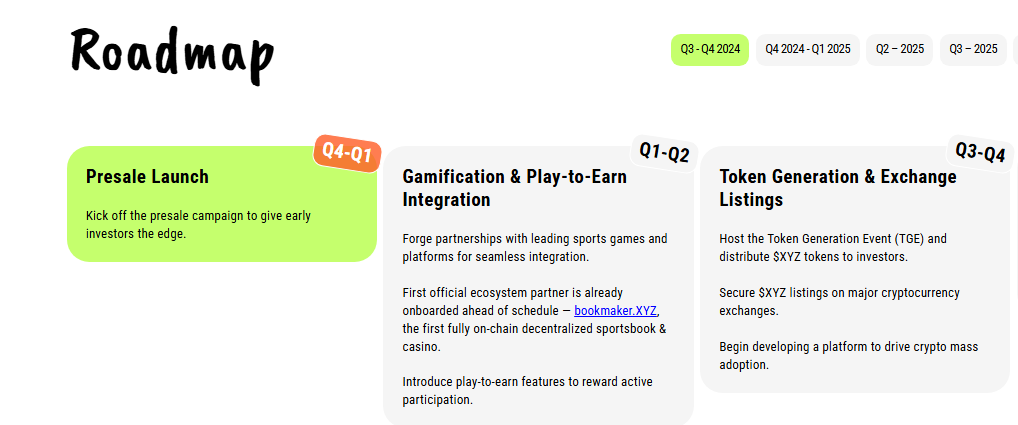
XYZVerse is a community-driven meme coin that merges sports culture, gamified staking, and crypto. At its core, the project aims to do more than ride the meme wave—it integrates with bookmaker.XYZ, giving token holders exclusive betting perks, rewards, and access to crypto-based play-to-earn experiences.
Unlike many meme coins that live and die by social media trends, XYZVerse is building a complete ecosystem featuring:
Telegram-based crypto games
Airdrop programs
Upcoming dApps for staking and rewards
Real-world sportsbook integration
How XYZVerse Reached $15M+ and Why Its Presale Strategy Works
XYZVerse launched its presale with a clear, methodical structure designed to reward early adopters and build long-term momentum. XYZVerse introduced a 15-stage pricing model where the token price gradually increases as each round sells out.
This tiered structure serves two key purposes:
It incentivizes early participation by offering substantial discounts at the earliest stages
It helps the project build sustainable traction, with each stage reflecting real demand and community growth
Starting at just $0.0001 in Stage 1, the price has climbed steadily with strong participation across every round. As of today, the presale has already raised over $14 million, reflecting confidence in both the token’s mechanics and its broader vision of merging sports, meme culture, and crypto rewards.
While XYZVerse is still in its presale phase, several signals suggest it is a legitimate and carefully structured project. However, as with any presale token, true validation will come post-launch—when real market performance and ecosystem utility are put to the test.
The audit results were highly positive, confirming that XYZVerse’s smart contract is secure, well-structured, and gas-efficient. No critical or high-severity vulnerabilities were found. This level of scrutiny and openness reflects a commitment to best practices in an industry where unaudited and hastily deployed meme coins are common. The audit report is publicly available and serves as a key foundation for investor confidence.
Liquidity & Token Control
XYZVerse operates with a fixed total supply of 100 billion tokens, introducing scarcity as a foundational principle. To further support long-term value, the project employs a deflationary burn mechanism—where a portion of tokens is systematically removed from circulation through buybacks and burns. This structure not only discourages inflation but also rewards long-term holders by reducing overall supply over time.
XYZVerse Tokenomics Breakdown
Total Supply: 100,000,000,000 XYZ
Category
Allocation
Quantity
Presale
17.87%
17,870,000,000 XYZ
Marketing
15%
15,000,000,000 XYZ
Liquidity
15%
15,000,000,000 XYZ
Deflationary Burn
17.13%
17,130,000,000 XYZ
Incentives, Bonuses & Airdrops
10%
10,000,000,000 XYZ
Development & Ecosystem
10%
10,000,000,000 XYZ
Team
10%
10,000,000,000 XYZ
KOLs (Key Opinion Leaders)
5%
5,000,000,000 XYZ
Tokenomics reveal a project’s economic structure and are a crucial factor in evaluating its long-term sustainability. XYZVerse adopts a clear and balanced tokenomics model, with a fixed total supply of 100 billion tokens—ensuring the project is non-inflationary and scarcity-driven by design.
The structure reflects a well-thought-out strategy focused on liquidity, growth, and community engagement. Key allocations include:
Marketing (15%) and Liquidity (15%), which ensure both visibility and exchange readiness
A generous 17.13% burn allocation, making XYZVerse one of the few meme coins with a built-in, large-scale deflationary mechanism
10% set aside for development and ecosystem growth, providing fuel for product innovation and long-term expansion
10% for incentives, airdrops, and bonuses, fostering early engagement and decentralized community participation
Unlike many meme tokens that overallocate to teams or rely on hype alone, XYZVerse limits team allocation to a responsible 10%, aligning with industry best practices. Meanwhile, community-focused distributions—presale, airdrops, and KOLs—make up over 40% of total supply, reinforcing the project’s grassroots-first approach.
If executed with discipline, this allocation model supports both market momentum and ecosystem utility, setting a foundation not just for hype, but for sustained relevance through 2025 and beyond.
Community: What’s the Sentiment?
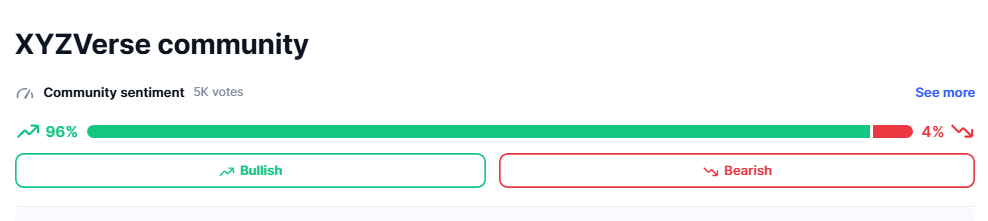
Community sentiment around XYZVerse is strongly bullish, reflecting both growing excitement and trust in the project’s direction. On CoinMarketCap, over 96% of user votes indicate a positive outlook for XYZ, placing it among the most favorably viewed tokens in its category.
This optimism is echoed across the project’s social channels:
21K+ followers on X (formerly Twitter)
12K+ active Telegram members
High engagement across airdrop announcements, presale updates, and interactive campaigns
Influential voices in the crypto space are already buzzing about XYZVerse, with several prominent analysts and content creators calling it a “moonshot opportunity” for the 2025 cycle. Their enthusiasm is fueled by the project’s transparency, unique blend of meme culture and sports utility, and growing credibility.
Combined with recognition from CryptoNews as the “Best New Meme Project”, and a partnership with bookmaker.XYZ, XYZVerse is not only attracting investors—it’s building a passionate, conviction-led community.
As broader crypto sentiment turns optimistic, XYZVerse appears well-positioned to become a breakout name in the upcoming bull run, supported by both grassroots enthusiasm and early influencer endorsement.
The future for XYZVerse looks increasingly promising as it positions itself at the intersection of community-driven meme culture, gamified crypto engagement, and real-world sports integration.
With a clear post-launch roadmap and strong early traction, the project is preparing for a high-profile debut on both centralized and decentralized exchanges. This move is expected to significantly boost visibility and liquidity, allowing XYZ to reach a broader investor base beyond presale participants.
Several key developments lie ahead:
Launch of staking and reward-based dApps, allowing holders to earn passively while engaging with the ecosystem
Expansion of its play-to-earn games on Telegram and other platforms, turning casual engagement into real crypto value
Influencer and athlete partnerships, bridging Web3 and global sports audiences
Aggressive marketing and sports sponsorships, giving the project exposure beyond the crypto-native crowd
Token burns and liquidity programs, reinforcing price sustainability over time
Importantly, the combination of a fixed supply, burning mechanics, and a loyal, growing community gives XYZVerse the ingredients needed for long-term relevance—not just a short-term meme cycle.
If execution stays aligned with its roadmap and community energy continues to build, XYZVerse could evolve from a speculative token into one of the standout crossover stories of the 2025 bull run—where utility, culture, and Web3 entertainment collide.
Visit the official XYZVerse website to learn more about the project: https://xyzverse.io/