By now, you’d be hard pressed to find anyone who isn’t broadly familiar with the AI heavyweights and their flagship models. OpenAI has ChatGPT, Anthropic has Claude, Google has Gemini. But what does Amazon have?
Not a whole lot, it turns out. Unlike its competitors in the tech megacorp scene, Amazon’s standout AI model — organized under the name “Nova” — is about the farthest thing from a household name. And that’s not likely to change anytime soon, because the ecommerce giant is now gutting its in-house AI labs, Bloomberg reports.
Per the outlet, Amazon is scaling back the ambitions of most of its Nova AI models and reorganizing its AI development teams as part of an effort to narrow its focus on “highest priority” goals, after its power-hungry large language models turned out to be a bust.
Accordingly, the company has put most of its AI models on ice, Amazon insiders told Bloomberg. This includes its text-based Nova models, as well as video- and image-generating models, all of which have been placed in a state of “keep the lights on,” meaning they’re technically still supported, but only receive the bare minimum resources needed to sustain them.
Instead, labor and computing power are being diverted toward a singular “frontier-model effort” led by Pieter Abbeel, director of the Berkeley Robot Learning Lab whose robotics company Covariant was hoovered up by Amazon in 2024. At the time Abbeel joined the tech giant, Covariant’s founders were working on AI models for robots, which lines up pretty well with Amazon’s push to automate everything it possibly can.
News of the shift in Amazon’s strategic focus comes a week after it closed one of its key AI offices in San Francisco, an 80-person site specializing in research on artificial general intelligence, the supposed next-level of AI development where the tech obtains human-level intelligence and reasoning skills.
With urgent questions swirling over whether LLMs can ever usher in a return on investment — let alone AGI — it may be that Amazon is jumping out of the AI hype cycle while it still can.
Cardano Advances Decentralization as Specialist Partners Take Ownership of Core Infrastructure
Built by Many. Owned by All.
CARDANO / DECENTRALIZATION / VOLTAIRE ERA / IO LABS
Input Output (IO) today announced the next stage of Cardano’s decentralization, as a growing network of specialist partners takes ownership of core components including the Haskell node, Plutus, Daedalus, Hydra, and developer experience (DevRel).
Cardano has already decentralized its protocol and governance. This next step decentralizes how Cardano itself is built, extending ownership of core infrastructure to a wider base of specialist teams.
“
The last stage of the Voltaire era is full decentralization of node and reference blueprint development. Since 2024, IOG and its partners have carefully managed a process that will conclude in 2027 and will result in several independent firms maintaining at least three Cardano implementations in Haskell, Rust, and Go, alongside a complete set of formal specifications supervised by MBOs like Intersect and Pragma and subject to community review and vote.
I’m extremely proud that we have arrived at the final stage with IO Labs spinning out the Haskell Node to community curation and control. Our partners are ready and the ecosystem now has many diverse options.
Charles Hoskinson
A Wider Developer Base
Specialist partners, including Se7en Labs and Teragone, bring focused expertise to the components they take on. Named partners, public repositories, and Intersect governance make the transition a transparent, accountable process.
This broader developer base establishes Cardano as the work of many independent teams and strengthens the case for community-led treasury funding. As specialist partners take ownership of infrastructure and delivery, IO deepens its focus on research and venture creation through IO Labs and IO Ventures.
A New Film Marks the Moment
The campaign opens with a short cinematic film establishing the vision behind this stage of decentralization, built on the premise that the strongest ideas belong to the people who carry them forward, not only those who first create them.
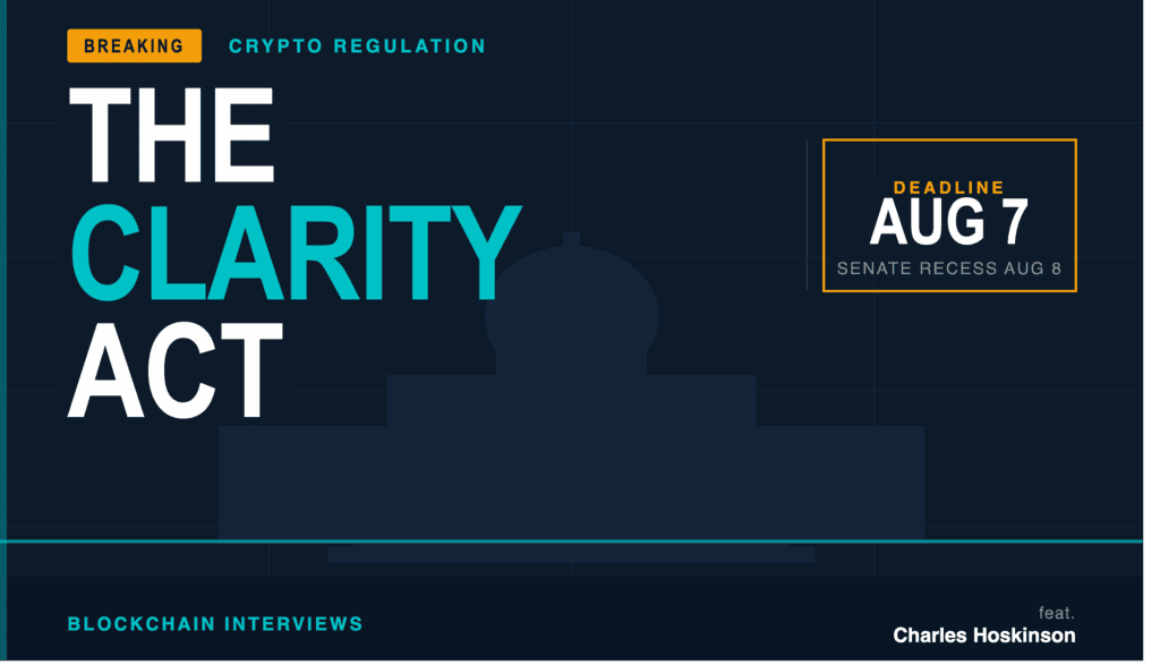
The CLARITY Act: Crypto’s Final Window — Blockchain Interviews
Crypto Regulation · Special Report
The CLARITY Act’s
Window Is Closing
Majority Leader Thune has already conceded the bill won’t pass before the August 8 recess. With 10 days left and three disputes unresolved, Charles Hoskinson says the bill as written could kill the very industry it claims to protect — and he’s the one who’d benefit if it passed.
Published July 28, 2026
The clock has effectively run out. Senate Majority Leader John Thune has already told reporters the CLARITY Act will not pass before the August recess — which begins August 8, with August 7 the last working day. The Digital Asset Market Clarity Act sits on the Senate Legislative Calendar at No. 423, no cloture motion filed, three interlocking political disputes still unresolved, and the pre-recess window almost certainly closed before a vote can happen.
What remains is a narrow hope: that Thune can get the floor process started before recess, keeping a September comeback technically alive — though election politics, appropriations fights, and a Democratic Party that has grown increasingly hostile to the bill all make that a long shot. What happens in the next ten days, or fails to happen, will determine which cryptocurrency projects can raise money, get listed on exchanges, and build a user base in the United States — and which ones quietly move offshore.
The Legislative Record
How We Got Here
The House passed H.R. 3633 on July 17, 2025, by a 294–134 margin — a genuinely bipartisan result, with 78 Democrats joining every House Republican. The Senate Agriculture Committee approved its digital commodity version in January 2026. The Senate Banking Committee advanced its version on May 14, 2026, by a 15–9 vote. The bill landed on the full Senate calendar on June 1. Then Congress left for the July 4 recess with no floor vote scheduled and three disputes unresolved.
July 17, 2025
House passes CLARITY Act 294–134 with bipartisan support — 78 Democrats cross the aisle
January 2026
Senate Agriculture Committee passes its digital commodity version
May 14, 2026
Senate Banking Committee advances bill 15–9; two Democrats join but signal floor vote not guaranteed
June 1, 2026
Bill placed on Senate Legislative Calendar No. 423 — eligible for full floor consideration
July 4, 2026
Senate leaves for recess. No cloture filed. Three core disputes still unresolved
July 22, 2026
Sen. Lummis releases consolidated Senate draft merging Banking and Agriculture versions — new disputes immediately emerge
July 23, 2026
Thune tells reporters the CLARITY Act will not pass before August recess. White House crypto adviser Patrick Witt pushes back, calling the first week of August still viable
Now — July 28, 2026
Senate in session. Final window open in theory. No cloture motion filed. No floor time allocated
August 7, 2026
Last Senate working day before recess — the real deadline. Thune has already signaled this window will be missed
August 8, 2026
Senate August recess begins. Bill waits until mid-September — deep inside midterm election season
What’s At Stake
A $680 Billion Question
The total crypto market stood at roughly $2.28 trillion as of mid-July 2026. Bitcoin accounts for $1.29 trillion. Stablecoins represent another $305 billion, now governed by the Genius Act. The CLARITY Act is principally about the remaining $680 billion — altcoins, DeFi protocols, token issuances, and digital securities — and who regulates them, and how.
$2.28T
Total crypto market cap, July 2026
$680B
Assets directly in scope of CLARITY’s SEC/CFTC division
60
Senate votes required to clear the filibuster threshold
7–9
Democratic votes needed beyond the Republican base
The Three Disputes
What’s Actually Blocking the Vote
Republicans hold 53 Senate seats. Senators Josh Hawley and Rand Paul are expected to vote no on substantive grounds. That means the bill needs seven to nine Democratic votes to hit 60. Those votes are contingent on resolving three disputes that have dominated negotiations since spring.
Ethics Rules
Democrats are demanding restrictions on federal officials — including family members — participating in crypto markets. The Trump family’s exposure to Trumpcoin and World Liberty Finance makes this explosive for Republicans. A July 16 private meeting reportedly moved Trump to approve ethics language, but multiple Democrats say the restrictions still don’t go far enough.
Stablecoin Yields
Coinbase earns roughly $1.35 billion annually from USDC rewards. The Senate Banking draft prohibits yield on stablecoin holdings but allows rewards tied to transactions, payments, and loyalty programs. The line between those categories remains undrawn, and crypto firms argue the language protects incumbent banks at their expense.
Anti-Money Laundering
Law enforcement groups have pushed back on provisions they say could weaken their ability to track illicit crypto flows. A new illicit-finance framework from Sen. Lummis addresses crypto ATM fraud and suspicious-asset freezes, but the core Section 604 dispute has not been resolved.
Charles Hoskinson — Blockchain Interviews
The Loudest Warning in the Room
In a wide-ranging interview on Blockchain Interviews with Ashton Addison, Cardano and Midnight Network co-founder Charles Hoskinson offered the most pointed critique of the CLARITY Act to emerge from the builder class — and he was explicit that his warning is not self-interested. Under the bill’s current “mature blockchain” standard, Cardano, Ethereum, and Bitcoin would qualify as commodities. New projects would not.
From the Interview
“If this bill passes, you’re not going to be able to change it. The Democrats will have at some point the ability to weaponize it. And when they do, they can structure it in a way that every new project will always be a security. And if being a security is not a problem, then why is Brian Armstrong fighting so hard for his stable coin not to be?”
— Charles Hoskinson · Blockchain Interviews · July 2026
Hoskinson’s argument is structural, not tribal. He co-founded Ethereum. Cardano has been trading for years. Both would almost certainly pass the mature blockchain test in the bill’s current language. He has every financial incentive to stay quiet and let the bill pass. Instead, he has been vocal about a fundamental flaw: the Securities Exchange Act of 1933 — signed into law when FDR was president, when Hitler ran Germany — cannot be updated, and the CLARITY Act does not fix that. It works around it in ways that create a permanent tiered system.
“Under the old ambiguous way, we were winning court cases. XRP won its court case under the ambiguous laws. Under this law, if Ripple was founded today, XRP would be a security.”
— Charles Hoskinson
His prescription: update the definition of a security first. Create a concept of a decentralized digital security. Allow disclosure regimes that don’t require a centralized company to survive. Build in rulemaking flexibility so technology standards don’t need to be baked into statute. Globalize the process by engaging JFSA, MiCA regulators, and ADGM in parallel. None of that happened in the drafting process. What happened instead was a patronage system where proximity to the White House and ability to write large checks determined who shaped the text.
The Two Paths
Pass or Wait — Neither Is Clean
This is the uncomfortable arithmetic the industry is navigating in real time — and Thune’s public concession that the pre-recess window is likely lost has sharpened it considerably. The CLARITY Act is not a good bill, in Hoskinson’s telling. But the alternative to a bad bill passed now may be no bill until 2029 — by which point a Democratic-controlled Congress could produce something considerably more restrictive.
Galaxy Research — 2026 passage
50%Down from 75% post-committee markup
Polymarket — signed into law 2026
48%Down from 74% one month ago
If CLARITY Passes by August 7
CFTC gains full spot market authority over digital commodities
Crypto firms can raise up to $50M/year via simplified SEC registration
Exchanges face mandatory AML, KYC, and suspicious activity reporting
Stablecoin yield rules get codified — disputes move to rulemaking stage
BTC, ETH, ADA get commodity status confirmed under mature blockchain test
New projects face securities-by-default risk under the same test
Democrats retain weaponization pathway in a future administration
If CLARITY Misses the Window
No floor vote until mid-September at earliest — inside midterm season
September consumed by appropriations fights and election positioning
Democrats projected to gain House and Senate seats in November
New Congress in 2027 likely more hostile to crypto-friendly legislation
SEC rulemaking under Atkins remains operative — fragile but functional
Ambiguity persists — court cases remain the industry’s primary recourse
Comprehensive bill must be redrafted in 2029 at earliest
What CLARITY Actually Changes
The Mechanics of the Bill
Strip away the political noise and the CLARITY Act is primarily a jurisdictional reassignment. The SEC retains authority over investment contracts and tokenized securities. The CFTC — currently limited to crypto derivatives — gains full spot market authority over digital commodities. The CFTC currently employs 535 permanent staff on a $365 million budget; the SEC employs 4,101 on $2.15 billion. Giving the CFTC authority without commensurate resources is, critics note, a recipe for regulatory theater.
For token issuers, the bill creates a simplified SEC registration process allowing raises of up to $50 million per year and $200 million cumulatively. For DeFi, it establishes a framework for determining whether a protocol is genuinely decentralized — but the test is case-by-case, and legal uncertainty does not disappear. It relocates from Congress to the courts and to the rulemaking process.
The Path Not Taken
What Hoskinson Says Should Have Happened
In the interview, Hoskinson laid out in precise detail the legislative process that was skipped. Bring NIST into the room to define what a blockchain actually is. Engage JFSA, MiCA administrators, and ADGM in a Washington workshop so global regulatory frameworks could be cross-pollinated before the statute was drafted. Send questionnaires to every major segment of the industry — layer-ones, exchanges, wallet providers, DeFi protocols — and build a merit-based steering committee from the respondents. Run an interagency working group with SEC, CFTC, DOJ, and Treasury identifying their concerns in writing before any bill language was drafted.
From the Interview
“Almost every major nation has a full cryptocurrency regulatory framework for better or for worse. Not once did the process go to Europe and talk to the MiCA people. Not once did it go to Japan and talk to the JFSA. There are no fingerprints for this, and they’re about 5 to 10 years ahead of us.”
— Charles Hoskinson · Blockchain Interviews · July 2026
None of that was done. What happened was a process shaped by donors, run by a crypto czar with no prior legislative experience, that excluded Democrats from the beginning and produced a bill structurally good for incumbents and structurally hostile to new entrants. The result is a piece of legislation Hoskinson says he would benefit from — and is nonetheless opposing, on behalf of the builders who come after him.
What You Can Do
Self-Custody Is the Hedge Against All of This
Hoskinson’s prescription for ordinary crypto holders does not involve petitioning Congress. It involves embracing the protocols that can’t be legislated away. Self-custody. Non-custodial wallets. Moving assets into truly decentralized systems rather than ETFs, custodial accounts, or securitized products. The political cost of banning cryptocurrency scales with the number of people who hold it themselves. The ETF makes it easy for Congress to regulate the intermediary. The wallet in your pocket is harder to reach.
In the meantime, Midnight Network is building the privacy infrastructure he argues is the missing layer beneath all of this — zero-knowledge proofs, selective disclosure, decentralized identity — designed to work across Bitcoin, Ethereum, Cardano, and Solana alike. Not as a Cardano play. As the plumbing for whatever crypto looks like when the legislators are done arguing.
The Senate has until August 7. Thune has already said it won’t happen. Patrick Witt is still insisting the first week of August has potential. Watch for a cloture filing — that is the signal. If it doesn’t come before recess, the window slides to September, into midterm season, and the odds the industry is looking at today will look optimistic in hindsight.
Watch the Full Interview
Charles Hoskinson on Blockchain Interviews
Full Interview — Blockchain Interviews with Ashton Addison
Charles Hoskinson, co-founder of Ethereum and Cardano and founder of Midnight Network, speaks with Ashton Addison on the CLARITY Act, crypto privacy infrastructure, and why the bill as written could kill the next generation of American crypto projects.
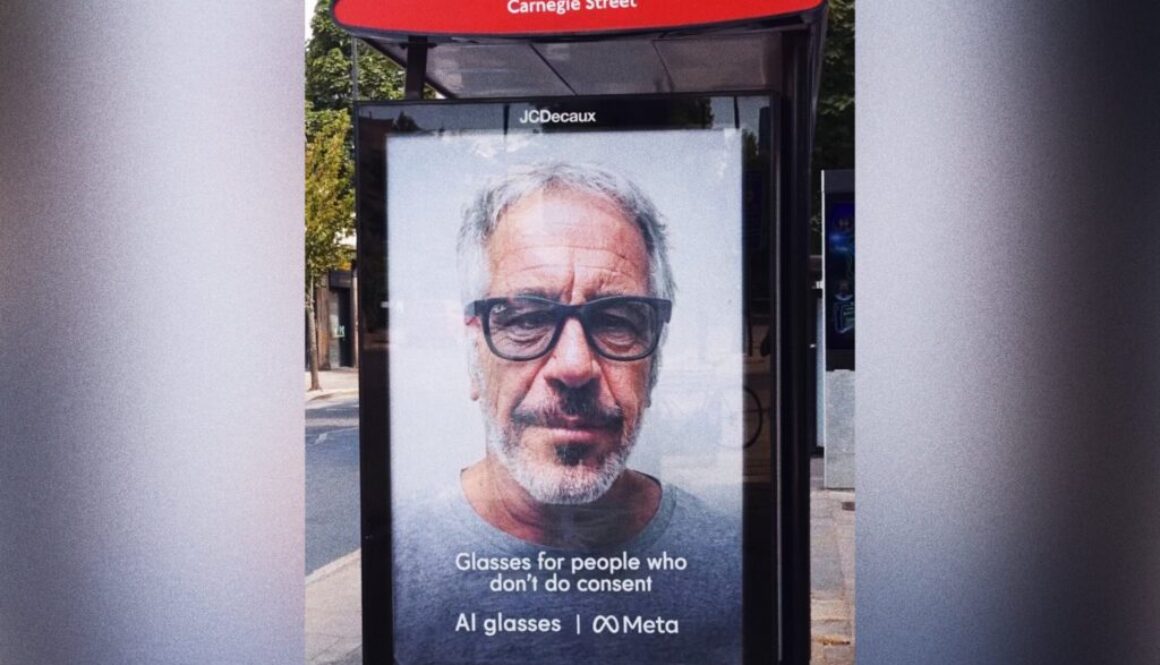
Last week, we came across a cleverly subversive advertisement for Meta’s controversial smart glasses, which overlaid socialite Kylie Jenner’s face with one of the terrifying bug-eyed monsters from John Carpenter’s “They Live” and a bold type caption that reads “We’re always watching” when viewed from a specific angle.
The billboard, created by activist group Everyone Hates Elon, called attention to how Meta’s camera-adorned and AI-enabled spectacles have quickly turned into a privacy-invading nightmare. The optics of the problem is so bad that Meta is now trying to ban “manfluencers” and juvenile pranksters who use the glasses to record members of the public without their consent.
It’s a clear reference to the late criminal’s sex trafficking operation, which recruited dozens of girls, many underage. Grisly documents details how his victims were convinced to go to his beachfront mansion and even bring friends. According to some of their depositions, they were coerced into taking off their clothes without their consent.
While Epstein died in 2019, years before roughly two years before Meta launched the first generation of its smart glasses, the billboard sends a grim message.
Critics argue that glasses that can be used to film strangers without their consent shouldn’t be legal.
“If regulators actually did their damn jobs for once, glasses such as these would be illegal,” one Reddit user argued.
“Pervert glasses have no place in our society,” another wrote.
Apple’s tightly controlled App Store is facing renewed scrutiny after three Bitcoin holders alleged they lost $1.8 million to a fake crypto wallet, adding to a growing list of malicious wallet apps that have reached users despite the company’s screening process.
The lawsuit, filed July 24 in California, accuses Apple of failing to adequately review and remove applications impersonating Sparrow Wallet while promoting the App Store as a safe and trusted source for software.
The case follows warnings dating back more than two years about fake Sparrow apps and comes months after researchers identified 26 applications impersonating major crypto brands across Apple’s ecosystem.
Together, the incidents are putting pressure on one of Apple’s longstanding arguments for maintaining tight control over software distribution: that screening applications before they reach users provides greater protection against fraud and malicious software.
Sparrow developer warned Apple more than a year before losses
Apple’s exposure in the case rests less on the initial appearance of a fraudulent app than on what the company allegedly knew before later victims were hit.
Sparrow founder Craig Raw had been flagging unauthorized mobile versions of his wallet since early 2024. Sparrow is a desktop-only product, so an iPhone app bearing its name should not have required a complex technical investigation to identify as an impersonator.
Yet the complaint says variants carrying the Sparrow name continued to surface inside the App Store over the following year.
The first plaintiff cited in the lawsuit, Jalen Delgado, allegedly downloaded one of those apps in May 2025. After supplying his seed phrase, he lost just over 1 BTC, valued at about $120,000 in the filing.
The alleged notice to Apple became more direct two months later.
James Ramirez says he lost 7.4 BTC, worth approximately $875,000, after using another Sparrow impersonator on July 25, 2025. He reported both the application and the theft to Apple that day.
Christopher Ellis allegedly encountered a Sparrow app through the App Store nine days later. He entered his recovery phrase and lost crypto assets valued at roughly $840,000, according to the complaint.
That sequence is central to the plaintiffs’ case. They are arguing that Apple was no longer dealing only with a previously reported brand impersonation by the time Ellis was targeted. It had allegedly received a fresh report linking a specific fake wallet to a major Bitcoin theft.
The complaint further claims Apple did more than distribute the app. It alleges the platform ranked the Sparrow impersonator and surfaced it within cryptocurrency app collections, potentially increasing the credibility and reach of software masquerading as an established wallet.
According to the lawsuit:
“Despite multiple reports made to Apple that its App Store hosted fraudulent and dangerous applications, Apple failed to warn consumers that spoofed wallet apps, including fake Sparrow applications, had appeared in the App Store and posed a serious risk of theft of cryptocurrency, seed phrases, private keys, wallet credentials, and other sensitive account information.”
Apple says it removed fraudulent Sparrow apps and terminated the developer accounts responsible for them.
The company has also pointed to its reporting channels and said it acts when applications are found to breach App Store rules.
Raw’s experience, however, illustrates the difficulty legitimate developers have faced in stopping the impersonations.
Last month, Raw revealed that he submitted a basic iOS listing intended to tell users that Sparrow had no official mobile version.
Apple initially treated that submission as potentially deceptive and warned that his developer account could be closed, according to Raw, before later reversing course.
The episode adds another layer to the lawsuit’s argument: Apple allegedly struggled not only to keep impersonators out, but also to distinguish the genuine wallet developer from those misusing his brand.
Apple’s App Store fake wallet problem has spread beyond Sparrow
Kaspersky Threat Research said in April that it had identified 26 fraudulent applications mimicking crypto brands including MetaMask, Ledger, Trust Wallet, Coinbase, TokenPocket, imToken and Bitpie.
Fake Crypto Applications on Apple’s App Store (Source: Kaspersky)
The campaign had been active since at least fall 2025 and was linked with moderate confidence to threat actors behind SparkKitty, according to the cybersecurity firm.
The attack was more elaborate than simply publishing a malicious wallet directly through the App Store.
Kaspersky found that the applications could redirect victims to phishing pages designed to resemble Apple’s marketplace and persuade them to install developer profiles. Those profiles could then be used to install trojanized versions of crypto wallets outside the App Store.
Once installed, the malicious software targeted the credentials controlling users’ assets.
For hot wallets, the malware monitored wallet recovery or creation screens for seed phrases. Attackers obtaining those words could then gain control over the victim’s funds.
Cold-wallet users faced a similar social-engineering threat. Fraudulent software impersonating interfaces associated with hardware wallets could persuade victims to surrender recovery credentials that should never be entered into an unverified application.
The campaign largely targeted users of Apple’s Chinese App Store, where official iOS versions of several wallets being impersonated were unavailable.
But significant losses involving fake wallet software have also emerged in the United States.
American musician Garrett Dutton, better known as G. Love, said in April that he lost 5.9 BTC after downloading what he believed was legitimate Ledger software from Apple’s App Store.
Dutton entered his recovery phrase when prompted by the application. His Bitcoin, worth roughly $424,000 at the time, was subsequently transferred away.
Blockchain investigator ZachXBT traced the stolen assets to deposit addresses associated with crypto exchange KuCoin, which temporarily froze a suspected account as the incident was investigated.
The episode closely resembles the allegations at the center of the Sparrow lawsuit: users encountered software carrying the identity of an established crypto wallet through Apple’s ecosystem, trusted it enough to enter recovery credentials and lost control of their assets.
Crypto scams challenge Apple’s App Store security pitch
The repeated incidents are increasingly colliding with how Apple markets its control over software distribution.
Apple describes the App Store as a “safe and trusted place” and says applications undergo a review process intended to protect users from fraud, malware and other security threats.
That promise has also supported Apple’s broader defense of its tightly managed ecosystem.
The company has argued that allowing unrestricted sideloading could weaken privacy and security protections on its devices, while its centralized review process allows potentially dangerous software to be intercepted before reaching customers.
Crypto wallets create a particularly difficult test for that model because an application does not necessarily need sophisticated malware to cause an irreversible loss.
A convincing imitation can be enough.
Seed phrases typically provide control over the assets associated with a self-custodied wallet. Once a user enters those words into malicious software, attackers can transfer the assets to addresses they control, with no bank or payment processor capable of reversing the transaction.
That makes the perceived legitimacy conveyed by an app marketplace especially important for crypto users.
The Sparrow plaintiffs argue that Apple’s own representations encouraged them to believe software distributed through the App Store had been sufficiently vetted. They are seeking reimbursement for their stolen assets, along with compensatory and punitive damages, restitution, and legal fees.
They also want Apple to improve and publicly disclose its procedures for detecting fraudulent applications and introduce warnings about risks associated with cryptocurrency apps.
Whether Apple bears legal responsibility for the losses remains unresolved, and the company can contest both the plaintiffs’ reliance on its security representations and their decision to enter sensitive recovery credentials into third-party software.
Apple also points to the scale of threats its review process already prevents.
The company said last year that the App Store blocked more than $9 billion in potentially fraudulent transactions between 2020 and 2024, including more than $2 billion in 2024 alone.
During 2024, Apple said it rejected nearly 2 million app submissions that failed to meet standards for security, reliability and user experience, while terminating more than 146,000 developer accounts over fraud concerns and rejecting another 139,000 developer enrollment attempts.
Those figures show the scale of malicious activity Apple is attempting to keep outside its ecosystem. They also highlight the stakes when fraudulent financial software gets through.
For crypto users, where surrendering a single recovery phrase can put an entire wallet beyond recovery, the growing list of impersonators is testing how much confidence Apple’s App Store badge should inspire.
Michael Saylor said on Tuesday that Bitcoin has won, and that its gravest danger now comes from within its own ranks. His company, Strategy, has not bought a single BTC in five consecutive weeks.
Blockchain intelligence firm Arkham dissected the pause. Strategy (formerly MicroStrategy) has built a $3.75 billion cash reserve instead. Two clocks are now running at once, and they point in opposite directions.
Why Michael Saylor Is Warning About Bitcoin Now
The timing is not accidental. BIP-110 is a proposed one-year soft fork that would cap the size of arbitrary data fields in Bitcoin transactions. Written by developer Dathon Ohm and shipped in Bitcoin Knots, it began miner signaling on December 1, 2025.
Miners have largely ignored it. That does not stop it.
The proposal’s own deployment schedule sets a mandatory lock-in window for around August 2026. Once that window opens, blocks that fail to signal are rejected as invalid. Lock-in becomes guaranteed. Activation follows two weeks later, and the rules expire on their own about a year after that.
In other words, Saylor is not arguing against something that needs to win a vote. He is arguing against something with a calendar. That window is days away.
What Saylor Actually Said About Consensus Rules
The Strategy executive chairman framed Bitcoin’s consensus rules as a constitution. They define property, scarcity, settlement, and power. Rewriting them to suit any faction, he argued, attacks every participant alive today and every one who comes later.
Bitcoin has won. Now it must survive victory.
Its gravest threat is not an enemy at the gates, but corruption from within: factions that invent pretexts, rewrite the rules, and seize economic rights until freedom becomes permission and law becomes loot.
BIP-110 censors valid fee-paying transactions in his reading.
Covenants create fresh attack surface.
Larger blocks thin out blockspace scarcity and raise validation costs.
His central technical claim concerns miner revenue. Block subsidies halve every 210,000 blocks. Fees must therefore carry more of the security budget over time. Weakening the fee market, he said, disarms the network.
The other side of this argument is well staffed. BIP-110’s backers say arbitrary data embedding burdens node operators and crowds out payments.
Saylor is not the only critic, and critics do not agree with each other. Blockstream chief executive Adam Back also opposes the proposal. His fork risk warning targeted the lowered 55% activation threshold, not censorship.
the reason it doesn’t have consensus is it’s stupid idea, doesn’t work, and completely fails at technical consensus. polar opposite to segwit which did have technical AND ecosystem consensus (modulo a later stage attempt to abuse the activation process to veto what was agreed)
Because equity became cheaper to sell than conviction was to abandon.
A Form 8-K filing dated July 27 confirmed a $525 million addition to the dollar reserve. The total reached $3.75 billion, which the company frames as 2.1 years of dividend coverage against roughly $1.76 billion in annual preferred obligations.
The money came from shares, not coins. Strategy sold $544.5 million of MSTR stock last week. Roughly $467 million and $263.5 million came from share sales in the two weeks before that, or about $1.26 billion across three weeks.
It sold those shares cheap. MSTR trades near $96.66, down about 76% from its 52-week high of $414.36. Every dollar raised this way costs far more equity than it would have a year ago.
Strategy has said it wants 1 million BTC by the end of 2026. It holds 843,775. The gap is 156,225 BTC.
About 22 weeks remain in the year. Closing the gap would require roughly 7,000 BTC per week, or near $447 million weekly at current prices. The company is buying none.
MicroStrategy’s plan versus its current position
Why It Matters for BTC and MSTR Holders
Strategy’s average cost sits near $75,494 per coin. Bitcoin trades around $63,817, down roughly 1.5% over 24 hours and about 49% below its October 2025 peak of $126,080. That leaves the stack close to $9.9 billion underwater on paper.
BTC would need to climb about 18% to return the position to break-even. The Bitcoin price today gives that no help.
The preferred shares explain the urgency. STRC trades near $88.86, still about 11% below its $100 par despite a dividend raised to 12% on July 1 and an authorized buyback programme.
That pressure on STRC shaped the Digital Credit Capital Framework announced on June 29, which cleared buybacks and up to $1.25 billion of Bitcoin sales.
What to Watch Over the Next 30 Days
Three dated events sit inside the window.
BIP-110’s mandatory signaling window is expected to open in August, which would guarantee lock-in regardless of miner support.
Strategy files weekly. A sixth consecutive week without a purchase would extend the longest pause of its accumulation era.
With $3.75 billion banked, the company has removed the near-term need to touch its $1.25 billion Bitcoin monetization authorization.
Strategy BTC holdings versus USD reserve, weekly, 2026, Source: BeInCrypto
Both positions can hold at once. One defends a protocol meant to last a century. The other has to fund a dividend next quarter. The tension is not hypocrisy so much as a scheduling problem, and the schedule is about to get crowded.
ISSUE #12 · JULY 25, 2026
WEEKLY MARKETS & INTELLIGENCE
Issue #12
Ethereum Pushes Toward $2K as the CLARITY Act Clock Hits Its Final Days
Plus: Hoskinson says CLARITY could kill American crypto, Propr brings onchain prop trading to $1M in revenue, and XYO lands on Crypto.com.
August 7 Senate Deadline — Counting Down
Lead Story — Regulatory
The most important deadline in crypto right now isn’t a price level. It’s August 7.
That’s when the Senate leaves for summer recess, and if the CLARITY Act hasn’t passed by then, the window closes until at least 2027. At that point, lawmakers pivot to midterm campaigning, and comprehensive crypto market structure regulation gets pushed back years.
294‑134
House Vote (July 2025)
33%
Polymarket Odds
30%
Galaxy Research Est.
Here’s where things actually stand: the bill cleared the Senate Banking Committee 15‑9 in May. On July 22, Senator Lummis released a new merged draft combining both committee versions, including an ethics provision barring senior officials from issuing their own crypto — but with a 2029 sunset clause and DOJ-only enforcement. Democrats aren’t buying it.
⚠ Sens. Murphy, Van Hollen, and Merkley came out formally opposed on July 14, calling the bill “corrupt” and tied to Trump’s own crypto holdings. Republicans need 60 votes to break a filibuster, hold 53 seats, and Hawley and Paul are expected to vote no. Senate Majority Leader Thune says it may not get floor time before recess.
Prediction markets have moved with the mood. Polymarket has the odds down to 33%, and Galaxy Research just cut its estimate to 30%, down from the high‑30s a week ago. Industry groups including the Blockchain Association and the Digital Chamber are publicly pushing the Senate to act.
If it passes: clear rules on which tokens are commodities vs. securities, a CFTC registration path for exchanges, and regulatory certainty that brings institutional money off the sidelines. If it doesn’t: agencies keep running the show through guidance and enforcement while Congress resets after the midterms. Watch the next two weeks.
This Week on CCS — Interviews
Regulatory · Cardano
The Clarity Act Will KILL American Crypto — Here’s Why
Charles Hoskinson — Founder, Cardano & Midnight Network
Hoskinson breaks down exactly why he believes the CLARITY Act is dangerous for American crypto. He argues the bill creates a “security by default” framework that traps new projects under SEC jurisdiction, outlines the attack vectors regulators could exploit through rulemaking, and warns that implementation could take 15 years while entrenching incumbents and driving innovation offshore.
Onchain Crypto Prop Trading Is Here, and It’s Already Doing $1M in Revenue
Louis Régis — Founder, Propr
Louis Régis, a former Credit Suisse quant who ran the crypto desk at Rothschild & Co, is building fully onchain prop trading where every challenge, rule, and payout is settled onchain and publicly verifiable. Two months in: $1M in revenue, 5,000+ active traders, and 300+ AI agents trading with funded capital. He also covers Propr’s expansion to Polymarket — the first platform to bring funded capital to prediction markets.
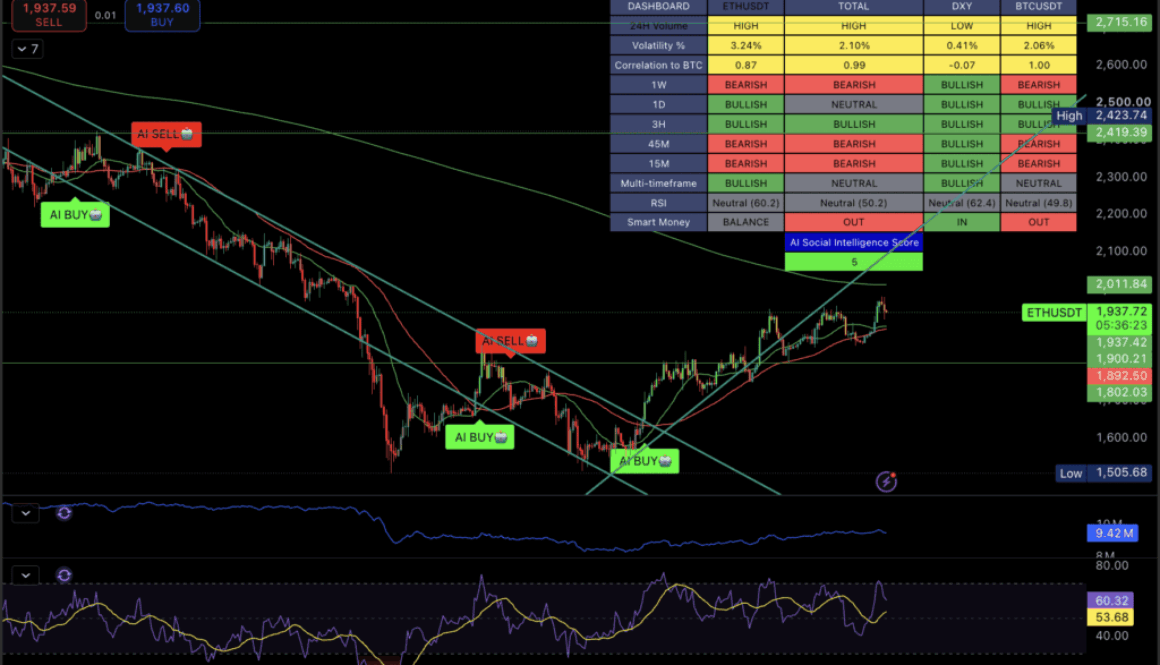
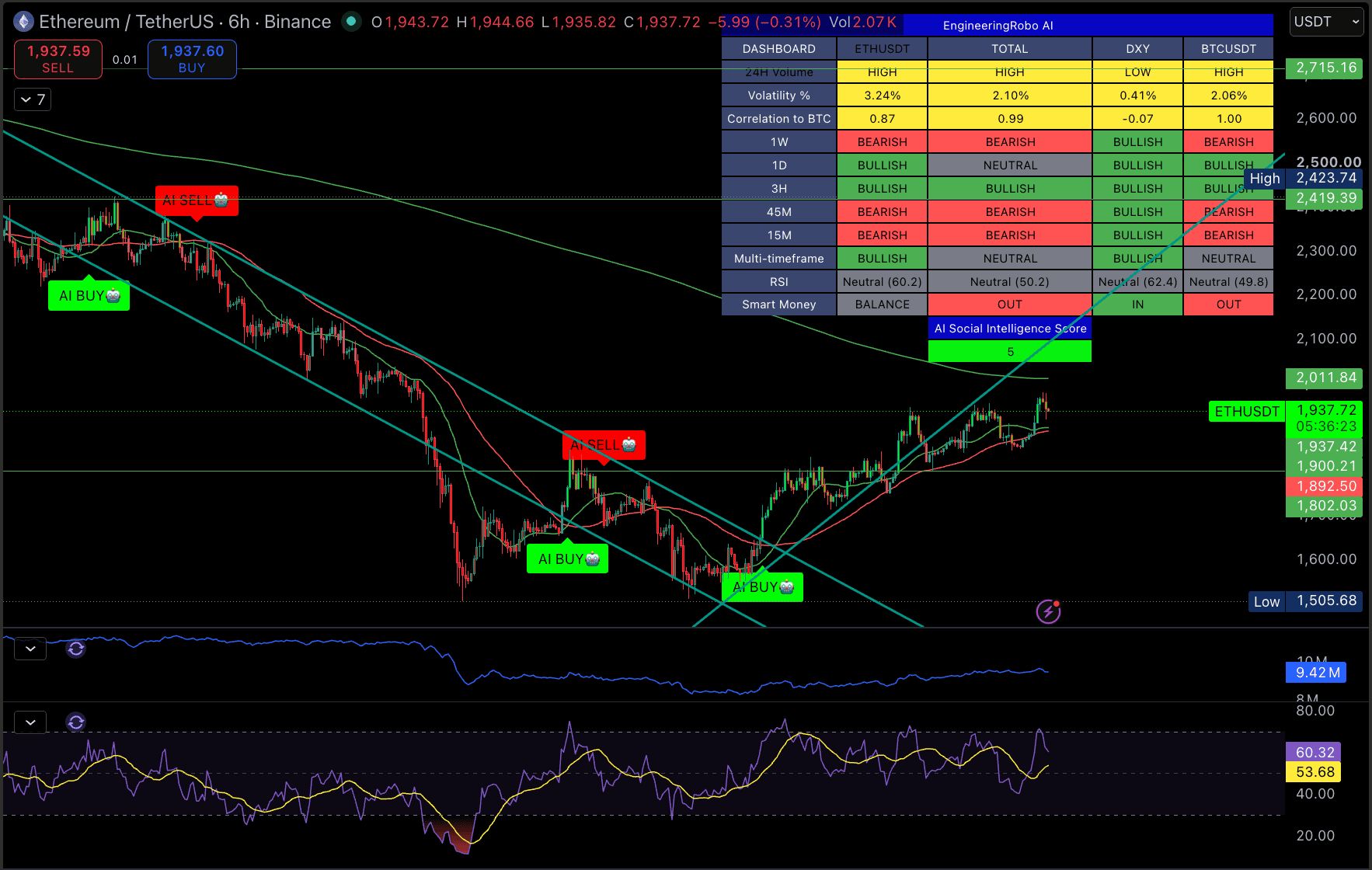
Consolidating just above support. Daily flipped bullish, but Smart Money flow still OUT.
ETH/USDCautiously Bullish
Support $1,900
Resistance $1,944 → $2,011
Holding $1,937 pressing resistance zone. Daily + 3H both bullish. Smart Money shifting to BALANCED.
BITCOIN — ASHTON’S TAKE
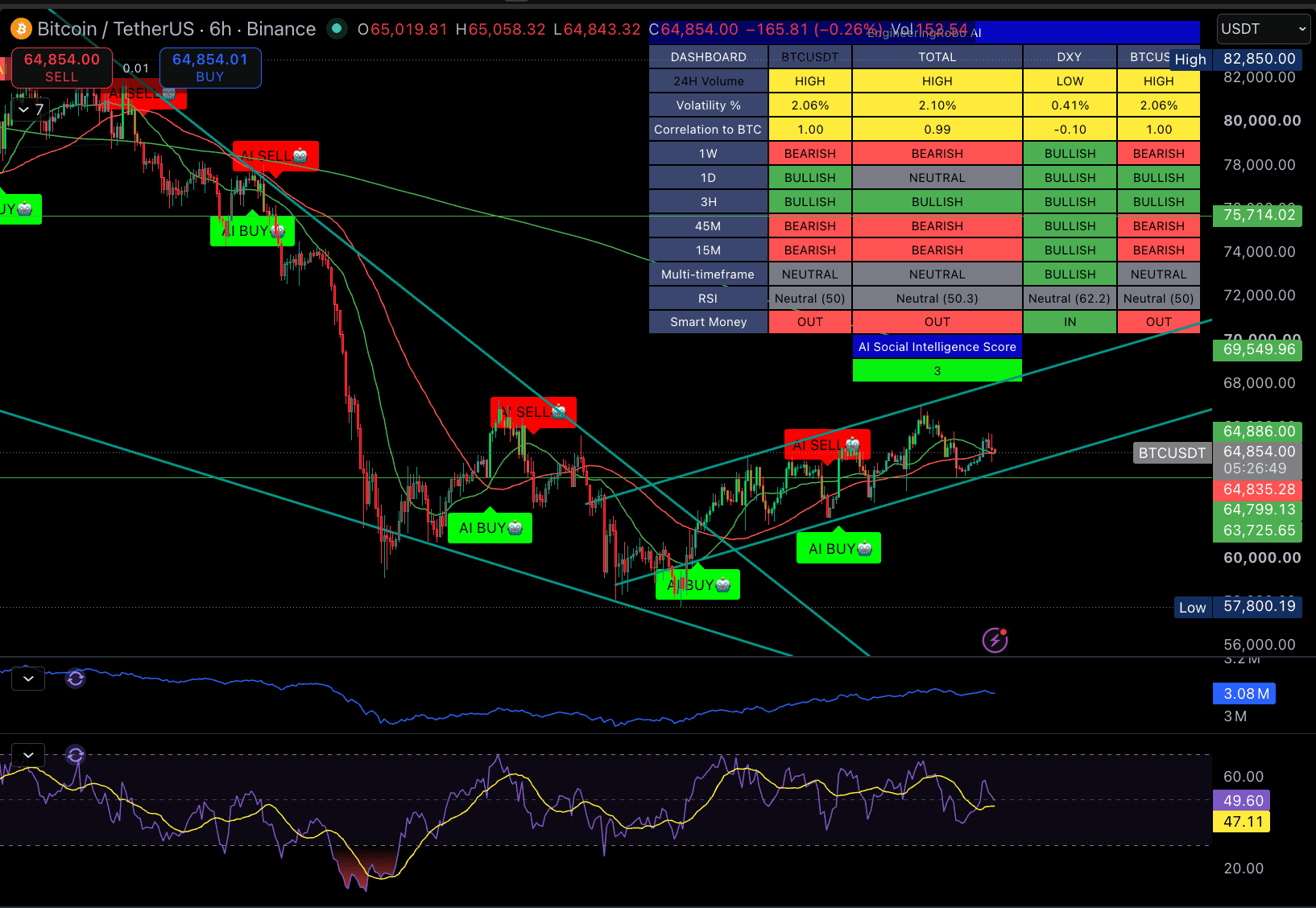
Bitcoin’s momentum has been slow all through July. Price is consolidating just above $63,725 support, grinding sideways rather than trending. RSI sitting neutral in the high 40s isn’t giving a clear read in either direction. The 1D timeframe has flipped bullish — worth watching — but Smart Money flow is still OUT. This is a chop-and-wait setup, not a breakout.
What to watch: Whether $63,725 holds on a closing basis, and whether Smart Money flow flips to IN or BALANCED. That combination is what turns this from indecisive chop into a real push toward $66K.
Ethereum continues to be the standout, holding at $1,937.72 and pressing right up against the $1,944 to $2,011 resistance zone. The daily and 3H timeframes are both bullish — a real step up from Bitcoin’s setup. RSI neutral at 60.2, meaning there’s still room to run. Smart Money flow has shifted to BALANCED, an improvement from OUT.
What to watch: A confirmed close above $1,944. Clearing it with volume opens the door to $2,011, and $2,000 psychological territory becoming the floor instead of the ceiling.
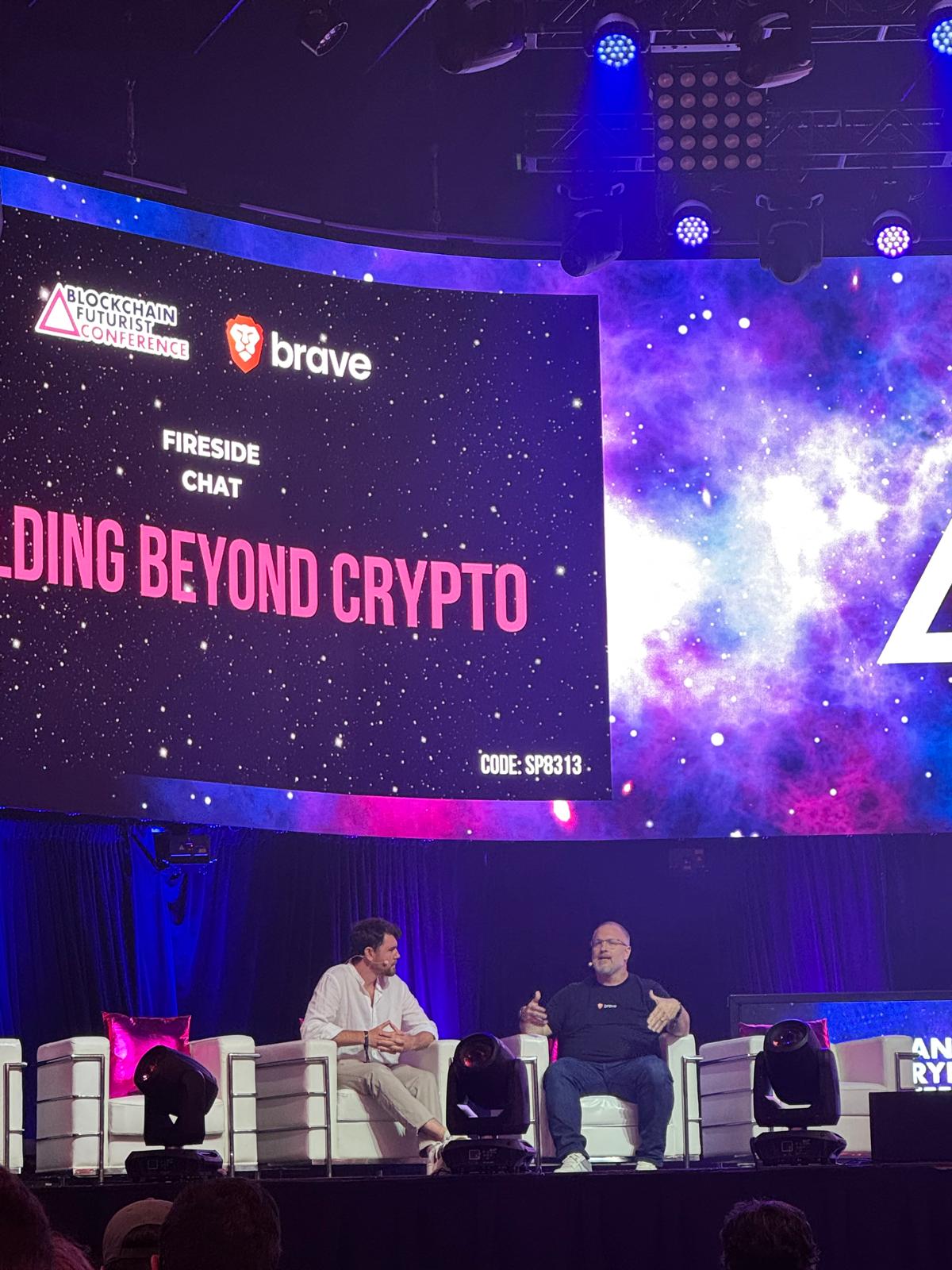
Blockchain Futurist Conference returned home to Toronto for its 9th edition, bringing together 250+ speakers and thousands of attendees at the Rebel Entertainment Complex and Cabana Pool Bar — the largest Blockchain & AI event in Canada.
Over 60 sponsors were on site — Deloitte, KPMG, Wealthsimple, Polymath, and Robinhood — signaling how mainstream this space has become. Ashton sat down with Drew from Brave for a fireside chat covering Brave’s product roadmap, new BAT token integrations, and the Brave Wallet’s expansion to a physical card. Drew confirmed Brave has crossed 120 million users.
Next stop: Futurist Conference roadshow heads to Florida — November 17–18, 2026 at the Seminole Hard Rock Hotel & Casino in Hollywood, FL.
Presented by — Sponsor
🔗 XYO Network — The Original DePIN Protocol
10M+ nodes. A decade of proof-of-work. XYO’s Layer One is built for high-volume data, AI infrastructure, and real-world asset tokenization — with dual tokens $XYO and $XL1.
🔥 Big week for XYO: Crypto.com just listed both $XYO and $XL1, adding institutional-grade custody through Crypto.com Custody. The listing lands right after Crypto.com’s $20B valuation on a $400M raise backed by Citadel Securities — putting XYO alongside the traditional finance players moving into digital assets.
Weekly Signal Recap — Filtered for Signal, Not Noise
★★★
Bitcoin ETFs post ~$900M in inflows — largest week since May. BlackRock’s IBIT led with nearly $475M across the week. Institutional demand is back. But BTC dipped below $65K as the US escalated strikes on Iran and Brent crude surged past $100/barrel.
★★★
CLARITY Act has until August 7. Polymarket odds down to 33%, Galaxy Research cut to 30%. Sens. Murphy, Van Hollen, and Merkley formally opposed the July 22 draft. Thune says it may not get floor time before recess.
★★★
Crypto.com now lists $XYO and $XL1 (our sponsor XYO Network), adding institutional-grade custody. The move comes on the heels of Crypto.com’s $20B valuation and $400M raise with Citadel Securities — another sign of TradFi moving deeper into DePIN. Full story →
★★
Bitmine now holds 4.8% of all ETH supply and is targeting 5%. Tom Lee’s company owns ~5.78M ETH worth ~$10.9B. This week’s purchase was the smallest since launch, pivoting instead to share buybacks.
★★
Strategy raises $263.5M selling MSTR shares, bolsters USD Reserve to $3.2B. Michael Saylor’s pivot from pure Bitcoin accumulation to active treasury management continues to pressure the stock, now down 77%+ over the past year.
★★
Uniswap hits $4.5T in all-time protocol volume. Robinhood Chain crossed $6B in Uniswap volume including a $1B+ single day. New AI trading tools live: DCA bot, index rebalancer, and copy-trade wallet mirroring.
We need to keep this momentum going. Bitcoin holding its range and Ethereum pushing toward $2K is exactly the setup we want heading into the back half of the year — and a real breakout above $2K on ETH could pull the whole market deeper into a Q3 run.
But let’s not get ahead of ourselves. The CLARITY Act is shaping up to be a make-or-break event, and however the Senate lands on it in the next two weeks could be the thing that pushes this market decisively in one direction or the other.
China’s Ministry of Commerce has told the United States to stop threatening to impose sanctions on Chinese artificial intelligence companies.
The ministry has warned that it will take “all necessary measures” to defend its interests if Washington acts against them.
Why did the U.S. sanction China’s AI?
A spokesperson for China’s Ministry of Commerce said the continuous sanction threats from the United States lack any factual or legal grounding and amount to what China calls “AI hegemony.”
Senior U.S. officials reportedly want to investigate Chinese labs over the alleged “distillation” of advanced American models and might sanction them on claims of intellectual-property theft.
The same spokesperson argues that several of the Chinese models shipped at roughly the same time as leading U.S. systems and already rank among the best in certain areas, including front-end coding. Innovation, the spokesperson added, belongs to no single country.
China’s sharpest point is that many U.S. AI firms have distilled Chinese models during research and training, according to the Ministry of Commerce. The ministry also noted that close to 200 U.S. startups have asked their own government not to cut off access to Chinese open-source models, arguing a cutoff would blunt their competitiveness, as Cryptopolitan reported.
A government spokesperson also previously dismissed the theft allegations, calling them an unfounded “smear” rooted in prejudice.
Beijing closed by suggesting both countries honor a consensus reached by the two nations’ leaders.
Why is the money moving to Chinese models?
Cryptopolitan reported that Chinese models now account for 46.4% of routed token traffic on OpenRouter, a platform that lets developers swap between systems, against 35.7% for US-built models. DeepSeek alone contributes 17.6% of that total as of July 2026. A Hugging Face study published March 16, 2026, found Chinese open-source models made up 41% of all open-source model downloads.
The reasons for this massive adoption of Chinese technology are that its compute runs far cheaper, and the U.S. export limits that were imposed earlier in 2026 on frontier models such as Anthropic’s Claude Mythos 5 and Fable 5 created openings that foreign systems filled.
Following Moonshot AI’s launch of Kimi K3 and developers’ claims that the model’s performance is close to Anthropic’s Fable and OpenAI’s ChatGPT, offered at a far lower price, the U.S. has been considering new measures against Chinese technology.
OpenAI’s most recent valuation stood at $852 billion and Anthropic’s at $965 billion, against a reported roughly $30 billion for Moonshot.
Cryptopolitan reported July 20 that the U.S. is likely to impose new procurement rules, renew its threats to add Chinese labs to the Commerce Department’s Entity List, and apply public pressure on American companies that use Chinese models. The Entity List already restricts hundreds of Chinese firms from buying U.S. goods without a license.
Emorya has launched its AI Health Module inside the live app, marking a major product update for the Web3 health and fitness platform as it continues to move beyond its original move-to-earn foundation.
The new module brings AI-powered food scanning into the Emorya app, allowing users to scan meals, analyze what they eat and add calorie intake data directly into their daily health tracking. The feature is now connected to the app’s existing calorie burn system, creating a more complete calorie balance experience where users can compare what they consume against what they burn through activity.
Why Emorya is launching its AI Health Module
This is an important step for Emorya because it changes the app from a movement-focused rewards platform into a broader health tracking product. Instead of only recording activity, the app can now begin to connect both sides of the daily health equation.
Users can see calories burned, calories consumed, macronutrient targets and body progress inside one interface, supported by a visual human-body system designed to make the information easier to understand.
Inside the updated experience, users are shown their daily calorie burn progress alongside their calorie intake target. The app also displays macronutrient categories including protein, carbohydrates and fats, while allowing users to update their weight and scan food directly from the same screen. This gives the product a clearer daily use case and brings Emorya closer to the type of health app experience mainstream users already understand.
Emorya is expanding its product foundation
The launch follows a wider rebuild of the Emorya app, which has included a new user interface, improved user experience, better speed, stronger analytics and a more structured product foundation. These updates give the app a cleaner base for the AI module and help move the platform towards a more accessible consumer experience.
For Web3 health apps, that accessibility is becoming increasingly important. Early move-to-earn products often placed the reward mechanism at the center of the user journey, which appealed to crypto-native users but did not always create a simple experience for broader audiences.
Emorya’s latest update points in a different direction by putting health utility first and allowing the Web3 reward layer to support the product from underneath.
According to Emorya CEO Oliviu Jurjica, the launch of the AI Health Module represents a major milestone in the project’s development.
“It is extremely exciting to see Emorya reach this stage. In the beginning, the app was much simpler, focused mainly on movement tracking and rewarding users for activity. That foundation was important, but the vision was always much bigger.
Over the last phase of development, we have rebuilt the app with a new UI, improved UX, better speed, stronger analytics and more control across the ecosystem. Now, with the AI module approved and live in the app, users can scan their food, analyse what they eat, track calorie intake and compare it live against what they burn through a visual human-body system inside the app.
This changes what Emorya is. It is no longer just a crypto project or a simple move-to-earn app. It is becoming a bridge between Web2 usability, real health utility and Web3 rewards. We are seeing blockchain technology become more abstracted into everyday products, and that gives Emorya a very strong position because the Web3 foundations are already built into the app. As users look for smarter health tools and more rewarding digital experiences, Emorya is ready for that next chapter.”
Is Emorya a health app now?
The launch also gives Emorya a clearer position in the wider health app category. Food scanning, calorie tracking and activity monitoring are already familiar behaviors for many users, but Emorya is combining them with a reward-based model that was built into the platform from the beginning. That gives the app a different route into the market, where users can interact with a familiar health product while also accessing the added value of Web3 participation.
The most important part of the update is that the experience does not need to feel technical. A user does not have to understand blockchain infrastructure to see the benefit of scanning food, checking calorie intake, comparing it with activity and following progress over time.
That is where Emorya’s mainstream potential becomes more practical. The product can lead with health, fitness and daily habit tracking, while the Web3 layer remains part of the underlying value structure.
With the AI Health Module now live, Emorya has moved into a new phase of product development. The app is no longer only about tracking movement and rewarding activity. It now gives users a more complete way to monitor calories consumed, calories burned and nutrition data in one place, supported by a redesigned interface and a clearer health-focused user journey.
For Emorya, the launch is a product milestone as well as a positioning shift. It gives the project a stronger foundation in the mainstream health app category, while maintaining the Web3 reward structure that made the platform different from the start.
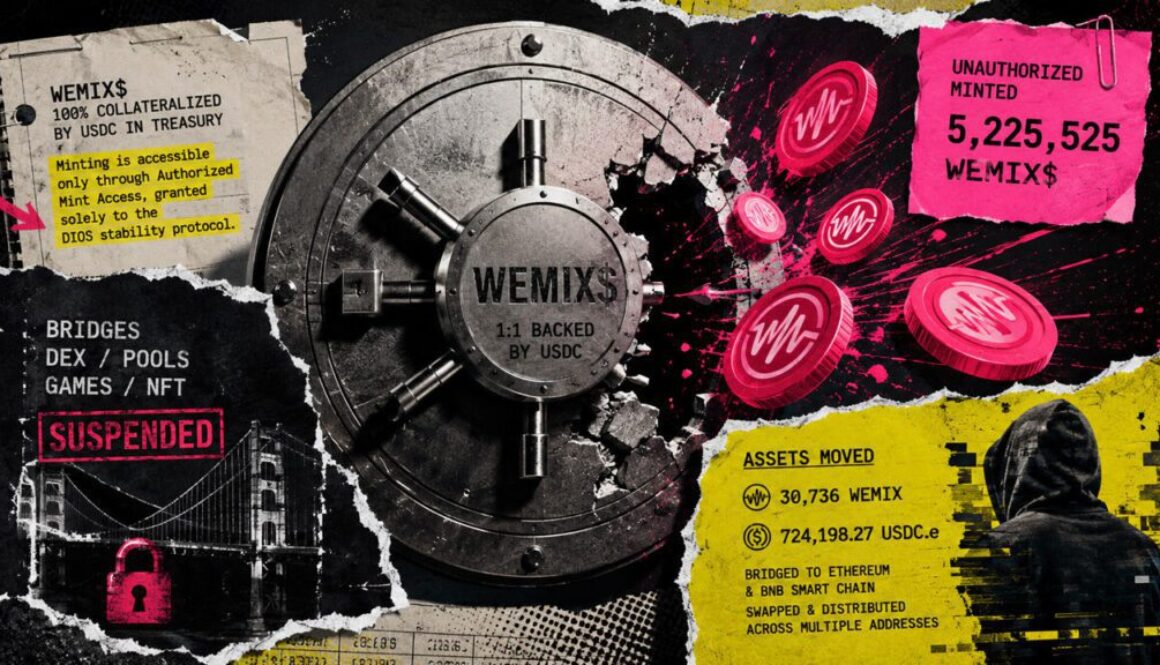
The WEMIX team said compromised ownership of a contract tied to its WEMIX$ stablecoin enabled approximately 5.23 million tokens to be minted without authorization, prompting it to suspend bridges, liquidity pools, and several services on the WEMIX3.0 network.
Contract-owner breach tested WEMIX$’s 1:1 design
The WEMIX3.0 whitepaper describes WEMIX$ as 100% collateralized by USDC held in a Treasury and says its supply should remain equal to the Treasury’s USDC volume. It also says minting is accessible only through Authorized Mint Access, which is granted solely to the DIOS stability protocol.
WEMIX’s preliminary incident update said the abnormal transactions began at 18:17 on July 26 (UTC+9), or 09:17 UTC, after ownership of a WEMIX$-related contract was compromised.
Taken together, the two documents show that owner-level control was used to produce tokens outside the whitepaper’s intended minting path. WEMIX has not disclosed the exact route by which that control was compromised, and its update does not establish that the USDC.e later moved by the attacker came directly from the Treasury.
WEMIX said the 5,225,525 unauthorized WEMIX$ was converted into 30,736 units of the network’s native WEMIX token and 724,198.27 USDC.e, the bridged stablecoin used on WEMIX3.0. The company specifically said the converted USDC.e was bridged to Ethereum and BNB Smart Chain, swapped into assets including ETH and USDT, and distributed among multiple addresses. Some of those assets were later deposited at centralized exchanges.
The nominal number of tokens minted does not establish a $5.23 million loss. WEMIX has not issued a final loss estimate or identified the exchanges involved. It said some exchanges froze attacker-associated addresses after receiving cooperation requests, but did not quantify the frozen amounts or state whether individual user balances suffered losses.
Containment reached bridges, trading, games and NFTs
WEMIX’s July 26 response listed every bridge connected to and from WEMIX3.0 as suspended, including its Chainlink CCIP route and PLAY Bridge. The announcement did not attribute the compromise to Chainlink or report a CCIP failure.
The update also listed trading in the WEMIX-USDC.e, WEMIX-WEMIX$, CROW-WEMIX$, TIPO-WEMIX$ and PLAY-WEMIX$ pools as halted. The WEMIX$ Module and PNIX DEX were paused, blockchain-linked features in some games were restricted, and NFT marketplace trading and bidding were disabled.
The disruption followed WEMIX’s September 2025 announcement that it would phase WEMIX$ out in favor of USDC.e while continuing conversions through the WEMIX$ Module. That module was among the services listed as suspended in the July 26 incident update.
WEMIX had not provided a reopening timetable in that update. The unresolved cause, final impact, frozen amounts and potential user losses leave the scope of the incident dependent on the company’s next findings.