Beijing robot games reward autonomy, and Tiangong Ultra beat two human records
China’s state-backed robotics program has achieved a symbolic breakthrough at the Beijing World Humanoid Robot Games, with Tiangong Ultra sprinting 100 meters in 9.39 seconds, surpassing Usain Bolt’s human record, signaling Beijing’s accelerating investment in embodied AI as a strategic priority through 2030. For institutional investors, the achievement reflects broader state backing and commercialization momentum in humanoid robotics, though performance claims remain largely unverified and actual deployment in industrial or consumer settings still lags far behind the marketing narrative.
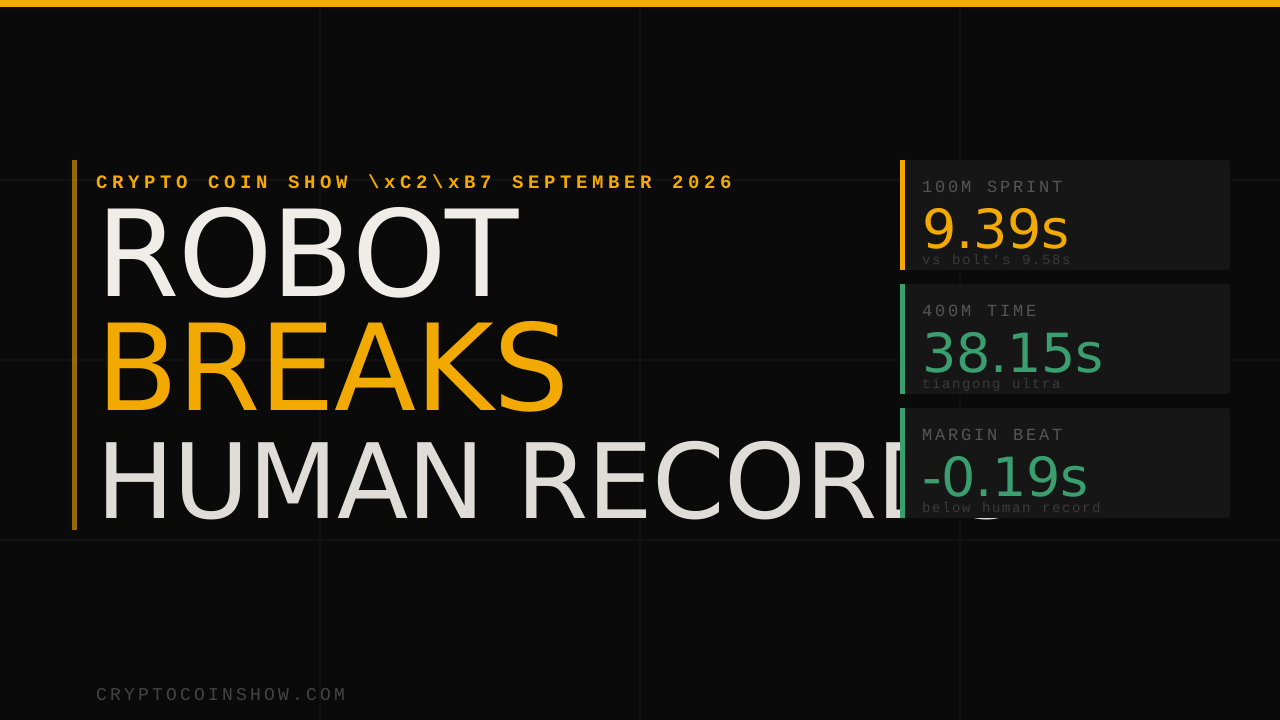
- Tiangong Ultra ran 100 meters in 9.39 seconds, beating Usain Bolt’s 2009 human record of 9.58 seconds
- Same robot completed 400 meters in 38.15 seconds, shaving almost five seconds off the previous world record
- Unitree Robotics Shanghai IPO valued at around $9 billion; company sold over 5,500 humanoids last year, mostly to labs
- 9.39s Tiangong Ultra 100-meter sprint versus Bolt human record
- $9B Unitree Robotics valuation at Shanghai listing on August 19
- 2M Industrial robots already operating in China versus worldwide total
China’s robotics ambitions moved from research laboratory to public spectacle on Saturday when the Beijing Innovation Center of Humanoid Robotics unveiled Tiangong Ultra at the city’s second World Humanoid Robot Games.
The headless machine completed a 100-meter sprint in 9.39 seconds according to state broadcaster CCTV, eclipsing the 9.58-second benchmark set by Jamaican sprinter Usain Bolt in 2009. A separate measurement by X-Humanoid, the manufacturer, clocked the same run at 9.32 seconds.
On Sunday, the same robot tackled the 400-meter distance in 38.15 seconds, removing nearly five seconds from the previous record for that event. The performances came as dozens of humanoid competitors participated in athletics, boxing, football, and martial arts contests at the Olympic speed skating arena in Beijing.
Tiangong Ultra’s Record Sprints Signal State Investment in Embodied AI Infrastructure
The records belong to a robot designed and built with direct government backing, underscoring how seriously Beijing’s policy apparatus treats robotics development. Embodied artificial intelligence ranks among the formal priorities in China’s 15th Five-Year Plan, which covers 2026 through 2030.
The country already operates more than 2 million industrial robots, roughly half the installed base worldwide, making the robotics sector a core economic and technological pillar rather than a fringe research pursuit.
Tiangong Ultra’s performance generated international media attention, with Reuters and other outlets reporting the speed records prominently. Yet the event itself revealed the stark gap between headline achievements and reliable autonomous function. In the 400-meter races, numerous robots either failed to start, moved at walking pace, or collapsed mid-competition.
One boxing robot fell into the ropes and required human operators to carry it off the arena floor. A machine with a white shell swung its arms so dramatically during a run that onlookers questioned whether it would maintain balance.
These failures highlight that record-setting machines in controlled conditions differ fundamentally from robots capable of sustained, independent operation in unstructured environments.
Spectator reactions underscored skepticism about the practical relevance of speed records. Hou Yali, a 72-year-old Beijing retiree who attended the games, noted that “right now, this is just running, just a competition of speed. It’s not a test of intelligence,” and expressed preference for seeing robots perform household tasks.
That sentiment captures the central tension in China’s robotics investment thesis: demonstrable hardware breakthroughs in narrow domains do not yet translate to the embodied intelligence needed for real-world deployment in homes, factories, or service sectors beyond entertainment and research.
Unitree IPO and Unverified Performance Claims Expose Verification Gap in Sector
The games coincided with a major market milestone in robotics commercialization. Unitree Robotics, a leading Chinese manufacturer, completed a Shanghai listing on August 19 at a valuation near $9 billion.
The company sold more than 5,500 humanoids in the prior year, though the vast majority went to research institutions and entertainment venues rather than to end-use customers in industry or consumer markets.
That distribution pattern suggests the sector remains dependent on government research spending and tourism revenue rather than on organic commercial demand from enterprises with concrete operational needs.
Unitree has made aggressive claims about its Superman model, asserting a maximum speed of 12.66 meters per second and a standing jump height of two meters. The company has released no independent third-party verification of those figures; they derive solely from Unitree’s own video demonstrations.
The same absence of external validation applies to X-Humanoid’s slightly faster 100-meter time of 9.32 seconds compared to CCTV’s 9.39-second measurement. Without standardized testing protocols and independent verification, investors lack reliable benchmarks to assess which manufacturers are genuinely advancing the technology and which are optimizing for publicity.
Honor, the smartphone maker, entered the games with two autonomous machines that completed an unmarked course. One finished in 50 minutes and 26 seconds running autonomously; the faster Lightning model traversed it in 48 minutes and 19 seconds but required remote control, so the event organizers multiplied that time by 1.2 under their autonomy rules.
Autonomous Operation Emerges as Regulatory Dividing Line for Future Competition
The games’ autonomy multiplier rule, penalizing remote-controlled robots by a 1.2x time penalty, signals a critical distinction that will shape the investment case going forward. The gap between a machine that executes pre-programmed movement sequences in a predictable environment and a robot that navigates obstacles and makes real-time decisions without human intervention is vast.
Tiangong Ultra’s 100-meter record does not specify whether the sprint was fully autonomous or triggered by remote activation; the headless design raises questions about onboard sensing and decision-making capacity. Likewise, Unitree’s sold units flowing primarily to research labs rather than operational deployments suggest that genuine autonomy in unstructured settings remains unsolved.
China’s formalization of robotics as a five-year strategic priority, combined with the state backing for Tiangong Ultra and the $9 billion public market valuation of Unitree, creates institutional pressure to demonstrate progress toward economic applications. Yet speed records in athletics competitions are the easiest benchmarks to game.
A robot optimized for a straight 100-meter dash bears little resemblance to a system capable of autonomous navigation, task switching, and safe human collaboration in factory floors or service environments.
The next phase of the investment thesis will depend on whether manufacturers can transition from record-setting stunts to repeatable performance in uncontrolled, real-world deployment scenarios.
Institutional investors should monitor whether Unitree’s Shanghai listing creates pressure for the company to demonstrate commercial unit sales (beyond research) and whether independent testing bodies establish verification standards for speed and autonomy claims. The August Beijing games attracted global media attention, but the lack of third-party validation for Tiangong Ultra, Unitree Superman, and competing systems leaves the investment thesis hostage to manufacturer claims and state-media reporting. The next defining metric will be whether any of these machines achieve sustained operational deployment, with verified performance data, in real manufacturing or service applications by the end of China’s 15th Five-Year Plan in 2030, or whether robotics remains confined to record-setting performances and research lab environments.