SaaS and eCommerce partners now represent 55.54% of NOWPayments merchant base
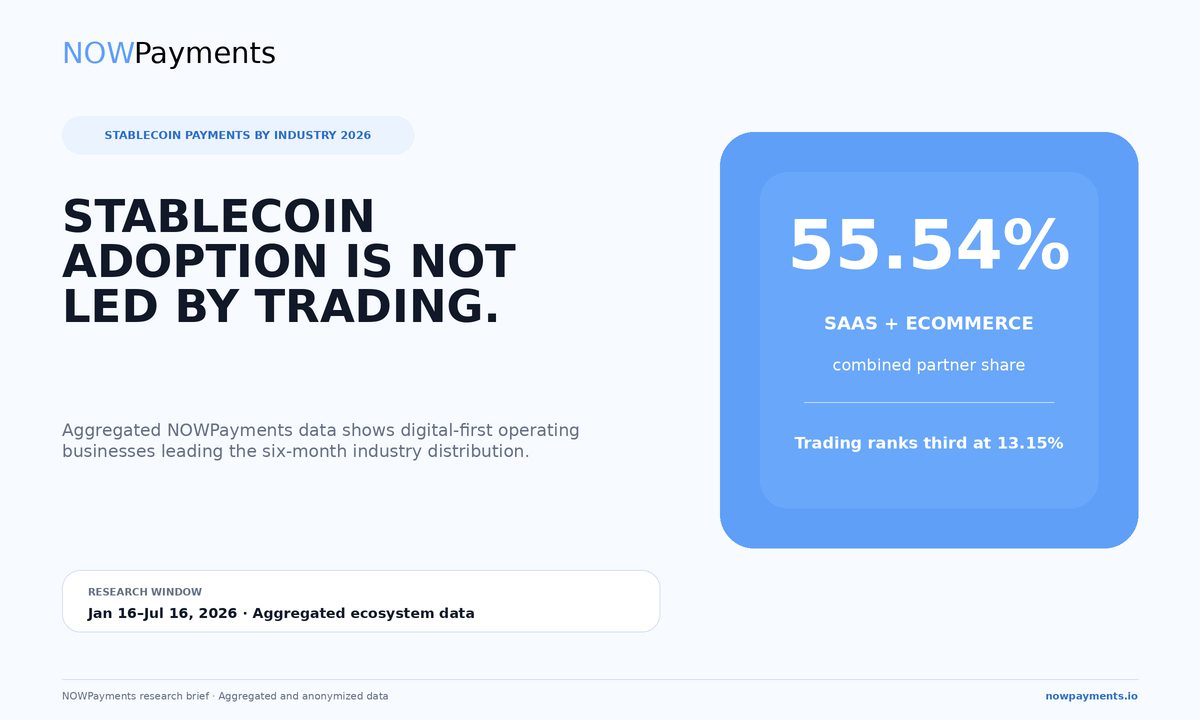
NOWPayments data reveals stablecoins are shifting from trading speculation toward recurring business operations, SaaS and eCommerce now account for over half of the payment platform’s classified partners, up from 48% a year earlier. This structural shift signals institutional adoption is maturing beyond volatility plays into the operational infrastructure of digital commerce.
- SaaS and Web Services grew from 15.58% to 27.78% of NOWPayments partners in one year, a 12.20 percentage point increase
- Combined SaaS and eCommerce share rose 7.28 percentage points year-over-year to 55.54% of classified partners
- Trading platforms declined from 14.07% to 13.15% of the sample, signaling stablecoins are now primarily operational tools rather than trading vehicles
- 27.78% SaaS and Web Services share of NOWPayments partners in 2026 versus 15.58% in 2025
- 55.54% Combined SaaS and eCommerce share in 2026 versus 48.26% one year prior
- 54.58% USDT on TRON’s share of successful eCommerce payments versus 12.04% in trading
Stablecoin adoption is cementing itself as operational infrastructure for digital businesses rather than remaining confined to trading and speculation. According to data released by NOWPayments, a cryptocurrency payment platform supporting over 350 digital assets, the composition of its merchant base has tilted decisively toward SaaS platforms and online marketplaces in the first half of 2026. Between January 16 and July 16, 2026, SaaS and Web Services accounted for 27.78% of classified partners, nearly matching eCommerce Marketplaces at 27.76%, together representing 55.54% of the sample. A year earlier, during the same window in 2025, these two sectors combined for only 48.26%. The shift reflects a fundamental reorientation: businesses are no longer treating stablecoins primarily as volatile assets to trade, but as settlement rails that integrate with billing, checkout, reconciliation, and payout workflows.
SaaS Adoption Nearly Tripled While Trading Platforms Retreated
The most dramatic movement in NOWPayments’ partner data is the expansion of SaaS and Web Services, which nearly doubled its share in twelve months. SaaS grew from 15.58% in early 2025 to 27.78% by mid-2026, a gain of 12.20 percentage points and a 78% relative increase.
This growth closed the gap with eCommerce, which had dominated the dataset at 32.68% in 2025 but held at 27.76% by 2026, suggesting mature adoption rather than explosive new merchant acquisition in that sector.
Trading platforms, by contrast, moved in the opposite direction. Their share declined from 14.07% to 13.15%, leaving them in third place for the first time in this measurement.
Financial Services also contracted, falling from 9.00% to 6.35%. The data suggests that institutional and retail traders have consolidated their venues and are not diversifying stablecoin infrastructure at the same pace as operational businesses.
Smaller categories including Gambling and iGaming (6.87%), Adult Platforms (5.89%), and Charity (1.40%) remained relatively stable or experienced modest shifts.
This rebalancing indicates that institutional investors should track stablecoin adoption not by raw transaction volume or cryptocurrency trading pairs, but by penetration into businesses that use digital assets as payment rails in their core operations.
Network Preferences Diverge Sharply by Business Model
The choice of stablecoin and blockchain network varies dramatically across industries, according to NOWPayments’ successful-payment data. USDT on TRON (USDt TRC20) accounted for 54.58% of completed eCommerce transactions, by far the dominant settlement method in that sector, yet represented only 12.04% of trading activity and 9.60% of SaaS payments. Within eCommerce, USDT TRC20 was approximately 4.5 times more prominent than in trading and 5.7 times more prominent than in SaaS.
This divergence reflects different operational requirements. eCommerce platforms prioritize speed and cost efficiency at checkout; TRON’s lower transaction fees and faster finality serve that goal. Trading platforms require broader network and asset coverage for liquidity and treasury flexibility.
SaaS businesses, handling recurring billing and reconciliation, may lean on different networks that integrate with accounting systems and settlement expectations. The data underscore a critical point for infrastructure developers: a single stablecoin and network cannot be optimized for all use cases simultaneously.
Define the Workflow Before Choosing the Asset
Kate Lifshits, Commercial Director at NOWPayments, articulated the strategic inversion that the data reveals: “The mistake is asking which stablecoin is best. The better question is: best for what?”
Businesses should define the billing, checkout, settlement, payout, and reconciliation flow first. The coin and network should serve that workflow, not the other way around.
Kate Lifshits, Commercial Director, NOWPayments
Five operating workflows determine stablecoin infrastructure needs. Billing connects payments to invoices, subscriptions, and account renewals, critical for SaaS. Checkout determines which assets and networks actually complete customer transactions. Settlement defines which stablecoin the business receives and timing of fund availability.
Payouts route funds to sellers, affiliates, contractors, or end users, essential for marketplaces. Reconciliation automates matching transactions with internal accounting systems and orders.
Not all businesses require all five: a SaaS platform may prioritize billing and reconciliation; a marketplace may need checkout, settlement, and payouts; a trading platform may focus on network coverage and liquidity.
The strategic implication is that stablecoin selection should follow workflow definition, not precede it.
The CCS read. We see institutional adoption of stablecoins maturing from trading speculation into operational integration. The shift from 15% to 28% SaaS adoption in one year signals that Fortune 500 operational technology leaders, not crypto-native traders, are now the marginal buyer of stablecoin infrastructure. This favors stablecoins with billing automation and reconciliation tooling over those optimized for velocity or treasury reserve appeal.
The dataset raises an open question: whether this rebalancing reflects SaaS businesses discovering stablecoins for the first time, or existing SaaS merchants increasing transaction volume through existing NOWPayments integrations. NOWPayments has not disclosed absolute partner growth, only shifts in share, leaving institutional investors without visibility into whether total merchant acquisition has accelerated, stalled, or contracted. A follow-up dataset comparing absolute partner counts and transaction volume trends by sector would clarify whether the workflow-first approach is driving net new merchant adoption or simply redistributing existing payment flows.