
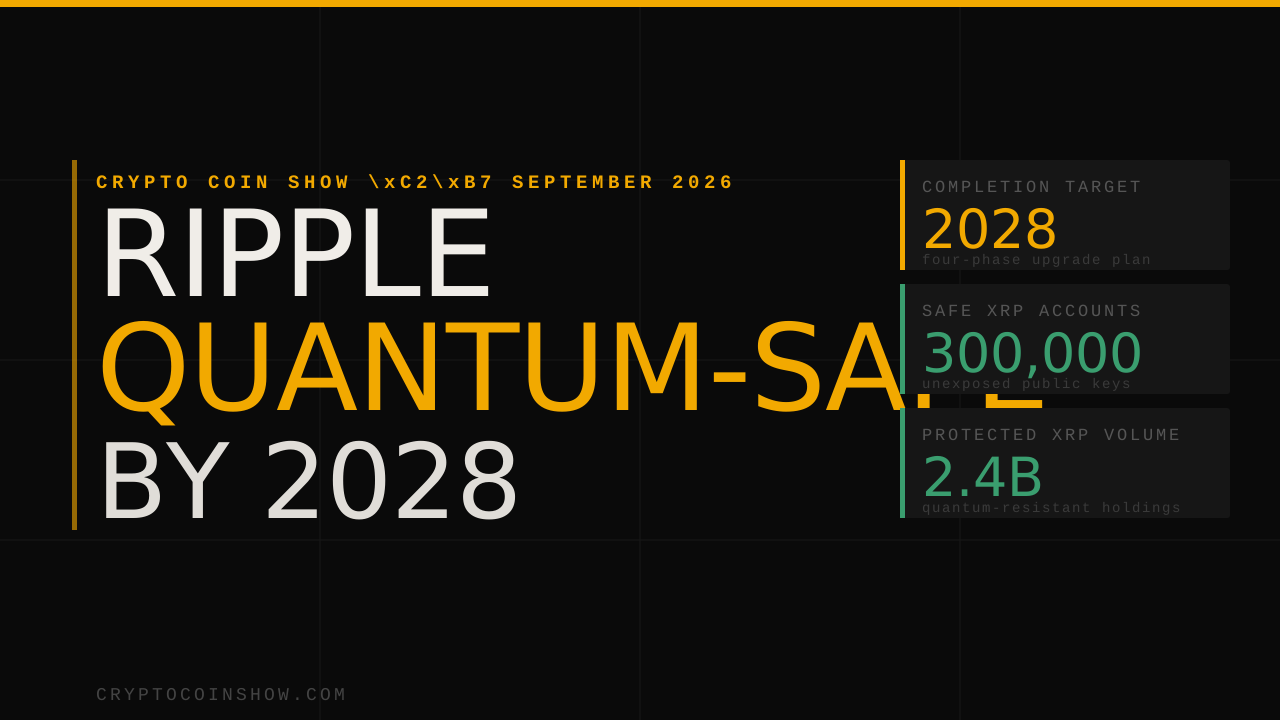
Ripple reveals a four-phase plan to make the XRP Ledger quantum-safe by 2028
Ripple has unveiled a four-phase roadmap to make the XRP Ledger quantum-resistant by 2028, responding to mounting industry concern that quantum computers could break the cryptographic foundations securing blockchain networks. For institutional investors, the timeline signals both urgency around a technical threat and an opportunity to assess which networks are preparing defenses versus those still treating quantum risk as distant theory.
- Ripple targets 2028 completion for full XRP Ledger quantum-safety upgrade via four distinct implementation phases beginning now.
- Approximately 300,000 XRP accounts holding 2.4 billion XRP remain quantum-safe because their public keys have never been exposed on-chain.
- Recent Google Quantum AI research has elevated quantum risk from theoretical to credible, forcing networks to prioritize post-quantum cryptography adoption timelines.
- 2028 Target year for complete XRP Ledger quantum-resistance upgrade versus current baseline security.
- 300,000 XRP accounts with 2.4 billion total XRP unexposed to quantum attacks today.
- 2026 Year Phase Two begins with formal testing of post-quantum security methods and privacy research.
Ripple has moved faster than most blockchain networks in confronting the quantum computing threat, publishing a detailed four-phase plan to make its XRP Ledger resistant to quantum attacks by 2028.
The timeline addresses a concern that has shifted from academic speculation to credible near-term risk following recent research from Google Quantum AI showing that quantum computers sufficiently powerful to break widely-deployed cryptography could emerge within the next decade.
The roadmap reflects a broader industry split: while some networks remain skeptical of the threat, others are treating quantum-resistant upgrades as infrastructure priorities requiring years of testing and coordination.
Google Research Elevates Quantum Threat From Theoretical to Credible Risk
The Google Quantum AI paper reignited industry concern by demonstrating that the elliptic curve cryptography protecting blockchain wallets, transaction approvals, and digital asset storage could be vulnerable to sufficiently advanced quantum computers.
Most major blockchains, including Bitcoin and Ethereum, rely on this class of cryptography, creating a systemic vulnerability if quantum hardware advances faster than expected. The finding has split industry opinion sharply: some participants, including MicroStrategy founder Michael Saylor, have dismissed the concern as overblown, while others view it as requiring immediate preparation.
Ripple’s assessment differs. In its announcement, the company stated that “the threat has moved from theoretical to credible, and preparation timelines now matter.” The company also flagged a less-discussed vector called “harvest now, decrypt later,” in which bad actors collect encrypted blockchain data today and store it for decryption once quantum computers become powerful enough.
This attack surface means institutions cannot simply wait until quantum computers are demonstrably powerful before beginning upgrades; the window for protecting historical data closes today.
The threat has moved from theoretical to credible, and preparation timelines now matter.
Ripple, in company announcement
Other networks are beginning similar work. Tron founder Justin Sun indicated his blockchain is evaluating post-quantum technical defenses, and various research teams are exploring quantum-resistant alternatives based on lattice cryptography and other methods designed to withstand quantum attacks.
Ripple’s Four-Phase Roadmap Allocates Five Years for XRP Ledger Quantum Upgrade
Phase One, starting immediately, focuses on emergency preparedness. Ripple is building tools enabling users to migrate assets to post-quantum encryption schemes, including zero-knowledge proof methods that would function even if current cryptography is compromised. This phase treats quantum risk as imminent enough to warrant defensive infrastructure now, before Phase Two begins formal testing.
Phase Two launches in early 2026 and runs through year-end, involving formal research into quantum risks and testing of new security tools in collaboration with Project Eleven, an external research initiative. By the end of 2026, Ripple will test advanced post-quantum security methods and explore new privacy-preserving techniques.
Phase Three, spanning 2027, encompasses the formal transition work preparing the entire XRP Ledger for cryptographic upgrade. The fourth and final phase, completing by 2028, deploys native post-quantum cryptography across the entire ledger via formal network amendment, making the protocol resistant to quantum attacks.
The five-year timeline reflects the complexity of upgrading a decentralized network. Unlike centralized systems, blockchain changes require consensus among validators and developers, testing on testnets to prevent unintended breaks, and coordination across custody providers, exchanges, and wallet operators who must support the new cryptographic standards.
XRP’s Current Quantum Exposure Is Lower Than Bitcoin’s Due to Account Age Distribution
An important detail distinguishes XRP Ledger’s quantum vulnerability from Bitcoin’s. Quantum computers pose the greatest risk to wallets where the public key has already been published on-chain, which typically occurs after a wallet’s first transaction.
An April 2026 audit by XRPL validator “Vet” found that approximately 300,000 XRP accounts, collectively holding 2.4 billion XRP, have never executed a transaction and therefore have no publicly exposed cryptographic keys. These accounts remain immune to quantum attacks under current threat models because their public keys remain hidden.
Bitcoin’s holder base skews older, with a far larger proportion of accounts that executed transactions years or decades ago, exposing their public keys to quantum decryption risk.
The same audit noted that only two major dormant XRP accounts with combined holdings exceeding 21 million XRP have remained inactive for more than five years, suggesting most XRP holders either trade regularly or hold on exchanges, where private key management differs from self-custody scenarios.
This distinction matters for institutional custody and risk models. If a significant portion of an institution’s XRP holdings are in newly funded accounts that have never transacted on-chain, quantum risk from those specific holdings is currently lower than for similarly sized Bitcoin positions.
Institutional Investors Face Timing Risk as Quantum Threat Accelerates Timeline
The shift from theoretical to credible quantum threat compresses institutional decision-making timelines. Five years is a short window for upgrading a protocol relied upon by exchanges, custodians, and asset managers managing billions in value. Institutions must now decide whether to treat quantum-resistant upgrades as core infrastructure priorities or allocate resources assuming longer timelines.
Ripple’s public roadmap gives market participants specific milestones to monitor: Phase Two testing in 2026 will reveal whether post-quantum methods can be deployed without breaking wallet interoperability or exchange settlement processes.
The Google research also raises competitive questions among layer-one protocols. Networks that complete quantum-resistant upgrades first may attract institutional capital seeking maximum cryptographic assurance, while networks remaining on classical cryptography face increasing regulatory and operational scrutiny.
Some institutions may require quantum-resistant custody or settlement before adding to positions in networks still running unencrypted key material.
Ripple will publish Phase Two results by end of 2026, providing the first real-world test data on whether post-quantum cryptography can scale on a live decentralized network. Institutions should monitor that testing window closely to assess whether Ripple’s timeline is achievable and whether other networks, particularly Bitcoin and Ethereum, announce comparable roadmaps before the 2028 target. The absence of formal quantum upgrade plans from larger networks by mid-2026 would signal either technical confidence in longer timelines or institutional risk that upgrades may prove more difficult to coordinate than Ripple’s sequential phases assume.