
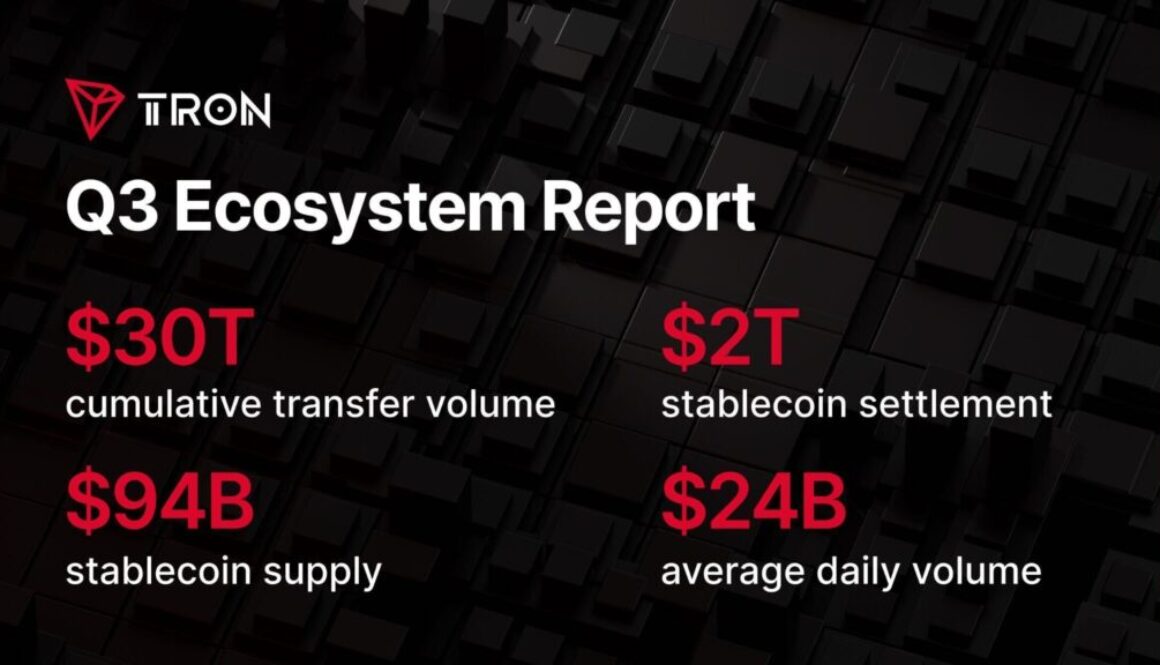
TRON processed $2.21 trillion in stablecoin settlements during Q3 2026
TRON’s stablecoin settlement volume reached $2.21 trillion in Q3 2026, underscoring the network’s role as infrastructure for institutional dollar transfers and cross-border payments. The $30 trillion milestone in cumulative transaction volume, combined with new ETF access and custody integrations, signals institutional demand for on-chain settlement at scale.
- Stablecoin settlement volume hit $2.21 trillion in Q3 2026, up 3.9% from Q2 to $24.05 billion average daily volume
- TRON surpassed $30 trillion cumulative transaction volume; active monthly addresses grew 9.8% to 18 million
- Canary Capital’s spot TRX ETF launched September 9 with staking rewards; TRON DAO rang Cboe Closing Bell September 29
- $2.21T Third-quarter stablecoin settlement, marking TRON’s role as dollar transfer layer
- $93.88B Combined USDT and USDD supply on TRON, up 5.5% from second quarter
- 18M Average monthly active addresses, up 9.8% quarter-over-quarter
According to the TRON DAO Q3 2026 report, the network processed $2.21 trillion in stablecoin settlement during the quarter, with average daily volume climbing to $24.05 billion from $23.14 billion in Q2. The milestone reflects sustained institutional use of TRON as infrastructure for USDT transfers and emerging-market payment corridors. Cumulative transaction volume on the network surpassed $30 trillion for the first time, a measure of total historical throughput rather than active settlement. The network’s active-address base widened to 18 million monthly average users, though transaction frequency remained flat quarter-over-quarter.
Canary Capital debuts first U.S. spot TRX ETF with daily staking rewards
Canary Capital launched the Canary Staked TRX ETF (ticker TRXS) on the Cboe BZX Exchange on September 9, 2026, marking the first U.S. spot exchange-traded fund to bundle exposure to TRON’s native token alongside passive staking yields.
The product gives institutional investors direct access to TRX price appreciation and net staking rewards accrued daily in the fund’s net asset value, eliminating the need for manual delegation or custody of private keys. TRON DAO’s leadership rang the Cboe Closing Bell in Chicago on September 29 to mark the launch, a ceremonial step toward mainstream institutional adoption of the network.
The ETF removes friction for U.S. fund managers seeking TRON exposure within regulatory guardrails.
Anchorage Digital, Ethena, and five partners expand institutional on-ramps
TRON expanded its institutional infrastructure in Q3 through five new integrations spanning custody, staking, trading, and stablecoin issuance. Anchorage Digital added TRX staking and TRC-20 token custody to its institutional platform, while Bitnomial and Backpack opened new markets for TRX spot trading.
Ethena brought its USDe and sUSDe yield-bearing stablecoins to TRON, and Ducat connected its Bitcoin-backed financial products to the network’s dollar ecosystem. On the payment and developer side, MoonPay introduced gasless transaction rails through Trust Wallet, removing the requirement to hold TRX for network fees, and Bitcoin.com Wallet added native TRX and USDT-TRC20 support.
MetaMask expanded connectivity across B.AI, SUN.io, JustLend DAO, and BitTorrent, while Fireblocks Flow added outbound payment support for TRON wallets. Eco and STON.fi extended cross-chain stablecoin bridges, and KiiChain linked TRON assets to 24/7 foreign-exchange infrastructure.
For developers, Privy expanded wallet and transaction-policy management, and OpenZeppelin ported its smart contract libraries to the network. These additions target three institutional use cases: treasury management for corporates holding stablecoins, DeFi liquidity for capital formation, and payment infrastructure for merchant settlement.
Stablecoin supply grows 5.5% while daily fees decline on higher throughput
Total USDT and USDD supply on TRON reached $93.88 billion in Q3, up 5.5% from the prior quarter and representing over 94% of the network’s circulating stablecoin base. Total value locked, including staking, hit $28.21 billion; DeFi TVL alone stood at $13.05 billion.
Network fees totaled $701.4 million in Q3, averaging $7.62 million per day, down 4.0% quarter-over-quarter despite the 9.8% growth in monthly active addresses. Average daily transaction fees fell from $0.668 to $0.643, reflecting marginal cost efficiency as the network spreads fixed infrastructure costs across a wider user base and higher settlement volumes.
The fee compression signals improved unit economics for high-volume payment operators and corporate treasurers routing stablecoins through TRON.
The CCS read. We see institutional adoption playing out in real-time: ETF access and custody integrations are the plumbing, but the $2.21 trillion stablecoin throughput is the business. TRON’s fee decline as users grew 9.8% shows protocol-level economics favour settlement operators over network holders, a structural advantage for long-term payment infrastructure, not necessarily for TRX token holders seeking yield or appreciation. The question unresolved by this report is whether staking yield alone can compete with competing settlement networks as institutional operators arbitrage fee differences across chains.
Institutional investors should monitor TRON’s stablecoin settlement volume in Q4 2026 and early 2027 to assess whether the ETF launch and custody partnerships accelerate adoption, particularly as other chains expand their own institutional on-ramps. The open question is whether TRON’s fee advantage can persist if Ethereum’s Layer-2s or Solana match USDT support and lower transaction costs further; the network’s next earnings catalyst will likely be a major corporate treasury announcement or central-bank settlement pilot.