
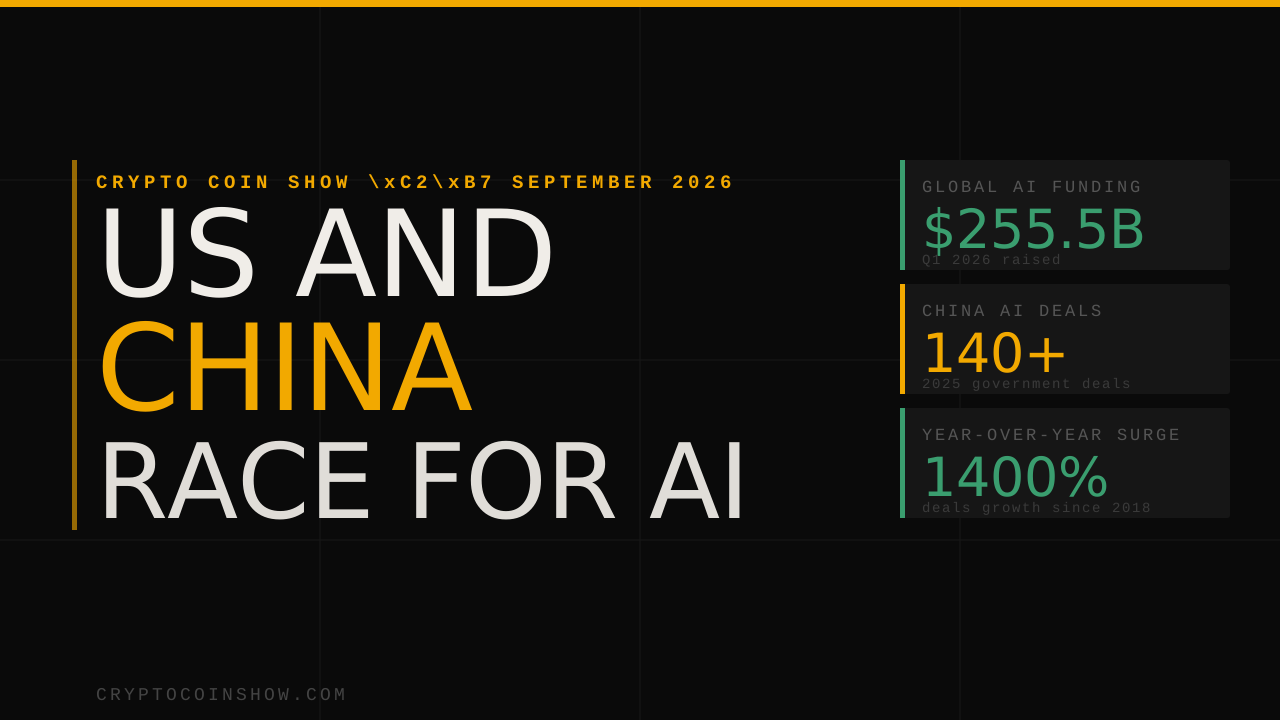
US and China pour record capital into AI as funding race intensifies on both sides
The United States and China are competing for dominance in artificial intelligence through massive, coordinated capital deployment, with both nations erecting investment barriers to protect domestic champions from foreign competition. For institutional crypto and blockchain investors, this geopolitical tech race reshapes the infrastructure landscape that underpins digital assets and decentralized finance.
- Global AI startups raised $255.5 billion in Q1 2026, while Chinese AI ventures separately pulled $16.2 billion in the same period.
- China’s government-linked investors participated in over 140 AI deals in 2025, a fourteenfold jump from 10 deals annually before 2018.
- Both nations have implemented capital restrictions: the US banned American investors from Chinese AI firms in January 2025; China reciprocated in April 2025 after Meta’s Manus acquisition.
- $144.45B Estimated scale of China’s national venture capital guidance fund for AI and hard tech
- 140 AI deals backed by Chinese government-linked investors in 2025 versus 10 annually pre-2018
- $45-50B DeepSeek’s estimated valuation by May 2025, up from $10 billion at founding
The artificial intelligence race between the world’s two largest economies has crossed into a new phase of state-directed capital concentration. Global AI startups raised $255.5 billion in the first quarter of 2026 alone, while Chinese AI ventures separately secured $16.2 billion during the same period.
But behind these headline numbers lies a structural shift: both Washington and Beijing are no longer leaving AI development to market forces. Instead, they are deploying coordinated government capital, regulatory barriers, and industrial policy to ensure their respective ecosystems remain insulated from foreign competition and control.
China Deploys $144 Billion Government Fund to Capture AI Leadership
In February 2025, Pan Xiaodong, secretary general of China’s Ministry of Science and Technology, announced the launch of a national venture capital guidance fund with an estimated total scale of approximately 1 trillion yuan, or $144.45 billion.
The fund explicitly targets early-stage, small, long-term, and hard-tech enterprises, with artificial intelligence, semiconductors, and advanced manufacturing as priority sectors. This represents the most aggressive centralized commitment to AI development capital that either nation has announced to date.
The scale of this intervention becomes apparent when examining participation rates. Government-linked investors in China participated in more than 140 AI deals during 2025 alone, a stunning acceleration from approximately 10 deals per year in the pre-2018 period.
Simultaneously, the Chinese government has partnered with financial institutions and local governments to establish additional funds totaling over 350 billion yuan, dedicated to tech-industry integration and secondary market support. This parallel layering of capital sources ensures multiple entry points and reduces dependency on any single funding mechanism.
The impact on flagship Chinese AI companies has been immediate and measurable. DeepSeek, a startup that gained international attention for cost-efficient large language models, is preparing its first outside investment round led by China’s Integrated Circuit Industry Investment Fund. The company’s valuation has surged from $10 billion to between $45 billion and $50 billion by early May 2025.
Moore Threads, a Beijing-based GPU designer, raised $720 million at a $4.1 billion valuation in February 2025, while Moonshot AI secured $700 million at a $10 billion valuation in January 2026.
StepFun separately raised $717 million, and robotics companies like Linkerbot and Unitree Robotics are targeting valuations above $6 billion with backing from major state-adjacent financial institutions including Ant Group and Bank of China Asset Management.
Washington and Beijing Erect Mirror Capital Controls to Block Foreign Investment
The acceleration of government-directed capital in China triggered a direct policy response from the United States. In January 2025, the Washington administration banned American investors from backing Chinese AI and chip companies.
This prohibition removed a significant historical source of capital for Chinese startups and marked an explicit rejection of the open venture capital model that had previously allowed cross-border investment flows in technology.
China responded with equivalent restrictions less than four months later. In late April 2025, the National Development and Reform Commission instructed three of its largest AI and technology companies, Moonshot AI, StepFun, and ByteDance, to reject American capital without explicit government clearance.
The trigger was Meta’s $2 billion acquisition of Manus, a robotics company, which Beijing interpreted as an attempt to acquire critical intellectual property and talent before China’s restrictions took effect. The speed and symmetry of these restrictions suggests both nations view AI investment flows as a zero-sum strategic asset rather than a normal market phenomenon.
The underlying dispute centers on technical methods used to accelerate AI development. The Trump administration has accused Chinese AI laboratories of engaging in “industrial-scale” model distillation, a process where developers extract knowledge from larger, more capable AI models trained by American companies and use that information to train smaller, more efficient models.
According to White House analysis, this technique allows rapid capability development while minimizing the computational infrastructure costs that would otherwise be required.
In response, a classified National Security Council memo outlined four measures to prevent further distillation, including coordinating intelligence sharing on distillation tactics and building collective defenses with American AI companies.
Institutional Implications: Infrastructure Competition Will Accelerate Decentralization Pressure
For institutional crypto investors, the geopolitical bifurcation of AI capital and talent has two immediate consequences. First, it accelerates pressure on centralized cloud infrastructure providers, both American (AWS, Google Cloud, Microsoft Azure) and Chinese (Alibaba Cloud, Tencent Cloud), to prove compliance with national security mandates.
This regulatory weight makes decentralized compute networks and blockchain-based infrastructure provisioning models more economically viable by comparison, even if adoption remains nascent.
Second, the capital controls now in place will create structural arbitrage opportunities in cross-border technology investment.
American venture funds and crypto-native investors may face restrictions on participating in Chinese AI deals, while Chinese capital seeking exposure to Western AI may route capital through jurisdiction-neutral vehicles such as blockchain-based funding protocols, tokenized investment funds, or indirect equity stakes held in crypto-adjacent holding vehicles.
The 140 government-backed deals flowing into China annually represent capital that previously might have been accessible to global investors; that closure creates demand for alternative financial infrastructure.
The open question is whether these restrictions will harden into permanent industrial policy or whether market pressure will force negotiation within 18 to 24 months. Both nations have stated that their capital controls are retaliatory and conditional, not permanent bans. However, the practical speed with which China reciprocated the US January 2025 investment ban suggests that whichever government moves first to reopen investment channels will likely be perceived as conceding strategic advantage. Institutional investors should monitor statements from senior Treasury Department and NDRC officials in Q3 and Q4 2025 for signals of bilateral negotiation or confirmed escalation.