
Infrastructure investment of $3.91 billion funds AI payments mostly worth under one cent
A new industry analysis reveals that despite infrastructure investment totaling $3.91 billion, over 90% of AI agent payments are worth less than one cent, exposing a vast gap between blockchain-based machine payment hype and actual institutional adoption. This matters to crypto investors because the infrastructure layer betting dominates funding while real trading automation remains practically dormant, with human approval still required at major exchanges.
- 90.8% of AI agent payments tracked were microtransactions under one cent, totaling just $119,947 across 6.4 million transactions in 35 days.
- Institutional adoption scored only 12.0 out of 100 on a readiness framework, with 14 of 19 major trading platforms requiring human sign-off on every trade.
- $3.91 billion in venture capital went to payment infrastructure like Tempo and Mastercard/BVNK rather than autonomous trading bots, betting on future demand that has not yet materialized.
- 90.8% of all AI agent payments worth less than one penny versus broader market hype
- 12.0 institutional workflows readiness score on 100-point scale versus 60.7 for micropayments
- $3.91B venture capital deployed in infrastructure, vastly outpacing actual transaction volume
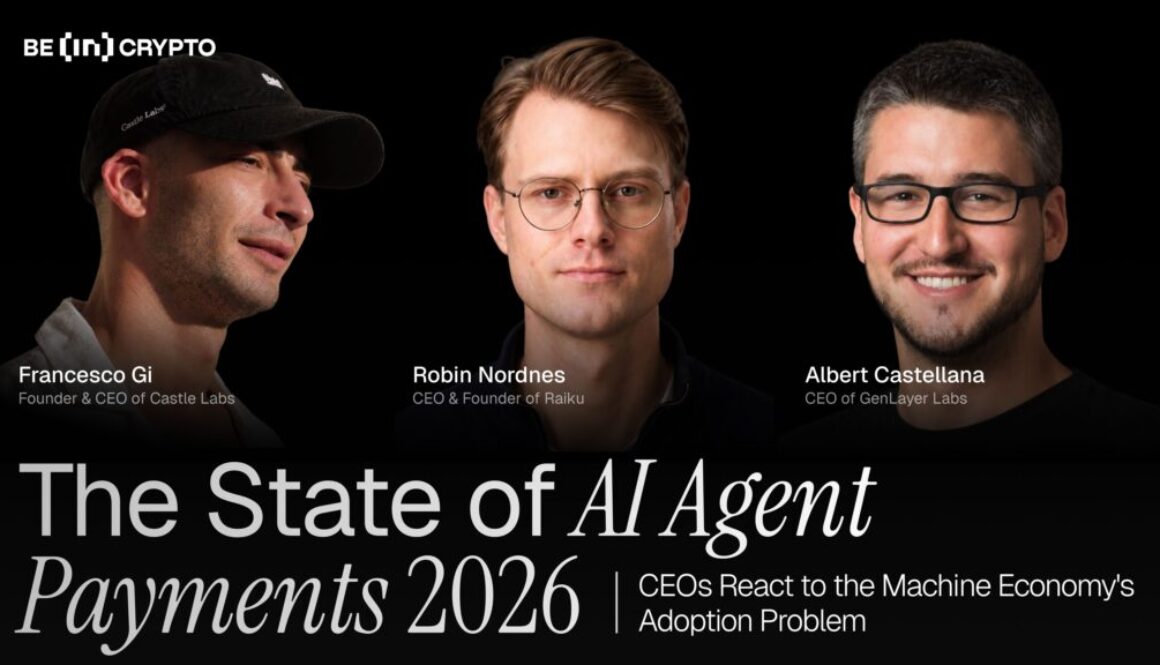
The crypto and fintech industries have invested billions in autonomous AI agent payment systems over the past two years, building what they claim are the foundational rails for a machine-driven economy. Yet according to new research, the underlying reality is far more pedestrian: almost all recorded agent payments move pennies or fractions thereof, mostly for API access and data queries rather than commerce or trading. The State of AI Agent Payments 2026, published by BeInCrypto in collaboration with AWS, Cloudflare, Chainalysis, and Zoomex, examined transaction flows on x402, a protocol designed to enable payments between software agents, and found a landscape of functioning infrastructure meeting almost no real demand.
Micropayments Dominate While Trading Automation Remains Frozen
The report tracked 6.4 million transactions over 35 days, moving just $119,947 in total value. Of those, 90.8% were transactions worth less than one cent. These are not purchases or trades; they are automated pings between machines paying each other for compute cycles, API calls, and data checks.
High transaction volume, in other words, masks a fundamental absence of economic activity at human scale.
On trading platforms, the lag is even starker. AI-labeled tools accounted for less than 0.55% of overall trading volume on Hyperliquid, one of the largest decentralized exchanges. At centralized venues like Zoomex, human traders still confirm every single trade order, regardless of whether an agent proposed it.
Of 19 major trading tools and financial systems reviewed, 14 operate under strict pre-approved spending caps set by humans and cannot exceed them without manual intervention. The autonomy promised in conference keynotes exists nowhere at institutional scale.
Safety and Execution Gap Block Real Institutional Trust
The readiness framework in the report scored micropayments at 60.7 out of 100 but rated institutional financial workflows at just 12.0 out of 100. That gap reflects a hard institutional reality: no major financial player trusts an AI agent to make decisions at meaningful scale without human supervision.
Albert Castellana, CEO of GenLayer Labs, explained the distinction between moving money and deciding what should move. “Most real agent transactions today are relatively small: paying for APIs, compute, data, maybe simple digital services,” Castellana said. “An agent can execute a transaction exactly as instructed and still make a terrible decision because the information was wrong, manipulated, or the other side didn’t actually deliver what was agreed. Moving money is one problem. Deciding what should happen when the transaction goes wrong is another.”
You can give an agent a $100,000 limit, perfect wallet permissions, and every normal security control, and it can still spend $100,000 on something that clearly wasn’t what you intended.
Albert Castellana, CEO of GenLayer Labs
The report also documented $281,200 lost in exploits where validly budgeted capital was redirected to attacker-controlled wallets. Robin Nordnes, Founder and CEO at Raiku, flagged what he calls the “execution gap”: delays or failed transactions that trigger agent retries, each individually approved, that collectively cause real damage. Until confirmation happens at machine speed, a feature still missing on most chains, agents cannot safely operate without human gatekeepers.
Infrastructure Betting Vastly Outpaces Commercial Demand
Venture capital has poured $3.91 billion into agentic finance since late 2024. Of that, 92% went to underlying payment and cash management infrastructure, protocols like Tempo and Mastercard’s BVNK partnership. Only 8% funded pure autonomous trading bots or decision-making agents.
This allocation reflects market reality: the infrastructure works, but there is almost no commercial reason for it to exist yet. Solana handled 94.5% of all transactions tracked in the report, suggesting that high-speed blockchains may eventually support agent-to-agent commerce at scale. Yet that day remains speculative.
Francesco Gi, Founder and CEO of Castle Labs, noted that “most activity in the machine economy is small, repetitive, and concentrated among a handful of users, indicating that the market is still early. Solutions already exist for some problems that haven’t even arisen yet, but technology ultimately depends on adoption and use cases.”
He added that adoption may accelerate once agents build verifiable track records and reputation networks prove reliable. At that point, stablecoin payments between machines could become routine for tasks too small to justify human oversight.
The CCS read. We see infrastructure betting masquerading as market demand. Institutional crypto players are funding payment rails and cash management layers as a hedge on future autonomous finance, not because institutions are moving autonomous capital today. If that future never arrives, the infrastructure vanishes with the venture dollars. If it does, the winners will be the infrastructure builders who moved first, not the token holders or trading bots.
The critical next step is whether major exchanges like Zoomex and Hyperliquid remove human sign-off requirements and allow agents to execute trades directly. Nordnes predicted that once Solana or another high-speed chain proves it can deliver reliable, sub-second confirmation for agent transactions, human gatekeeping will disappear and real autonomous trading volume may finally materialize. Watch for the first major exchange to announce zero-human-approval trading for AI agents within the next 12 months, that decision will validate or demolish the entire agentic finance thesis.